Welcome to our community

Be a part of something great, join today!

  • Hey all, just changed over the backend after 15 years I figured time to give it a bit of an update, its probably gonna be a bit weird for most of you and i am sure there is a few bugs to work out but it should kinda work the same as before... hopefully :)

Ask David Mullen ANYTHING

Hello David,

I have a question about a lighting kit. I saw some Redheads on the internet. These are cheap chinese Redheads. I know they are tungsten 3200k. I now only have some worklights which also work on 3200K. For me the only difference between the worklights and the Redheads are that the worklights are 500W and the Redheads are 800W.

Are there any other differences between these two lights? (Except for the barndoors) I want to know if it is worth the extra money they are gonna cost me. They cost $300.

Are these Redheads good enough for some basic lightning? Better than my worklights?

Hope to hear from you.
 
David

Thank you in advance for reading my post. This is not so much a question about cinematography as it is about directing. What kind of working relationship do you ideally wish to have with a director, from a cinematographer's point of view? How much should the director worry about things like camera angles, lens length, shutter speed, lighting, etc etc etc? In other words, how much should the director delegate his responsibilities and creative decision-making to the DP in that area?

I ask because fairly recently, I directed and co-produced my first short film with a professional crew and professional level equipment. I was very inexperienced and somewhat nervous the first few shooting hours (compounded with the lack of sleep). Towards the end of the 4 day shoot, I was really getting the hang of it. One of the pieces of advice the DP (who is more experienced than me) gave to me was "don't think so much like a DP, think more like a director". He told me this because I was so concerned about the look of the film, along with coverage, camera movement, angles, etc.

Sean Yu
 
Hello David,

Are these Redheads good enough for some basic lightning? Better than my worklights?

Well, it's very useful to have lights that take scrims and have barndoors on them to clip gels to, though it's a total pain to drop scrims in a Redhead due to the clasp it uses. But Redheads are very useful when you just want a bright light. However, I can't vouch for any Chinese-made Redheads, I have no idea how well-built they are, not that Ianiro Redheads are particularly sturdy.
 
David,

Congratulations on the release of "Jennifers body," and thank you in advance for your advice and being a resource for my questions. My question is two part and comes with experience shooting with the RED.

PART 1: How would you shoot a forest scene with high contrast? There would be very dark parts and some bright bright highlights. The subject is the lush green forest and you can shoot anytime of day you wish.

What ISO would you choose, what lens choice would you make and assuming you'd use tracking/dolly and/or jib arm/crane for motion, what shutter speed would you use and is there a shutter speed you'd never go under/over? What would you look for in your histogram?

What changes would you make if you were following a character being chased/chasing?

PART 2: Same question but with a meadow instead of a forest?

Thank you again for all your advice and for being so generous with your time,
 
David

Thank you in advance for reading my post. This is not so much a question about cinematography as it is about directing. What kind of working relationship do you ideally wish to have with a director, from a cinematographer's point of view? How much should the director worry about things like camera angles, lens length, shutter speed, lighting, etc etc etc? In other words, how much should the director delegate his responsibilities and creative decision-making to the DP in that area?

I ask because fairly recently, I directed and co-produced my first short film with a professional crew and professional level equipment. I was very inexperienced and somewhat nervous the first few shooting hours (compounded with the lack of sleep). Towards the end of the 4 day shoot, I was really getting the hang of it. One of the pieces of advice the DP (who is more experienced than me) gave to me was "don't think so much like a DP, think more like a director". He told me this because I was so concerned about the look of the film, along with coverage, camera movement, angles, etc.

Sean Yu

There are as many kinds of directors as there are human beings, and they generally have their strengths and weaknesses.

Your DP was right however to tell you to think like a director, not a DP -- not that you shouldn't care about lighting or lens selection (many great directors do), but you should never let the technical side of filmmaking distract you from your primary job on a movie set, which is directing the actors. Alexander Mackendrick, a great director who taught at CalArts when I was there, once said to us that directors get seduced by technical problems because they are easier to deal with than human problems. Some directors would rather deal with cameras and lenses than an actor who is having trouble delivering the right emotions.

On the other hand, a French New Wave director once was asked about what the most important relationship there was in his movies, and he said it was the one between him and the camera...

If you hired a good DP and you've laid down the groundrules for visual style in lighting, lens choice, etc. that you and the DP are going to follow, it's easier to leave set-ups to the DP rather than micromanage him.

The term "directing" suggests that the job entails directing other people -- that your job is to get everyone on the set to do their job at their best, to make them look good... because in the end it will make you look good. And you don't get the best out of real artists by doing all the thinking for them. Instead, you get them to use all their artistry to serve your vision for the movie, you get them to think as artists, and you can't do that if don't give them some freedom to contribute.

My favorite directors challenge me to work harder and better, to take risks, and they get me to take risks by trusting me, and not punishing me for making mistakes. Because when a DP is afraid of making a mistake, he tends to play it safe.
 
David, I've never posted a question or comment to you, but thanks for taking the time to regularly share your knowledge here. It's a great resource!

I just saw "JB" last night and I really liked it. I was at Austin Film Festival last year for the premiere of "Juno" with Jason & Diablo...they are both extremely talented and I look forward to anything either of them does. I also loved the look you achieved in so many scenes, so great job.

I had a nuts & bolts question about how many takes you would usually do for some scenes. I realize in heavy acting scenes, you may shoot until it's right, but I was wondering what is the norm on the less dialogue driven scenes. For instance, I'm curious how long did you spend on the scene when Johnny Simmons/Chip is at Jennifer's house. There is a good bit of suspense and time taken in his walk through the house and up the stairs. Is this something that you just do a couple takes of and use the best bits...or was there a lot of planning into these types of scenes? How long did it take to film those until he sees Jennifer and we're back to dialogue scenes? Would that normally be a 2nd unit deal or 1st unit?

Thanks again. Great job. The movie is obviously not hitting it for everyone, but I loved it. I wish for Diablo's sake it had better box office...but an R-rated high school movie was probably a tough sell. I'm sure it will do very well in rentals later...
 
Typical movie in that budget range averages 4 to 5 pages that have to be shot per day, but we had a few complicated days with smaller page counts.

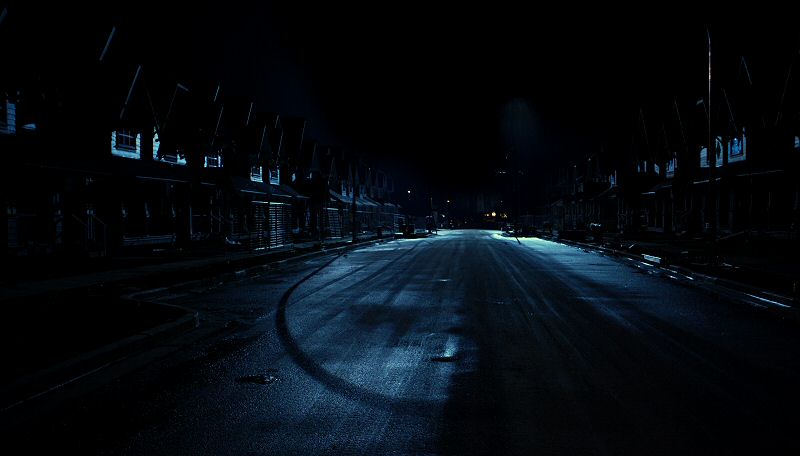
That day that Colin (not Chip) goes to the abandoned house to meet Jennifer included the driving sequence as Colin drives down the street, the exterior street drive up, and the walk through the first floor of the house under construction.

The walk through the second floor of the house and the room with the candles was a set on a soundstage. That was another day of shooting.

Anyway, that night on location, we had to light three blocks of streets to get the driving scene (the final street, being under construction, had no streetlamps at all). So the process trailer stuff took a couple of hours, and the exterior shots -- by the time we got inside the house, we had very little time, so we basically shot it in two shots, one looking at him as he walks through the house, and the other a moving POV shot. I lit it very quickly and sketchily, just some spots of light using Source-4's and a few Kinoflos.

The exterior streets took longer to light -- the empty street with the super-wide shot was lit with two 18K's on one condor. I took a snapshot here and blacked out the condor and lights with my finger in front of my lens:

jb25.jpg


I learned that a 125' condor, when two blocks away, is not high enough to get out of the shot when you are at eye level... which is why the shot in the movie is from a high angle.
 
Hi David. I wanted your advice regarding a vehicle shoot I have coming up. We're shooting in an all-white studio and need to do a wide beauty shot of the vehicle. We're thinking of lighting from above through a 20 x 20 silk with a a key coming from one side through a 10 x 10 silk. Any suggestions/advice?
 
David, I am not a DoP or anything similar, Just a PostSup on another RED feature and had a simple question.

I am on prepro for a feature that's a Psycho Thriller. They are planning a lot of low-light (mostly Tungsten) shots and I kindly recommended that they please put 1/4 to 1/2 CTB in front of the camera to help balance the light more towards the daylight balance of the Red's Chip (wanting to avoid noise in the shadows), I also went ahead and talked with the DoP explaining to him how the Camera is natively rated at ASA320. He recently told me that the idea of the CTB's on the camera to balance more towards Daylight makes sense, BUT that would basically mean he is shooting 160ASA and that would be a NO-GO. Is this right? to my understaqnding all that mean is that he would be loosing at most a full stop, but that doesn't convert the camera to 160ASA, right? I am giving him suggestions of how to better shoot with red for post based on our previous experiences, but its the first time a DoP has told me this ASA160 comment and I am a bit perplexed. I don't intend to know more than a DoP about photography, so I want to get an educated response to further my understanding here.

thank you so much.

On a side note, Printing this thread out was the best thing I could do, Great reading material, and I am not thru half of it yet :-)

-Frank
 
Hi David. I wanted your advice regarding a vehicle shoot I have coming up. We're shooting in an all-white studio and need to do a wide beauty shot of the vehicle. We're thinking of lighting from above through a 20 x 20 silk with a a key coming from one side through a 10 x 10 silk. Any suggestions/advice?

That should work OK, but just remember that a car is a big mirror, it reflects EVERYTHING -- c-stands, the pipe frame of the 20x20, clamps, cables, the soundstage ceiling, etc. You really have to be neat about everything, use white cards to hide equipment, etc. This is one reason why some people use a big Fisher box or something like a huge Chimera because it's a white diffusion frame in a black box, a neat reflection. If you go with a 20x20 frame, I'd get some diffusion large enough to wrap around the pipe, or instead, be prepared to put a black border to cover the gap between the diffusion and the pipe, the put a black skirt on the sides, etc.

I'm not a car shooter so someone who has done more of this work may have some practical advice on this in terms of equipment to use.
 
David, I am not a DoP or anything similar, Just a PostSup on another RED feature and had a simple question.

I am on prepro for a feature that's a Psycho Thriller. They are planning a lot of low-light (mostly Tungsten) shots and I kindly recommended that they please put 1/4 to 1/2 CTB in front of the camera to help balance the light more towards the daylight balance of the Red's Chip (wanting to avoid noise in the shadows), I also went ahead and talked with the DoP explaining to him how the Camera is natively rated at ASA320. He recently told me that the idea of the CTB's on the camera to balance more towards Daylight makes sense, BUT that would basically mean he is shooting 160ASA and that would be a NO-GO. Is this right? to my understaqnding all that mean is that he would be loosing at most a full stop, but that doesn't convert the camera to 160ASA, right? I am giving him suggestions of how to better shoot with red for post based on our previous experiences, but its the first time a DoP has told me this ASA160 comment and I am a bit perplexed. I don't intend to know more than a DoP about photography, so I want to get an educated response to further my understanding here.

Yes, he's right -- you lose a stop I'm guessing from the 1/2 CTB camera filter, so that turns 320 into an effective 160 ASA. Sure, the sensor remains the same sensitivity, but in practical terms, you have to compensate for the filter density in some manner, whether it means adding more light or opening up the lens.
 
On the ASA 160--

Add some more light. Why would that make it a "NO GO?"

Is the budget that tight?

To my understanding the budget is not "that" tight.

We are exploring different acquisition mediums, and RED is a great option. The DoP is also looking into S16 500ASA Vision3 film or Viper.

I honestly don't know why adding more light seems like a bad idea, but i get a feeling that they rather have a very fast sensor/film than add a bunch of lights.
Would S16 500 Vision 3 be THAT much better in a low light situation? How about the Viper?

I would love to work on RED, since i have it all figured out, but I have to be open minded and respect the DoP's decision on this. Any extra info you guys give me would be most welcome.

Crazy idea, is it recommendable to get some Leica Mounts and shoot with those insanely fast leica lenses? Or are those mostly for stills work and would be cumbersome in a production?
 
Fast lenses give you less depth of field and more focusing challenges, that's all. And most, other than the Zeiss Master Primes, are rather soft when shot wide-open.

Just remember that if the goal is a dark, moody, shadowy noir-ish image, that doesn't necessarily mean using lower light levels. There is actually no connection between the amount of overall light used and how dark the final image is -- you can make a sunny exterior look like moonlight after all using day-for-night techniques.

Sure, 500 ASA film stock is more sensitive than the RED sensor, by 2/3 of a stop, but toss in the grain of Super-16 and you might as well just rate the RED faster and just get more noise instead of grain -- the image would still end up with more resolution overall.

Honestly, just test the RED camera at different ASA ratings and filter combinations, look at the results on the largest screen that the product is likely to be shown on, and judge for yourself. I've gotten acceptable results with the RED at 500 and 640 ASA in tungsten balance for night exterior work - it all just depends on how much noise you can live with and how you color-correct the image (you essentially have a weak blue channel so if you can live with a warmish image, you can avoid cranking that channel up and getting more noise. Plus most of the noise is visible in the blacks so if you can live with crushing them a little, you can bury some noise that way. So worst thing to do would be to lift the blacks and take away the warmth.)
 
Last edited:
There is actually no connection between the amount of overall light used and how dark the final image is -- you can make a sunny exterior look like moonlight after all using day-for-night techniques.

I have to respectfully disagree with this.

In many scenarios, this is true, but there are specific circumstances where you can get unexpected results. An example off of the top of my head: There is a scene in "The Pianist" where Adrian Brody is playing the piano at night for a German officer. He is backlit by "moonlight" which was clearly a very bright light (4k or 6k, maybe). It looks ok, except for the fact that this bright light is shining through his nose and making it glow reddish orange. Totally destroys the nighttime effect, as that could clearly never happen with actual moonlight.

I also feel (although I have admittedly not tested this) that the amount of ambience in a room from bounceback is greater in brighter scenes, even after taking into account a change in aperture to adjust for the brighter key light.
 
Puzzling quote...

Puzzling quote...

I've gotten acceptable results with the RED at 500 and 640 ASA in tungsten balance for night exterior work -

I've asked around this forum and from what I can tell changing the ASA doesn't matter one bit. So I'm posing this question to you to make sure I've learned correctly.

It's a 320 ASA, you can change it in camera, but your still shooting 320ASA. So why trick yourself?

Changing the ASA/ISO in camera can get you in trouble as I've learned. If you set it higher, say 640, you'll see more light in your LCD/viewer then your actually getting, and you'd iris down/shutter up.... underexposing your image.

Can you explain why you are changing the ASA, or is this in post your doing this?

Thank you kindly for your thoughts,
 
Will, he's just setting how he'll interpret the footage in post.

Since he doesn't have enough light for that shot he'll interpret the RAW data as ISO 640 to get info out of there at the cost of noise (a problem minimized with Color Science that will be further minimized with the debut of Mysterium X).

The RED ISO ratings only get you into trouble when you don't fully understand them, ie when you think the actual sensor sensitivity is changing.
 
David

Congrats on your work with Big Love and United States of Tara. I've been wondering about this for some time now and was hoping you (or anyone else with first-hand experience or knowledge) can tell me about how the looks or styles of TV shows or series are developed. Who has the most influence on the look or style of the show? Would it be the show's creator, the executive producer, the network head, director, DP, or a combination of more than one?

By just watching, I've noticed a lot of the TV shows with very high production value like the Sopranos, C.S.I franchise, True Blood, Numb3rs, Law & Order, etc, all the episodes within that particular show have a consistent look or style, regardless of who the episode's director or DP is. I've noticed the director and DP may change, but not the style so much. I know they have directors and DP work on more than one episode each, but there is a consistency regardless, which is the way I'd prefer it, anyway.

I also remember you mentioning that HBO had strong influences on the way you did lighting on Big Love, since you had come aboard after they had already established their look.

So, I guess, could you tell us a little bit about how the look of a TV show is developed?

Sean Yu
 
I have to respectfully disagree with this.

In many scenarios, this is true, but there are specific circumstances where you can get unexpected results. An example off of the top of my head: There is a scene in "The Pianist" where Adrian Brody is playing the piano at night for a German officer. He is backlit by "moonlight" which was clearly a very bright light (4k or 6k, maybe). It looks ok, except for the fact that this bright light is shining through his nose and making it glow reddish orange. Totally destroys the nighttime effect, as that could clearly never happen with actual moonlight.

I also feel (although I have admittedly not tested this) that the amount of ambience in a room from bounceback is greater in brighter scenes, even after taking into account a change in aperture to adjust for the brighter key light.


Honestly, I think you are confusing exposure with light level. If that 4K or 6K had been exposed darker, it would have not shined through his nose, etc. If you lit a pitch black room at night with a single 650w light shining through a window or a 10K shining through the window AND EXPOSED THEM TO THE SAME LEVEL then the contrast ratio would be very similar, as would the ambient bounceback, etc. The difference would have been depth of field due to the stop used.

Now the only exception is that when key lights get dim enough, you get into a zone where other ambient light from other stray sources starts to compete and the contrast never get high enough because the key is not strong enough to overpower the other ambient sources.

But if you go onto a black stage and use a 1K instead of a 5K as a single key light, for example, other than some difference due to the size of the fresnel, you can make either shot look equally dark and contrasty.

Honestly, it's very easy to make very large lights look very, very, very dark! I can make the sun itself so dim that you can see a darn thing in the scene if I underexpose the shot enough.

I remember back when I was a beginner shooting Super-8, I pointed a 650w light directly at an actor, with a waving leaf pattern in front, and underexposed it two stops for a moonlight effect... and the response in a class I showed it to was "wow, you really must have shot in low light levels!" when the light was actually quite bright.

In the example you cite from the "The Piano" the 4K or 6K HMI was clearly exposed on the bright side as a strong backlight for it to have created a translucent effect to the skin -- if it had been underexposed another two stops, for example, it would have looked a lot darker in the shadows. It's just that this is one common method of lighting night scenes, especially by DP's like Robert Richardson or Jordan Cronenweth -- use a strong backlight and then expose for the shadows to the degree of detail you want to see there, regardless of how bright the edge or halo becomes. Now in this case, you do need a fairly strong light because you want a lot more spread and exposure so you can expose for the bounceback into the shadows -- you could try it with a smaller light but you simply couldn't open the lens wide enough.

I mean, look at the night scene in the valley in "No Country for No Men" -- it's pretty dark yet it's lit with THREE Musco lights! But those lights were very far away to cover the entire valley, which is why Deakins had to shoot it at T/1.3 on Master Primes.

I don't think in the case of "The Piano" that the results were unexpected at all by the cinematographer. He could have lit it or exposed it differently if had wanted to. He could have underexposed the backlight more and then compensated by adding more soft fill light into the shadows, but he didn't want that, he wanted the effect of a strong dominant backlight.

I remember shooting a bunch of low-budget movies for one producer, which always had some suspense/action scene at night I always tried to light those scenes to an f/2.8 to f/4 just to give the focus puller a chance, but I visited a set lit by another DP for the same producer and he was lighting a big chase through a moonlit house with tweenies with blue gel and shooting at f/1.3 on Super Speeds, with hardly anything coming into focus. And it would have taken the same amount of time to use 1K's or 2K's instead of 650w lights for that moonlight effect, but the difference would have been a workable stop for shooting action on a short schedule.

Like I said, the only time when it really makes a difference is when you are balancing to other ambient sources, often ones with a limited intensity. The classic example is if this moonlight chase through the house had involved characters with flashlights and the moonlight level was determined by the relative brightness to the flashlights, to look correctly balanced. Or when there are candles in a scene, or streetlamps, or anything else that gives off only a certain amount of light. Then your lights have to be balanced to those levels. But in a more abstract situation, like a stage set lit for expressionistic moonlight only, then you might as well light to a decent f-stop if you have the lighting units because you can make it look as dark as you want through exposure and contrast ratios, but you'd be at a more comfortable stop for the focus-puller.

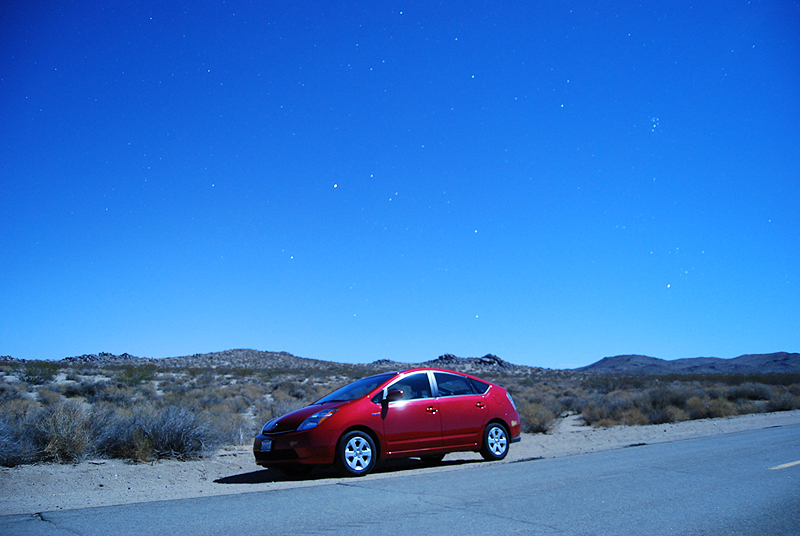
Conversely, you can expose very weak sources to look very bright and the bounceback effects become the same -- look at this long exposure I took of my car in the desert under the real moon -- other than the stars in the sky and the blue-ish cast from setting my camera to 3200K balance, it is similar to daylight in terms of contrast and brightness:
moonlit3.jpg


My main point is that beginners need to stop mistaking light levels with how bright or dark the final results can look. I've seen too many people overlight a scene with TINY lights and then wonder why it looks overlit when they used such little lights. It's because they didn't factor in key exposure and contrast ratios into the look, thinking that merely by working in low levels, they would automatically achieve a low-key and moody look. I can overlight a scene and give it a high-key look with a dozen 650w lights and I can take a 10K and create a very dramatically dark scene. The light level itself is not the reason why a scene looks dark or bright unless you factor in exposure.
 
Last edited:
I've asked around this forum and from what I can tell changing the ASA doesn't matter one bit. So I'm posing this question to you to make sure I've learned correctly.

It's a 320 ASA, you can change it in camera, but your still shooting 320ASA. So why trick yourself?

Changing the ASA/ISO in camera can get you in trouble as I've learned. If you set it higher, say 640, you'll see more light in your LCD/viewer then your actually getting, and you'd iris down/shutter up.... underexposing your image.

Can you explain why you are changing the ASA, or is this in post your doing this?

Thank you kindly for your thoughts,

I'm changing the rating because I need to expose at the higher ASA rating in order to balance with existing streetlamps and whatnot. Obviously I know that I'm actually underexposing the sensor and am boosting the signal for the monitor and later in post, and thus getting more noise -- and obviously I wouldn't due that unless I needed to do that! If I'm told I have to shoot a car chase scene through several city blocks at night and there's no budget or time to light those blocks, what can I do other than get the fastest lenses I can rent, shoot them wide open under available light, and find a level of underexposure and thus noise that is acceptable for the final results?

It's no different when shooting film? Look at the movie "Taxi Driver" -- that was shot on 100 ASA film stock! Do you honestly think it was exposed at 100 ASA for those night scenes on the streets of NYC? Or the night scenes in "The Long Goodbye", also shot on 100 ASA stock. Or the candlelight scenes in "Barry Lyndon"? Even there, Kubrick rated that 100 ASA stock at 200 ASA and pushed it one stop. Pushing a stock by one stop doesn't actually make it a stop faster, it just boosts the information that got recorded and adds more density there, similar to boosting a weak signal in electronics. So that the final boosted image is close to the correct brightness, even though at the expense of other artifacts (like grain, or noise, or weak blacks, etc.) And this is done either out of necessity or by visual design.

The point of making a movie is not to make technically perfect images, it's to make artistically and emotionally correct images, and sometimes that means making them look rougher or less polished, etc. You are telling a story, not selling a technology.

As for why not just rate the RED camera at 320 ASA and underexpose by one stop rather than rate it at 640 ASA, that just depends on the intent. If the intent is for the final image to look one stop underexposed, then it's actually not "underexposed", it's exposed correctly at a 320 ASA base for the intended look, which is somewhat dimmer than normal in brightness. But if the intent was for the final image to look normal in brightness, to have the one-stop underexposure corrected back to normal, then setting the camera to 640 ASA is simply a method of getting the brightness of the signal to the monitor and the eyepiece to match the intended look, and for the post path to know that the intended processing method is for the underexposed shot to be boosted up to normal brightness. Besides, had you simply lived with a dark-looking monitor image thinking that you'd change it later in post, perhaps you'd never seen on the set monitor just how noisy the image was when boosted, whereas had you rated the camera faster, you would have seen the boosted signal on the set and decided that sometimes it was too noisy to be usable (assuming you are working with a large enough set monitor.)

All that said, underexposure with film or digital is risky business and it affects the entire post chain all the way to distribution.. WHICH IS WHY YOU SHOOT TESTS. Lots of them. Test, test, test.
 
Last edited:
Back
Top