Welcome to our community

Be a part of something great, join today!

  • Hey all, just changed over the backend after 15 years I figured time to give it a bit of an update, its probably gonna be a bit weird for most of you and i am sure there is a few bugs to work out but it should kinda work the same as before... hopefully :)

Ask David Mullen ANYTHING

With the deep focus of 1/3" DV, you're better off with "mist" type diffusion (ProMist, etc.) rather than something with a visible pattern of lenslets in the glass.

David, I'm looking into the 72mm Tiffen ProMist f/x 2 or 3 for my DVX. What sort of results could I possibly expect from the combination of this filter with the 1/3" chipset?
 
Most people shoot with a 1/4 or 1/2 ProMist -- a #2 or #3 is pretty heavy. The heaviest I've ever used was a #1.

Are you thinking of the Soft-FX or Diffusion-FX?

Right, right. I forgot how strong they are. As for soft-FX or Diffusion-FX, I'm actually not sure. I'm on BH's website right now and I'm not sure which I'm looking at. It mentions "soft focus filter," so I'm assuming I'm looking at a Soft-FX. Is there one you would recommend? I'm looking for something that will give me a nice, subtle glow in the image and, of course, produce some pleasant halos on lights and highlights.
 
American Cinematographer Came in the Mail

American Cinematographer Came in the Mail

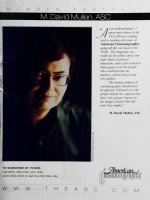
Congrats David! (with apologies to Owen Roizman for the poor reproduction of his otherwise wonderful photograph...I didn't have a scanner handy.)
David...as always, you had wonderful thoughts to share. Your quotation served as a wonderful reminder in a magazine that is often very technical that cinematography, ultiamtely, is an art before anything else.
Anyway, this is very cool David. Congratulations again.
Peace,

-Harry
 

Attachments

  • americanCinematographerAug09DavidMullen.jpg
    americanCinematographerAug09DavidMullen.jpg
    92.2 KB · Views: 0
Right, right. I forgot how strong they are. As for soft-FX or Diffusion-FX, I'm actually not sure. I'm on BH's website right now and I'm not sure which I'm looking at. It mentions "soft focus filter," so I'm assuming I'm looking at a Soft-FX. Is there one you would recommend? I'm looking for something that will give me a nice, subtle glow in the image and, of course, produce some pleasant halos on lights and highlights.

I'd stick to a ProMist for now.
 
@DaveM: When do you use LoCon filters? And do they also visibly blur or soften the image? Is it more fit for available light conditions?

Here are some examples of the Tiffen Low Con #3 from "Barry Lyndon":

barrylyndon4.jpg


barrylyndon5.jpg


barrylyndon6.jpg


As you can see, there is a mild fog filter effect around bright lights. It softens a little as well. If you just want contrast-lowering, no halation around lights, these days I'd use an UltraCon instead. I think the Schneider Low Con may be more like a Tiffen Ultra Con though.
 
David, your appetite for research, technicality and artistic progression is very impressive to me. Where are you at these days? What new things are interesting? Obviously I don't expect you to give away 'the goods' of anything you're researching that you wouldn't want to share, but I guess general topics is curious to me. We're all asking you things you already know, so I'm wondering where you're going now. Or, is this entire question irrelevent in that you mostly just do research on a project-by-project basis?
 
Well, personal growth as an artist and cinematographer is a multi-prong attack... there is the macro issues that concern me, and the technical education aspects, most of which tend to correlate with specific projects, though when I'm not working, it then becomes less specific.

I'm finishing prep for a TV series shooting on the Genesis and am having some issues to deal with in terms of the LOG post workflow, it seems on every show, the post people want to tackle it in a different manner, so there's always something new to learn. Same goes for any digital camera, there are so many post options today, but some affect how you shoot with the camera.

Since this is my second season on the same show, there is also the learning curve of thinking of ways to improve how the sets were lit, etc. both for the look and also for efficiency reasons.

But there are always the macro issues, like what do I want to be doing, and how should I be thinking about my work, etc. I spend time reading books on past filmmakers looking for clues, I spend time looking in art books, going to galleries, looking for inspiration. I just recently read a book on the making of "Singin' in the Rain", a book by Hitchcock's line producer, Herbert Coleman, and have started a book by Orson Welles' final cinematographer, Gary Graver. I guess I like reading and watching old movies as a way of leaping over contemporary obsessions in style, in being hip and trendy, and looking for some greater truths about cinema.
 
Here are some examples of the Tiffen Low Con #3 from "Barry Lyndon"....
As you can see, there is a mild fog filter effect around bright lights. It softens a little as well. If you just want contrast-lowering, no halation around lights, these days I'd use an UltraCon instead. I think the Schneider Low Con may be more like a Tiffen Ultra Con though.
Damnit Dave I was thinking exactly about Barry Lyndon when I wrote this :w00t:. But okay I have an idea now. I wouldn't want bleeding lights or fog, so if nowadays LoCons can do that it could help with available light situations. Maybe even more so if there are only a few bright light parts in the pic or on covered skies?

Thanks for your kind answers.
 
Hi David, I'm a film student preparing to shoot my thesis film at the end of the year. One of my lecturers has managed to secure a great deal for a 16mm 2K DI at cut throat prices. I love film and all, but living in the country that I am in now, I don't know if film is the best acquisition medium. I would like to ask what you would do if you were in our situation. Sorry in advance for the long novel piece ahead.

Currently, our school has a fleet of Arri SR2s. There are different problems with each camera, some have optic issues, others have faulty gates & magazines, and we have no video assist units at all. All these problems slow us down on set as we make sure everything is working correctly and properly. I've heard that they will be sending them out soon for repairs but frankly put, some of these cameras have been through war zones before.

On top of that, I don't know if you've ever been to Singapore before, but because of rapid economic expansion, location shooting causes major problems. Being the second most dense country in the world, plopping a 16mm camera anywhere is sure to attract a crowd of people both infront of the camera and behind it. It's alright if we have the manpower to get these people to move, but being students, we're still not up to that level yet.

And on an aesthetics level, I don't know if film cuts it for S'pore. I watch a lot of home grown movies shot on film and I just feel that our pre-fabricated buildings don't match the warm, organic feeling of film. Our buildings have a lot of clean straight lines which seem more pleasant on HD. But it could just be my virgin eyes. Although the story is really what should be influencing the visuals, being in such a small country limits our creativity and options. For example, shooting horror flicks are tricky since most of our buildings are cleaned every 2 weeks, and graffiti is intolerable. Having a ghost coming down a slick and clean hallway might be a good comedy piece but I seriously doubt anyone is going to get scared from that. And it's happened before. The director gave up trying to shoot here and moved his production to Hong Kong.

However, on the flipside, our HD options are limited. As it stands, I don't think we have the money to rent out a Red One for the period we need to shoot, nor do I think we need that sort of quality for a short film. I have been exploring two other options, one being the SI-2k and the other the Canon 5D Mk2. I played with these two cameras before and they have their pros and cons. The SI-2K produces cineform DNGs which are pain to move to a Mac, where we do most of our editing. The 5d has overheating issues but it's small form factor and gorgeous 35mm depth of field produces some stunning images. Which brings me to the last issue I have, do I really need the 2K DI to create a visually stunning film?

A 2k DI is fantastic, but it's probably only going to get screened at a theatre once (there is a chance it might get encoded to be DCI compatible), and when we send it out to film festivals, it'd probably be brought down to a DVD. Moreover, I think that shooting digitally would allow me to get more production value into our short, since we can move production money needed for processing and film to sets, locations, actors, props, costumes, etc. I could probably shoot more digitally since it theoretically would take less time to set up scenes. And have a wider variety of locations and shots since the camera is smaller and lighter. I take a lot of inspiration from slumdog millionaire both creatively and technically, because although we do not have the slums, we do have the hordes of people moving in and out of very small and tight spaces. A small camera is a better option for these kind of situations.

I'm a strong supporter of Red for long form mediums like features and TV series. In the long run, I believe a red one would be much cheaper than shooting on 35mm, for my country at least. But for a short film, it might possibly be cheaper to shoot on film or a less intensive HD option. My country's film industry is in it's infancy and I honestly feel that we need to make cheaper and better films before we can get any form of international recognition. We can't do anything about making our films better because that requires experience and talent but we can bring our production costs down. Film prices aren't going to come down anytime soon, but HD is letting people shoot good quality stuff at lower prices.

So, as you can see from my novel, we have a dilemma. We like film, but we don't know if it's worth it. HD also has it's problems and faults but might be a better option for a small country like ours. It would be a great help hearing advice from someone with your sort of experience.
 
I think you've answered a lot of your own questions. First figure out the specific look you want that is appropriate for the story, and then figure out the most efficient and practical way to get that look for the most likely release format. If you don't absolutely need the film look and you're not excited about shooting in Super-16, then digital sounds fine for you.

I don't have experience with the SI-2K or Canon 5D, so I can't comment much... they have different looks, and the Canon may be rather tricky to use and to color-correct.
 
Hey David, thanks for the explanation on growth, I'm very excited to see where you go from here.

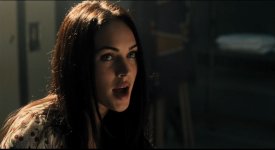
Recently while watching Jennifer's Body trailer I was very impressed with your work. There are a number of very complex lighting setups but I was especially interested in two simple setups, do you happen to remember exactly how you did these two?
 

Attachments

  • JennifersBody_1.jpg
    JennifersBody_1.jpg
    38.6 KB · Views: 0
  • JennifersBody_2.jpg
    JennifersBody_2.jpg
    62.3 KB · Views: 0
We had a scene in a dark hallway where Jennifer slams Needy against a wall -- I suggested we find a doorframe to stage the shot so we could get the reverse angle on Jennifer's face, rather than have her facing a solid wall and faking a close-up with the camera "inside" the wall. In the master shot of the hallway, the moonlight was coming through that open doorway, so when we came around to that close-up, it was logically front-lit. So I tried to take the curse off of that by breaking up the frontal light with a faint pattern of leaves and lace curtains, though it is subtle. The light itself was probably something like a 1K tungsten fresnel with 1/2 CTB gel on it, underexposed about a stop and a half. I also had a Kamio ring light around the lens for a faint eyelight, though it was less needed in this angle (it helped me in other angles because I find when the lighting is dark and underexposed, that glint in the eyeball helps you feel that you are still seeing the actor's expressions in the dark.)

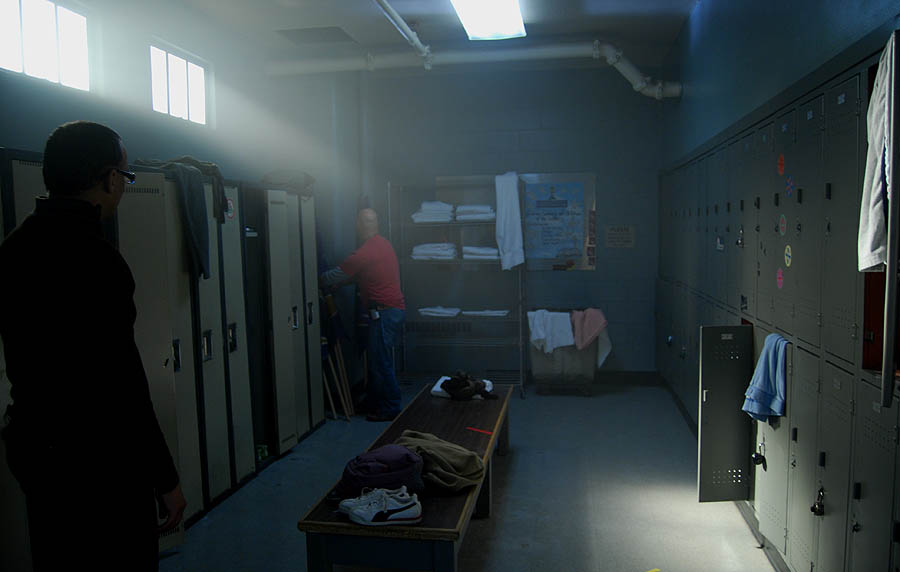
The second shot was a scene in a locker room. The lighting is more clear in this wide shot I took with my still camera while the art department was still dressing the set. It was a real locker room but a wide-open windowless space, so we added a false wall on the left to narrow the room up and give me some fake casement windows. Since the windows were too close to the ceiling to allow me to have a light shine downwards through them, I had to put a mirror board below the ceiling and bounce the light from below off of the mirror and then down through the window. I used overhead daylight kinos in the ceilings fluorescents but tungsten 1K PARCAN's for the beam effect, and then in the final timing, sort of timed it halfway to 5600K so the sunlight was warmer than the overhead light.

jb44.jpg


So in the wide shot, I just had Jennifer backlit by the windows and hid a white card (behind the open locker door you see) on the opposite side of the room to catch some of the window light back into her face. In the close-up I augmented that bounce a little more by putting a 650w tweenie on the floor and bouncing it into the white card.
 
Hi David,
Why is it so difficult for a camera/lens to mimic what the human eye sees, particularly in terms of lighting? For instance, if I'm outside at night I can see lots of different lights (close and in the distance) and various objects in the dim light, but for a camera to capture those things, I need to consider additional lighting, shutter speeds and apertures, medium, etc. Why is it so hard for a camera to just take a snapshot of what I see, just like I see it? I don't mind if does not do it in the best resolution, but atleast the lighting/contrast should come out like I see it.

Thanks.
 
Because a camera and lens is "dumb" -- it just sees reality within the parameters it has been set-up to see in terms of brightness, color, and dynamic range.

Your eyes are connected to a brain that is "smart" and makes lots of adjustments constantly to read information and interpret it, to bring out some details and ignore others.

The rods in your eyes are also, simply, more sensitive to light than a sensor in a camera. But your brain is also "balancing" levels so you can see into a dim area and yet read detail when your eye notices a bright object.

We also see in 3D, not 2D.

Ultimately though I'm not too bothered by this difference between how the eye/brain sees reality and how a camera/lens sees it because it's very useful that there is a difference or else it would be hard to manipulate reality for creative purposes. I don't think filmmaking is about accurate reproduction of reality, it's about the creative interpretation and transformation of reality.
 
We had a scene in a dark hallway where Jennifer slams Needy against a wall -- I suggested we find a doorframe to stage the shot so we could get the reverse angle on Jennifer's face, rather than have her facing a solid wall and faking a close-up with the camera "inside" the wall. In the master shot of the hallway, the moonlight was coming through that open doorway, so when we came around to that close-up, it was logically front-lit. So I tried to take the curse off of that by breaking up the frontal light with a faint pattern of leaves and lace curtains, though it is subtle. The light itself was probably something like a 1K tungsten fresnel with 1/2 CTB gel on it, underexposed about a stop and a half. I also had a Kamio ring light around the lens for a faint eyelight, though it was less needed in this angle (it helped me in other angles because I find when the lighting is dark and underexposed, that glint in the eyeball helps you feel that you are still seeing the actor's expressions in the dark.)

The second shot was a scene in a locker room. The lighting is more clear in this wide shot I took with my still camera while the art department was still dressing the set. It was a real locker room but a wide-open windowless space, so we added a false wall on the left to narrow the room up and give me some fake casement windows. Since the windows were too close to the ceiling to allow me to have a light shine downwards through them, I had to put a mirror board below the ceiling and bounce the light from below off of the mirror and then down through the window. I used overhead daylight kinos in the ceilings fluorescents but tungsten 1K PARCAN's for the beam effect, and then in the final timing, sort of timed it halfway to 5600K so the sunlight was warmer than the overhead light.

jb44.jpg


So in the wide shot, I just had Jennifer backlit by the windows and hid a white card (behind the open locker door you see) on the opposite side of the room to catch some of the window light back into her face. In the close-up I augmented that bounce a little more by putting a 650w tweenie on the floor and bouncing it into the white card.

Those beams appear to be bigger than a 1k parcan. Are there multiple cans per window? Any remembrance of how far back and what bulb was in it?

I'm surprised to find out that her face is only lit by a mirror bounce! Was it the glossy silver type, bumpy silver type, etc? 4x4? Although if you said you hid it, that must have been much smaller. Was it difficult to keep her in the beam? I guess Megan would have to hold fairly still?
 
Back
Top