Welcome to our community

Be a part of something great, join today!

  • Hey all, just changed over the backend after 15 years I figured time to give it a bit of an update, its probably gonna be a bit weird for most of you and i am sure there is a few bugs to work out but it should kinda work the same as before... hopefully :)

Ask David Mullen ANYTHING

As a extreme example of blocking, check out Coppola's One From the Heart (1981), half the movie is Steadicam (Garrett Brown operating). Some of the takes were 3 minutes long, involving stairs, actors delivering lines, the camera going thru windows etc.
I watched Garrett do one interior shot, with stairs, 26 times, with a Arri BL. ouch.
And the color/grad/lighting stuff that Storaro did was wild, sunrise/sunset in the same shot.
Should still be available on DVD.
 
I see. Good to know I am not missing any sort of "official" rule. I like to ask a lot of basic questions since I never actually went to film school. Thanks again for your posts David.

What was the name of that recent-ish movie shot in a single take? Was it particularly good blocking wise?

An other interesting resource for blocking might be the DVD set "Hollywood Camera Work" which does a good job at dissecting blocking and discussing the effect of each move, framing, blocking, etc... might not be what everyone is looking for but worth a look. As you guys said, nothing beats watching good movies. Hitchcock's "Dial M for Murder" is in my Blockbuster cue.
 
What was the name of that recent-ish movie shot in a single take? Was it particularly good blocking wise?

Are you thinking of "Russian Ark"? The staging is amazing in terms of the camera running through the Hermitage and coming across a scene with hundreds of extras dancing, etc. But in terms of staging actors doing dialogue, it's not a good example of that.

The talkier movies adapted from stage plays are good to watch because the director has so much dialogue to handle, and multiple actors. "Glengarry Glen Ross" is a good example.

There's an impressive dolly move for a dialogue scene covered in one shot in "Superman: The Movie" following Lois and Clark through the newsroom, out into the hallway, and finally into the elevator lobby, all without a Steadicam, just conventional dolly on a smooth floor. Or the first scene in "12 Angry Men" where all the jurors are introduced one by one in a single shot. Early seasons of "E.R." and "West Wing" were famous for their fast Steadicam dialogue scenes.

I also want to toss in a word for Robert Altman's movies -- though they seem more loosely staged and shot, almost like a documentary, it's not easy to stage so many characters in a naturalistic way. "McCabe and Mrs. Miller", "The Long Goodbye" and "Nashville" all have some complicated group scenes.
 
Last edited:
Nothing to add or any questions to ask but I wanted to say that I am glad to see you mention "The West Wing". I always was a big fan of their style. Their West Wing "office" shots where a M-A-Z-E. Absolutely fantastic. Coupled with the super fast paced and very intricate dialogue it brought a ton of complexity and really helped paint the characters as very smart. I also loved their use of "pools of light". Loved the look of that show.
 
"So do the majority of us a favor and think before you write in this thread..."

Hey Tyler Black, don't read my posts anymore. I'll return the favor.

David's quite capable of responding any way he sees fit to any comment posted. And he has done so, expanding on most topics related to film and cinematography.

David I respect completely.

You, on the other hand... Need to back off.
 
Come on guys be civilized. This is an exchange of ideas and a learning experience, let's be respectful to each other.
 
Solstice Question

Solstice Question

I'm watching the DVD at the moment and would like to ask:

- about the scene in which Megan breaks down on her way back to the house from the general store.

Broadly, how did you go about lighting it?

Specifically, what time of day was it shot and how long did you shoot the scene for? (If most of the day, how did you maintain the look of the sun setting through out the scene?)

Lights used?

- Flashbacks. Was the look achieved in camera with filters or in post?

Thank you for your time and wisdom.
 
That little road bridge in the bayou was a total pain to shoot on -- imagine a dirt road with no shoulder, just swamp on each side... and it's the only road in the area, with no crossroads. It led to some oil rig or something at the end, and we had to keep all our equipment on the edge of the little road in a long line to let occasional trucks go by. So we couldn't do a 180 pan because everyone had to hide down one length of the road or the other, there was nothing to hide behind.

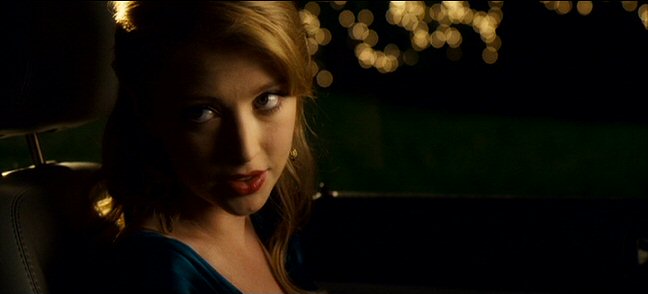
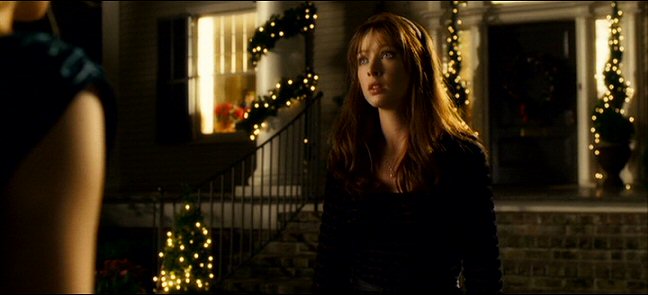
Anyway, that scene where her car breaks down was shot near sunset so I tried to work as fast as I could using the Steadicam to get most of the shots as the sun was getting lower and lower. I had one HMI shining onto the car for the beginning so we could see her sitting in the cab and then going to the engine, since all of that was in heavy shade or backlight. Then once she starts to walk around and go back to the bridge, it was all available light except for a handheld bounce card. That was all on Fuji 250D. I think we shot the whole scene in two hours or so, so from late afternoon past sunset. We had one last shot made in late twilight that was way underexposed and pushed, but luckily it wasn't used in the cut. (Later in the schedule when we shot the flashback of what originally happened on that bridge, we had the same problem, losing the light... but it was much worse because it was a 3-person scene with dialogue.)

Then she tells what happened to her back at the house and I gelled the windows with ND and lit with tungsten to get a mixed blue and warm look, as if it was dusk now and the room lights were on but it was blue outside. That was on Fuji 500T.

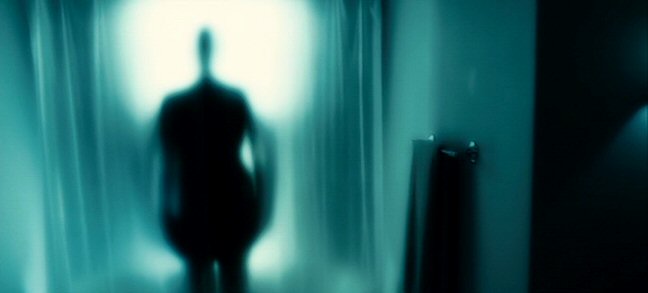
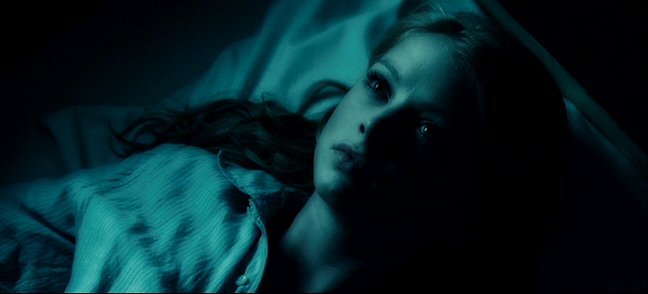
I shot the flashbacks originally with just a 1/8 ProMist - they weren't originally flashbacks, just the opening of the movie, a prologue... but later they got chopped up into flashbacks and dreams, so I added more diffusion in post using a gaussian blur overlay:

solstice10.jpg


solstice11.jpg


solstice15.jpg


solstice16.jpg
 
Last edited:
David: quick question on textiles. Obviously, I want to minimize the rental cost, but I also want to make sure I have coverage. What are the most useful sizes 4x4, 6x6, 8x8, 12x12, 20x20, or 30x30? Obviously, indoor shots would not need the larger sizes. But for outdoor shots, how often would you really use a 30x30 or a 20x20 versus 12 bys or 8 bys? Thanks
 
Outdoors in the sun, the larger the overhead diffusion on a frame, the harder it is to secure from wind -- you need more manpower, ropes, etc. On the other hand, a larger diffusion is the only way to cover a larger space, so it all depends on the shot.

For bounce fill, the larger sizes are softer but at least it doesn't kill you to be limited to a row of smaller bounces rather than a giant one.

4x4 are useful for diffusing a light up close to the actors. 6x6 or 8x8 are used for softening a large lamp like an 18K or Maxibrute, something with some spread. You can also fly a 6x6 or 8x8 overhead to soften a close-up of someone not moving much.

12x12 is the workhorse size for an overhead diffusion -- it's enough to cover an over-the-shoulder or medium 2-shot with a few steps up or away allowed, and it can be secured generally. I often clip tree branches and leaves to the edges so that when an actor steps away and passes out from under the 12x12, you don't see the shadow of the frame and ties and the gap where the diffusion ends, etc. It breaks up the shadow so it looks like a tree shade that they are passing out from under.

Half Soft Frost is a very mild diffusion that loses less than a 1/2-stop of exposure underneath, so it doesn't make the actors much darker than a sunlit background, whereas a Silk definitely makes the actors look shaded by something unless the background is naturally dark or shaded itself. For example, if the actors have a dark treeline in the background, then the silk actually helps balance that brightness difference better because you end up opening up the lens and overexposing the dark background a little.

So basically I switch between those two, Half Soft Frost and Silk.

20x20 is great for covering a larger area, like a small group of people talking, or when you need to give your actors a little more room to pace around, but it needs more work to secure even in a light breeze.
 
Hi David, I’m fearing this may be a stupid question but I’m going to ask it anyway.

My work camera is a Sony digibeta (which is a 2/3 chip camera correct?) it has a canon zoom lens with the marking 8-128mm on the zoom ring. I understand the marking refer to the FOV the 2/3 digi beta chip offers…

My questions is: what are these marking referring to? And what would be the equivalent zoom lens on the red with a Nikon mount?

PS: Is there a preferred standard of lens measuring Imperial or Metric in Australia?
 
8-128mm is the focal length range of the lens, it's not a marking of FOV -- focal length is focal length. It's just that on a 2/3" sensor, it has a certain FOV and would look much wider-angle on a 35mm sensor camera, if it even covered the sensor (which it wouldn't.)

The conversion factor between 2/3" (9.58mm wide) and Super-35 (24mm wide) is 2.5X. Although to be precise, it's more like 2.3X because the Red uses an Academy 35mm width in 4K mode (22mm instead of 24mm wide).
So that's an 18.4-294.4mm range you'd need for a zoom on the Red to match the 8-128mm zoom on the 2/3" camera.

16X zooms like that are a bit rarer in 35mm cine filmmaking though. The closest is more like a 12X zoom like the Optimo 24-290mm. Or if you needed to start at 18mm, there is an 18-100mm Cooke, a 17-102mm Ang. HR, the 16.5-110 Zeiss Master Zoom, and Fujinon has a series of PL-mount zooms coming.
 
An FL-D filter is basically magenta with probably a hint of blue, to convert a Cool White tube to daylight, and an FL-B filter is magenta + orange, to convert a Cool White tube to tungsten.

I haven't heard of them being used for getting a color effect outdoors, though using CC Magenta or Cyan filters for a look is not unusual. "The Woodsman" was shot with a Cyan filter, and the ice planet landscapes in "Star Trek 6" were shot with a heavy magenta filter (I think the God planet in "Star Trek 5" was also shot with a similar filter.)
 
Sure, but I always have to think a moment about the FL-D versus FL-B -- it would have made more sense to call the FL-B the FL-T, but Tiffen was probably thinking of Type B film (balanced for 3200K) and the 85B filter.

Truth is, those dyes were developed in the 1970's for the film stocks of the day and the Cool White tubes of the day, most modern Cool Whites (except the cheapest) have a better CRI rating than they used to, so I think the FL filters have a bit too much correction in them now.
 
Back
Top