Welcome to our community

Be a part of something great, join today!

  • Hey all, just changed over the backend after 15 years I figured time to give it a bit of an update, its probably gonna be a bit weird for most of you and i am sure there is a few bugs to work out but it should kinda work the same as before... hopefully :)

Ask David Mullen ANYTHING

David,

Agree that the image is more "enhanced-sharp" than Red. Do you find you're using a slightly heavier diffusion to bake in a kinder look?

When you guys go handheld, do you put the SR deck back at the DIT station? Just curious. Camera gets a lot lighter but also crazy front-heavy, which I think is worse than heavy.
Cheers,
Harry

Yes, I found that I didn't want to use much more than a 1/4 Classic Black on the RED whereas the filter barely registers on the Genesis, but that is partly due to the higher contrast LUT I'm looking at the Genesis image with.

We take off the SR1 deck for Steadicam shots and use a separate backpack rig, but for handheld, we leave the deck on, backloaded, for balance.
 
There are so many issues wrapped up in the "film look" debate, some of which are not so much technical but political...

I've shot 8 features on the F900 and I never worried too much about the whole film look issue, other than by the fact that I was shooting in 24P mode (well, 23.98P...) Some of my directors worried more about it than others -- I felt my job, like always, was to find a look appropriate for the story and use the given technology in a way to achieve that look. Beyond that, I didn't specifically do any "tricks" to get a film look.

I shot one of the first F900 movies back in 2000, and I remember someone at Deluxe Labs walking in while we screened the answer print from a film-out, and she said "you shot it like film!" -- I recall saying "I don't know how else to shoot something..." I mean, I just shot it like any other movie I would shoot, with the appropriate lighting, etc.

Now this doesn't mean I believe that there are no fundamental visual differences between HD and film, just that given I was shooting in HD, I wasn't going to set-out to deliberately "fool" anyone into thinking I was shooting on film, which seemed like an academic exercise to me.

On "The Quiet", the director was very ambivalent about using HD, which was more or less mandated by our tiny budget and the deals we made (we got the F900 more or less donated and part of the HD post taken care of by UT Austin) -- she would have been just as happy to shoot in Super-16. But she had read somewhere (probably regarding "Personal Velocity", which was shot in DV) about using smoke as a way of softening the video look, so she wanted to smoke the whole movie. I like smoke effects for daytime scenes, so I embraced the idea (much to the detriments of my lungs, like on all my other smoked movies) but I drew the line for night interiors lit by table lamps, because often you see the smoke "boiling" over the lampshades. One way of dealing with that was by having many night interiors be moonlit, which was like shooting a day scene in terms of light streaming in through windows. But I think the smoke did help take away some of the edgy clean HD look.

If I had complete freedom in choosing formats and processes for movies I shoot, I'd prefer using digital for projects I felt benefited from the look, or the particulars camera's features. It may be different things that appeal to me, low-grain, or cleaner night photography, or more depth of field in low-light when using a 2/3" sensor, it just depends. I sometimes feel that digital is well-suited for comedies in general, though romantic comedies can benefit from the more flattering effects of film. I also tend to question digital for period movies, particularly ones set in the day and age of early photography -- like a WW1 or WW2 movie -- but I just shot "Manure" on the RED camera, and that was set in the early 1960's ala "Mad Men".

As digital cameras produce images closer and closer to the look of 35mm film, it gets harder to make a case that there is an entirely different visual aesthetic at work, unless you push hard to bring out the digital "look". In some ways, it is easier to make the case that interlaced-scan DV requires a different aesthetic sensibility than a modern HD camera or the RED camera.

On the other hand, people discuss the visual qualities of Kodak versus Fuji, Zeiss versus Cooke, prime versus zoom, anamorphic versus spherical... and how they affect the narrative visual design of a movie, so certainly it is valid to look at how digital versus film may impact the visual language of a movie.

---

In regards to what you should do to get a "35mm film look" I think it is much more practical to think in terms of what aspects of the digital look that you want to avoid or minimize. Maybe it's frame rate (i.e. to avoid interlaced-scan, easier today) or maybe it's dynamic range or color reproduction or depth of field (easier again with modern digital cameras with 35mm sensors). Maybe what you want to avoid are digital artifacts like compression, noise, edge enhancement, etc.
 
Thanks for sharing your thoughts David.

This is a debate that certainly could benefit from more input from people with your level of experience in both formats!

I also tend to question digital for period movies, particularly ones set in the day and age of early photography

One of the things I adore about the Michael Winterbottom film Tristram Shandy: A Cock and Bull Story is the use not only of digital cameras but the visual style broadly labelled 'verite' or 'documentary.' It's such a bold statement considering half the material is 18th C. period, but of course works so well with the nature of the material (and Winterbottom's own style).
 
That's sort of something you have to judge at the moment, whether a lens flare works or is distracting. I don't like unmotivated flares, i.e. a flare from an off-camera movie light where the viewer doesn't know where it is coming from or why, but I like motivated flares from on-camera sources sometimes, as long as it doesn't distract from the actor's eyes or it is momentary.

Just the other day, I did a shot with a big flare in it -- it was for a montage sequence, our lead actress was sitting at a drawing table, drawing in frustration as the camera slowly arched around her face in close-up. I had a strong backlight from a window behind her head, but on the first rehearsal, I didn't have the sunshade on and as we dollied, a massive rainbow lens flare played across the frame at one point in the move and then faded away again - it seemed perfectly timed to the peak of her frustration so we decided to leave the flare in, it was so beautiful and graceful as it faded in and out.

First take, I'm watching on the big HD monitor and when we get to that moment in the dolly move... there was no lens flare. After we cut, I went out to the set and saw a lens shade and hard matte on the lens -- my 2nd AC had come back from the bathroom after the rehearsal and thought to himself "jeez, no one here noticed that light smacking the camera lens? I'd better fix that..." Obviously we did the second take with the lens shade off again.
 
Hi David,

Just a quick question about metering - I've been shooting commericals exclusively digitally for the last few years and have started more and more to use the waveform function on the Panasonic 17" (LH1700W) LCD monitor I now try always to hire, which I find is allowing me to be much more consistent in achieving correct exposure. My question is, do you ever use waveform monitoring when shooting digital? Also, how do you feel about using field monitors for exposure, and do you have monitor preferences? Thanks.
 
Lighting with a lantern

Lighting with a lantern

Hi David,

For my next project, several of the scenes are set in an abandoned house with no power. So the characters (backpackers) have lit a wood fire and have battery powered lanterns and torches.

My questions are:
1. what is the best I can realistically do to enhance the lantern as a practical? Is this likely to be sufficient for the Red, using the 18-50mm lens?
If not, what is the best way to cheat it? (Note: in reality there is electricity, just not in the story)

2. as the light from the fire will be yellow/red, will this be a problem in terms of blue channel noise on the Red?

Thank you,
Antony
 
Well, if the fire is off-camera a lot of the time, you could use less orange on the lighting units and set the camera closer to 5000K for a warm effect that is less noisy... even if the fire is on-camera, it may work to just let the real fire go very reddish and use lights that are gelled maybe half-orange instead of full-orange. Something to test at least...

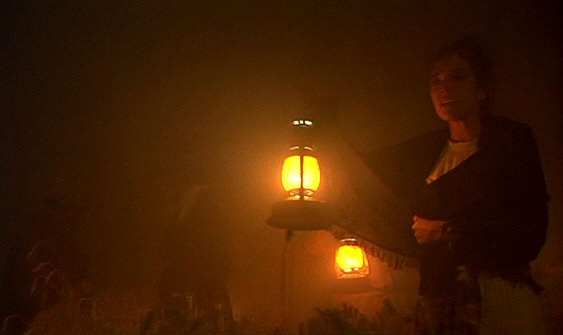
Here is a lantern with an electric bulb, with the bulb painted orange and the lantern frosted, lighting the face:
lantern1.jpg


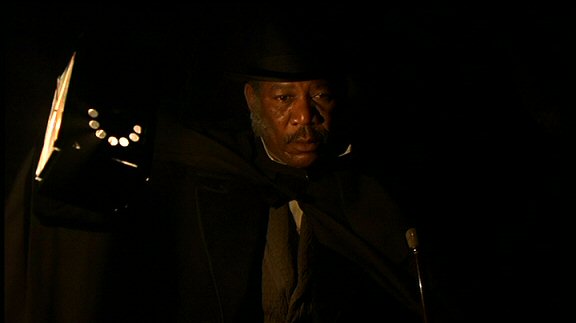
Here is a lantern with an electric bulb, not frosted, so a harder source (and a real candle flame is a hard source in reality):
lantern2.jpg


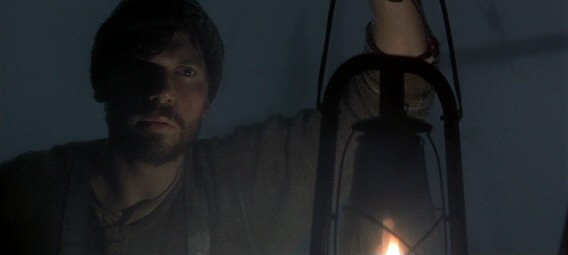
Here is a lantern with a hidden electric bulb behind the lantern (or off-camera) with a real flame visible:
lantern3.jpg


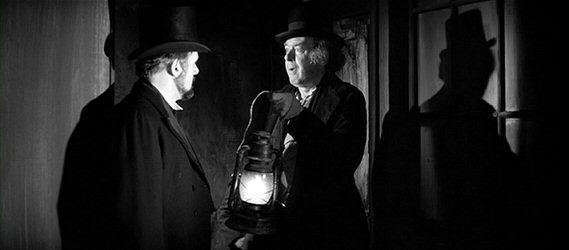
Here is the old-fashioned way of lighting lantern scenes, with a projected off-camera light following the actors:
lantern4.jpg


The thing is that nowadays, you have to use a little of every trick for a scene where someone carries around a lantern. It helps to use a gag lantern that is bright enough to expose a face when held close to the face, but for scenes where they set it down and walk a few steps away, you probably need to key them from off-camera with a light simulating the lantern, so stage scenes in a way to make that easier, with the on-camera lantern on one side of the frame.
 
Antony,
Just humble supplement to David's input:

http://stephenlucas.info/Demo_Reel.htm
Not a shameless plug I promise :) There's a lot of lantern scenes in this lil' reel. Majority of the time, the lantern light is used to suggest an off camera source; sometimes with dimmers acting respectively. For some closeups, the lantern is bright enough to expose to, I even used some of its flare if appropriate.
The RED zoom is a f2.8 I believe? So you'll definitely be using off camera sources, thus the directionality becomes important. Whether the quality is hard/diffuse is your call of course.
Hope that helps any.

*I must chip in my "this is the best thread to ever exist, thanks David!"
 
Antony,
Just humble supplement to David's input:

http://stephenlucas.info/Demo_Reel.htm
Not a shameless plug I promise :) There's a lot of lantern scenes in this lil' reel.

Some great footage there Steve. The one which is probably closest to what I want is near the end of the reel, with the red sleeping bag in front of the cliff (or is it inside a cave?).

Was that a standard "off the shelf" lantern? Or did you upgrade the bulb/battery?

What other lighting did you use for that shot?

Thanks,
Antony
 
Well, if the fire is off-camera a lot of the time, you could use less orange on the lighting units and set the camera closer to 5000K for a warm effect that is less noisy...

Thank you for your helpful reply, David.

But I am confused by the above quote. I thought the colour temp was just metadata, and doesn't actually affect the recorded RAW image.
 
Antony,
thx! All of that is old school hvx200; Is the zoom the only lens you have?
Indeed, that was a cave. With bat poop.
Ambience was augmented with a lowel tota light, and I had some small arri lights (300, 650) to key with, but that was it.

The lamp was nothing but a propane coleman lamp, you can even control the brightness on those lamps. It worked like a charm. the hissing from the gas can be noisy. That lantern motivated half the light for that feature!

**5000K is the native color temp for RED; thus daylight sources will be slightly warm.

David, I have mucho questions I'd like to drop. But I'm still trying to keep up with the invaluable Mullen Thread novel and make sure I don't repeat something. Thanks for all the insight.
 
Thank you for your helpful reply, David.

But I am confused by the above quote. I thought the colour temp was just metadata, and doesn't actually affect the recorded RAW image.

Yes, color temp is just metadata, but ultimately you have to work within a color temp. If you want a warm look, you'll get a cleaner result by working within a base setting of 5500 to 5000K for "white" rather than 3200K for "white".

For example, if you want the look of Full Orange color on a light, the image will be less noisy if you use an ungelled tungsten lamp, which is 3200K, and processed it as a 5500K image in post, rather than put Full CTO on a tungsten lamp and processed it as a 3200K image in post.
 
Hi David,

Just a quick question about metering - I've been shooting commericals exclusively digitally for the last few years and have started more and more to use the waveform function on the Panasonic 17" (LH1700W) LCD monitor I now try always to hire, which I find is allowing me to be much more consistent in achieving correct exposure. My question is, do you ever use waveform monitoring when shooting digital? Also, how do you feel about using field monitors for exposure, and do you have monitor preferences? Thanks.

I've had a waveform lately, but I don't seem to use it much other than to glance at. I find waveforms more useful for telling you the highs and lows rather than to tell you how to expose the scene creatively, but that's just because I'm not used to waveforms...
 
Thanks David,

That's certainly my main use for the waveform; possibly it's something that's only really relevant when shooting in high-compression formats like HDV, where dark parts of the image which are apparently correctly exposed (and looking good on the monitor) often turn out to have been 1/4 stop too dark for the compression to cope with.

Are you ever asked / ever ask to do your own grading on your films?
 
hi David, I always learn from you/an other question if you don't mind
Have you ever work with Elite anamorphic lenses if so whats your idea of using them with red.
thanks
 
Back
Top