Welcome to our community

Be a part of something great, join today!

  • Hey all, just changed over the backend after 15 years I figured time to give it a bit of an update, its probably gonna be a bit weird for most of you and i am sure there is a few bugs to work out but it should kinda work the same as before... hopefully :)

Ask David Mullen ANYTHING

David,
What movies are inspiring you as of late?
 
RED 320T2.jpg

Thanks for the contribution so far David.

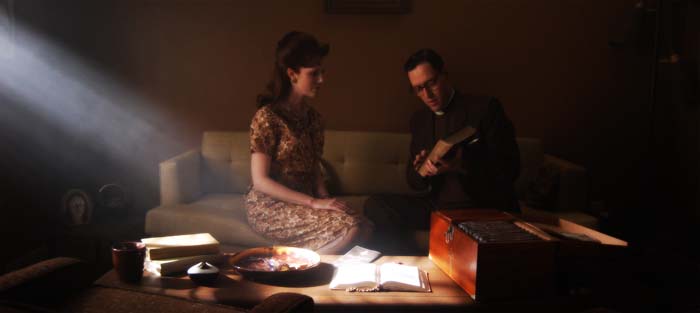
I have a beginner question regarding this picture...

Usually when I try to add some backlight to the subject It ends up spilling too much and it doesn't give me the result I originally thought.

What kind of light did you use to make a backlight on this actor?
Small source? Large source? Diffused?
Was it some feet to the back, up, pointing down at him?

I'm sorry if it's too basic but that is the kind of light that I couldn't reproduce so far.

Thanks in advance.
 
It's either a 20K or 10K outside the patio doors in the background.

If you are simulating direct sunlight falling into a room, you want something hot so that you get the natural kickback and bounce into the shadows. But you also want something farther away because of the gradual fall-off and parallel beams of light, as opposed to something close with a fast fall-off and light spreading outwards.
 
Now that's something I did not know, about the spread of the beams and all.

Interesting...

And thanks again!
The lack of spread is why a smaller lamp like a Xenon or an HMI Source-4 (ellipsoidal) tends to simulate sunlight well (assuming it is bright enough) even when it is not backed far away, because the beams are fairly parallel. Trouble then becomes coverage, you don't have a large enough area being lit (like to fill a large picture window) compared to a huge source backed far away. But on a smoked set, I've clustered a bunch of Source-4's to make it look like a single beam of sunlight is being broken up by trees, for example, into separate but parallel beams.

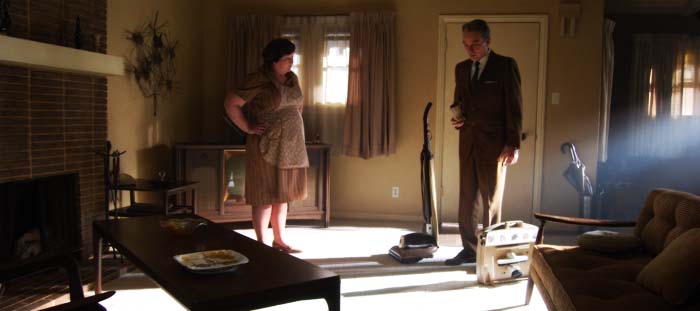
Here is a snapshot I took of a lighting set-up where I had two HMI Source-4's just off-camera on the right, maybe just six feet away from the actors, inside the room (not coming through a window) to simulate sunlight:

manure32.jpg
 
Here is a snapshot I took of a lighting set-up where I had two HMI Source-4's just off-camera on the right, maybe just six feet away from the actors, inside the room (not coming through a window) to simulate sunlight:

You also had haze in this shot also, correct?

Matthew
 
Yes, obviously! :wink:

Yeah, I gotta practice with haze as my indoor shots that have sunlight coming in are good, but not great. I wish there was another better way than getting a hazer. We don't have anyone around here that's got a hazer, just a fogger:(

Matthew
 
Actually, I was dealing with a cheap fogger on that shot I posted, on Day Two of our shoot, on a drafty stage in a set with holes in the ceiling, so the smoke level and evenness was not quite correct.

Smoke has to -- wants to -- fill a space. So even if you are in a small set on a soundstage, you really have to haze the entire soundstage before the smoke stops wanting to drift around to every corner. On this shooting day, I had lots of short scenes in small rooms but the sets were too open-ended for me to contain the smoke, and the soundstage was too large to fill quickly and evenly. Here was another set on the same day -- the smoke is a bit "chunkier" than I'd like, but passable:

manure29.jpg
 
I think that looks wonderful, Mr. Mullen! I notice that your "sunlight" beam in this last shot looks more white perhaps even a hitch blue(on my MacBook Pro anyway..).. was that the look you were going for specifically or did you just let it happen ala HMI-use and knew it would be something like this? With a beam this angled and cool(in color) it feels like a morning scene?

thanks for the visual "goodness" you give us all!
~Sarah :)
 
Newbie Question on Lighting Backgrounds

Newbie Question on Lighting Backgrounds

I am teaching myself cinematography and from various books or dvds I have seen basically only show how to light using the 3-4 point lighting and usually when it comes to backgrounds they only show someone either putting a cookie on the light for the background or just creating a slash of light on the background.

How do you approach lighting backgrounds? Should background lights be placed in certain positions on your location?

Any help or advice would be greatly appreciated,

Shaun
 
It depends on the style chosen for the show and the mood you are trying to create. But since most modern cinematography aims for some degree of naturalism, generally you are trying to recreate a realistic source for the background, whether it is a slash of hot sunlight or soft skylight or the glow from sunlight bouncing off of the ground, etc. For night scenes, it may be the way a streetlamp or moonlight would fall through a window and across the background. Sometimes you add practical sources in the background (lamps, etc.) that do half the lighting work for you.

But it generally would be motivated by the mood you are trying to create.
 
Dirty vs. Clean C/U

Dirty vs. Clean C/U

David, I was wondering what your take is on a creative decision regarding close-ups. What is your rationalle for using an over-the-shoulder/dirty c/u's versus clean c/u's? I know this is a personal choice that's is often a product of a discussion between you and the director, but what are the ramifications as you know them to be? Thanks in advance.

Nick.
 
If you are using long lenses, it's hard to get clean of the foreground person's shoulder who is only standing a few feet from the subject. You can step the foreground person back until they are clear of the lens, but it becomes awkward if the camera is far from the subject -- the actors become too far apart to really act and interact with each other. So you tend to live with "dirty" singles instead. The downside there is that with both actors visible in all the coverage of the scene, it's harder to make cuts unless the actors match their movements from take to take. They have to lift that beer bottle at the same point on every angle, every take, etc. With some clean singles, you have more flexibility to make the cut.

On the other hand, overs and dirty singles create a better sense of the spatial relationship between the actors.
 
Hi David, thanks for being available for interaction with us mere mortals ;op

Do you still flash film every once in a while or do you find it unnecessary with modern stocks/post?

What's your opinion on the aesthetic benefits/differences of using a large (let's say 12'x12') silk for diffusion versus a smaller one. I know that you'd be able to place it further away and get a similar effect to a smaller one closer to the subject, etc... but please give me some practical example(s) of what a larger diffuser would allow you to achieve (i.e. more natural ambiance fill, etc...)
 
David, I was watching Boogie Nights recently, and paying strict attention to the opening steadicam shot. It's kind of strange, because the whole shot plays out in real time, starting on a crane, but when the shot finally ends, and the camera lands on Dirk Diggler carrying a dish tray, the scene appears to be overcranked at 48fps or maybe 60fps. Does this mean that the whole sequence was shot overcranked?

I'd love to get my hands on the AC back issue for this movie.
 
Back
Top