Welcome to our community

Be a part of something great, join today!

  • Hey all, just changed over the backend after 15 years I figured time to give it a bit of an update, its probably gonna be a bit weird for most of you and i am sure there is a few bugs to work out but it should kinda work the same as before... hopefully :)

Ask David Mullen ANYTHING

Master Primes versus Ultra Primes at Long Focal Lengths

Master Primes versus Ultra Primes at Long Focal Lengths

David,

What is your experience and opinion about differences in optical performance between Ultra Primes and Master Primes at the long end, say 135mm or 180mm Ultra Prime versus 100mm or 150mm Master Prime. Is there enough contrast and corner resolving power differences to justify the extra cost of Master Primes? Say I would like to use them between f/2.8 to f/11, no need for T/1.3. Can you estimate (in ballpark) corner resolving power in lp/mm at f/2.8 for those lenses? Would the camera resolution be a limiting factor or the glass? Also, what about contrast differences at lower frequences?

Also, any other differences you can think of, like mechanical, etc...

Many thanks in advance.
 
I haven't made a direct comparison, but it would be simple to go to a rental house and put the two lenses up on a lens projector bench and look at the resolution differences. My gut impression, having used both on my last feature (but only three days with the Master Primes) is that the Master Primes may be a touch more contrasty / less flarey than the Ultra Primes. They may have some other improvements in terms of distortion, etc. but if you don't need T/1.3, I'm not sure I could justify the extra cost if budget was an issue (if budget wasn't an issue, the only argument I can see against the MP's are the extra size & weight compared to UP's.)

I'm not a lens fanatic -- if I get to rent any of the decent (i.e. expensive) prime lenses out there, Primos, Ultra Primes, S4's, etc. -- I'm usually happy. They all work for the majority of what I have to do. There are real world factors that will mitigate differences that you can see by shooting charts, so I try to not get to anal retentive about it. But then, I'm not evaluating them for purchase.
 
I would suspect that corner resolution and distortion are mostly phenomena associated with wider focal lengths. Longer lenses usually have more of an issue with portholing wide open.
I've not seen any portholing on longer Master or Ultra Primes.
Contrast aside, I would not be surprised if the difference between Ultras and Masters 135 and 180 at a 2.8 is small.
Cheers,
Harry
 
You previously recommended Alexander Mackendrick's Sweet Smell of Success to learn about blocking the actors to the camera, and I have learned a lot from this movie. Could you recommend others but with 2.35 cinematography (apart from Spielberg's movies)? 2.35 framing appears to require more thought and hence more practice.

Also, having different story elements at different depths simultaneously in acceptable focus seems to give a vivid feeling of being in the scene: do you have any special advice/examples producing this effect? (apart from, I suppose, using shorter lenses and stopping down the lens)

Thank you.
 
Hi David,

I've got a question so stupid that I hardly dare to put it on your forum, but here we go:

A stubborn photographer friend of mine keeps on telling me that photography lenses are not as good as cinema lenses. I've not worked with cinemalenses a lot but my answer is:

1) Cinemalenses in most cases are used with smaller stops, so they need to be better from the lowest stop.

2) Cinemalenses have to run more smoothly because you pull the focus and you use the zoom during a shot.

3) It would be stupid to run million dollar movies with cheap lenses.

4) Any unsharpness on a negative has more to do with movement than with the quality of the lens.

Can you give me some more arguments so I can really finish the discussion?

Thanks beforehand,

Johan Pabon
 
Someone once said that putting the final 5% of extra quality in a lens is responsible for 90% of the cost.

This is why if you aren't looking at critical things, you wonder why a cine lens is so much more expensive than a still camera lens.

You listed most of the issues. Cine lenses have elements that move during the shot, not between the shots. This is even harder to deal with if you are making zoom lenses. A still camera doesn't care if there is side-to-side tracking problems as you zoom the lens, or breathing problems as you rack-focus the lens, or even exposure loss at the extreme end of the zoom.

Most people don't focus still camera lenses based on the distance markings on the barrel. In 35mm movie photography, focus is constantly being adjusted and if you tape measure that an actor in a close-up is 4' 5" away and leans forward to 4' 8", you want to be able to find those marks on a lens. Plus how long it takes you to rotate a lens barrel from minimum focus to infinity affects the feeling of a focus rack -- if the barrel rotation is too short, you feel the focus racks more because you snap more quickly from one point of focus to another, not roll into them.

Fewer cine lenses are sold than still camera lenses, so economies of scale come into play in terms of cost of manufacturing -- cine lenses are hand-built one by one, not mass-produced.

Because cine lenses tend to have to be physically larger, to allow bigger barrels and better distance markers, plus design out distortions and give you more speed, etc. -- they also have to be built stronger, more robust, so that the extra size and weight doesn't cause the lens to fall apart when put on a camera mounted to a car during a bumpy ride, for example.

And finally, the degree of magnification of a 35mm cine frame (half that of a 35mm still camera frame) to fill a 75' wide cine screen is quite extreme, so subtle lens defects become more pronounced.

And yes, there is a lot more shooting at wide apertures because you don't have the advantage of just using longer shutter speeds.
 
You previously recommended Alexander Mackendrick's Sweet Smell of Success to learn about blocking the actors to the camera, and I have learned a lot from this movie. Could you recommend others but with 2.35 cinematography (apart from Spielberg's movies)? 2.35 framing appears to require more thought and hence more practice.

I recommend watch Kurosawa's 2.35 movies from "Hidden Fortress" to "Red Beard" to see the how of longer telephoto lenses for staging.

Leone's Techniscope westerns.

David Lean's widescreen movies.

Nicolas Ray was considered a master of widescreen in the 1950's from dramas like "Rebel without a Cause" to epics like "King of Kings".

Michael Mann / Dante Spinotti use the widescreen frame in interesting abstract ways in "The Insider" and "Heat".
 
Just keep in mind that if you plan on transferring to 35mm negative for printing, some "texture" (i.e. grain) will be added and some softening will happen in projection, so that may be enough of the "film look" added for you.

If you are shooting for digital projection or HDTV broadcast, then you may want to experiment with diffusion filters and/or older lenses for a softer look. I find a #1/8 ProMist (or the similar #1 GlimmerGlass) does a nice job of taking the edge off of things without being too much diffusion.

Otherwise, I tend to believe that you should embrace some of the unique characteristics of the format you are using, otherwise you'll never be happy.

I'm agree with you concerning the unique characteristic of the format. I just think that audience see tons of TV stock shoot on HD. They also see movies. The perception with digital cinematography tends to associate the specific digital cinematography to network and 35 mm to story and movies. This how I feel when I see a movie. The overall perception comes probably with DOF and dynamic range. Probably... As director, I don't want mismatch the perception of the story. What is your perception?
 
There are textural differences between digital and film, and 2/3" HD versus 35mm in particular, and you can work to de-emphasize or emphasize the differences according to the needs of the project... but I feel that if you absolutely need your project to look 100% like film you should shoot it on film.

Some viewers are more attuned to those differences than others. I'm sure a large percentage of people watching "21" or the Jackie Chan film "The Forbidden Kingdom" were not aware that they were shot digitally instead of on film, or that "Deception" was half on film and half digital. The differences are there -- mitigated by the depth of field of the Genesis since it has a 35mm sensor -- but for most viewers, they are subtle.

And viewers are seeing more and more digital footage in movies every day, so each passing year, they are more conditioned to see digital images in moving pictures. And while that is happening, digital cameras get closer and closer to a film look. So while a digital movie shot in interlaced-scan HD in 1999 would be quite distinctive compared to a traditional 35mm movie, and slightly less so with 24P HD that came out in 2000, and even less so with even better digital cameras, some with 35mm sensors... you see where this is going. Most people are not going to notice the final transition to digital cinematography for movies when it finally comes.

And in the meantime, either shoot film if that's absolutely the look you want, or shoot digital, minimize any aspects you don't like, embrace the ones you do like, and figure a lot of people aren't going to be thrown off either way if you get in the ballpark of a film look.

I mean, how many people who watched "Superbad" were thrown off by the fact that it was shot digitally? Or "Walk Hard: The Dewey Cox Story"? Or the upcoming "Get Smart"? You see the trailer for that and you don't think "digital".

On the other hand, "Speed Racer" is clearly going for look that is uniquely digital.
 
Many thanks David,

We're schedule to shot a side-by-side comparison of 35mm and RED based on same aperture, same lenses, same light, same subject. I will post here to get your feedback. Actually, the only think that still makes me "feel digital" is the way the highlight are handle. There is a gap without softness when the higlight clamped. On an high-reflective object, a RED loose information. I just don't like it very much....
 
David, I had a look at your website and read a lot of your posts. Reading all of them at once seems impossible because I stepped in later. Things I noticed is that you like vivid light when you can use it, that you find it hard to come to terms with security (nowadays) and more expression (formerly) with lack of equipment and youth that you sometimes wish back.
I like the perspective you use. Camerawork serves the bigger goal. It's all about the story.
You sometimes refer to meaningfull books.
How about writing one in the perspective of Red Camera, using our questions?
And by the way: I read you like the Japanese Cinema. I like the story of Narayama. Saw it five times one after another.
 
Hi David,

I saw your posts on this thread about deep focus color cinematography on the Cinematography forum: http://www.cinematography.net/CML Dearth of Deep Focus.htm

I was wondering if you had some examples of films which you thought were able to accomplish this look and make it loog good via very well thought out art direction.
 
Not a lot of examples of deep focus color cinematography for interior scenes these days, except for the occasional trick deep-focus shot, like when using split-diopters and slant-focus lenses.

One DP who was fairly consistent about lighting to high f-stops in color was Douglas Slocombe ("Raiders of the Lost Ark") -- "Lady Jane" is an interesting example of a candlelit period movie shot in high light levels with deep focus. Or at least, for a number of scenes.

The first Adams Family movie, the portions shot by Owen Roizman, had some deep focus photography. So did some of "The Quick and the Dead", shot by Dante Spinotti. Both benefitted from a somewhat monochromatic production design so that all that in-focus background was not distracting (unlike the current deep-focus color movie out right now in theaters, "Speed Racer", which is quite an eyeful of aggressive color and detail.)
 
Okay David

This one's a visual.

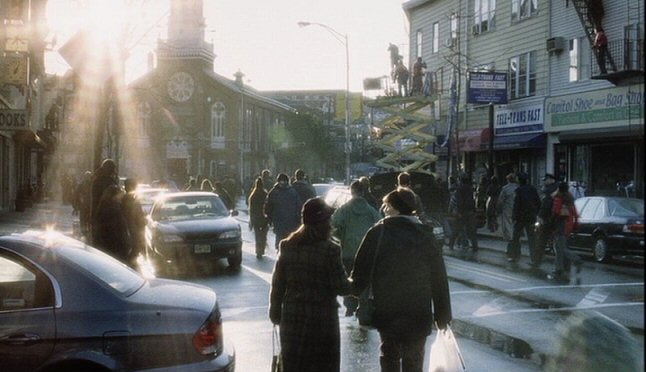
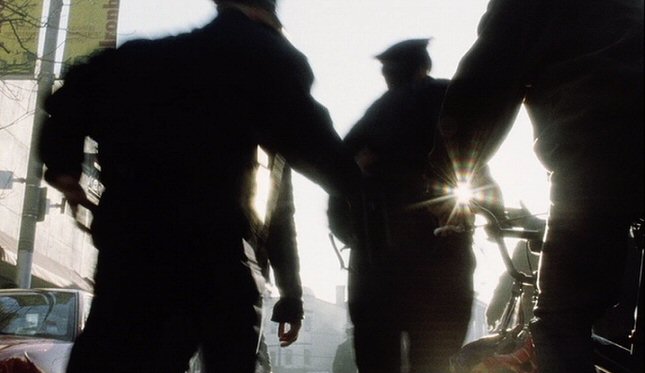
In Steve and Janusz's War of the Worlds I always notice the following shot. I have always joked that it is Spielberg putting in some sacred Hebrew text ...

Is this silk ? A filter ? What exactly ?

after1bs.jpg
 
Deep Focus in Speed Racer

Deep Focus in Speed Racer

Hi David Mullen!

I am a film student who right now is researching deep focus. I just saw the the 7-minute preview of Speed Racer that Warner Brothers made available online, where there is one striking deep focus shot. Then I checked out this thread and saw that you mentioned the deep focus look of this film.

picture-1.png


Here is my question to you:
Is the shot above achieved with the use of greenscreen? Or is it captured by the use of enormous amounts of light and small apature?

Question 2:
I read you post about the telephoto deep focus look of Akira Kurusawa's Red Beard, but i can't find it again. So I wonder which lenses Kurusawa used? 200 mm +? Which lightning levels? f22?

Sincerly,
Tabula Rasa
 
Back
Top