Welcome to our community

Be a part of something great, join today!

  • Hey all, just changed over the backend after 15 years I figured time to give it a bit of an update, its probably gonna be a bit weird for most of you and i am sure there is a few bugs to work out but it should kinda work the same as before... hopefully :)

Ask David Mullen ANYTHING

David,

I found an Oconnor 2575B + tripod for $4,000.

What is your opinion of this tripod for use with the Red One?

Thanks,

-Thor
 
It's an industry workhorse. A heavy head like that is good for lighter cameras (like the RED) actually for smooth operating. The only downside is the weight when you carry it around. I usually don't have to do any lifting on a film shoot because I have assistants, but the few times I've shot on the F900 in a run-and-gun manner by myself, I get a lightweight Sachtler video head and live with it being a bit flimsy, just to save my back! If you are going to do some of that, you may want a second lightweight head.
 
$4,000 is a crazy good deal. I just spent quite a bit more on a nice sachtler setup. You'll need a case for the head and a seperate one for the sticks.
 
Hi David, All


Have you played around or used a Red in production yet? I was not sure after going though your sticky forum...

As I'm quite interested in what you really feel about digital - From what I've seen of the raw files - it looks great..

How do you feel about digital? - I know its tool etc.. but film/digital making is also about the reaching out and working on emotional aspect as well as the tech mind ...

With film you have to wait for the lab to see your result and of-course with knowlege and experience we slowly get stronger and start to undertand - what we believe works and what does not.

but I love how digital cuts the lag time. It helps you learn faster from your mistakes , tests and experiments.... as we all get better with each project right? even if didnt work as well as we had hoped?

But film! Its so sexy right? I love holding 35mm film in my hands - when you hear the projector flicker at the back of the theatre etc -

I know is just romantic etc.. and film is going to be for around alot alot longer...


How do you really feel about digital? Not in negitive light etc but more if say film did finish would you miss it? or rather as long as your happy with the final result - its all good?


Thanks
 
I would miss film -- besides its beauty, it has the whole history of cinema wrapped up in its own history. I feel that every time I look over at the camera.

When I rent an old Panaflex Gold, for all I know, it was used on "Days of Heaven" or "E.T."... in fact, on one of my first low-budget features, we got a Louma Crane donated for a day, and the operator told me it was the first one built, used on "1941" and then "Raiders of the Lost Ark". That's a weird feeling to be using the same piece of equipment that some famous movie used.

Anyway, as digital moves closer and closer to film, I think a lot of the aesthetics carry over without too much difficulty, unlike shooting DV, for example, which I think requires thinking on a different visual level to accommodate the characteristics of that image.

I enjoy shooting digitally. Though I don't find the delay in getting results back from film a problem -- you get used to it after the first day of a feature -- I like the immediacy of seeing a shot on an HD monitor and adjusting it. I like not having to rely on my meter as much.

But film has such a wide latitude that nowadays, if the scene looks good to your eye, it will look good on film. You don't have to worry too much about bright windows and lamps in the frame, or the sun going in and out of the clouds, the stock often handles the extremes.

But since I didn't come up the ladder as a camera assistant, the moment I started shooting 35mm, I only worked with assistants. In 30 features to date, I have never had to load a camera (I loaded plenty of 16mm cameras in film school.) When I started shooting HD on the F900, it was so similar to the betacams I had been using for EPK & infomercial work earlier, that I felt comfortable running around with it grabbing footage on my own. So that's an aspect of digital I like, though if I had more training in 35mm gear, I'd probably be comfortable using that on my own now and then (though not so interested in the heavy lifting.)
 
David, have you ever done a scifi?
 
Hi David

This is my first post in this wonderful thread. My question for Christmas is this: If I had to choose one KODAK stock for an entire feature shot on super 16mm, what would you choose? Due to weird complications, I may have to purchase the stock before having access to a finished script (and we may use film instead of Red because of timing issues as well). The story is a drama with all mixed scenes (both day and night and Ext. and Int.). I was thinking a tungsten 200 speed (7217)... although I am sure the script will be more day Int. than Ext. or night. Would you choose something else? Oh, and the lighting package is smallish. Thank you very much.


P.S. Merry Christmas
 
I would miss film -- besides its beauty, it has the whole history of cinema wrapped up in its own history. I feel that every time I look over at the camera.

When I rent an old Panaflex Gold, for all I know, it was used on "Days of Heaven" or "E.T."... in fact, on one of my first low-budget features, we got a Louma Crane donated for a day, and the operator told me it was the first one built, used on "1941" and then "Raiders of the Lost Ark". That's a weird feeling to be using the same piece of equipment that some famous movie used.

Anyway, as digital moves closer and closer to film, I think a lot of the aesthetics carry over without too much difficulty, unlike shooting DV, for example, which I think requires thinking on a different visual level to accommodate the characteristics of that image.

I enjoy shooting digitally. Though I don't find the delay in getting results back from film a problem -- you get used to it after the first day of a feature -- I like the immediacy of seeing a shot on an HD monitor and adjusting it. I like not having to rely on my meter as much.

But film has such a wide latitude that nowadays, if the scene looks good to your eye, it will look good on film. You don't have to worry too much about bright windows and lamps in the frame, or the sun going in and out of the clouds, the stock often handles the extremes.

But since I didn't come up the ladder as a camera assistant, the moment I started shooting 35mm, I only worked with assistants. In 30 features to date, I have never had to load a camera (I loaded plenty of 16mm cameras in film school.) When I started shooting HD on the F900, it was so similar to the betacams I had been using for EPK & infomercial work earlier, that I felt comfortable running around with it grabbing footage on my own. So that's an aspect of digital I like, though if I had more training in 35mm gear, I'd probably be comfortable using that on my own now and then (though not so interested in the heavy lifting.)


Thanks for the great reply.

best
Ash
 
I haven't done a true sci-fi movie; I've done things with sci-fi elements, like the rocket in "Astronaut Farmer" and the space scenes. I've done some really low-budget stuff with a slight sci-fi angle, like a little movie called "Tomorrow Man" with Corbin Bersen with a time-travel aspect.

---

If you have any tungsten-lit scenes and you have to use one stock for the entire Super-16 movie, then it would have to be a tungsten stock. Normally I'd say 200T 7217 but the new 500T 7219 is so close in quality and is faster, it may be better if you have a small lighting package.

However, it would be better to use a second slower-speed stock for your brighter scenes, like 100T or 50D outside.

Thanks for the fast reply. So you think 500T Vision 3 is close in graininess as a 200 stock? That is amazing. My only worry if I got two stock is if a 500 stock will intercut nicely with a 50 stock. Wouldn't the grain be too different?
 
However, it would be better to use a second slower-speed stock for your brighter scenes, like 100T or 50D outside.

After working on a student short using (Fuji) 200D 16mm for day exteriors in the full Australian sun - ND1.2 (stacked) and rolling at about f/11; diffraction ahoy! Definitely want at least a bit of slower stock if you anticipate full sunlight exteriors.
 
Thanks for the fast reply. So you think 500T Vision 3 is close in graininess as a 200 stock? That is amazing. My only worry if I got two stock is if a 500 stock will intercut nicely with a 50 stock. Wouldn't the grain be too different?

Since the new 500T is similar to the old 200T and 250D in terms of graininess, that only leaves 100T or 50D as finer-grained alternatives. So I'd do some testing to see how they match.

Actually the 200T is still technically finer-grained than the new 500T, just that if you have a small lighting package or any low-light scenes, the new 500T may be more practical and be similar in quality.
 
Thank you for your answers and time, David. Okay, here is my second and last question for the year. :innocent:

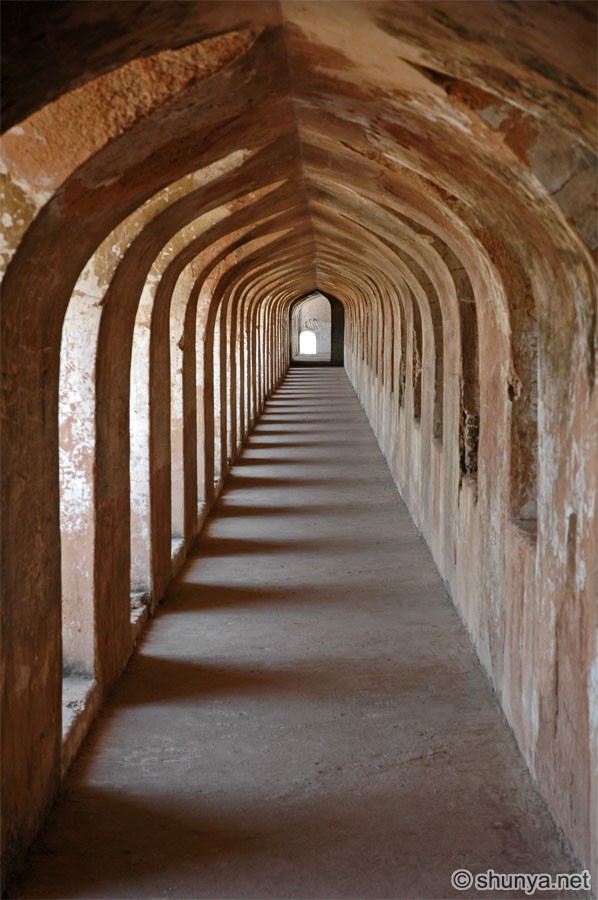
When one has a shot of a long corridor, where is the best place to start focus. The scene would start with the corridor being empty (like in the pictures bellow). Then someone would appear at the end and walk forward towards the camera. I understand that once the person appears into the scene we would rack focus to them and follow them... but when the hall is empty, where is the best place to start the focus? (In other words, to what exactly does one measure to? ... Should the front of the hall be more in focus even though the center of the frame would be out of focus?) The reason I ask is because I actually managed screw up this shot once.

EXAMPLES:

BaraImambara21.jpg


hotelflur-hotel-corridor-days-inn-roncesvalles-ave-14-toronto-ontario-canada-kanada-dscn7530.jpg


c2k3_5286_corridor.jpg
 
P.S Oh, one more thing: From what I understand the best way to light the person walking towards the camera (to maintain even lighting on his face) is with a fresnel shot straight ahead just above his head (not directly on him). Is this true? Or is there a better way to maintain even exposure through the long walk towards the camera? This would be of course for a long corridor where we wouldn't want to see any light sources along the ceiling or walls.
 
You can either set the focus on some sort of hyperfocal distance for maximum depth of field -- or just on what area you think the eye will go to naturally and expect it to be sharp, usually a brighter area at mid-distance with obvious detail, or something prominent in the center of frame in a lot of light.

--

If someone is walking down a long hallway, in reality they should be lit by whatever light sources are in that hallway, from overhead, through open doors, etc. You can't really shine a light over the top of camera and expect that to look realistic, unless you are suggesting that they are walking towards a bright window behind the camera. And even if that were the case, then you'd want them to get brighter then as they got closer. And it probably should be a soft light, not a fresnel.

Unfortunately hallways are the hardest sort of location to light. Shining a light over the lens is only going to work for fill light, if the eyes sockets are too dark from overhead lights or if they go through dark gaps in the lighting. And even then, it would be hard to get fill light to shine all the way down a hall in a long shot. It only works in a moving shot where you have a little light over the camera lens to bright out the eyes, and the camera is maintaining the same distance to the actor as it moves back.

Generally you try to get the practical sources to be bright enough for shooting, or you add practicals (more sconces, etc.) or you add fake header beams along the hallway ceiling so you can hide a light behind it (maybe a Kino tube). Then the new problem becomes how to hide the power lines to the light -- sometimes you can run them inside of a drop ceiling, but if there is no drop ceiling, sometimes you can power a light through a socket, or use thin zip cord painted to match the wall/ceiling color.

As for the classic problem of someone walking towards the lens like in a parking lot at night and you want to keep the light an even brightness, either you can use a row of soft side lights, or you can light 3/4's frontally with a big light, or a couple of them, and use net flags on the side of the light (and half-scrims inside the light) to darken the light as the person moves closer to them, sort of like an ND grad effect. You need the light to be angled though for this to work. If the light is straight-on, there isn't much you can do except either dim the light as they get closer (and have the color shift) or float a series of net flags in front as they get closer. Or flood out the light as they get closer. But the problem with all three of those tricks is that the background will visibly chance. It's better to break up the light into pools and control them separately. But floating net flags and using dimmers is a good trick to remember in certain situations with a complex camera move or actor movement.
 
You can either set the focus on some sort of hyperfocal distance for maximum depth of field -- or just on what area you think the eye will go to naturally and expect it to be sharp, usually a brighter area at mid-distance with obvious detail, or something prominent in the center of frame in a lot of light.

David, thank you again for your thorough post. This is gold for me (and I am sure for many others as well). I am eternally grateful for your time. Regarding your answer, it sounds like I will also have to look at what image immediately precedes the hallway shot (to see where the eyes 'are left at'). So, if in the previous shot the actor was holding an object and he lifts it up to look at it... and then we cut... then the hallway should be brighter and in focus in the same area of the frame where that object was... (I hope I'm right)


Unfortunately hallways are the hardest sort of location to light.

I am sooo glad that this is the case and that me messing up was 'normal' and 'inevitable' on my first feature. :whistling:

As far as your suggestions are concerned, I will make diagrams of all scenarios to better understand them. I like the option of making pools of light the best as well... it lends itself for very dramatic lighting. But I also want to master the high key version. I'll also try to find the place where I read that about the fresnel method... I know I have that book here somewhere...
 
Hi David,
Black Level Compensation? I guess that is setting a black index level, same as a white index for white balance? On RED I would presume this is a menu initiated feature? How often would one need to perform this compensation? I have a simlar post in another thread but thought about posting here too as it also relates to the act of cinematography.

Cheers,
Mark.
 
I am not really familar with the reasons for black balancing a RAW camera -- I thought that the point of RAW was that it didn't get any traditional video processing until post. Unless this is a way of mapping any dead pixels or cleaning up random noise or making sure the RGB conversion for 720P monitoring looks correct. In a 3-CCD camera, black balancing is a way of balancing the three colors so that they reproduce black equally. Not sure how that applies to a Bayer-filtered RAW camera.

Hopefully someone who understands the reasons why it is necessary and what actually happens when it is done will explain. Sorry.

Generally you don't have to black balance too often.
 
Back
Top