Welcome to our community

Be a part of something great, join today!

  • Hey all, just changed over the backend after 15 years I figured time to give it a bit of an update, its probably gonna be a bit weird for most of you and i am sure there is a few bugs to work out but it should kinda work the same as before... hopefully :)

Ask David Mullen ANYTHING

With film, you pay for real estate -- 5-perf 65mm is one perf taller than 4-perf 35mm and twice as wide, so it roughly works out to be twice as expensive for a 1000' roll, which runs slightly shorter than it does in 4-perf 35mm.

Cameras themselves can actually be cheaper to rent (being older) than the current state-of-the-art 35mm sync-sound cameras.

Processing is higher, and harder to find, and so is finding a telecine for editing, and scanners for D.I. work. I think CFI and FotoKem do 65mm processing & printing work here in Los Angeles.

Compared to overall production costs of a typical studio feature, 65mm is not particularly a financial burden. The real disincentive is the lack of 5-perf 70mm venues for releasing the movie, meaning that the most likely release scenario would be 35mm reduction prints. It's hard to get a director excited about shooting a movie in 5-perf 65mm when you tell him that it will probably not get released in 70mm prints, just 35mm.
 
If it were not for the coming of 4K+ digital cameras, I would love to see a comeback of 65mm.

Nolan could have shot his Dark Knight entirely in 65mm, for example, to be DRM'd (assuming there is a 65mm DMR process) and released on IMAX screens, in addition to regular theaters. I wonder how seriously Singer considered 65mm for Superman Returns? I seem to recall him talking about it.

But I think digital technology is the best hope of getting back to 65mm quality. 6- or 8K sensors the size of 5-perf 65mm would be cool.
 
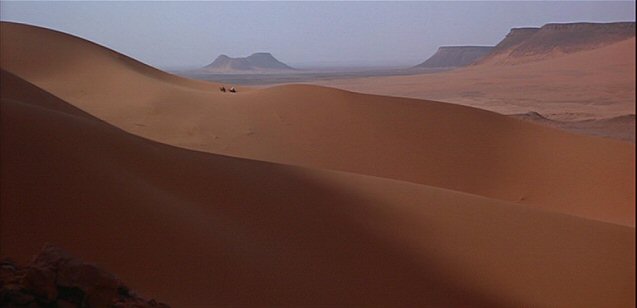
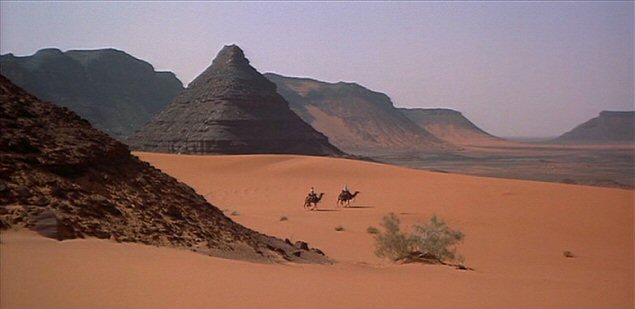
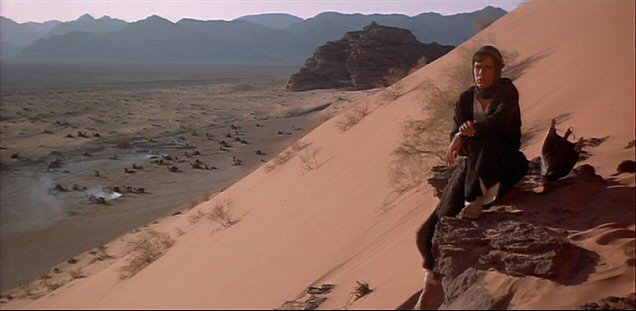
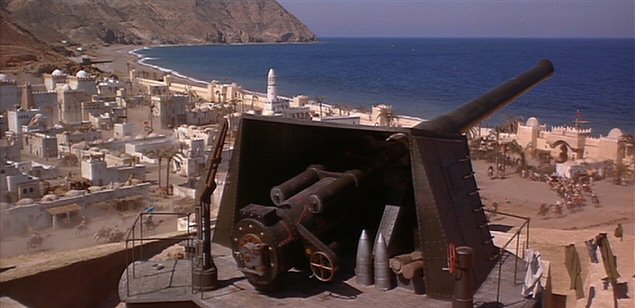
"Lawrence"

"Lawrence"

Man it would be nice to see this projected properly in a real theater!!


Certainly 65mm movies such as "Lawrence of Arabia", "2001", "Patton" didn't "suffer" from a lack of being engaging due to the clarity of their images -- the opposite in fact. In "Lawrence of Arabia" the 65mm photography & music wordlessly demonstrates and explains the fascination that Lawrence had with the desert.

loa1.jpg


loa2.jpg


loa4.jpg


loa5.jpg
 
Sensors the size of 65mm

Sensors the size of 65mm

But I think digital technology is the best hope of getting back to 65mm quality. 6- or 8K sensors the size of 5-perf 65mm would be cool.

What are the issues with a 65mm size sensor in terms of available lenses and even further reduced DOF? Is that desirable or would it be better to get the 6 or 8 K pixels into the S35 size and be able to use all of the standard lenses?


Four words: Aero Theater LA 70mm
I live in Florida,but may come out for LART. What's showing?
PS. Never mind just pulled it up - gotta love the internet. Missed it on Sep 15. http://www.americancinematheque.com/Aero/aeromastercalendar.htm
 
What are the issues with a 65mm size sensor in terms of available lenses and even further reduced DOF? Is that desirable or would it be better to get the 6 or 8 K pixels into the S35 size and be able to use all of the standard lenses?

I live in Florida,but may come out for LART. What's showing?
PS. Never mind just pulled it up - gotta love the internet. Missed it on Sep 15. http://www.americancinematheque.com/Aero/aeromastercalendar.htm

I think the trouble with cramming more pixels into a S35mm size sensor is that it doesn't help with increasing dynamic range or reducing noise, as I believe a larger 65mm-size sensor would.

There's probably a lot of 65mm glass sitting around collecting dust right now. But yeah, DOF would have to be taken into consideration. Some might like the 65mm DOF, others not.

Forum member Sam Druckerman does a great job of keeping everyone posted here about LA 70mm showings, so talk to him or make a post before you come out for LART.
 
The Phantom 65 has a 65mm-sized 4K sensor, basically twice as wide as their 2K sensor in the Phantom HD camera.

Yes, you run into problems cramming too many photosites into the same size area. For a 2.20 : 1 70mm aspect ratio at 8K, you'd need a 28MP sensor (8000 x 3600). If you make it 6K, which is probably enough for a 70mm release, (6000 x 2700), that's a 16MP sensor, not too far off from the RED sensor.

Of course, some argue that the 4K RED image projected in 4K looks close enough to 65mm photography.

I don't see 65mm depth of field as being a particular advantage (anamorphic 35mm has a similar problem since it uses similar focal lengths, which tend to be twice as long as with spherical 35mm photography.) The only reason to make the sensor 65mm wide is if it solves heat and sensitivity problems.

You would probably use medium-format (and even some of the 35mm still format) lenses adapted for use. The Arri 65mm cameras uses adapted Mamiya lenses I think, made for Hasselblad use.
 
Big sensor

Big sensor

I don't see 65mm depth of field as being a particular advantage (anamorphic 35mm has a similar problem since it uses similar focal lengths, which tend to be twice as long as with spherical 35mm photography.) The only reason to make the sensor 65mm wide is if it solves heat and sensitivity problems.

Thanks, you answered my question re DOF, and with that said it seems like the S35 sensor with say that 6K resolution is the most practical evolution. That is about the same density of photosites as on the latest DSLRs, so should be manageable, particularly as sensors improve, and it leverages the existing lenses.

4K seems to be the big leap. The rest of the evolution will probably be less radical even if it happens fairly quickly.
 
hi David,

Interested in your thoughts on using RED for documentary/EFP production. Basically the idea of shooting as a one man band in an unpredictable fast paced environment.

I know RED may not be the ideal camera for these situations but it would be great to hear how you would approach such a mission. Stick to 4K with Red zooms, light weight matte box and stop down to help with DOF, or go 2K. 2K with a S16 zoom of the B4 servo lens route.

What do you think??
 
Depends on if you are specifically shooting a documentary for the big screen, in which case, shooting in 4K might be worth it, especially for a nature/landscape documentary.

As for 4K capture-to-2K (or HD) in post versus 2K-windowed... just depends on how comfortable you will be with the focusing issues and what lenses you want or need to use. Again, that might depend on the nature of the shoot. Some doc / EFP stuff is very controlled, more like a commercial/narrative shoot, while others are more run and gun, guerilla-style.

If you need a 10:1 handholdable zoom lens, you might want to stick to 2/3" / Super-16 optics.

You could consider shooting both methods/modes, 4k full-sensor for wide shots or when you want a shallow depth of field, then 2K windowed mode for wild verite-style shooting, handheld, etc.
 
David,
What are your thoughts on FAY lights? According to my reading, they were designed to be used as day fill. Have they fallen out of favor and replaced by modern HMIs? 5000k seems fairly low temp as a fill, especially in comparison to the more typical 5600k or 6000k. Mole FAY lights go dirt cheap on eBay all the time though the bulbs are not cheap.
 
Dichroics are still used now and then; for example, some people put FAY's in every other globe position in a Dino for a half-blue moonlight color without gelling.

Just for regular day work, they use a lot of power and put out a lot of heat in relation to their light output compared to an HMI.
 
Dynamic Range Chart

Dynamic Range Chart

Dave, I have been trying to compile the following list of examples of dynamic range. I wonder if you have gathered this kind of information yourself --or know where I can find it. Can you help me fill in the blanks, or see how close I've guessed?

Print, white to black ink: 4 f-stops?
DV camera: 6 f-stops?
Pocket digital camera: 7 f-stops?
Digital SLR shooting RAW: 11 f-stops?
Typical HDV camera: 8 f-stops?
F900 10.5 f-stops?
Red: 11.5 f-stops?
Motion Picture Film: 12 f-stops?
High end digital projector ___ f-stops
Motion picture film projector ___ f-stops
Typical outdoor scene on a bright day, from highlight detail to shadow detail: ___ f-stops
Typical outdoor scene on a cloudy day: ___ f-stops
Typical indoor scene lit with incandescent: ___ f-stops
What the human eye can see at once: 22 f-stops?

[any other common examples you might know]

Thanks,
Phil

www.artbeats.com
 
Dear David, sorry to cut into your thread, but I'd have to say to Phil that dynamic range depends very much on how much noise you can accept.

I would say that there is a lot more than half a stop difference between motion picture film and Red footage.

For digital SLRs, check out DPreview.com - they have dynamic range tests. Be aware that dynamic range is ever increasing - the Fuji SLRs have significantly better dynamic range and also the new Canon 40D is significantly improved on the 30D for example.

On the HV20 for example I have measured between 7 and 9.5 stops depending on your noise sensitivity.

I will post Stouffer wedges, etc, I promise. I suck, I am slow on delivering this. Sorry.

For the Red I think 11.5 stops is optimistic. Just my opinion, that's all ;)

As far as real scenes go, Phil, just get a spot meter. On my Sekonic 508c I can get from f64 to f2 in a single scene.

Bear in mind that digital projectors are now cheating - eg they increase and decrease overall brightness in order to fake increased dynamic range. The extents of these that are allowed are all in the DCI spec.

Bruce Allen
www.boacinema.com
 
Dave, I have been trying to compile the following list of examples of dynamic range. I wonder if you have gathered this kind of information yourself --or know where I can find it. Can you help me fill in the blanks, or see how close I've guessed?

Print, white to black ink: 4 f-stops?
DV camera: 6 f-stops?
Pocket digital camera: 7 f-stops?
Digital SLR shooting RAW: 11 f-stops?
Typical HDV camera: 8 f-stops?
F900 10.5 f-stops?
Red: 11.5 f-stops?
Motion Picture Film: 12 f-stops?
High end digital projector ___ f-stops
Motion picture film projector ___ f-stops
Typical outdoor scene on a bright day, from highlight detail to shadow detail: ___ f-stops
Typical outdoor scene on a cloudy day: ___ f-stops
Typical indoor scene lit with incandescent: ___ f-stops
What the human eye can see at once: 22 f-stops?

[any other common examples you might know]

Thanks,
Phil

www.artbeats.com

Phil, I have searched internet on your questions, very interesting ones.
Many numbers came back but the information is as good as your source.
Most of your numbers depend from the extremities you are going to accept.
However, I have one question on my own.
Why we are dying for DR so badly when human eye can accept in any instance maximum of 6.5 stops of DR
Yes, it can adjust to light for total of 20 stops or so but this is like dynamic brightness on most LCD monitors, it takes time for the eye to adjust.
 
Why we are dying for DR so badly when human eye can accept in any instance maximum of 6.5 stops of DR
Yes, it can adjust to light for total of 20 stops or so but this is like dynamic brightness on most LCD monitors, it takes time for the eye to adjust.

It's because color-correcting is generally easier when we have some information we can throw away when making color-correction decisions in post. Film, with its very wide dynamic range, allows a lot of flexibility and creativity in post to create a look or fix an exposure problem, or deal with a high dynamic range situation where you can use Power Windows-type selective corrections to bring certain areas up or down to balance the image.

When a capture format has less dynamic range, it starts to be closer to the final display format's dynamic range, which means you have to work harder to get the original image close to the final look you want in terms of dynamic range, controlling it and condensing it sometimes, and make fewer exposure mistakes.

If we could all shoot perfectly balanced images right at the time we shoot, the dynamic range of most video cameras would be acceptable.

The same thing applies to film: color reversal (slide) film has the gamma of negative-to-print in that it is designed for direct projection. So the dynamic range, though limited, is perfect for final display in terms of contrast, black levels, etc. But color reversal leaves you with no room for error when shooting even if you can scan it and digitally color-correct it, especially compared to color negative.

Even in a big-budget production, a cinematographer cannot control everything in the frame, exposure-wise. You may set-up a lovely long-lens close-up of your star in an outdoor cafe during the daytime, and during a key acting moment, a white van may pull-up in the background, several stops overexposed. You may stage an important scene in front of a two-story house and end up with one person's coverage in full-shade and the background in full sun, and blasting the foreground with 18K HMI's is not going to look natural. So you want a shooting format that gives you a wider dynamic range to work with in post than what you are ultimately going to show in the finished product.
 
Even in a big-budget production, a cinematographer cannot control everything in the frame, exposure-wise. You may set-up a lovely long-lens close-up of your star in an outdoor cafe during the daytime, and during a key acting moment, a white van may pull-up in the background, several stops overexposed. You may stage an important scene in front of a two-story house and end up with one person's coverage in full-shade and the background in full sun, and blasting the foreground with 18K HMI's is not going to look natural. So you want a shooting format that gives you a wider dynamic range to work with in post than what you are ultimately going to show in the finished product.

David,

As usual, so right you are. But exactly because of those intangibles, the low budget/indie film maker should actually make an effort to avoid such situations, which to a finite degree and with lots of planning and a bit of luck is achievable. I always felt that we should pick locations where we have control of the "white van" cruising by. Granted, this may eliminate the known landmark and force us to shoot in lesser known places, but it may be worth it. And pre-production time is the biggest luxury the small people have, so why not use it to ascertain lighting conditions for every scene, better yet, block or rehearse the scene with friends/extras or even cardboard pieces for people in every intended set at the intended time while shooting it with a DV camera and a DSLR to know beforehand what conditions to expect? That's exactly what I did on a couple of experimental 30 minute projects years ago where I took reference shots of everything with a Nikon D-100 and by the time we showed up to film with an F-900 we knew what to expect and it saved us a lot of pain with the less than forgiving F-900, where we knew ahead of time the parts where we could expect blown highlights or washed out shadows and came prepared for it. This added only about 10 days of extra pre-production work but proved to be an invaluable little tool.

Again, notice I say "to a finite degree"...
 
Dave, I have been trying to compile the following list of examples of dynamic range. I wonder if you have gathered this kind of information yourself --or know where I can find it. Can you help me fill in the blanks, or see how close I've guessed?

Print, white to black ink: 4 f-stops?
DV camera: 6 f-stops?
Pocket digital camera: 7 f-stops?
Digital SLR shooting RAW: 11 f-stops?
Typical HDV camera: 8 f-stops?
F900 10.5 f-stops?
Red: 11.5 f-stops?
Motion Picture Film: 12 f-stops?
High end digital projector ___ f-stops
Motion picture film projector ___ f-stops
Typical outdoor scene on a bright day, from highlight detail to shadow detail: ___ f-stops
Typical outdoor scene on a cloudy day: ___ f-stops
Typical indoor scene lit with incandescent: ___ f-stops
What the human eye can see at once: 22 f-stops?

[any other common examples you might know]

Thanks,
Phil

www.artbeats.com

Keep in mind, Phil, that the RED's Dynamic Range (for 25fps and below) is also going to increase soon (as well as reduced noise) with the recently announced additional daughterboard.

http://www.reduser.net/forum/showthread.php?p=99971#post99971

Since DR is already outstanding, I can't wait to see the results.

(And thank you, once again, David, for a great response to Phil's question.)
 
Back
Top