Welcome to our community

Be a part of something great, join today!

  • Hey all, just changed over the backend after 15 years I figured time to give it a bit of an update, its probably gonna be a bit weird for most of you and i am sure there is a few bugs to work out but it should kinda work the same as before... hopefully :)

Ask David Mullen ANYTHING

Lens options/opinions

Lens options/opinions

Greetings David,

Curious about your thoughts/opinions regarding the Angenieux 25-250 HP in conjunction with "Lucky" RED #13 (that's the lens I think I am going for). I have also considered a Cooke 25-250 MKII or Cooke 20-100 and the Angenieux 20-120 T2.9

These seem to be quality lenses in my price range that will allow me to add a wide angle prime and Telephoto to fill out me kit.

Thank you in advance for your expert opinion. I seriously appreciate you taking the time to share your opinion/experience.

Best,

Billy Summers-
 
I wish I could help you, but shooting mostly on Panavision gear over the past decade has meant that my experience with zooms (which I generally have avoided in the past) has been the Primos, and the old 20-100mm Cooke (which we use for almost everything on "Big Love", my first TV series). Oddly enough, I have no hang-ups about using zooms in HD, but normally I dislike 35mm zooms (particularly 10:1's) and prefer using the primes.

The classic T/3.1 20-100mm Cooke, though, is a very well-designed lens and covers 90% of the common focal lengths I use. I wish it was a T/2.8 though... and sharper. There is also a faint fall-off/portholing effect when shooting wide-open, nothing bad.

On my last show, I had probably the best-quality zoom I've ever used, the new Zeiss T/2.6 16.5-110mm Master Zoom -- super-sharp, even wide-open. But it's the biggest lens I've ever seen; it makes an Ang. Optimo look like a lightweight zoom.
 
David Mullen, I have a question for you...

What is it that typically attracts you to the projects you choose to do? Is there any one "key element" that makes you want to sign on to a particular show?

Also, where might someone post to solicit DP reels for a project?
 
It depends on how desparate I am at the time for work... right after a bigger show, I feel more confident about turning stuff down, but if I hit a dry spell...

Also, I do projects for people I know from previous jobs.

Mainly when I look at a script, I look to see if it needs me in particular, my skills. I don't want to work on some indie movie where all they need is a competent DP. I'm sort of beyond proving myself to be competent.

I also get turned off by talky scripts because covering dialogue can get boring. But if the dialogue is good enough, then it doesn't bother me as much. But I get too many indie comedy scripts of friends talking in diners, then in their kitchens, then in their cars, etc.

I like visual scripts, but generally those are harder to shoot, so I look to see if the schedule and budget are realistic. If I get a movie that is all night exteriors of people chasing each other through backyards, woods, etc. with stunts, etc. and they tell me that it's an 18-day feature, I usually don't get involved because I know how much longer night photography takes. Early on in my career, I went to a job interview for a horror film with monsters at night in a graveyard and it was an 18-day schedule. When I told them the problems with that, they didn't hire me. Later I asked the DP who did get hired how long the movie went and he said they went 7 days overschedule, which is nearly double the original days budgeted.

I don't like to get involved with projects I perceive as potential train wrecks, hence I try and get an idea of the producers and director, to see if they know what they are doing.

And just to maintain my healthcare access, I have to work a certain number of union days per year...

Generally you get reels from the below-the-line agencies that rep DP's.
 
David,
Thanks again for this thread, it's phenomenally helpful.

What are your thoughts on lens-mounted ring lights such as the Kino Kamio 6e? I've never been able to use one and can't quite picture when you'd want to use one in narative work. I've heard they're useful on music videos, but features?

Another one (sorry if you already answered this), but what fixture do you prefer to use for eye-lights?

Lastly (for now :-), outside during direct noon-time sunlight, what specific rag do you find yourself most often using and on what frame? A 12x12 quarter silk? A 20x20 full artificial, etc?
Thanks again.
 
I have yet to use a ring light, but apparently the Kino Kamio has the advantage of being a small-enough ring that you don't see a big donut-shaped light in the eyes of the actor.

But this ring effect in the eyes is probably the main reason why it isn't used much for theatrical feature work -- on a 50' screen, that can be distracting. Plus it's a bit unnatural.

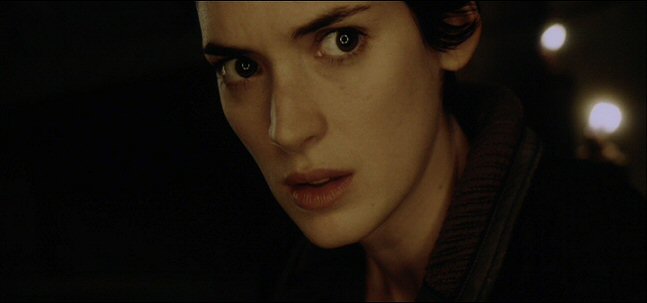
When "Alien Resurrection" came out, a number of people posted in cinematography forums about seeing the cluster of Kino Miniflos taped around the mattebox, reflected in Sigourney Weaver's and Winona Ryder's eyes as a square-shape.

In harsh sunlight, I alternate between regular silk (when I want a lot of softening, as if the actor was in the shade of a building or tree) and Half Soft Frost, which only loses a half-stop of brightness. It's more like Opal (but not noisy) and softens nicely without losing the feeling of the sunlight.

Whether I use a 12'x12' or a 20'x20' depends on many things (how much wind for one thing) but mainly how much area I want or need to cover and how easily I can keep the stands out of the shot.
 
I don't like to get involved with projects I perceive as potential train wrecks, hence I try and get an idea of the producers and director, to see if they know what they are doing.

Amen to that David! I take the same approach.

I recently got an offer to DP a super low budget film, and the first thing I'm told is its a 12 day shoot....

RED FLAG!


This is before I have even been given a script to look at. In fact, when I asked for it, I found out it wasn't done yet... Oh, and they want to shoot early November of 2007! Yikes. I'm already half way out the door on this one... Oh, and only 30 grand to work with, as in total budget for the whole thing, pre-production, production, and post.

I have some general rules of thumb:

If anyone tells you how long a shoot is before consulting you, get ready to run... Most of these people have no idea of what is really required to make a script come to life photographically. Furthermore, these types of people usually don't have much experience anyways, so before you know it, people are locking in locations without consulting you on how long you really need to be there, etc..

Film offers for unfinished scripts... this says a bunch. It says the person likes to rush things, and is probably an idiot to work with. Why on earth would you push around a half finished script? Thats like trying to sell a book with no pages in it. I can understand looking around for DP's early on, but full on job offers and no finished script? Just silly.

Unprofessional correspondence. I know email is email, but if you want me to take you and your project seriously, please, sign your name and give some contact info at the very least. I have had people send me offers and not even sign their name. I just don't even bother with these types, clearly not detail oriented enough to make a film.

*End of rant*
 
I guess it was more than just four Kino Miniflos around the mattebox in "Alien Resurrection", judging from this frame grab:

alienfour2.jpg


Yes, there is a product called Half Soft Frost.
 
I love creative eye lights. Andrew Lesnie used a bunch of christmas tree lights for Galadriel (spelling?) in the first Lord of the Rings film. She is like the elven queen or something. The scene has a bunch of close ups, and all the other characters eyes have simple dots, but she has a galaxy!

I really like the technique if it helps the story out.
 
David, I was able to find one vendor (Barndoors) that actually sells a 12x12 Half Soft Frost. Interestingly, the Matthews web site doesn't even acknowledge it. Perhaps it's really new or old and discontinued?

It is an interesting look on that screen cap, I can now see why you'd stay away from a ring light.

What is your eye light method of choice?
 
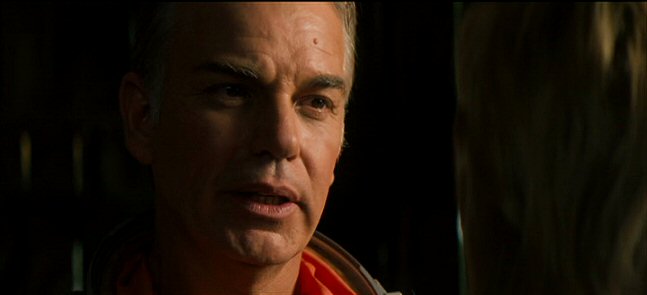
Fill light in general can create a reflection in an eye... Here is an example from my own work in "The Astronaut Farmer" where the fill light (a 4' 4-bank Kino) created a reflection in the eyes, as well as the key and some windows in the room):

af4.jpg


But in terms of a special light for the eyes, I only do it on special occasions, like a romantic close-up. Or when I have very toppy light, like from an overhead softbox.

I also do it sometimes for dark moonlit scenes so that I have a bright glint in a very underexposed face, so you still notice the expression in the actor's face.

My most common technique is to use a Dedolight over the lens, sometimes mounted to the camera itself with a bracket, sometimes armed over the lens on a c-stand arm. I usually snoot the light with some blackwrap. Occasionally instead of a snoot, I'll use the beam projector attachment that turns the Dedo into a tiny Leko/Source-4.

When I want a more frontal key light that serves as an eye light as well, I'll arm a Tweenie over the lens.

Other way I create an eyelight is with a Kinoflo, sometimes a 2' 2-bank over or under the lens. On some close-ups of older actresses, I will have two 2' 2-bank Kinos on each side of the lens, low, to fill-in the bags under the eyes. I've been thinking of trying two Kino Barfly lights (which are dimmable) under the lens on a double-head arm on one stand.

I've used real Obie-type lights before, and recently, I used the small LitePanels LED light over the lens, on a moving Steadicam shot. It can be powered thru the camera and is dimmable.

Truth is, almost anything can be used for an eyelight.

You see lots of Kino eyelights in the "Lord of the Rings" trilogy, with their telltale horizontal line reflection.

Here is another example from "The Astronaut Farmer" of a Dedolight eyelight in a dinner scene lit with an overhead Kinoflo:

af1.jpg


And here is an example of a Dedolight eyelight in a dark moonlit scene, which you can barely see on the camera left eye:

af2.jpg


As you can see, I generally knock the eyelight way down so it's not too obvious, because on the big screen, you can still see it pretty clearly.
 
Wow, thanks, I think I understand it. I really appreciate this.
 
David, did you see Roger Deakins' comments in the current A.C.? He says he finds anamorphic too clean and "pristine", and he prefers S35mm, which is more "real".

I guess I make this point too often, but take the Deakins' comment, along with Soderbergh's apparent preference for windowed 2K on at least one project, as reported by Jim Jannard, and it does seem to suggest that increased absolute resolution, in and of itself, isn't always desirable in dramatic cinema.

Seems to me there's still a case to be made for *shooting* 4K, particularly given the demerits of d-cinema at lower resolutions. But I wonder if the brain doesn't effectively disengage once its perceptual limit is reached or neared in the delivery format, since there's nothing for it to "fill in"? The effect being, you tend to view the projected image as "spectacle" rather than drama.... And there's less imaginative/emotional involvement in the drama as opposed to the spectacle of the projected image, which may be grand, but isn't drama in the usual sense.

Anyway, that's the best I can come up with, from my own subjective responses to 65mm and 4k projection. But never having seen Red footage projected.

What do you think?
 
I don't think there is one way to shoot a movie, resolution-wise or anything. Hyper-clear, immersive "you are there" images like with 65mm or the old Cinerama format, or IMAX, are just as legitimate as shooting in Super-16.

Look at "Saving Private Ryan" and "The Thin Red Line", both WW2 movies. The first is shot in a grainy, desaturated style in the 1.85 format, the second in 35mm anamorphic with very clean, pristine, saturated (or normal saturation compared to SPR) images, almost like 65mm.

Is one approach "better" than another? You could say that the first is more impressionistic rather than realistic I suppose, or at least, its "reality" is derived from the look of 1940's combat photography and newsreels, while the second has a "you are there" immersive big screen quality.

What I like about higher-resolution images that are fine-grained is that they create more of the effect of a "window" onto reality that allows you to step into the image, not look AT an image. They are more 3D in a 2D format. Surface grain and lower-resolution have a flattening effect that is more 2D - however, that may also make it more pictoral, more painterly therefore. Kubrick was right to use 1.66 35mm for "Barry Lyndon" but 2.20 65mm for "2001".

As for shooting in 4K, it can be argued that Roger Deakins, while shooting in S35, is still shooting "in 4K", so it's not particularly like he's going for a low-resolution look. And he's never been much to use graininess as a look other than a few movies. But he's not necessarily against surface grain either as a texture (otherwise, he wouldn't have done the partial bleach bypass on "Jarhead" and "Jesse James".)

Personally, I think the reason Deakins doesn't like anamorphic has more to due with optics than graininess. He likes the practicality (size, weight, speed, close-focusing, shorter focal lengths) and look of spherical optics. He's shot entire movies on 200 ASA stock (like "The Shawshank Redemption") that were fairly pristine-looking.
 
What I like about higher-resolution images that are fine-grained is that they create more of the effect of a "window" onto reality that allows you to step into the image, not look AT an image. They are more 3D in a 2D format. Surface grain and lower-resolution have a flattening effect that is more 2D - however, that may also make it more pictoral, more painterly therefore.

No disputing that "stepping into" an image could be desirable for certain projects, but I wonder if movies aren't emotionally engaging because they present a pictorial 2d image -- suggestive, but without being literal, which gives the mind something to do. A hyperreal image seems to engage a different part of the brain.

When 4K acquisition and projection becomes commonplace, for all sorts of projects, I guess we'll find out.....
 
I think you're generalizing too much about the movie experience -- an action movie, for example, tends to require a more physically immersive experience than a drama.

There is always the problem with more hyper-real photography that there is a greater burden on the part of the filmmaker to convince the audience that the fictional elements of the movie are believable -- that the sets are real locations, that the costumes are real clothing, that these actors are real characters, etc.

So yes, to some extent, the 2D image with its rhythmic 24 frame cadence, which is very non-real, can have the contradictory effect of enhancing the realism of these "fake" elements of classic filmmaking. And the opposite, let's say a 3D image running at 60 fps that is hyper-sharp on a giant screen, can have the effect of making everything put in front of the camera look staged, artificial. But that also suggests that the solution, to some extent, is to do everything better, work harder at being convincing.

Movies are as much a psychological experience as a visceral one, so there is no single standard for what constitutes "realism" in narrative cinema -- it is generally a construct, a creation of an artist.
 
We could beat this one to death, but I'm not thinking so much of "realism" in the conventional sense, as absorbing the viewer in a fiction, whatever its content. Will audiences accept that a world presented in grainless high resolution is an imaginary one, to the extent the filmmaker wishes to create such a world?

These are not new questions in aesthetics, but it seems to me 4K may answer them. Or perhaps 65mm did answer them -- sort of.
 
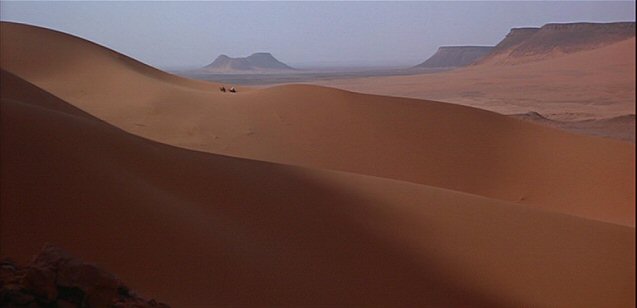
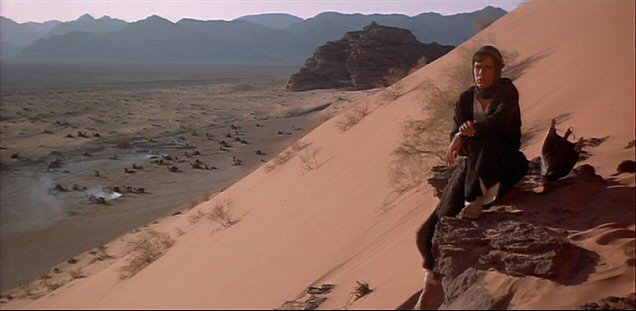
Certainly 65mm movies such as "Lawrence of Arabia", "2001", "Patton" didn't "suffer" from a lack of being engaging due to the clarity of their images -- the opposite in fact. In "Lawrence of Arabia" the 65mm photography & music wordlessly demonstrates and explains the fascination that Lawrence had with the desert.

loa1.jpg


loa2.jpg


loa4.jpg


loa5.jpg
 
Back
Top