Welcome to our community

Be a part of something great, join today!

  • Hey all, just changed over the backend after 15 years I figured time to give it a bit of an update, its probably gonna be a bit weird for most of you and i am sure there is a few bugs to work out but it should kinda work the same as before... hopefully :)

Ask David Mullen ANYTHING

Hey David, I've got a real specific question for you this time.

Others are encouraged to chime in, as always.

Here's the scene, as written:

====================

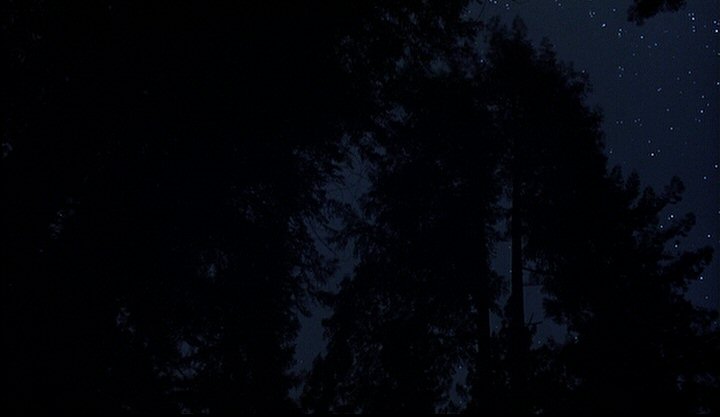
starsvl1.jpg


FOREST - NIGHT
John and Andie (girl) walk into a clearing in the woods. They sit on the forest floor and look up through the trees at the Milky Way.

ANDIE
Oh my god.​

JOHN
Lie back. Now hold up your hand up, like this...​

POV - we see John’s silhouetted hand against a sky full of thousands of stars. Then POV of Andie’s hand against the stars.

JOHN
If our eyes could see forever, your hand right now is blocking out more stars than there are grains of sand on every beach on Earth.​

It’s very dark, so we really only see outlines of them. It’s also quiet, except for the sounds of crickets. Their conversation is basically taking place in the dark. In a hushed, almost religious whisper...

JOHN
Do you hear that? It’s quiet.​
​

====================

Questions:

1. How could I shoot that scene of the hand silhouetted in front of the Milky Way? The only way I can think of is to shoot a timelape plate looking up through the trees, then somehow composite in the dark hands? The problem with this is that the stars will obviously be moving very fast across the sky, timelapse style.... which may turn out of kind of cool, possibly. But I was wondering if there are any special effect "plates" of a sky full of stars, complete with twinkling effects or whatever makes it look real, that I could buy and then use for the composite? Or could I possibly shoot a single frame like this and get it "video-ized" so it looks like footage rather than a still? Any other ideas come to mind? The POV shot would only be like 2 or 3 seconds long, max.

2. I guess I would choose a night when the moon will be a as bright as possible to shoot the two characters in the woods, but I do not want to use any artifical light at all if I don't absolutely have to for this shot. Knowing what you know about RED and its low-light abilities, do you think I could shoot with only moonlight for this? I don't care if it's really dark. I want it to be. That way the voices are everything.

thanks
 
Moonlight is too dim to get a usable image for moving images shot anywhere close to 24 fps -- even if you got an image, you wouldn't be happy with the level of noise. Plus what if it's not a full moon that night or a cloud blocks the moon?

Truth is that a shot like that would be an efx composite. Since the trees are silhouette anyway, you could shoot them against a white daytime sky or a dusk sky and pull a luminence key. Then put a starfield behind them, whether or not it is a still photo of the real Milky Way or a piece of artwork (I've done some of those in my past, pinholes punched in black posterboard with some airbrushed haze on the front side of the board, put tracing paper on the back, etc.)

Now in "reality" a camera lens at night (or your eye's iris) would be so wide-open that your hands would be very blurry in front of your face if you focused on the stars, so you'd have to shoot the hands in silhouette (again, against a white field for a luminence key or a blue/green field for a chroma key -- though a compositor would probably just make it a luminence key) -- shoot the hands in focus -- and let the compositor decide the degree of softness of the hands.

"E.T." did something like what I'm talking about for one scene -- they needed a shot of pine trees blowing/swaying in front of the stars, so they shot some trees moving in the wind against a daytime sky and pulled a hi-con matte, which they put in front of a background piece of film of a starfield artwork to create an optical printer composite of silhouette trees moving against the stars. Here's the shot from the original release of "E.T.":

et1.jpg


You'd want the starfield plate to have enough blue-ish atmospheric haze so that you get a good silhouette effect when you place black trees in front of that background, otherwise you'd have black trees composited over a black starfield.
 
David, thanks for that info. Jeez... a lot of that sounds too complex for my little show. But then again, I'm always willing to do anything for a great shot.

Would the grain in the moonlit scene necessarily be so pronounced? As long as I left the camera at ASA800/T2 or whatever is normally capable of shooting 4K super-low-light shots that can hold up at 2K downsamples, as long as I am willing to live with near total darkness in the shot, and I don't try to push it, won't I be left with a very dark image still worthy of the description in the screenplay? Or are you saying that light that low will definitely trigger horrible noise in any camera, even RED?

BTW, have you seen any of the low-light ASA1000 tests from early RED guys? Forum member Shawn has an awesome little test up called "Up in Smoke" or something like that on the footage forum here.
 
Tom, something about your scene is bothersome to me. They walk out of the woods into the clearing apparently using only half or quarter moonlight (in order to get the starlight/darkness contrast you seek). And even though your image shows what are probably lodgepole pines, still, they are tall enough and thick enough to make walking through woods full of fallen trees etc. difficult. Should they appear into the clearing using something like a small led light to light the way? It would show up about like a dozen or so units of star pouer on the image, but would give the audience comfort that they weren't walking blind. Once they get into the clearing, maybe a shot of a crescent moon off to the side through tree branches removes the fear of darkness that some may harbor. Remember, most movie goers have never been very far from a streetlight their entire lives.

Don't mean to interfere, just adding thoughts to be pondered or discarded as you see fit.
 
At 800 ASA at T/2, a scene lit by real moonlight would be so dark as to be unusable probably and you'll find yourself trying to bring it up, hence the noise. Sure, if you left it nearly pitch black, it wouldn't be noisy...

I just did a movie where I lit some night exterior scenes to T/1.3 at 800 ASA and the levels were much higher than real moonlight.

The best thing would be to take your digital still camera, unless you've received the RED camera, and do some tests and see for yourself. Set your camera to the shutter speed that you'd probably be shooting at, then test to see what ASA level is needed to get enough exposure. I think you'll find it to be more than 800 ASA, unless you are willing to undercrank and have your actors move very slowly...

Generally you'll find that a moonlit scene would need to be about two to three stops under key exposure to feel dark... yet allow the audience to see something of value (and give yourself something to work with in color-correction). Below that (like four stops under key) and you have a scene so dim that any ambient light in the movie theater or living room would be distractingly / annoyingly brighter in comparison, which is the problem. No one watches a movie in a purely black room with no ambience. So even a dim scene has to have enough luminence to draw your eye and overpower the viewing room's ambient light. And if you don't expose enough for that luminence, you'll find yourself adding it in post color-correction, hence the noise problems.

Also think that if there was a full moon that night bright enough to record information on the ground, it would probably be way too bright to see stars beyond the moon, especially for a camera (your eyes may adjust).

I would guess at the higher ASA levels of the RED camera, like 6000 ASA, you could shoot actors stumbling around at 24 fps in real moonlight if you had a fast lens. It might be an interesting effect. But at 800 ASA, I doubt it unless you undercranked for longer shutter times.
 
David, thanks for that info. Jeez... a lot of that sounds too complex for my little show.

Your shot can pretty easily be tested ahead of time.

I helped on a 35mm VFX shot of a starfield with a pretty experienced VFX director and I asked about just shooting real stars and he said his experience was they were hard to shoot and didn't look right projected. Just about any starfield you see in a movie is an FX shot according to him. We had an artist photoshop a starfield and it was awesome... actually he painted it a 4K so we could pan it over a 2K shot.

I think David's prescription was dead on target. As FX shots go it's a pretty easy one.
 
Tom, something about your scene is bothersome to me. They walk out of the woods into the clearing apparently using only half or quarter moonlight (in order to get the starlight/darkness contrast you seek). And even though your image shows what are probably lodgepole pines, still, they are tall enough and thick enough to make walking through woods full of fallen trees etc. difficult. Should they appear into the clearing using something like a small led light to light the way? It would show up about like a dozen or so units of star pouer on the image, but would give the audience comfort that they weren't walking blind. Once they get into the clearing, maybe a shot of a crescent moon off to the side through tree branches removes the fear of darkness that some may harbor. Remember, most movie goers have never been very far from a streetlight their entire lives.

Yeah, the lead character John could have a small red LED headlamp on, a prop which plays often in this movie I'm working on.

Generally, I think the idea is that you shoot in as much moonlight as is humanly possible. The milky way plates you would shoot at other times, when there is no moon.
 
I'm out in the Mojave Desert visiting my parents, and being a full moon tonight, I decided to take my light meter and my Nikon to see what it would be like to shoot a scene by real moonlight.

Figuring that two-stops underexposed would look about right for a moonlit scene, the real moonlight, according to my incident meter, needs to be shot at 8000 ASA at f/1.3 at 24 fps with a 180 degree shutter to end up two-stops underexposed.

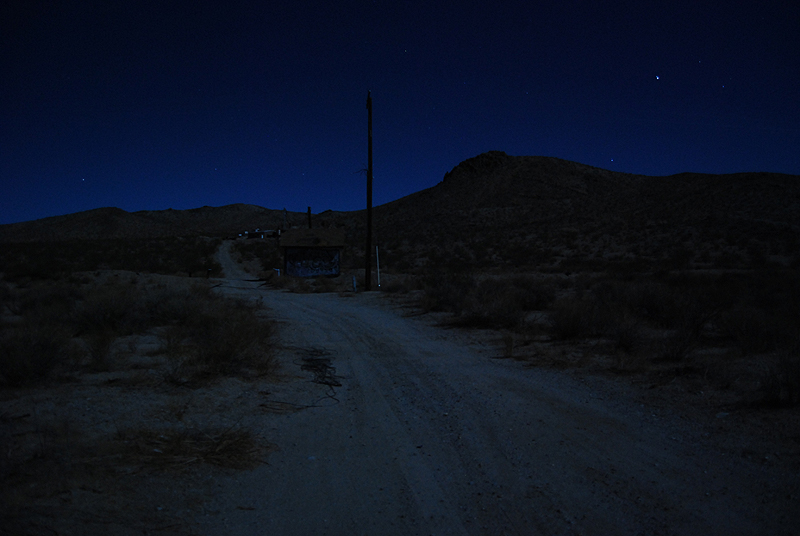
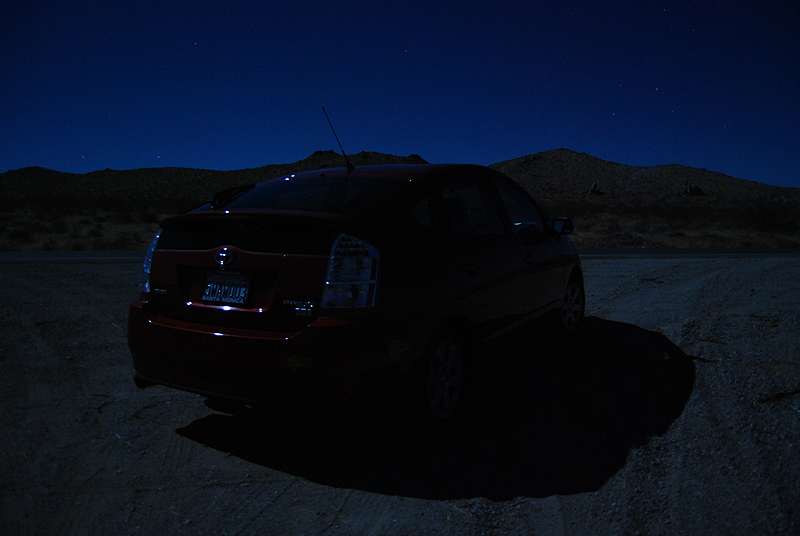
I took some photos, at 800 ASA, f/3.5, with a 4 second shutter speed, which is a bit more exposure than what I mentioned above:

moonlit1.jpg


moonlit2.jpg


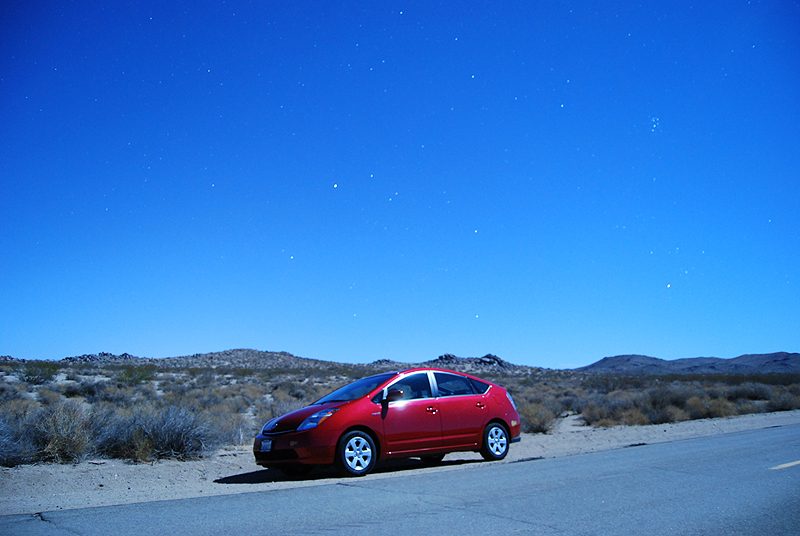
Just for fun, I took a photo of my car with a 30 second exposure:

moonlit3.jpg


Now one thing this experiments teaches me is that a night with a full moon is a bad time if you want to see stars -- normally the desert night sky is full of stars but the moon is too bright tonight to see many.

The photos also suggest that faked day-for-night is not so far off from the look of real moonlight in the desert...
 
Wow, thanks, David. Those photos really serve to illustrate the points you made earlier. I guess artificial light is something I probably I can't avoid in the case of this scene.

So, given how the scene reads, and given the fact that in reality two people lit by only the Milky Way (which is extremely dark in the first place, in order to even see the Milky Way in all its glory), what in your opinion would be my absolute minimum electrical light augmentation to keep this as realistic as possible? Maybe a gelled 1K or 2K raised high above them, plus a lot of moonlight? I'm trying to avoid needing a big gennie for this show. One of my big pet peeves is overlit night scenes. It's one of my only complaints about the cinematography in The Fountain, for example. The "jungle" scenes in the beginning of that movie appear way too overlit for me. Then again, as it's written, I've kind of boxed myself in. I'd be very interested to know how you might handle shooting this, if realism was your highest priority?

Also, your point about shooting stars in moonlight is one I've been learning for a while with timelapse. I've found that a 1/3 moon is the best, because it causes the sky to glow a beautiful blue, but also allows the stars to shine. If you watch the end of Baraka, Fricke lights a bunch of his star trail shots with what appears to me to be about a half moon. Then again, he shot that picture in 65mm, so maybe he had more dynamic range on his side. I use various tools, including weather.com's "sky simulator," to plan which nights the moon will be out at the right time, but also be in an ideal phase. What this usually comes out to is only a handful of days in any given month that are ideal, when both the moon's phase and the moonrise/set times sync up... and this doesn't even take into account the weather!
 
Great pictures David. Natrually lit scenes are close but the fact that you have to use 8000ASA...
 
I'd still be curious to see a test of something like ASA 1200 or 1500 at T/1.3 on the RED with a full moon overhead. Could you make out any moving shapes? Faces? Bodies? Anything?

We get RED 400 Nov 30th, so this is one test I'm thinking of trying.
 
Great point David, the truth is, night-for-day footage with blue filters does look startingly close to this at a fraction of the effort and pain. And that last 30 sec exposure is amazing, so well lit yet so obviously not daylight, what a uniquely different feel to it, amazing really...
 
The moon is a big single source in the sky, so what would be "realistic" is to light a moonlight scene with a big source, far away, that lights everything with an even level. Doesn't matter if it is an 18K HMI or a tweenie -- that only affects the light level you want to work at, which is based on the f-stop, camera speed, ASA rating, etc. you want to work at.

The problem of shooting against starlight is that it is so dim that you'll probably be at an unacceptable level of noise if you want to shoot at 24 fps (probably you'd do some trick like shoot at 6 fps with a 360 degree shutter to gain more exposure and have your actors barely move). Certainly any artificial light to balance with starlight would have to be incredibly dim. Whether or not it is a 1K, whatever, depends on how far away it is.

The truth is that real moonlight out in the desert looks "fake" to your eye, so if you replicate it with lighting, it will also look fake -- a big light all over everything, and not necessarily at a backlit angle. The moon can be dead overhead and produce a noon-type sunlight effect, just much dimmer. It can be front-lighting everything flatly. Just depends on the camera's relationship to the moon.

But if the moon is the only source in a scene, and you're not trying to balance its level with some other source (a match, a flashlight, etc.) then there is no reason why a smaller light would be more "realistic" than a big one -- if anything, a bigger light farther away would be more realistic than a smaller light closer.

Other problem you run into is when you shoot in the woods -- a big light far away may get so blocked-up by foilage that hardly anything reaches the ground. This is one reason why you often end up using multiple small lights like PAR's to punch through gaps in the canopy.
 
But David, keep in mind that the scene is actually supposed to take place under a milky-way-lit sky (super, super dark), so using a full moon would actually be "artificial" light. :) I would shoot the star background plate weeks away from the moon-lit actual scene in the woods with the actors.

So I guess the question is, if the moon is not bright enough, what would "realistically" mimic the type of light from the milky way? It would be extraordinarily dark if we wanted the audience to believe the two main characters could see their hands in front of the milky way stars.
 
Again, you run into some conceptual problems -- one is that it is near impossible to hike around by starlight, two is that you would not be able to read any expression on anyone's face by starlight, and three, you run into the problem again of screen brightness -- what would be "realistic" is for there to be a dim soft light on the ground that was four or five stops underexposed, but that would look like crap on a movie theater screen or TV screen due to light polution in the theater or living room. The audience would be more aware of the exits signs in the theater than what was going on the screen. And the problem is even worse for TV viewing where you aren't being surrounded by an incredibly dim but at least incredibly big image.

So the notion of "realism" is almost irrelevant here, most people don't have a frame of reference anyway for what real starlight on the ground looks like.

But considering that starlight is a soft source (if you'd even call it a source) then you'd want to either shoot it (1) overcast-for-night, (2) dusk-for-night, or (3) use a big lighting balloon or other soft bounce lighting unit at night. Or a mix -- dusk-for-night or overcast-for-night for your widest shots, and soft top lighting at night for your close-ups. I've created a soft night effect in the woods by stringing Chinese Lanterns in the treetops with daylight blue photofloods (daylight compact fluorescents might also work.)

I certainly wouldn't underexpose it more than by three stops if you want any signal to play with in post (I usually stick to a two-stop underexposure). It's always easy to make something another stop darker, but bringing up something too underexposed looks like crap.

The thing with really dark/dim scenes is that you have a basic problem of directing the viewer's eye to what is important (audio of course helps a lot). This requires fairly careful camera placement to build, shot by shot, a sequence where it feels dark... but the viewer isn't just looking at murk and wondering what's going on in the frame too often (now and then is fine). And you still get into the issue of whether you want the audience to see the actor's expressions or not.

And just like with shooting the moon or anything else in the sky, you have the split exposure problem of the fact that the ground is so much dimmer than the objects in the sky, since the sky is the source. So some sort of piecemeal approach is necessary to create the sequence, maybe dusk-for-night when looking at the ground, and post efx when looking up at the sky (or real night sky photography but undercranked, etc.)
 
As you can tell, I'm always somewhat cynical about notions of "reality" in filmmaking -- reality is sort of what you manage to convince a viewer is real, whether or not it is real. And for the most part, they are willing partners in being deceived. And when you get into things like night photography, notions of realism break down even further -- nighttime landscapes almost cry out for an impressionistic approach, being closer to the landscapes of dreams and nightmares.

I was talking to my gaffer on the last show about my theories of unreality in movies -- for example, in real life, most restuarants are lit to show off the architecture, not the people, and in real life, most people try to sit outside of the lights, not under them. And sometimes where they are under them, they are horribly lit by toppy spotlights. And there are horrible shadows and multiple shadows everywhere. Yet the needs of the story and the performance often mean directing the eye to see the action and the acting beyond what would be realistic. And often for aesthetic reasons, we "clean-up" the real lighting in a space to get rid of bad shadows, etc. and conversely, this often makes the space look more "naturally" lit!
 
Back
Top