Welcome to our community

Be a part of something great, join today!

  • Hey all, just changed over the backend after 15 years I figured time to give it a bit of an update, its probably gonna be a bit weird for most of you and i am sure there is a few bugs to work out but it should kinda work the same as before... hopefully :)

Ask David Mullen ANYTHING

I'd love to pack up and transport it to AZ.

I don't want to hi jack David's thread... but maybe. Just maybe.

So David, how 'bout that RED? You're very talented, well established, you know and love film - but you have shot HD for various reasons. Is RED now on the menu?
 
I haven't heard of the bending problem. The jibs will most likely be from mo-sys or General Lift.
It might be more on dolly shots that you might have that problem. I don't know too much about the different tracking methods + systems out there myself, but from what I've seen/heard... if the system does mechanical tracking (i.e. the angles between all the parts), it has to assume that the parts aren't bending. If the parts are bending then the tracking info will be off. (*I'm not 100% sure if this is true. Just the explanation that I heard.)

There are some other tracking systems and they have their own limitations.

2- You can also run into some greenscreen problems and limitations... where 95% of the shots have to be re-keyed. You have to deal with things like hair, reflections, motion blur, etc. etc. If you look at Lazytown, the stuff with high motion doesn't key 100% perfectly.

If you want to add shadows, then you'll have to key things in post of course. So for this type of work it can really pay off to have a VFX supervisor in pre-production (before props are made) and to do camera tests.

3- While this type of work has some shortcomings (and I am a little jaded because you can spend a lot of time fixing keys), there's also some advantages to shooting virtual sets.
- You get to shoot in a controlled studio environment.
- The sets can look really nice if you have good artists.

TV shows like Lazytown and feature films like 300 look pretty nifty.
 
David:
To pull this on topic a little more, I'm curious as to your opinion on virtual sets.

Do you feel that they are creatively less/more interesting?
 
As a DP, I'm not so interested in spending a lot of time shooting people against a greenscreen -- it's not really why I became a DP. As a filmgoer, heavy CGI movies like "300" or "Sin City" fascinate me because I have a graphic arts background in painting and drawing, but unless I decide to get into the post side of efx work creating these backgrounds myself, I see virtual reality movies as being more fun for the post guys than for the DP. I like being on location and using and manipulating natural light, or lighting sets to feel natural. I like environments.

I've been shooting a feature (Super-35 3-perf Arricam) for the past five weeks out in New Jersey, with two weeks to go, so I've been out of the loop on the RED developments other than what I've seen here. The footage looks fantastic, best digital cinematography I've seen except for the similar Dalsa footage I've seen, so I'm excited to get a chance to shoot with the RED camera.

I would say though, spending some time in a D.I. suite playing with my Super-35 images, that 35mm can look gorgeous -- what I've seen of the RED so far looks more like DSLR photography to me than the gentle 35mm Fuji Eterna negative I've been shooting for the past month; the RED stuff is very clean and sharp, vivid, which I love... but I'm also hoping to see some footage with a more romantic quality, less technical, more evocative.

But the clarity of the RED images excites me -- I would love to use it for a widescreen landscape movie in the style of the CinemaScope westerns or Cinerama travelogues with big sharp wide images on the big screen. Or conversely, a "Collateral" urban nightscape movie shot in ultra low light levels.
 
There are some other tracking systems and they have their own limitations.

You can also run into some greenscreen problems and limitations... where 95% of the shots have to be re-keyed.

If you want to add shadows, then you'll have to key things in post of course.

Due to construction red tape with my county government, I've had more time than I wanted studying tracking methods. It's my belief that mechanically tracked systems (like encoded jibs and camera heads) do a better job than systems using infrared beams etc.

I'll be compositing live through the Orad system and Ultimatte chromakeyers. We'll be able (I believe) to tweak the Ultimatte before we record the scene, then watch it live, to hopefully make sure we don't have keying problems.

This Orad virtual system is very sophisticated -- virtual shadows are added to the virtual objects (based on the real lighting). These virtual shadows then also fall on and bend on the real objects and people. It's pretty amazing. It's all live so we can be confident that it has worked before moving to the next scene.
 
I like being on location and using and manipulating natural light, or lighting sets to feel natural. I like environments.

I'm with you on that. My favorite thing is to be somewhere I'd otherwise have no connection with and drink in how the locals live, the scenery they look at etc. That's one reason I like movies -- I imagine what it would be like living there. Movies can also help me re-connect with places I've been before. That's one thing I loved about The Astronaut Farmer. Several years ago my travels took me to Las Vegas , New Mexico, where you shot a good portion of the film, and it was great to see it again.

I'm hoping I can keep some of the fun for the DP (and me), even on my greenscreen set-up. It would just be less time on location and with a smaller crew and less (or no) cast. For example, if a movie was set in Las Vegas NM, a small crew would go there to shoot all the movie's exteriors. This small crew would also shoot real background plates, to in effect insert the cast into New Mexico from the comfort of the studio in Florida.

Although the time and fun of being on location would be significantly shortened, there might be other advantages for the DP. For example, it would probably be impractical for the DP to take his wife and/or family to most location shoots. But with my plan, re-creating the location in my Florida studio, maybe the DP's family could come along for a vacation on the beach.
 
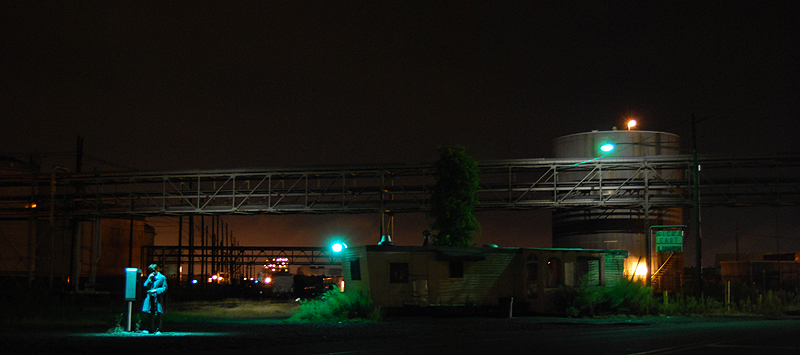
On the movie I'm shooting right now in New Jersey, I did a night exterior shot on Fuji Eterna 500T pushed one-stop (and rated at 640 ASA) with the new T/1.3 Zeiss Master Primes, shot wide-open. It was lit with just four 1K PAR's on a 40' Condor (plus I added a mercury-vapor practical to the abandoned diner we found), and those had scrims in them to get the level down to a T/1.3 so that I could capture the ambient streetlighting and glow in the horizon. This is a digital snapshot taken with my Nikon of the set-up:

night3.jpg


Now of course the 35mm version is a little grainier, but it also has more detail due to the wide dynamic range of Fuji Eterna. But it's an example of where a camera like the RED would come in handy -- I probably could have done the same shot on the RED with the normal T/2 lenses I was carrying, maybe even had lit to an even lower level and get more exposure from the real streetlamps.
 
Man, that still certainly looks interesting David! Do let us know (when you can) what movie that is...
 
Now of course the 35mm version is a little grainier, but it also has more detail due to the wide dynamic range of Fuji Eterna. But it's an example of where a camera like the RED would come in handy -- I probably could have done the same shot on the RED with the normal T/2 lenses I was carrying, maybe even had lit to an even lower level and get more exposure from the real streetlamps.

Very cool shot. If I'm understanding this the pars on the condor are lighting the phone booth (gelled?) and the sodium vapor light is the yellow pool of light on the right. Where are the pools of green light coming from? The street lights? If so, are they gelled? Seems like such a dramatic color. The streetlights in the distance are very warm.

You're right, this should be RED territory. At ISO 1600 what would RED look like. I'm hopeful that RED can pull off the romantic images you mentioned also. It's not ever going to look just like film, but it's sure going to allow for a lot of experimentation and instant feedback.
 
Hi David,

How do you like the Master Primes ? Obviously they are sharp and well corrected... but do they have a personality ? Any issues besides size and cost ?

Matt Uhry
www.mattuhry.com
 
The Master Primes may be the best lenses, technically, I've ever seen -- it's bizarre how you can't see any loss of resolution when you go to T/1.3. They are heavy, yes, though nothing like the anamorphic lenses I'm used to.

Personality-wise, it's the clear & crisp Zeiss look. Actually, my only point of reference are Panavision Primos, which I have been using for years, and the Zeiss Ultra Primes seem very similar to Primos, and the Master Primes just a bit crisper than either of those.
 
Nice work David, I only wish you had a RED in your hands now cause this one of those scenarios that many of us want to see how RED performs in. Well keep it up and look forward to hearing more about this picture.

Cheers.
 
Tim... our discussion is getting off-topic so check your private messages.

And this thread rocks by the way. Thanks to David for sharing his insight and experience.
 
David you should have a blog. It would definitely be one of the most popular blogs ever in this realm. I only ask because you mention stuff like "maybe when the rules of the forum change" etc... and I'm just thinking why is he waiting for some thread to arrive when he can have a blog that everyone and their mother would be visiting as much as they visit HDforindies...

The "ask David anything" thread is pretty much like a blog anyways..


-=-= *** What do y'all think of shooting Red in the way Jim described that would let you see the RAW debayer (I think it was some setting called Linear, but I will have to go back and look at Jim's post), and then just do an "old school" type of grade at the very end, like how Harris Savides shot Zodiac?
 
Not sure what you mean -- look at a 10-bit Log RGB image on set, debayered from RAW, and just get used to the low-con look until I color-correct the final project?

yeah i'm not sure if i would be able to stick to the savides/zodiac way of working because im sure i would want to use the power of RAW sometimes, but yeah, savides didnt digitally correct the green cast of the viper on zodiac, he talked about how the technical stuff was too much for him, and the only way he could make sense of everything was to just work with the "raw" image that came off the viper, so he would correct for the green cast with magenta filters on the lens of the camera instead, and as if he was shooting film, shoot to get it the way he wanted right there on the set, and then later they did a sort of mild, "standard" color grade, almost as if they were using printing lights instead of digital tools. i was really into this when i read about it, because i loved how, just like when harris shoots film, he kind of found the "organic center" of the viper, and took that as far as he could.. i forgot the other details of the article now, but he liked correcting with magenta filters in camera instead of digitally for other reasons too, one of them was that he got more information in a certain channel later, and it was "better" than if they corrected the green out digitally, again im fuzzy on it, but it was something like that.

anyways i was kind of into doing this with red, working with the "raw" look of the image that it naturally has, etc... but maybe staying in the raw format somehow, just putting a lut on it that is the equivilent of raw debayer, and then keeping the color correction simple later on...?
 
It's not really a "RAW" look you're talking about, but a "Log" look, the Log that emulates the standard 10-bit Cineon Log RGB file used for scanning and recording film in a digital intermediate.

Tom Sigel also operated his own camera on "Superman Returns" and got used to just looking at the 10-bit "Panalog" output of the Genesis without a LUT (the director's monitor got a viewing LUT.) I can see the appeal of that, though I'd be afraid of basing lighting decisions on an overly milky low-con image.
 
Smoking the set

Smoking the set

Hi David

Could you talk some about smoking the set? For instance, the pros and cons of smoke machines versus something like Fog in Can. Does smoking the set really eat up a lot of time and delay shooting? And what about the health aspects of breathing in all that atomized baby oil? Have you ever used actual smoke? (I’ve read about some home-made smoke boxes that burn sawdust and ground corn, etc to produce smoke effects on the set.)

What about smoking the set when shooting DV or HD. I’ve heard and read various reports saying it’s not as effective as when shooting film and not really worth the bother.

Thanks,

Shawn
 
You haze a set when you want that softer lower-contrast smoked look (like in a bar scene) and/or want to see shafts of light -- whether you shoot DV or film, doesn't matter. It works just as well in either.

The best are professional hazemakers, not fog machines -- hazers put out a diffused stream of smoke rather than big puffs that have to be wafted around.

The key to smoke is really to shoot in a sealed, draft-free set. Smoke always will move until it has filled a space evenly -- you can't smoke just part of a room or a hallway that connects to other hallways where there is a draft.

The time-consuming aspect is that you have to keep an eye on the level of smoke and keep adjusting it. If the room is particularly sealed and smalled, that's not too hard, but in other spaces, you have to worry about the level dropping even during the take.

Smoke machines use a heated chemical/water mixture -- I wouldn't burn anything to create real smoke because of the dangerous particulate matter it would create.
 
Back
Top