Welcome to our community

Be a part of something great, join today!

  • Hey all, just changed over the backend after 15 years I figured time to give it a bit of an update, its probably gonna be a bit weird for most of you and i am sure there is a few bugs to work out but it should kinda work the same as before... hopefully :)

Ask David Mullen ANYTHING

are you changing the angle of the light/sun or just the color temp? (being that they are pre-lit)

are you creating silhouettes and shadows to add to his time of day effect?

Just because the set is pre-lit doesn't mean you don't make adjustments (unless it is a very low-budget show with no time) -- in our case, the "sun" (20K's on a sliding truss) can be lowered up or down on chain motors, though I can't raise them high enough to get a near-noon angle because of the limitations of the stage height. But I can lower them all the way down to the floor of the stage (which we do to change gels on them). Most of the time, I just leave the camera at 3200K and do the adjustment to the color of the sunlight with gels or dimming (though a 50% dim is just like a 1/4 Orange gel effect.)

As for silhouettes and shadows, that's an exposure and mood issue that depends on the scene.
 
I've been reading your posts for years David and always learn a great deal from them. Thanks and The Marvelous Mrs Maisel is beautiful. Keep up the excellent work.
 
Hi David,

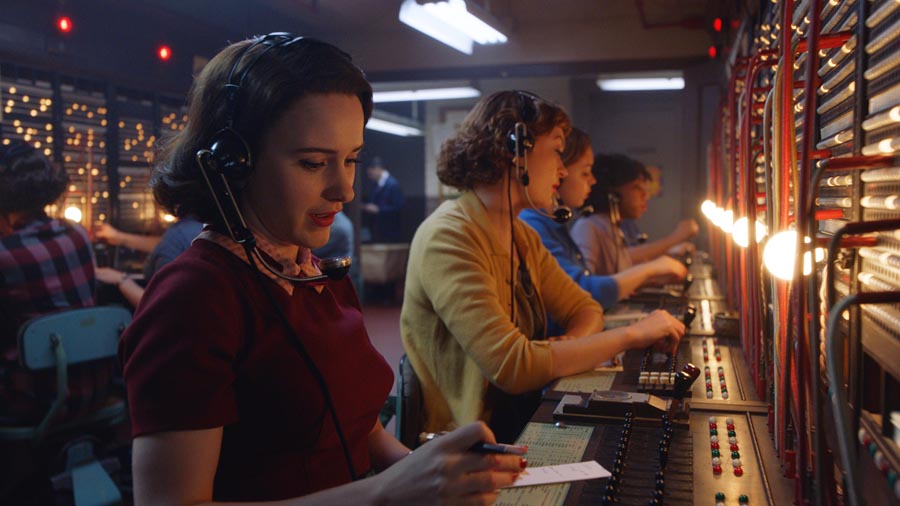
I was amazed with the opening shot of this season opener, the one in the operator room. With such a tight location, I couldn’t figure out how you got that. Then I stumbled on a video on twitter. It looked like a Movi on a boom on a steadicam. Is that something you go to often?

Do you stabilize in post to get the stedicam shots to “land” so quietly or is that the result of superb operators?

I really love the blocking and shot sequences as well as... well everything else. It’s great.
 
The counterweighted pole with the Movi and the Steadicam arm was something that Larry and Jim McConkey worked out, we call it the McConkey Wonder Stick on the set. We've only used it a few times in the past two seasons. Jim McConkey uses a Wave under the camera on his Steadicam rig that takes care of the horizon level issue, but in terms of landing so still and holding it, that's all Jim and his skill. And he does it take after take (we do a lot of one-shot scenes so it's a lot of work because of the number of takes...)

For VFX shots using the Steadicam where we will have to do morphing or match dissolves, etc. I will sometimes shoot a bit wider with the idea of cropping it in post so the effects people can stabilize and align elements better. So whereas we normally shoot on a 24mm Primo on the Steadicam, we use a 21mm for those shots. That opening showroom to switchboard room move was done on a 21mm.

We've found that the Movi is one of the smallest stabilized remote heads out there, so we use it on a jib arm or crane sometimes to squeeze through a tight space.
 
The Marvelous Mr. McConkey! Thanks for the response. You guys are fantastic. Thanks for the info.
 
Hi David,

In season one of The Marvelous Mrs. Maisel, had a jib to a Movi Pro move seen in this behind the scenes.

https://www.youtube.com/watch?v=A7Co2w9Uw8o

Do you know any thing about the mechanism that held the Movi to the jib? Was it a magnetic lock? Do you know if it's commercially available?

I want to do something like this on a music video with my Scarlet W and Movi Pro.

Thanks,
Jeff
 
That was an electro-magnet set-up created by Larry McConkey, so it is not off-the-shelf so to speak but I'm sure the parts are commercially available. The trick is not just the release of the magnet but also of a safety chain just before that and then someone counteracting the loss of weight as the Movi is disconnected from the crane arm, though it is nowhere as dramatic as a Steadicam operator stepping off a crane, which usually requires someone stepping on at the same time.

The hardest part really is hiding the little drop as the camera is disconnected and doing it all in one fluid motion. I think we did over ten takes of that shot, mainly because of that transitional moment but also then the criss-crossing of the background waiters timed with the dancers. This is one reason why often the director hires dancers as extras because if the timing is off, you end up doing take after take.

If your shot is more of a crane down and then travel, maybe a Steadicam or Movi operator on a crane platform doing step-off is better -- in our case, it was a fast pull-back on a 45' Moviebird telescoping crane right over some dancers' heads so we couldn't use a platform with a person on it.
 
Last edited:
Thanks for the behind the scenes on the behind the scenes. I did see the safety chain disconnect, I'll add that as well.

I have a small jib so I'll try using simple hooks instead of the magnet. I appreciate the tip about using dancers to time the shot. Looks like the jib and camera team need dance training as well.

--Jeff
 
Dear David,

I've just finished my first feature film shot for film school. Budget US$5K approx. Shot mostly on a 'battle tested' Red One.

Synopsis: Identical twin mathematicians investigate what Einstein called "The world's greatest mystery".

Inspired by Linklater's "Before Sunrise" films, Bergman and "My Dinner With Andre".

I appreciate how busy you must be but I would welcome any criticism or advice on even a minute of the film! Thank you

 
Hi David. I'm a Seattle based DP and have shot about 10 low budget features and have recently been reading "Directing Actors" by Judith Weston. It has a pretty good section about breaking down the script from a directors point of view. A lot of it seems like it would transfer over. What is your process in terms of breaking down a script beyond just the basics? Finding the key images that would illuminate the script seems to be key. Do you comb through the script looking for strong images? How much do you dig into the script and how much does the director drive?
 
Before I get too far down the rabbit hole, I talk to the director to get a sense of their vision for the project, even if it's just a few pointers or things they want to avoid. That narrows things down.

There is also a chance that the production designer has already been hired and there are reference photos and artwork that they have already come up with working with the director.

Otherwise, the process of breaking down the script always starts from the general to the specific, you have to figure out the big brushstrokes first. Visual rules have to be very simple in order to track day to day when shooting. Sidney Pollack used to develop his scripts around a simple concept, like "freedom versus possessions" in "Out of Africa", so every scene comments on that conflict in some way. This is why a shot of the crates of china being shipped on the train in the first scene is so important. When Coppola did "Apocalypse Now" and Storaro at first declined the job because he couldn't figure out how to shoot a war movie, Coppola told him that it was a story about civilization, not war, and to read "Heart of Darkness". From this, Storaro developed the visual plan for the movie, that it was a conflict between the West and the East, between artificial energies and natural energies, which is why the night scenes with the U.S. Army are lit with search lamps or lots of tungsten lamps, to make it feel like they are an intrusion on the natural light of the jungle.

I generally haven't come up with themes so big, but when I did "Astronaut Farmer", my visual plan was the juxtaposition of the Old West and the 1950's space age, with a heavy dose of Norman Rockwell.

When portraying some of the office spaces in "The Marvelous Mrs. Maisel", I refer to the look from 50's advertising as "industrial optimism" and use that as a guide.

Often I look at a story and notice that it is structured in two ways -- some are a journey from A to B, some are a journey back and forth between A and B. So I start out playing a mental game of extreme opposites -- wide-angle versus telephoto, moving versus static, warm versus cold, etc. -- just to get my ideas flowing. Usually these ideas are too crude and obvious at first but as you get more specific, you realize how quickly they get diluted so you have to start out with strong, simple ideas. Probably if you thought "everything in this scene will be blue", by the time you shoot, maybe 50% would be blue, which might be better... but if you had started out wanting 50% blue, you might end up with 25% blue.

So as I said, some stories develop from one look to another look, some juxtapose two looks against each other, and a few just have the same tone throughout. The story would be your guide. For example, look at horror films. Many move from Realism to Expressionism, everything seems normal, even mundane, at first and then things start to slide into horror and by the end, everything is stylized. But some horror movies just create a unique world right from the start ("Sleepy Hollow" for example, but even there, it moves into darker territory as the story unfolds.) Or look at "Seven", which has an overall grim and sad tone but certain sequences are heightened visually.

So with some overall visual arcs in mind, based on a feeling for the script, you start to look at individual scenes and finding ways of reinforcing your visual plan. It might mean something as making sure an interior dusk scene has a strong blue cast outside the windows versus a warm golden sunset -- the scene itself might just say "early evening" with no indication of what that means in terms of the color of the sky, just that it is a transition between a day and a night scene. You might even just look for ways of creating some visual interest through variation -- for example, if you have a series of tungsten-lit night interiors that will probably be warm and the characters go to a night club, you might decide to use strong blues and greens in the club lighting to contrast with the warmth of the other scenes, if that chance in tone helps with the story.

This is so great, thanks David.
 
Okay, I've got a question. Let's say Amazon came to you and was like, "Dave baby – great job but Jeff wants all his money to go into SpaceX, so we're cutting the Maisel budget. Your entire G&E kit needs to fit in a one-ton." Would you say no way? Or could you still shoot something decent with compromises? If so, what would you bring?
 
It’s a strange hypothetical if for some reason, the budget for sets, costumes, and NYC locations remained the same and yet they only wanted to shoot all of that with a tiny G&E package. Sure, I could make it look good — many scenes are already lit with minimal lights — but you wouldn’t have the occasional “big” scene like in a period nightclub set with a floorshow going on. You needs lots of lights for a set like that, so no experienced producer would put a cinematographer in the position where a big night club set is created but it’s expected to be lit by a couple of Litemats. So smaller budget means smaller sets, smaller scenes, etc. and I’d light them at the same quality as I did before. It’s just about scale.

The best-looking scenes in the show are not necessarily the ones that used the most lights, or the biggest lights.

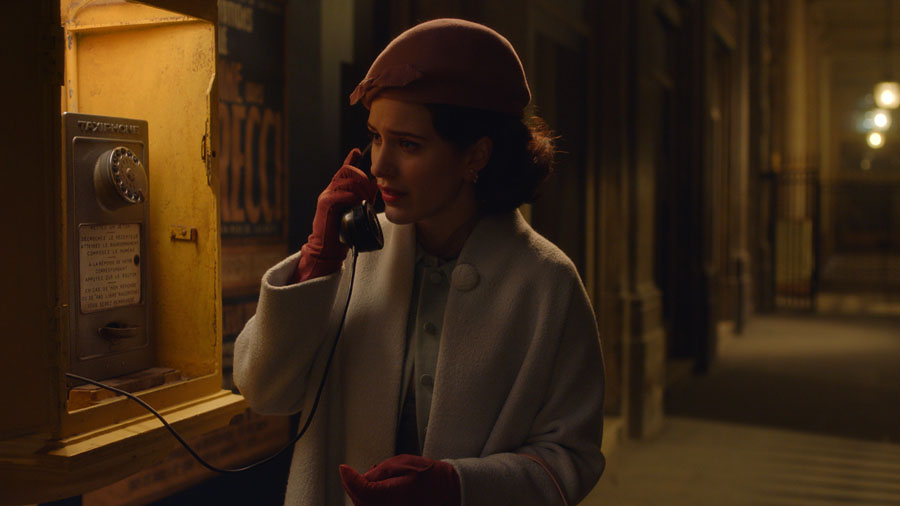
A shot like this, for example, is just lit with a small LED hidden in the phone booth, augmented by a 750w Source-4 Leko bounced into the wall next to the phone, plus a Litemat 1 under the lens for fill and another one armed out as a backlight, plus a small light in the background hitting the wall:
maisel6.jpg


And this one is just lit by the practicals in the shot:
maisel1.jpg


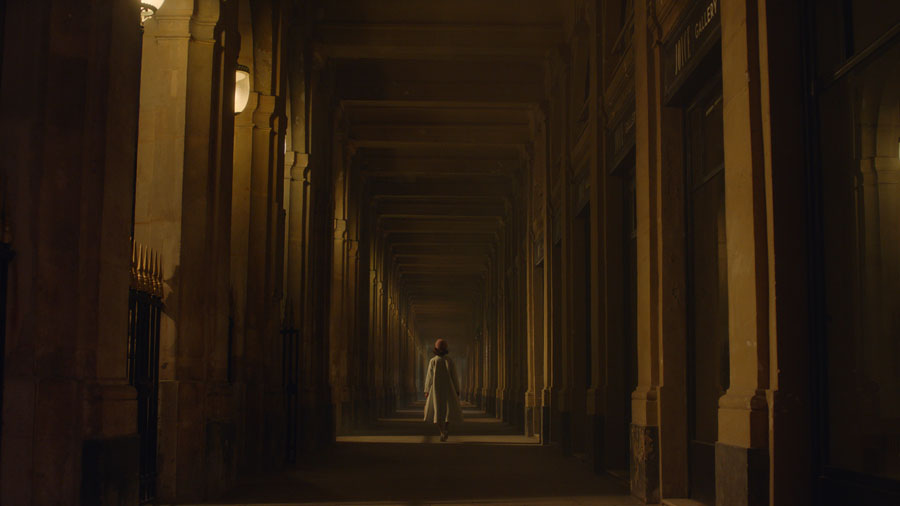
But this shot took a 2K coming through every fourth arch, so it ended up being over 20 lamps in a row. So that's hard to do on a much smaller budget. However, maybe I could have done it with 1K's coming through every fifth arch and stopping after 10, and pushing the camera to 1250 or 1600 ISO and shooting at a T/1.9 (I think I shot this at 1000 ISO at T/2.0-2.8 split.)
maisel7.jpg


But the thing is, we shot this at the Palais Royal in Paris -- so why spend the money to fly to Paris and shoot at this palace, and then tell the cinematographer that they only get a handful of small lights?
 
Last edited:
So smaller budget means smaller sets, smaller scenes, etc. and I’d light them at the same quality as I did before. It’s just about scale.

Sorry if it's a weird question! I guess I'm trying to figure out: on projects I get hired on, budgets allow for a sprinter or a one-ton and that's about it. So I'm trying to learn how to best use the resources I've got. On the last film I shot we only had a sprinter and it was almost all set in one house, so I didn't really feel like I was lacking in lights, but I know you would've made it look ten times better at the same budget, and also would've identified situations where more/different units would've helped. But it's hard to even articulate what questions to ask to learn how you would've done things better.

That makes sense though that it's just about scale. It's probably also about making lots of mistakes. But I want to know everything NOW, dammit :)

David, sorry if this has been asked, but im so curious what you use as key lighting for scenes in the Weisman’s apartment.

Not sure exactly what you're looking for, but did you see his answer on pg 580?
 
What I use for a key partly depends on how close the actors are to the windows where the lights outside might be doing a lot of the work, but when the actors are more in the middle of the room, most of the time I use a Litemat for the key, maybe through a diffusion frame. Sometimes I bounce a tungsten lamp, especially for a ceiling top light effect.
 
Back
Top