Welcome to our community

Be a part of something great, join today!

  • Hey all, just changed over the backend after 15 years I figured time to give it a bit of an update, its probably gonna be a bit weird for most of you and i am sure there is a few bugs to work out but it should kinda work the same as before... hopefully :)

Ask David Mullen ANYTHING

It looks like it's the shadow pattern maker that is moving, not the hard light behind it, so somehow they are moving that pattern maker very smoothly between the subject and the light, as close as possible to the subject for a sharp pattern. The light is very hard and probably far away as possible.
 
Hi David,
Love your recent work on "The Marvelous Mrs. Maisel"! You mentioned that you used Primos with 1/4 Hollywood Black Magic. Are there any other diffusion filters you used? And if you had to create this show without using Panavision lenses, what would be your lenses of choice and would you still go with Hollywood Black Magic? Thanks!


------------------
Chris Saul
Los Angeles
www.chrissaul.com
 
Thanks! 80% of the show or more uses the 1/4 Hollywood Black Magic. We sometimes have to drop to a 1/8 Hollywood Black Magic, like when doing wider shots in a smoked room (and if we go super wide, I might even drop further down to a 1/8 Black Frost.). Same goes for wide establishing shots.

After those filters, we sometimes have to use a Tiffen Black Diffusion/FX filter (1/2 or 1) instead because the Hollywood Black Magics are creating a distracting halation pattern around a bright light next to an actor's head (or a bright window right behind them.) Sometimes I've had to use a Tiffen Black ProMist / Schneider Black Frost filter instead. I did one foggy twilight shot with a 1/8 Fog filter. And for some flashbacks, I've added more Black Frost to the Hollywood Black Magics (which have a base of a 1/8 Black Frost.)

I've been thinking of trying the Radiant Softs instead of the Black Diffusion/FX for when I need to avoid the halation effect from the Hollywood Black Magics.

Yes, I'd use the same filters because they create the same halation effects on different lenses, it's just that some lenses might be a bit softer or sharper than the Primos, so that might affect when I switch to a 1/8, etc. Like I sometimes use the 1/8 Hollywood Black Magic on B-camera if it has a zoom lens on when the A-camera has a Primo prime on with the 1/4 Hollywood Black Magic.

I think Leicas probably feel the closest to Primos but I don't think the differences are huge between the major prime lens manufacturers.
 
Hi David,

We have an arriflex 235 3 perf camera. We are shooting with Hawk v lite 1.3 anamorphic lenses and trying to figure out our frame size. We have both 1.85, and 4 perf 2.40 ground glass. We shot some tests with the 2.40 ground glass thinking this would work best for our height as it has the same final aspect ratio. We noticed that we lost some of our head room in the final image and are wondering if you have any tips to help us moving forward.

Thank you,
 
The 2.40 area is the same size for 3-perf and 4-perf framed for 2.40 extraction, but 2.40 can be center extraction, common top, or 1/4-offset from common top.

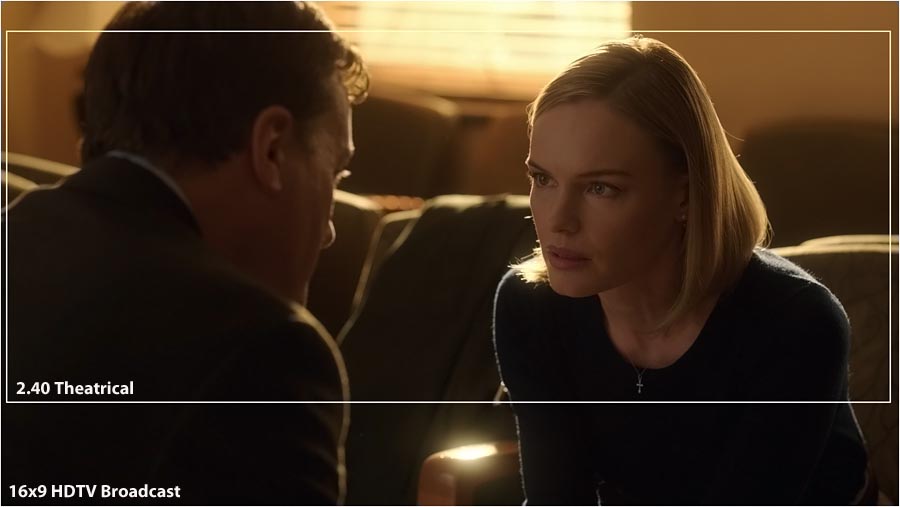
I did a movie on the Alexa and recorded 2K 16:9 with a 1/4-offset 2.40 frame -- ARRR makes a 3-perf GG with the same (I've done a number of 35mm movies this way -- used to be called the Fincher GroundGlass because Panavision developed it for "Panic Room" for Fincher when he started shooting 3-perf.)

90M_framing.jpg


The reason why I like the 1/4-offset is that the headroom is similar between the 2.30 letterbox / theatrical frame and the 16x9 HD full-frame version. Trouble with common top is that you have no flexibility to adjusting headroom in post, plus with film, your top edge of the frame is the top edge of the gate, so any hairs along that edge are immediately in the picture.
 
Last edited:
Sorry, I see you said you were using 1.3X anamorphic lenses. A 2.40 Super-35 GG wouldn't work then because it would be cropping the (unsqueezed) image.

An anamorphic ground glass has frame lines for the unsqueezed optical image, it's the viewfinder optics that then needs to unsqueeze the image of the ground glass if you don't want to operate while looking at a skinny image.

A 1.85 ground glass would be more accurate because the image would have a 1.3X optical squeeze and once unsqueezed, it would become 2.40 : 1. But a standard 1.85 4-perf GG inside a camera optically centered for Super/full-aperture 3-perf would be a bit inaccurate. You need a 1.85 GG centered for Super/full aperture.
 
Last edited:
David,

We have both the 3 and 4 perf movements for the camera, with the 3 perf currently installed. With 1.85 3 perf ground glass and 2.40 4 perf ground glass. Yes, we are shooting on 1.3X anamorphic lenses with 3 perf. So the 1.85 ground glass would be our best option? We would be able to see our entire frame we are shooting, but without the squeeze? If we used the 1.85 ground glass and unsqueezed with the viewfinder optics would this be the correct height? Or is this basing it off of 4 perf? We are using a trans video rainbow ii as onboard and tv logic 056 wp for pulling focus. Thanks so much for the help, we are having a hard time figuring out the best way to get as close to our finished framing as possible while shooting.
 
Yes, 1.85 3-perf would be the right area for 1.3X anamorphic to yield a 2.40 : 1 image once unsqueezed (1.85 X 1.3 = 2.405). Since 3-perf is slightly taller than 1.85, you'd have a little extra image to play with / crop out vertically in post (full aperture 3-perf is about 1.79 : 1, so with a 1.3X squeeze, your image would be 2.33 : 1).

Hawk makes a 1.3X anamorphic viewfinder for Arris, see:
https://www.vantagefilm.com/file/edee/downloads/hawk/vf-hawk-lens-table-1-3x.pdf

I'd contact them for advice on the video tap display issues.

Shoot a 2.40 framing chart with the 1.3X lens on and see how close it lines up with the 1.85 frame lines. You'll want a framing chart anyway for post.
 
Holy cow David, Maisel season 2 is amazeballs. Having also watched Gilmore Girls, I get the sense that you captured it straight out of Amy Sherman-Palladino's head! It's got all the charm of a Technicolor musical, and every shot is gorgeous, but not a single one distractingly so.

I'd love to better understand your thought process when lighting a show like this. I know this is sort of an open-ended question, but I'm not sure how to be more specific. Take a common location, like the Wiseman house, or the cramped quarters of Susie's apartment – do you have a go-to set of fixtures you like to use (like Phantom Thread seemed to be heavily lit with litemats), or is it like, an 18k for one shot, and a skypanel and a leko for another? Any chance of seeing any lighting diagrams?
 
I'd love to better understand your thought process when lighting a show like this. I know this is sort of an open-ended question, but I'm not sure how to be more specific. Take a common location, like the Wiseman house, or the cramped quarters of Susie's apartment – do you have a go-to set of fixtures you like to use (like Phantom Thread seemed to be heavily lit with litemats), or is it like, an 18k for one shot, and a skypanel and a leko for another? Any chance of seeing any lighting diagrams?

Thanks!

I don't do lighting diagrams (no time!) other than rough sketches for a new set or a big location, and those get thrown away at some point.

The Weissman Apartment set is ringed by a long Skypanel above each window to provide the soft skylight spilling down, and further away on a rail above, some 20K's that can be moved around for hard sunlight effects. The backing is lit with Skypans below. We also have a small lift that we can drive around outside each window (the set is elevated).

The interiors have hard ceilings and lots of practicals so are treated most of the time like a location, though I can pop out part of the ceiling if I need to for rigging.

I use a mix of techniques. Most of the time, I use Litemats, our one big Litemat 8 or a couple of our Litemat 4L Pluses, sometimes through a 8'x8' or 6'x6' Light Grid. We also have a square Litemat 2 and some 2L's. And I often use a Litemat 1 under the lens for an eyelight.

Sometimes when the den is in the background of the kitchen and I need a big soft light spilling in from the living room, I use a Skypanel through a T-bone rigged 8'x8' or 6'x6' Light Grid.

I also sometimes do a Source-4 or tweenie ceiling bounce. Or a hard slash of sunlight with a Source-4 or a Parcan. We also have some tungsten "Spider lights", a cluster of bulbs with a long skinny Chimera bag in front. I use those more in the Gaslight Cafe set since I mainly want to mix tungsten with tungsten there -- the ceiling is all rigged with black 1K fresnels and a few Parcans. Everything is dimmed to about 50% in there.

A lot of the lighting is dictated by the camera moves, which are quite complex sometimes. I ended up with a soft top light over the actors just because that's the only way to key them during a 360 degree camera move.

Susie's tiny apartment is mostly lit through the windows for day scenes, sometimes with spot Parcans for each little window, then a small Litemat inside if I can fit / hide it.

I like to play with color temperature a lot, looking for chances to create a late afternoon effect with warm sunlight and cold skylight, or blue twilight, etc.
 
A lot of the lighting is dictated by the camera moves, which are quite complex sometimes.

Understatement of the year. That ep 1 phone bank opening shot is crazy! I bet the actors had a lot of fun with it.

I like to play with color temperature a lot, looking for chances to create a late afternoon effect with warm sunlight and cold skylight, or blue twilight, etc.

I actually noticed this in a later episode, where Abe's in the apartment talking to Midge about something (maybe Ben?) and you're raking him with a warm sunset light. I thought, man, that is a beautiful lighting decision.

Thanks so much. That's so incredibly helpful!
 
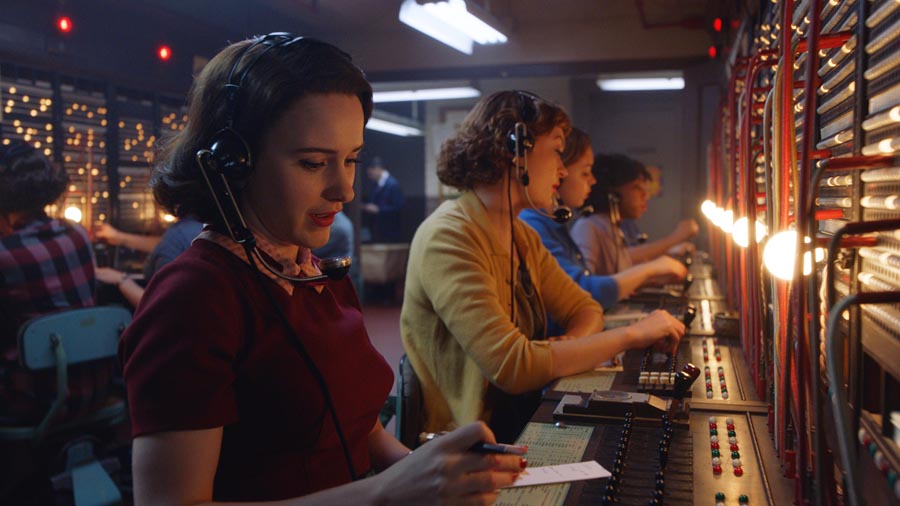
I had to ask the art department for some small tungsten practicals in the switchboard wall because otherwise there would be no light in their eyes. They put a row of small lightbulbs along the wall, which were dimmed down to about 50%, and overhead I had a fluorescent practical with Cool White bulbs that I added 1/4 Blue to (and ND.3). Since the switchboard was a historical prop, it was tricky to rig anything to it since we couldn't use screws. I had to switch from our normal 1/4 Hollywood Black Magic to a 1 Black Diffusion/FX filter because the bulbs were creating a distracting halo ring with the HBM filter.

maisel1.jpg


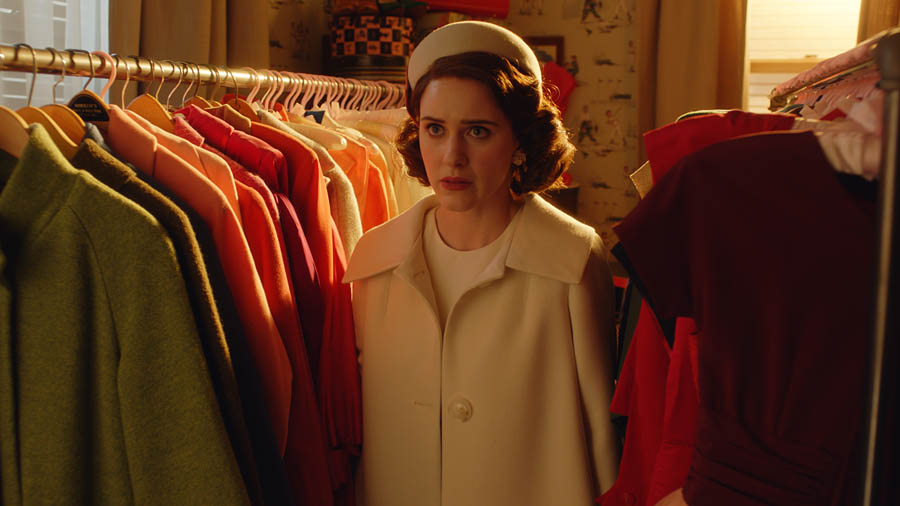
That Steadicam shot that moves down the hallway from the foyer to the rear bedroom/closet was lit with Full Orange as the sun and 1/4 Blue for the opposite windows. Once we got into the bedroom, I had a 10K with Full Orange coming in as a backlight, 1/4 Blue from the other window, and the face was lit with a very dimmed-down Litemat 2 hidden in the clothing rack. This shot used our normal 1/4 Hollywood Black Magic.

maisel2.jpg

David I love these posts so much. Can't tell you how much they mean to me. it's so great to get an up an close view of how you work.

Quick question, and apologies if you've answered this before, but what lenses are you using on the show?

Are they vintage or modern? And does your choice of lens type (say older Super Speeds vs contrastier Master Primes) affect the strength of diffusion you'd use?

Thanks so much.
 
I had to ask the art department for some small tungsten practicals in the switchboard wall because otherwise there would be no light in their eyes.

Haha, I suspected those lights were your doing!

That Steadicam shot that moves down the hallway from the foyer to the rear bedroom/closet was lit with Full Orange...

Yes, that's exactly the scene I was talking about! Really great way to support the story.
 
Quick question, and apologies if you've answered this before, but what lenses are you using on the show?

Are they vintage or modern? And does your choice of lens type (say older Super Speeds vs contrastier Master Primes) affect the strength of diffusion you'd use?

Thanks so much.

We shoot on Primos. Since when I did the pilot, I was told that they didn't want any sort of faded period look, I didn't bring up old lenses and the P-Vintage / Ultra Speeds are in high demand / short supply anyway, it wasn't an option on the pilot. Yes, I might have had to back down on the diffusion level if the lenses were softer. Because of the camera moves, I often move past a bright window or hot practical in the middle of a sweep, so I'd be wary of only carrying lenses that were prone to flaring. If I could carry two sets, old and new, then maybe but that's not really in our budget.
 
Yes, that's exactly the scene I was talking about! Really great way to support the story.

When breaking down a script, I always look at when a story day moves from daytime to night and whether then the day scene should or could be played for late afternoon, sunset, or dusk. When I first started shooting television, where half the sets are standing and pre-lit to some extent, I noticed a lot of TV shows just had a day and a night look. I tried then and now to bring in other flavors, like overcast versus sunny, time of day, etc. Sometimes you get screwed because some TV shows really mix around the scenes in editing. The worst for me was in an episode of a show several years ago where the whole plot was that the characters had two days to put on a show, but in the middle of the night scenes, the editor put one of the day scenes (two people eating lunch with bright day windows behind them), thus creating a third day.
 
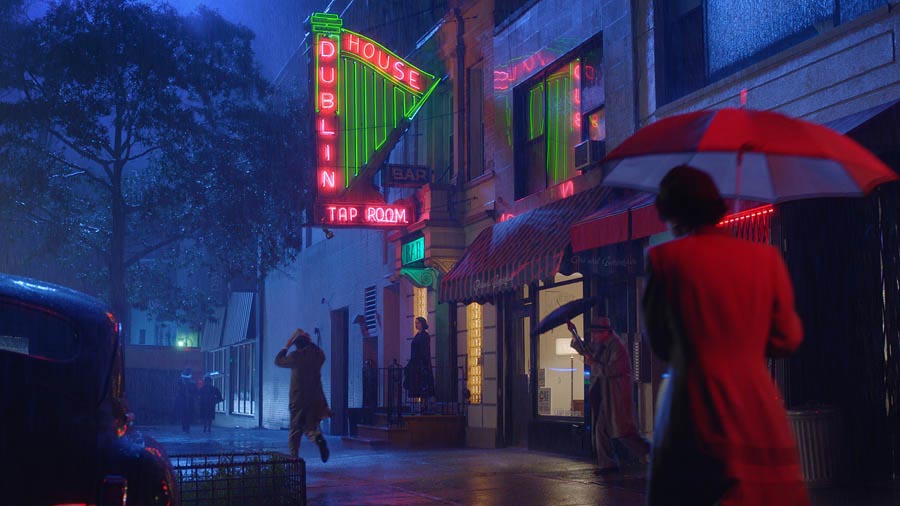
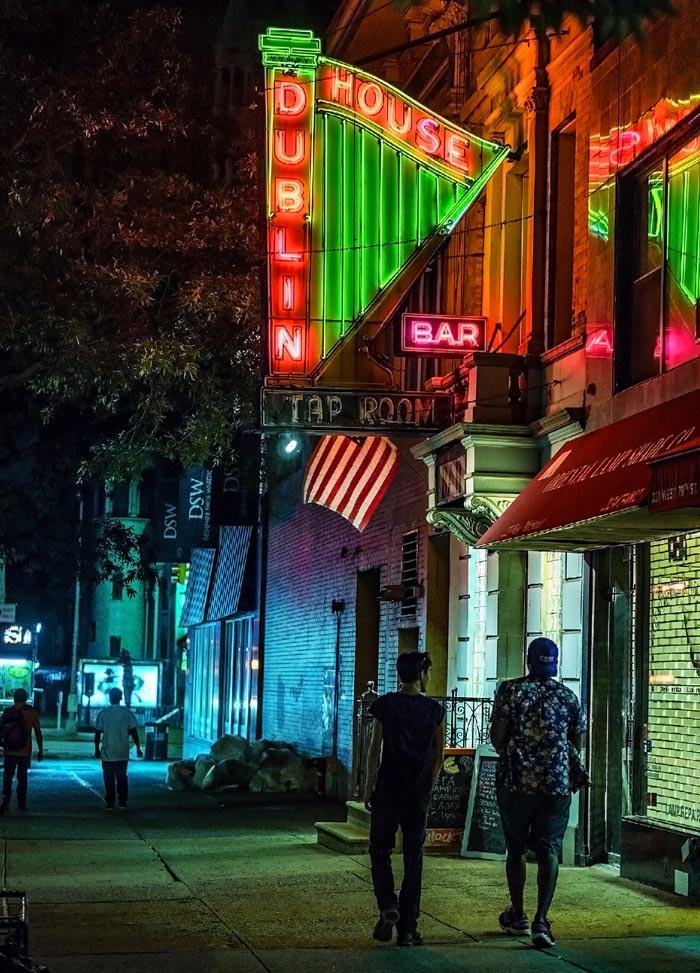
Another example of looking for opportunities to add color -- I had taken a photo of this old bar in the Upper West Side after work one night and the sidewalk was backlit blue by an advertisement sign down the block. The director asked me if I could replicate the mixed colors of the street if we shot a scene there. Since it was a rain scene, I needed a backlight overall so I ended up putting six Skypanels in a grid frame on a condor, and we picked a deep blue color for the Skypanels, which did most of the lighting. I added some orange-gelled fluorescent tubes in the glass bricks of the bar and a green-gelled fluorescent tube in the roof of the alcove. We had to park a period truck at the end of the block to hide the modern traffic (Broadway) but you can see a mercury-vapor streetlamp over the truck that a church had across Broadway.

maisel5.jpg


This is the photo I took on my off-hours after work one night:
maisel4.jpg
 
Last edited:
When breaking down a script, I always look at when a story day moves from daytime to night and whether then the day scene should or could be played for late afternoon, sunset, or dusk. When I first started shooting television, where half the sets are standing and pre-lit to some extent, I noticed a lot of TV shows just had a day and a night look. I tried then and now to bring in other flavors, like overcast versus sunny, time of day, etc. Sometimes you get screwed because some TV shows really mix around the scenes in editing. The worst for me was in an episode of a show several years ago where the whole plot was that the characters had two days to put on a show, but in the middle of the night scenes, the editor put one of the day scenes (two people eating lunch with bright day windows behind them), thus creating a third day.

are you changing the angle of the light/sun or just the color temp? (being that they are pre-lit)

are you creating silhouettes and shadows to add to his time of day effect?
 
Back
Top