Welcome to our community

Be a part of something great, join today!

  • Hey all, just changed over the backend after 15 years I figured time to give it a bit of an update, its probably gonna be a bit weird for most of you and i am sure there is a few bugs to work out but it should kinda work the same as before... hopefully :)

Ask David Mullen ANYTHING

I'm afraid the answer is that you either have to stop down a little and live with the hard sun as part of the look... or drive in a different direction so that the sun is more coming from behind.

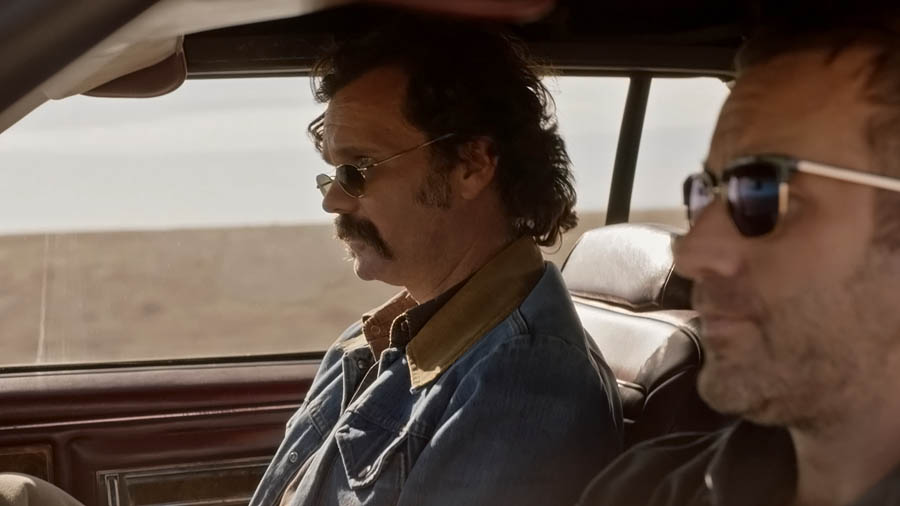
Here's a car scene I did in the TV show "Get Shorty" with a hostess tray mount and available light:
getshorty1.jpg


When we did the reverse angle we just drove with the same backlit background, but at times the road curved around and the sun came around more frontally, which didn't look great but it was acceptable -- it's realistic after all as long as you don't have clipping problems.
 
Thanks, I shot the pilot of "The Marvelous Mrs. Maisel" and three more of the episodes along with DP Eric Moynier.

Alexa Mini with Panavision Primo lenses, 1/4 Schneider Hollywood Black Magic diffusion most of the time. Recorded 3.2K ProRes 4444 Log-C for a UHD / HDR finish at Light Iron NYC.
 
Thanks, I shot the pilot of "The Marvelous Mrs. Maisel" and three more of the episodes along with DP Eric Moynier.

Alexa Mini with Panavision Primo lenses, 1/4 Schneider Hollywood Black Magic diffusion most of the time. Recorded 3.2K ProRes 4444 Log-C for a UHD / HDR finish at Light Iron NYC.

Fantastic, thanks so much. Looks lovely.
 
The show looks fantastic and really captures a certain optimistic spirit from that time. The look is great but what I really like are the long, well blocked shots They are so well done. Kudos to the operators. Can you share how those shots are designed and executed and the challenges they pose? Is it all steadicam? Do you use stabilization in post to nail the landings or do you employ a crab dolly on a dance floor? I really love this style of camera movement. It seems modern but with a classic lyrical feel.
 
It's mostly very good Steadicam operating by Jim McConkey on the series and Maseo Bishop on the pilot. Jim uses some extra device under the camera body ("Wave"?) that keeps the horizon level as he turns corners, etc. Adds some weight of course. On the pilot, we either used the 21mm or 27mm Primo for those shots but we found a rare 24mm Primo for the series that became our hero lens for Steadicam work.

Amy Sherman-Palladino has been designing complex moving camera shots ever since "The Gilmore Girls"; she wants to play many scenes with as minimal coverage as necessary but she wants a lot of energy so there is a lot of movement of actors and camera often from room to room. My challenge of course is lighting those moves without getting camera shadows or without seeing any lighting units. Sometimes I hide Litemats or Sourcemaker Blanket Lights in the ceiling, otherwise I rely a lot on practicals dressed in the set.

We've also done some elaborate Technocrane shots and once attached a Movi with a magnet to a telescoping arm in order to first fly over the heads of a crowd and then turn it into a shot that moves through a room and out a door into another room.
 
Thanks for the reply, David. That is some stellar steadicam operating. Wow. Thanks for the details on lighting and lenses. I’m looking forward to going back to watch the series again to study those shots. You mentioned placing Litemats in the ceiling. Are those Upper West Side apartments locations?
 
The apartments were real locations on the pilot and then recreated for the series, but we generally don't pull ceilings or walls when we shoot (plus most of the walls are double-sided so aren't easy to move.) But at least with the sets I can screw in a mounting device into the ceiling rather than use wall spreaders.

For the pilot, we rigged 4'x4' Sourcemaker LED Blanket Lights with Light Control soft grids, one over the center of the living room, and two side by side for the foyer, and the kitchen, using wall spreaders.
 
Last edited:
David, your work in Mrs. Masiel looks amazing. I just got one of the LG OLEDs and the show looks phenomenal on it in 4K HDR.

I have to ask how you did one of the shots though. Episode 4 about 2 mins into the episode, there's a steadicam shot that circles around Miriam and transitions from a flashback of a New Years Eve party to her now empty apartment. First I thought motion control, but it's such a long shot. So maybe Steadicam? I can't see where the cut is...did she just stare at the fireplace in both versions and they morphed the two steadicam shots with VFX?
 
It would have made life easier for the visual effects team if it had been motion control, but because it's sort of a figure 9 move and then pull away, there's no way to move on track for that so it was done on a Steadicam, using overlay playback to match the second move as much as possible to the first. I framed everything for a 10% crop to give post more room for reframing to line up the two shots. Some morphing and replacing elements had to be done to make the transition seamless and we made sure that her two outfits were similar in design.
 
David, thank you for your generosity to share knowledge and support this thread for so many years.

Have you had the opportunity to try the Angenieux EZ-2 and EZ-1 zooms configured for S35? If so, how do they compare to Angenieux's Style or DP lines?
 
Hi David,

Just finished binge-watching Mrs Maisel,
I love what you did and the decisions you made that kept it both retro and modern at the same time.
Excellent work !

Matt Uhry
Dir / Camera
www.mattuhry.com
 
cars

cars

hi david,

one more question about car stuff:

when dealing with the reflection of the sky in the windshield... unless you're in full shade from trees, it seems like quite the problem. a polarizer seems to only partially take care of it. that is, if you want to get rid of it so that you can see the actor/actresses face due to the story. so this is in assumption that their face being obscured hinders the story and doesn't help. so is the only other option to have a rigged light to just light the actor's face in general so that it can fight the exposure of the sky?

also, i'm just curious on a scout or on the day (whenever you are deciding on shots with the director); how much are you trying to push the director to adjust to something that's easier for you? like say carrying in an actor from outside to inside (and thus you have to expose the entire interior to the exposure of the outside... so that the exterior isn't blown out). because this will obviously cost more money and time to light it this way. so at what point do you combat this... or is it too risky to do this with a new director because you don't want to be known as a DP who "can't" do something. and so then you just end up keeping quite and saying yes to the director's shot... and then fighting with the producer or upm about more lights and crew in order to make it happen..

thanks,
- dw
 
You can either add some light to help the face compete with the bright reflections, or you can rig a black solid over the windshield to cut all the reflections of the sky. Pick your poison...

In terms of a director asking for complicated shots, first there is the question of editing, will the difficult shot make it into the final cut without being chopped up -- if you and the director agree that the shot will be broken up in editing, then there is an argument for breaking it up when shooting if that makes it easier and faster to shoot. But the other issue is just time, you just have to be honest and accurate with your time estimates about how long the complex shot will take and let the director decide if that is worth possibly losing some other shots later in the day. And if the director wants something and the producer doesn't, then you have to remind the producer that this is between the two of them to work out. Sure, you can go back to the director and offer some cheaper alternatives at the behest of the producer but if the director refuses and then the producer refuses, then again, that's between the two of them to work out. All you can do is inform both of them what is required to achieve the shot that the director wants. But be prepared to offer alternatives that you think are viable and good options.
 
David,

I'm shooting a film that involves 2 elements I've never quite dealt with before and figured I'd check with you to see if you've had dealings with these sort of challenges. 1) We're shooting scenes that involve a webcam where we may intercut between Alexa and something that is designed to feel like a separate format. I'm considering testing a DSLR, GoPro, and even an actual webcam, but was curious your experiences. 2) We're shooting scenes where the lead interacts with a computer screen to gain information and we're debating shooting practically and using VFX over a blank screen. What have you found helpful in these situations? Thanks so much for your constant support and advice, it's so helpful and appreciated.
 
I did a TV series with some webcam scenes and I used my own Sony NEX6 with a wide-angle lens to shoot them. Usually that video was rephotographed off of a monitor in a scene so that really was the way it was "filtered". I wouldn't use a large sensor camera for webcam footage since it's usually deep-focus due to the small sensor. If you needed something good enough to color-correct and/or add visual effects, you might consider a camera that records 10-bit instead of 8-bit, such as a GH5 or BlackMagic.
 
My questions to you are as follows:

(1) Has there been any recent innovations in HFR and ultra-HFR video of frame rates above 120fps outside the laboratory, played realtime, not slomo?
e.g. Presentation of true-240fps video (non-slomo) on now currently-shipping true-240Hz eSports gaming monitors (more than one dozen models are now on the market).

(2) Are there any pre-existing articles in the HFR community, that accurately explain in a simple way?
e.g. How source persistence (camera shutter) & destination persistence (display persistence) interact to create, a final human perceived display motion blur.


More context: http://www.reduser.net/forum/showth...ave-witnessed-realtime-1000fps-on-real-1000Hz

Cheers,
Mark Rejhon
Founder, BlurBusters.com
 
Last edited:
You seem to already know more on the subject than me!

All I recall are the old tests that Douglas Trumbull did for his Showscan process. He felt that at really high frame rates, over 100, the ability for the audience to perceive a difference was too small to offset the practical issues of shooting and projecting at those rates.

Keep in mind that 1000 fps is over a 5-stop exposure loss compared to 24 fps, though you can gain one-stop by not using a shutter at those rates. But even if it's just a 4-stop loss, your 800 ASA camera just became a 50 ASA camera.

At those high rates, the screen becomes essentially flicker less and seems like a clear window, assuming there is sufficient resolution. But I also think you run into a variant of the uncanny valley phenomenon when shooting narrative fiction -- the more "real" the process becomes, the more artificial the techniques of moviemaking appear -- costumes, lighting, make-up, etc. Which is one reason why this sort of approach works better in nature documentaries, for example, because everything in front of the camera IS real.
 
Thank you!
I am trying to research the state of HFR in the "ultra high framerate" sphere; there is little on realtime HFR above 120fps.

All I recall are the old tests that Douglas Trumbull did for his Showscan process. He felt that at really high frame rates, over 100, the ability for the audience to perceive a difference was too small to offset the practical issues of shooting and projecting at those rates.
From what I am (faintly) aware of the old tests of Douglas, he was unable to push the frame rates on an exponential curve necessary to make it worthwhile.

What we discovered is you have to double in order to have a really noticeable effect.
e.g. 120fps -> 240fps -> 480fps -> 960fps

Basically, these steps halve motion blur. The diminishing points of returns continue, but doesn't quite stop, because it is equivalent to display motion blur of:
1/120sec blur -> 1/240sec blur -> 1/480sec blur -> 1/960sec blur

With experimential ultrahigh-refreshrate headroom now available for scientists/researchers/experimenters to experiment with, it has been observed that display persistence (refresh cycle length, for sample-and-hold displays) has the same behaviour as camera shutter speed. 480fps@480Hz on a flickerless display (like a 360-degree shutter), has exactly the same display motion blur, as a photograph taken with a 1/480sec shutter speed, for the same equivalent physical angular motionspeed for the display plane relative to the human eye.

Which is indeed noticeable. The jump from 120fps HFR->1000fps HFR is roughly as noticeable as the jump from 60fps HFR ->120fps HFR Yes, it's a much, much bigger jump that becomes mandatory to punch the diminishing points of return curve -- but we're comparing 1/60 versus 1/120 versus 1/1000 which is 16.67ms versus 8.33ms versus 1.0ms -- that's nearly the same apart (8.3ms delta versus 7.3ms delta). But it clearly outlines that overlooked "diminishing points of returns" headroom, you need a massively ginormous jump up in frame rates to be really noticeable. But it's quite useful for VR and Holodecks to try to achieve near-zero-persistence -- something 120fps HFR can't even do without strobing or blur side effects, for the aboveformentioned reasons.

Today, it's more pratical to just (about) experiment -- current off-the-shelf DLP chips can be attached to a custom firmware to actually display a monochrome image at a true-1000Hz refresh rate, thanks to the DMD's ultrarapid pixel switching speed. Several scientific suppliers now sell 500Hz and 1440Hz DLP projectors (albiet at often 5 figure prices) -- e.g. ViewPixx. My prediction is that ultrahigh refresh rates will eventually be a minor cost-add within 20 years to future displays. But right now I'm researching the source-side of the equation.

4K is cheap now, tomorrow, 1000Hz may be too.

Keep in mind that 1000 fps is over a 5-stop exposure loss compared to 24 fps, though you can gain one-stop by not using a shutter at those rates. But even if it's just a 4-stop loss, your 800 ASA camera just became a 50 ASA camera.
I'm certainly aware! Past high speed cameras need to utilize a ton of light.

Several private brainstorms have privately been discussed amongst us about what will be needed in 20 years from now, to try to film for a VR or Holodeck environment in much more truer manner:
-- One theoretical camera being imagined, is a photon camera. After you recorded the video (essentially timecoded photons), you can play back the video file at any frame rate you want, whether 37fps or 24fps or 1000fps. Post-processing would allow full-brightness at low framerates to be multiplexed with the temporal resolution of ultrahigh framerates
-- One can convert a 1000fps video into a much-brighter 25fps video simply by stacking 40 frames into 1 each. It's still the same number of photons, so with a proper sensor & proper tech, with a good high-efficiency sensor, this can in theory work as perfectly in brightening 1000fps videos to the same brightness as a 25fps video. But when objects move, denoising algorithms are REALLY bad. However, natural learning has shown some shocking improvements -- artificial intelligence denoising algorithms can in theory re-brighten 1000fps videos, while keeping temporal artifacts at bay. Artificial-intelligence denoising algorithms would solve the problem of denoising artifacts.

I saw some really good artificial-intelligence scalers at CES 2018 that actually converted 1080p into 4K and 8K material in a really fantastic way -- it was as if it knew that blurry house and windows and tree leaves were actually the real thing, and artistically (in realtime!) put in real sharp wood, real sharp leaves, etc, creating detail whereas there wasn't before. In 20 years from now, AI algorithms can probably realtime convert a VHS videotape into a retina-sharp Holodeck environment, by automatically recognizing objects and using its own library of 3D objects and material, to replace the blurry stuff with the real thing. Pretty much a supercomputerful of realtime processing.

Some of us have commented, that the the exact same kind of process, could be used to apply AI-based denoising/deblurring to framestacked-brightened 960fps videos (which could theoretically also output 480fps, 240fps, 120fps, 60fps, 24fps, as divisors of 960 -- and these multiple source files of multiple different brightnesses (lower framerate being brighter and lower noise) by the AI algorithm -- to successfully ultra-brighten 960fps video without the darkness and noise.)

Back in 1930s and 1940s, you really needed bright light to expose color film even at just a mere 24 frames per second (e.g. Wizard Of Oz) -- far more light back then than for today's 1000fps. Tomorrow's breakthroughs, in a couple of decades, could make practical much-brighter 1000fps filming, or some other framerateless method necessary for VR realism without the side effects of using a frame rate (aka static imagery to represent moving images).

At those high rates, the screen becomes essentially flicker less and seems like a clear window, assuming there is sufficient resolution.
At ultrahigh framerates, flicker doesn't need to be involved to eliminate motion blur.

Blurless sample-and-hold. Blurless 360-degree.

The ultra-high framerates make low-persistence possible without the need of black periods.

Which is better (for VR / Holodecks) because real life doesn't strobe and doesn't enforce a motionblur above-and-beyond human vision.

Real life has no frame rate either, and a frame rate has many side effects (stroboscopic effects, wagonwheel effects, stepping effects, persistence motion blur from eye-tracking across static frames) which affects passing a theoretical Holodeck Turing Test (unable to tell apart VR and real life). But since we can't go framerateless or analog-motion, ultra HFR is the next best thing.

But I also think you run into a variant of the uncanny valley phenomenon when shooting narrative fiction -- the more "real" the process becomes, the more artificial the techniques of moviemaking appear -- costumes, lighting, make-up, etc. Which is one reason why this sort of approach works better in nature documentaries, for example, because everything in front of the camera IS real.
Yes, this is a consideration.

That said, virtual reality literally requires the realism factor or you get nausea/headaches. In a "Holodeck" situation, this is a very different phenomenon from just staring at a flat screen: You're unable to do things like depth of field, defocus, motionblur, etc -- the human eye needs to do that instead if you're in a virtual environment. Even motion blur (beyond human vision) creates major nausea in VR. This can become important when designing virtual reality movie, or a movie that you can eventually walk in.

Most of the time, this is computer generated graphics, but can also include 360-degree movies (currently often looks like a flat plane, and has lots of problems) -- but eventually when 360 VR movies becomes true 6dof stereoscopic 3D in one way or another (intense research is occuring as we speak) there is a lot of technological progress needed.

Some of this is futurist stuff, obviously, however, I'm fascinated by the topic of HFR beyond 120fps. Humankind will certainly definitely need to plan a path for eventual ultra-HFR for virtual reality purposes -- e.g. 360-degree 6dof films that actually look like being immersed into a Holodeck like the real thing instead of looking inside a hollow projection sphere.

All fascinating areas of study, and I'd be happy to collaborate ideas with a few bleeding-edge HFR people into "push beyond 120fps HFR". As a display-side guy, I have to reach across the universe to the source-side people, and work on long-term solutions that successfully solve the "Holodeck Turing Test" problem of successfully matching real-life even for fast motions like downhill skiing, racing, speedboating, etc -- where all motion blur needs to be naturally from the human eye rather any existing than in the source/display.

VR is growing leaps and bounds, but the ultimate test is when VR stops looking fake and looking identical to real life: I believe that the Holodeck Turing Test experiment is achievable within 1 to 2 human generation (ultrahigh-Hz retina-resolution VR headset + ultrahigh-framerate video) to successfully trick a person that VR is a transparent ski goggles and that they're staring into real life (even for fast motions). Yet it is actually virtual reality -- a Holodeck per se. But is going to require a lot of future co-operation between the displayside experts and the sourceside experts. Still, this is real "Within our kid's life" stuff.

Cheers,
Mark Rejhon
Chief Blur Buster
 
Last edited:
Back
Top