Welcome to our community

Be a part of something great, join today!

  • Hey all, just changed over the backend after 15 years I figured time to give it a bit of an update, its probably gonna be a bit weird for most of you and i am sure there is a few bugs to work out but it should kinda work the same as before... hopefully :)

Ask David Mullen ANYTHING

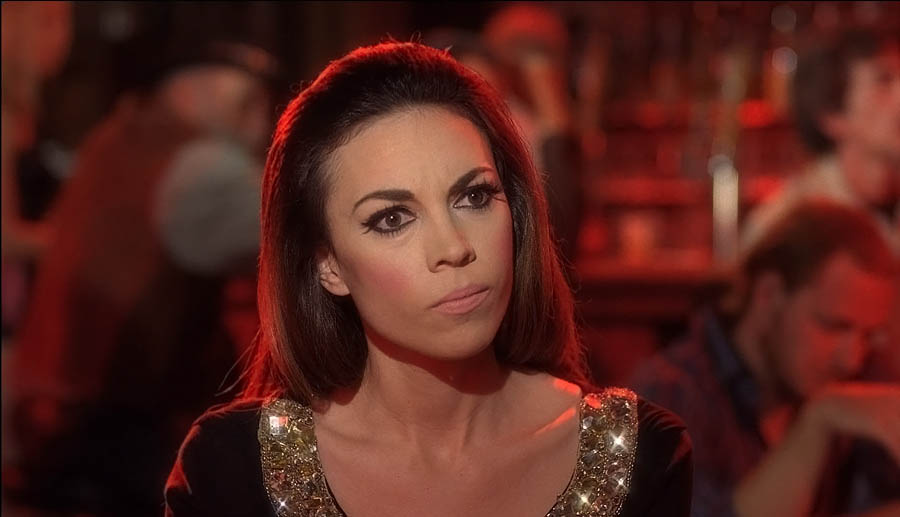
Dear David, I came across an image from The Love Witch (bar scene with a lot of red back light). May I ask what you used as key light for Elaine? Looks like a frosted ellipsoid to me, I love this strong and clear light combined with the smooth fall off, fantastic work! And thank you for being so generous and sharing so much wisdom in this thread.

Cheers

Ulf
 
Most of the close-ups were lit with a 1K fresnel directly, sometimes with a strip of 1" black paper tape across the barn doors to throw a shadow across the neck or chest, though the main character often wore black so I didn't do that as much on her. 35mm 5213 200 ASA film rated at 100 ASA, usually shot at f/2.8 on Zeiss Super Speeds. I did use Source-4 Lekos with red gels for the backlight in that scene.
 
Thanks for your swift reply. The light looks classic and razor sharp, really thought of something more exotic but makes sense, the 1K fresnel must have a small diameter. Once again thanks for the insights!
 
I don't have a frame of the main character, but this is one from that scene with another character:
lovewitch11.jpg


From the little X shapes in the glints you can see also that I used a black net on the camera lens for diffusion.

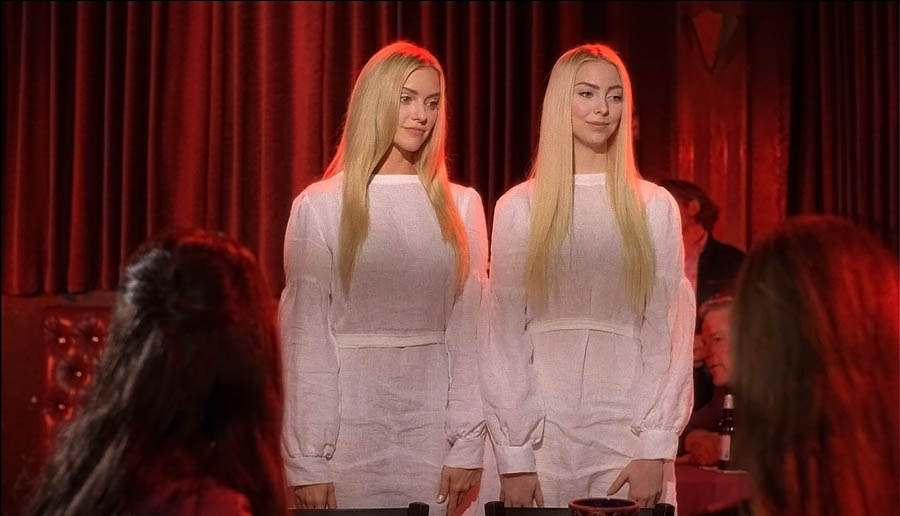
This shot of two other characters wearing white shows more clearly the shadow I got from the strip of black tape across the barn doors. This technique only worked though at the sort of distance I was between the light and the subject (about 6 feet). If I had used a 2K fresnel that was 12 feet away, for example, I would have had to use a piece of wood on a c-stand to create a bar shadow like that.

lovewitch10.jpg
 
Yes, thanks for the illustration. The net surely adds to the classic feel. I enjoy things being done in camera, they always feel more organic.
 
All your information on filters has been great but I do have one question. Would it make sense to stack a Hollywood Black Magic or Black Pro-Mist with a Digicon?
 
Sure, if that's the only way to get the look you want, although if you just want a little more contrast reduction, it would be simpler to use a "mist" filter that did not have the black dots or specks added, since that's designed to counteract the contrast loss of the mist particles in the filter. For example, instead of a Digicon + Black ProMist, use a regular ProMist.

There isn't a non-black version of the Schneider Hollywood Black Magics, since those are a combination of a 1/8 Black Frost + degrees of HD Classic Softs, they don't make a version with a White Frost instead of a Black Frost. However, you might like their White Frost filters, basically similar to regular ProMists.

However, the Tiffen Satins may be closer to the look you want since they have a base of a GlimmerGlass (similar to ProMists), I believe, with degrees of Digital Diffusion-FX (there is a "black" version of the Satins as well.) There are also the Tiffen Pearlescents, which are different than Satins since the "mist" element in Satins is constant through the range, whereas Pearlescents are similar to ProMists and GlimmerGlasses, they get mistier with each degree of strength.
 
Hello David,

Do you know what light fixture this is?
 

Attachments

  • Untitled-1.jpg
    Untitled-1.jpg
    31.5 KB · Views: 0
Perhaps an obscure question, but I am wondering if you might know how Jean Renoir stabilized his train shots in "La Bête Humaine"?

I can see a big difference in camera stability between "La Grande Illusion" (1937) and "La Bête Humaine" (1938). How were cameras stabilized back then? In watching Renoir's footage, I am guessing perhaps some kind of bunjee-cord suspension?

Thanks, David. Hope you are well. Thanks for your amazing posts here.
 
I don't know how -- I'm sure though some tracks are smoother than others so it might have been partly a question of just scouting for better tracks, just like scouting for smoother roads for car work. But any camera stabilization back then would have been homemade, low-tech solutions to minimize vibrations.
 
David, should camera sensitivity be codified as ISO or exposure index? Current image sensitivity discussions and debate seem generally related to the amplification characteristics of a camera sensor, not necessarily the dynamic range. Arri does state its EI values and it seems to have merit in todays shooting environments
 
If you're asking if the label for sensitivity settings on the camera should be ASA, ISO, or EI, I don't see why it matters if the values are the same. Technically I think EI is probably better because it doesn't suggest that the value was determined scientifically but could have been tweaked by the manufacturer for optimal results, as Kodak did when they switched from ISO to EI, it allowed them some flexibility in what sensitivity number they wanted to put on the stock.
 
Thanks David. Did you ever have opportunity to shoot with KODAK's High-Speed Infrared Film? If so, any thoughts on how results compare with the todays digital capture?
 
No, I've never shot infrared film. Certainly infrared digital seems a lot easier to deal with...

Looks like I am working the week of NAB and can't go.
Bummer, Like for you to check out Kira some day. Kira
 
Hello David,

Do you have an opinion as to why so many high-end feature films (when seen on Blu-ray)
have such varied black levels from scene to scene?

For example, the beautifully shot, and meticulously photographed, "Gone Girl" has nice dark,
true blacks in many scenes, and then muddy, lifted blacks in others.

Since these films have more than enough money and talent behind the Blu-ray mastering,
and the cinematography etc. it makes me wonder what the cause of these muddy blacks might be.
 
I think it is usually a creative choice, after all, there is a waveform in the color-correction suite to tell you if blacks are hitting "0" or not. But the thing is that there are situations where you wouldn't have a true black -- a hazy room or a foggy day, for example, especially if on longer lenses. Some shots have no black objects or shadows in them as well. And other times, by setting black to "0", the scene can look too crushed, lacking in shadow detail. I recall an old interview with Ozzie Morris, who when asked about his use of smoke and filters (like fogs and low-cons) not always allowing true blacks in a print, he said he wasn't a fan of pure blacks anyway. I think this was partly a reaction against the standard for deep blacks & saturated colors in dye transfer Technicolor prints that cinematographers were starting to break away from by the 1960's (or in Ozzie Morris' case, in 1952's "Moulin Rouge").

So technically perfect blacks have not always been the goal in every scene for a lot of cinematographers. Sometimes a smokier look is preferred. And at least with digital images, there isn't as much of an issue with grain the shadows becoming more obvious when the blacks are lifted compared to film images (though crushing the blacks a little does hide noise problems there.) In terms of David Fincher movies, he often has some scenes with a somewhat muted, dim quality where the blacks are dark but not always deep black. Anyway, I'm sure anything you see in "Gone Girl" is very intentional.
 
Back
Top