Welcome to our community

Be a part of something great, join today!

  • Hey all, just changed over the backend after 15 years I figured time to give it a bit of an update, its probably gonna be a bit weird for most of you and i am sure there is a few bugs to work out but it should kinda work the same as before... hopefully :)

Ask David Mullen ANYTHING

Most of those scenes were shot at an old movie palace in Washington Heights that is now a church and live-events theater. A Broadway lighting designer named Don Holder lit the big production numbers and I used his instruments in the grid to light the rehearsals, though sometimes I lowered the grid and attached 2K's with large Chimeras to get a softer key light. We also had a tungsten lighting balloon for the house seats that I sometimes pulled over next to the stage for a big soft key light.

The stage lighting had programmable color wheels so I could just pick a selection of colors.
 
Thank David. It's great to have you explain the projects you have worked on. It's a great opportunity for us to understand how you work. I really enjoy Smash, thanks.
Paul.
 
Looking to pull off a long oner inside of a convenience or grocery store where the camera will be whip-panning and revealing characters as we dolly up and down a few aisles. The director mentioned using a tripod dolly, but I can't imagine that there's a version that would support professional gear and deliver smooth dolly movement. Any options or should I just make sure we find a store where I can squeeze a Fisher 11 in the aisles?

Thanks!
 
Linoleum floors are not as smooth as you'd think unless the lens is very wide and the move is very slow, otherwise the hills and valleys in the floor will create some bumps. The small wheels of a tripod dolly would be worse than large tires on a doorway dolly, but the main issue is how are you going to operate all these elaborate whip pans if you are also shuffling your feet trying to keep up with the tripod dolly?

This sounds like a Steadicam shot, or putting the Steadicam arm on a dolly shot, unless you can lay track. Or handheld from a rolling chair or grocery cart, something that gets you closer to eye level but rolls you around.

The whip pans are going to be hard to do on a Steadicam or handheld just because of the inertia, making it hard to stop on a dime. That requires more of a tripod head, but then you're back to how you are going to roll around on a wavy floor. Maybe a doorway dolly or small PeeWee-type dolly with pneumatic tires, but you will have trouble moving fast and then stopping or turning due to the mass of the set-up.

Actually sounds like a job for the new Movi device.
 
David we were shooting against windows with a large light bank off to our left. The bank was all flagged off to work as a big bank. The problem was once we placed 1/2 ND gel on the outside of the windows we had most of the set and actors reflected in the windows. What is the best way to get rid of all the window reflection. Would a Pola filter take them all out of the windows and work the filter cause skin tone issues. What is the best way to shoot through large glass windows in general. and avoid seeing those reflections that just ruin the shot? Thanks for any all of your input on this problem
 
This is a common problem that comes up -- the darker you make a window, the more it becomes a mirror --- think of it this way, if it were pitch black outside the windows and the room was lit, it would be a total mirror situation.

You'll also see any wrinkles and creases in ND gel taped to windows as they get darker if anything bright like lights are reflected in the surface.

The solutions are limited -- basically use heavy ND acrylic sheets if reflections are an issue (or at least use soapy water and a squeegee to get ND gel to lie really flat to the surface of the glass) and treat the situation like shooting in a mirror: only reflect things in the glass that are OK to see, and keep anything bad out of the angle of reflection, or hide bad things behind furniture, black flags, etc. When I've seen lights bounced off of the ceiling reflected in the glass, sometimes I've created sharp patterns like rectangles or circles with Source-4 Leko's so that the reflection was a shape that could be a ceiling fixture.

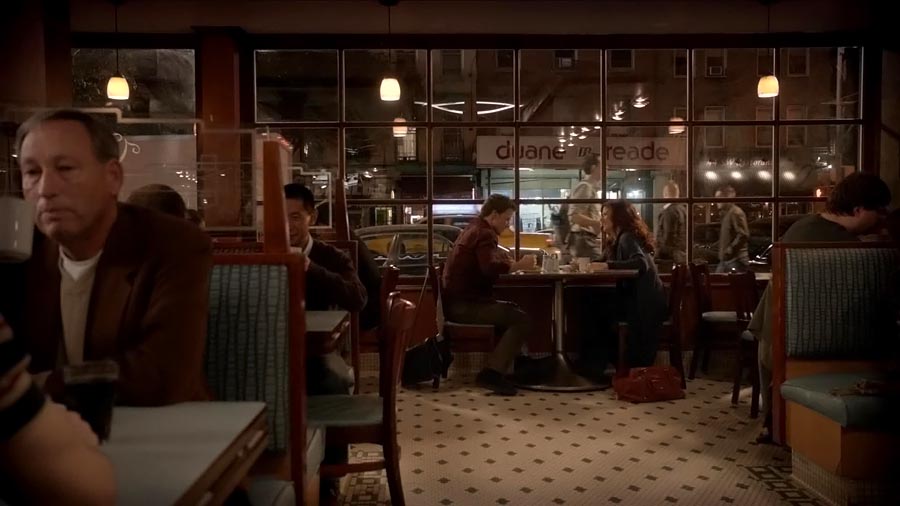
I had this situation in a diner in NYC at night where I had to turn off most of the overhead fluorescents because they were too green, but now the room was too dark and any light I added got reflected in the big window facing the street. So I put a Source-4K Leko on the floor pointed up at the ceiling and created a narrow bright line of light on the ceiling -- in the glass it looked like a fluorescent tube in the ceiling (the window was double paned and warped, so that line became doubled and warped, but that would have happened anyway with a real source in the ceiling):

smash4.jpg
 
Last edited:
When I was on location with Juan Anchia Asc on 'The Stone Boy" w Robert Duval I remember us shooting out of a room on the farm towards this huge field with these large bails. They had some kind scrim looking product on the window which was huge. David might that be a Rosco product I think is Rosco Scrim or Rosco Cinescrim it looked like it had a metal looking shiny side and there was no lights reflected with that in the windows I remember. And Juan was into the umbrellas the white ones at the time he kept burning them up and they kept shiping them in. Is that what it is and do they still make it. Have you worked with that window control product David? ND gel is just so time consuming to deal with and not good in the wind also. I was trying to find a picture to share of the window from that location
 
I worked with Rosco scrim once or twice. I've also used Double Nets on large frames but that's only the equivalent of ND.3. Scrims soften the view just like a window screen will, and you can't get too close to them with the camera but for a background window they can work fine.
 
David what is the best way to create the flickering candle light effect? As well as all other types of firelight effects
 
The best way is for me to wiggle my fingers in front of a small soft light, or wave my hands (or a small blade flag) randomly in front of a larger soft light, but that's difficult for me to delegate to others if they don't have a feel for the dancing quality of a fire. What's nice about waving your arms around is that it causes the soft light to shift from side to side a bit, the way that flames in a fireplace peak at different ends of the fireplace, or if the effect is for a TV flicker gag, it suggests motion across the screen.

Sometimes just putting a soft light on a dimmer and doing a subtle and random dimming up & down is enough to give the effect a little life.

My other method is to put multiple lights through one frame of diffusion, have two on flicker boxes at different rates, or one flickering and one dimming up & down, and maybe a third that is constant. They all blend together.
 
Hi David,

How do you break the ice with talent, or a new director, to make them feel at ease on day 1 and continue to develop those relationships through wrap?

Thank you
 
Hopefully you broke the ice with the director well before Day One of shooting!

I like to engage with a director around, hopefully, a shared love of cinema. I talk a lot about what excites me in movies, what I am inspired by, and what might be relevant to the project at hand, though hopefully you move beyond that and discuss art and life in general.

My brain tends to work like an episode of "Mystery Science Theater 3000" -- I'm a film nerd -- and so my (few) jokes at the video monitor are often absurdist in nature.

As for breaking the ice with actors, it's not my strong suit actually -- I introduce myself to them, exchange pleasantries, but my relationship with them often takes some time to build as they see that I'm working to support what they are doing, and to make them look their best. On a set, I tend to be very focused on the work and probably don't engage in enough small talk with cast and crew, but most don't see this as rudeness, they just recognize that I am very focused. But I should try harder to be sociable. On the plus side, being quiet and low-key also means that I'm generally not shouting unpleasantly at people.
 
Thanks for the insight. I work ALOT like you do in terms of personality and focus so that's good to hear. My jokes are awful though ;)

I had an actress, unknown, walk onto set and immediately make lighting demands to make her hero shot lighting flat; No modeling. Which went against the dramatic mood/feel of her character and the story. I was very surprised as was the director. We went silent, looked at each other and then I explained to her that she's beautiful to begin with and that her "character" wants this light/shadow. The duality of man. The dark side of ourselves becoming more exposed. So to speak... Against her wishes, she agreed. But, it was for the story that the lighting motivated it. Not because I had to have it. "Flat" wouldn't have engaged anyone symbolically. How do you handle situations like this? I'm really looking to make the most of working well with actors and serve the story because it always seems to be my hardest part to deal with. Thanks David.
 
I think you handled it well. You're talking about dealing with individual personalities so there is no way to generalize on the best approach. As for the problem of actresses demanding a flat frontal key light, that's always going to come up. It helps to see it from their perspective, they are the ones on screen, exposed and vulnerable, so part of your job is to protect them, even if it means compromising on a visual idea.
 
Thanks again David. I hear you loud and clear about protecting them and making compromises where needed.
 
Hey David,

Thanks again for answering so many of my questions. I have a location that consists of a small cabin. The exterior has a great mountain landscape that can be seen through the windows (much of the scene plays out at a table by these windows). The look i'm going for is a very soft, but contrasty look, where most, if not all, of my light is coming from outside of my windows. I plan on using 6k pars bounced outside off of frame. Here is where my question comes in. I want the little bonus of being able to have the mountains just "register" through the windows. My first thought was to just blow the windows out and line them with 250 or 216 as I often do. That being said, I scouted the location and feel the mountains really add to the story. I still want a over exposed look to the windows, I just want a hint of the mountains if possible. I've used Hampshire frost before, but I've found that when not shooting directly at a window, and backlighting the window, it often just becomes blown out as well. I want the look that hampshire frost provides, as I think it will help me even out any changes in the background on the mountains, and it will give me that "touch" of blur I am looking for.

Do you know of anything else I could put on the windows? Or would Hampshire frost work (aka was i doing it wrong in the past?) ? The time of day we would be shooting would render the mountains in the background front lit all day, so they should stay fairly consistent, that being said, it is Montana, and the weather changes so often.

Any thoughts on how to achieve this?
 
There is 1/4 Hampshire Frost, which would blur the view, but you could also use a Double or Single Net scrim on a frame, which diffuses the view.

Either way, ideally it would be on a frame back away from the window so that you can shine light through the window without glowing the material, though you should test 1/4 Hampshire Frost with a light shining through it at an angle to see how much it gets spread.
 
Hey David, I'm shooting a feature starting in oct. and I have been working with color palettes and creating my look book and such, and I have a pretty solid idea on the look of the project, and the emotions I want to describe with color, but in the age we are in now with digital cinematography so much can change when it gets to post. How much planning do you put into color correction when you shoot, and what goes into that planning for you? I find my self thinking of how I want to shoot so that the colorist does "such and such" to get the look i'm going for rather than the colorist doing "this and that" and not getting me what I intended.

I am interested in your process.
 
Back
Top