Welcome to our community

Be a part of something great, join today!

  • Hey all, just changed over the backend after 15 years I figured time to give it a bit of an update, its probably gonna be a bit weird for most of you and i am sure there is a few bugs to work out but it should kinda work the same as before... hopefully :)

Ask David Mullen ANYTHING

I think wider-angle lens do create the false impression that the space is bigger -- take a look at Terry Gilliam's "The Fisher King" , there are some scenes in a tiny basement with Robin Williams but shot with a 14mm lens -- it looks more spacious than it probably was to shoot in. I've shot handheld with very wide-angle lenses and have bumped into things because I thought they were farther from the lens than they actually were.

Of course, if you can back the camera through a door or window and get a bit wider, that will help. Some people even get a front-surface mirror and shoot into that to get the camera "inside" the wall so to speak, backed up effectively (but probably at an angle in order to not see the camera in the reflection.)

However, if wide-angle photography is not part of the visual style of the movie, then you're better off changing locations so that you can get a wide shot on a less wide-angle lens. I don't like it when one scene is shot super wide-angle because the room was too small when the rest of the movie does not have that feeling.
 
Using smokers or hazing sets

Using smokers or hazing sets

David I am looking for different kinds of smoke to use on locations for Low to Micro Budget motion pictures. Can you please talk about the best way to smoke & haze sets. My application is for a night exterior. I have been watching Vittorio Storaro on "Apocalypse Now" and heard Francis talking about getting as many of what looked like some sort of crop bug smoker. Do you know or maybe read or use / used them or somthing like them. I am trying to find them to rent or buy. Thank you in advance for any light you can shed on this here. Also thank you for your time
 
In the old days, something like bee smokers might be used, also smoke cookies (toxic, so aren't used anymore). I recall an AC article on "1941" where Bill Fraker, ASC had to smoke an airfield at night and they used some film cans with burning charcoal in them sprinkled with bee's wax or something -- probably considered a fire hazard today, same as a bee smoker might.

Large scale hazing might be done with something like an igeba fogger (very loud, sort of like a leaf blower) or running some plastic tubes through the woods with holes poked in it and then pumping smoke through it (called the "tube of death" for some reason). Or smaller but multiple handheld foggers like a Mole fogger. You can look at the products here:
http://www.specialefxunltd.com/seu_011.htm
http://www.reelefx.com/index.php?c=rental.view&id=3

I would just caution against burning something yourself to create smoke, both as a fire hazard and as being harmful to breathe.
 
Thanks for the tips David. The Igeba looks to be the best to get to effect we are looking for outdoors at night we need a kind of fog bank for the actors to walk into and then disappear. Also you mentioned the Bee Smoker I use to have one but someone borrowed it on a set and I didn't get it back. Do you have a suggestion of who I can buy one real cheap from?
 
Red Epic & Panavision Anamorphic glass for widescreen process

Red Epic & Panavision Anamorphic glass for widescreen process

David I have a movie that I am talking to a director about. He wants to shoot with Panavision Anamorphic glass on the Epic. I have access to two Epics now. How does that work first with renting them from Panavision and what series do think would best be suited. Also what is the process when it reaches post. I would imagine I will have a squeezed imaged. Plus on playback I will have a squeezed image also I don't think there is a way for the Epic to unsqueeze the image for playback for video village or in my viewfinder. Please give any and all insight into this type of widescreen process.
 
The ANA mode in the Epic is supposed to unsqueeze the monitor image for you -- I haven't used anamorphic lenses yet on the Epic, but plenty of people here on RedUser have. As for post, I'm not sure what the most common practice is, to leave it in its native resolution and aspect ratio (1.20 : 1 with a 2X squeeze) and just unsqueeze it for viewing and color-correction, or to convert it to 4K without the squeeze, or do that last as a deliverable (since a 2K or 4K DCP would not have a squeeze but a film-out might benefit from using the 1.20 : 1 original in terms of vertical resolution.)

You're going to have to use an Epic with a PV mount if you are using Panavision anamorphic lenses.
 
Thanks David for a good starting point on this. Will Panavision rent the Anamorphic glass alone with a Epic / Panavision adapter? Also can you refer us to someone at Panavision for such a thing?
 
That's what I was hoping not to be the case. Perhaps Panavision will realize it's a bit of a different world now in the future and help out us Dp's trying to stay with them but are being faced with the fact a lot of people have invested in the Epic's. I hope we don't have to rent the Arri glass instead due to the fact I have access to two Epics now. On a low budget it's hard to make a deal that works for the producer's and Panavision as much as I love them. Thanks again David for your help to us all your a God send.
 
I am just excited for the world of cinema in general that there are so many wanting to shoot on a widescreen process, I never realized Mr Mullen what the demand is like here just stateside alone. I was just listening to Ridley Scott saying how the bigger the screen the better it is to bring people into the movie theatre. And many of the chains are now becoming like restaurant cinema's with some being very upscale. And I am totally in agreement with you this it is a business and it just makes sense Panavison rents packages first before all else.
 
Facial Flaws

Facial Flaws

Hi David,

What do you do when you run into situations where actors or actresses don't have the greatest skin? Do you always make sure you have some kind of softening filters to throw in front of the lens? Or a combination of filters and just trying to light them with the softest/broadest source you can? What kind of things do you do to deal with such issues? Or are you at the point now where all the actors that you deal with just all great, or else they wouldn't be where they are.

thanks,
-dan
 
There are two kinds of skin problems -- bumps, like from pimples mainly, and blotchiness. The blotchiness can be fixed with make-up. The bumps can be helped with make-up but also flatter lighting can help to avoid having the bump cast a shadow. Diffusion can help a little, though lighting is more important. And of course, post touch-ups can fix the problems you can't fix on the set with make-up, lighting, and filters.

David Watkin wrote about the problem of photographing older actresses in his hard-to-find autobiography "Why is There Only One Word for Thesaurus?" -- he wasn't a fan of diffusion filters, and his theory was that you saw a wrinkle because it was a raised surface that created a shadow next to it, and all diffusion would do is make this shadow blurrier, but only flat lighting could erase the shadow. But of course, diffusion can blur things enough to hide very fine lines. But in terms of things like bags under the eyes, lighting was the main solution (and now, erasing things in post...)
 
Skin-tones

Skin-tones

Hi David

On the topic of lighting skin, are there any factors to keep in mind when lighting for darker vs lighter skin-tones? Some actors from central Africa and India have really dark skin, while some from Europe have very light skin-tones, and I was wondering if you have a different approach to them, or something that experience have taught you? For example: Does a key/fill ratio on very dark skin give you the same dramatic result as the same ratio would give you on very light skin? Or the ratio between the actor and the background? Do you tend to use warmer or cooler lights on darker tones and vice-versa? Or do you find that differences in skin-tones do not really affect your approach much?

Thanks!
 
To some extent I try not to normalize everyone to one look, I want to preserve differences. Now occasionally someone in a group shot looks too dark compared to everyone else, dark enough that your eye does not go to them, so you may need to find a way to lift them a bit, exposure-wise, or add more separation with maybe a backlight. But in lighting close-ups, I find that darker skin can really glow in the way that it reflects soft light, in ways that are more interesting than with very pale skin. In terms of contrast lighting ratios, I don't think you have to always fill-in darker skin more just to hold detail, just getting a nice soft kicker on the fill side and wrapping the key around more softly may be fine rather than using a lot of fill.
 
Lighting your work on Smash

Lighting your work on Smash

David I love your use of warm tones mixed with cold tones. Can you talk about how you approach lighting this shot of yours? The types of units used and gels on the lights or camera filters?
 

Attachments

  • web-smash25.jpg
    web-smash25.jpg
    62.5 KB · Views: 0
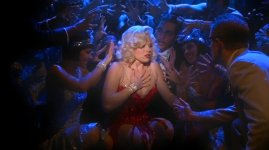
The main lighting was done by a Broadway lighting designer named Don Holder, at this moment in the dance, he had the space shift to this deep blue created by moving stage lamps with color wheels, etc. The blue color was one of the options you could program in. I think these units were HMI-type, not LED. I had to replace the follow spot with a tungsten 750w Source-4 Leko on a stand because the camera pushes in to a close-up so it had to be controlled more precisely. I used a homemade net filter on the camera lens.
 
Just wonderful work David just wonderful so you mostly get the look on Smash by working with the stage lighting designers on the big stage scenes. Do they rely a lot on your direction in terms of the set ups as the Dop? Also I would imagine the net was a black one behind the lens. The cold tone was done then in different ways compare to this other remarkable shot of yours. How did you light this so very ethereal shot? How was the cool tone achieved along with the distorted look? Where the cameras you were working with both the same?
 

Attachments

  • web-solstice11.jpg
    web-solstice11.jpg
    25.7 KB · Views: 0
Last edited:
I was shooting back-to-back episodes on "Smash" so did not get as involved as I would have liked in the design of the big musical numbers, but Don Holder is so experienced and talented that I knew he would deliver great stuff on the day. I remember on that number "Let's Be Bad" that my main suggestion was that the other dancers be in silver because they were supposedly shooting a b&w movie. Otherwise, what I did was more on the shooting day, tweaking some of the lights as we got into closer shots to reduce shadows under the eyes and to deal with camera shadow problems as the crane or Steadicam danced around, sometimes crossing the follow spots. My primary job was figuring out how to shoot the dance with the director and operators and choreographer.

There were other big numbers on "Smash" where I got to suggest things that were incorporated into the design or lighting, more general thoughts that I passed along while I was shooting something. I had more to do with the smaller numbers like the fantasies that didn't take place on a big Broadway stage with complex light cues in the traditional style of a Broadway musical numbers.
 
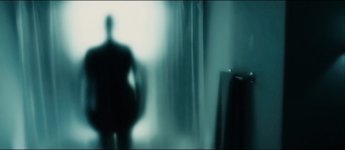
The look of that flashback / dream sequence image in "Solstice" was partially created in post -- I think I had lit the curtain orange originally, not cyan, because the reality-version of the scene had an orange street lamp outside the window, but in post, we decided that the nightmare version would be more of a cyan color, and we also did some digital diffusion to make it dreamier. But the ethereal quality is mainly due to the shower curtain in front of the person silhouetted by the window.
 
Back
Top