Welcome to our community

Be a part of something great, join today!

  • Hey all, just changed over the backend after 15 years I figured time to give it a bit of an update, its probably gonna be a bit weird for most of you and i am sure there is a few bugs to work out but it should kinda work the same as before... hopefully :)

Ask David Mullen ANYTHING

Dear David

I wanted to ask you if you have any experience with the Zeiss T1.3 ZEISS DISTAGON (mk.3) lenses for Super16 format.

I found this page with plenty of technical information, but am looking for some practical experience.

http://cinematechnic.com/resources/zeiss_super_speed_f1,2_lenses.html


Have you any experience shooting with these? Can you perhaps elaborate a little on how they performed? Quirks? Things to look out for?
I have read that the 9.5mm barely covers S16 wide open. Is this a problem in the real world?

Would you know how they perform compared to something like an ANGENIEUX zoom of similar vintage and price range (sub $10,000).
Maybe the 11-110mm T2.2 ZEISS VARIO SONNAR or 9-50mm T2.5 COOKE VAROKINETAL ZOOM (PL)? Canon zooms?
I would like something around T2, so I can match the DOF of shooting S35 at T4.

Perhaps you have some general suggestions. I'm looking to purchase either a set of four of the Zeiss primes or a zoom in the same price range
and am not terribly familiar with S16 glass, as I normally deal with S35.

Any insight you can provide would be greatly appreciated.

Thank you in advance.
 
I did only one feature in Super-16 about 14 years ago, using Super-Speeds... I avoided the 9.5mm because I heard it didn't cover Super-16 so I rented a 8mm Optex instead. The Super-Speeds looked great until you opened up to a T/2.0-2.8 split, then the sharpness dropped off quite a bit. I thought they were better than the Canon zoom I was using.
 
I did only one feature in Super-16 about 14 years ago, using Super-Speeds... I avoided the 9.5mm because I heard it didn't cover Super-16 so I rented a 8mm Optex instead. The Super-Speeds looked great until you opened up to a T/2.0-2.8 split, then the sharpness dropped off quite a bit. I thought they were better than the Canon zoom I was using.


Thanks David.

So, basically past T2.8 they started to go soft? I figured that was to be expected, given the age of the optical design.
On the other hand they are probably still better than most older zooms at that aperture range. The upside being that the Zeiss will go to t1.3 and especially with the older glass your stuck at around T2. Cooke had a 10-30 T1.6, but they are as rare as hens teeth.

T2 would be good enough to match T4 in S35. I'm not necessarily obsessed with shallow DOF, but I'm considering the extra speed for shots like the one of Grace Kelly coming in to focus when she kisses Jimmy Steward in 'Rear Window'. I'm gearing up for a project and there are a few occasions where such an effect would be very appropriate for the story. And in that case there is no substitute for a high speed optics.


S16 lenses are an interesting topic. The format has somewhat fallen out of favor over the past few years, so information is relatively scarce.

Apparently the Angenieux 11.5-138mm HR T2.3 is a stellar performer, but it also commands an appropriate price (which is out of my price range)


Thanks again.
 
car rigging

car rigging

Hi David,

I have a question concerning shooting a moving car scene with a dialogue between two people in the front seat. Do you ever use the hostess tray with a dialogue scene? Due to the window needing to be open, isn't it always a problem for sound? And if so, are your only options for covering a dialogue scene a process trailer or a large speedrail rig on the side of the car? Have you tried and trusted a couple of suction cup mounts for a camera as heavy as a Red?

Also, how often do you find yourself trying to increase exposure density on set to then later bring it down in post (i.e. for night scenes, purposely underexposed scenes, etc.). Do you only do it when you know you'll be able to be a part of the post process? Along with that, do you ever put in your contract that you want to be around for color correction?

Thanks,

dan
 
Yes, hostess trays are done all the time; yes, sound has to deal with having that one window open. However, if the window is closed, it is very hard to get that raking two-shot without the camera being reflected in the glass anyway, unless you are on a process trailer and can back up a little so that the mattebox isn't hitting the window and can use a longer lens.

I wouldn't trust suction cup mounts alone for a heavy camera though a bunch of suction cup mounts and c-stand arms to brace the camera and hopefully a ratchet strap or two would probably work.

I try to err on the side of a conservative exposure for dark scenes, not overexposure, but generally a leave myself a little room to bring the image down further in post. Generally I'm always asked to be involved in the final color-correction though a few times, I haven't been able to attend. But then I send notes, etc. to the colorist. I don't think I've had mandated color-correction involvement in my contracts though.
 
Hi David, I was wondering if you could share some of your opinions on positioning the character within the frame.

I'm aware of the "Rule of thirds," but I'm curious about your application of it. I ask because a few weeks ago I watched "The Shining" at the LACMA, and a friend of mine pointed out the frequent use of center framing. Now this might be partly a result of the film's aspect ratio and a lot of shots being inside hallways/tunnels. But it got me thinking about framing and how much of a "rule" the "Rule of thirds" actually is... I realize that it isn't hard and fast, but I tend to believe that one should have a reason to break convention. So I'm wondering what your reasons for doing so might be.

Thanks so much. I really hope you realize how VERY MUCH appreciated you are!!
 
Hi David,
I've got a shoot coming up in the islands and the client want to shoot some of our wider shots day for night. The tighter, more controllable shots we'll shoot night for night. My question being with my Epic should I use HDRx to do my underexposures and, if so, scenes which are backlit what's a good underexposure to start at. Originally I was thinking three stops. Also the client wants the BG to be on the blue side and flesh tones to be natural. I was thinking setting WB to 4000 or so, and use warmed HMI's for the talent.
Thanks for always taking time to share your knowledge with us all.
Steve
 
Hi David, do you know why there's no movie shot in anamorphic 3D by now? Is it possible at all?

Until now, i haven't found anyone that was able to answer, maybe it has to do with the squeeze?

Thanks to you and the comminity in advance!
 
Hi David, do you know why there's no movie shot in anamorphic 3D by now? Is it possible at all?

Until now, i haven't found anyone that was able to answer, maybe it has to do with the squeeze?

I'm sure it has something to do with the breathing when you pull focus, the shallower depth of field, the stretched bokeh (which breathes as you rack focus), and the difficulty of finding perfectly matched pairs in each focal length. Plus many 3D shooters want to use zoom lenses to avoid time-consuming lens changes, and you don't get the anamorphic look with rear-adapted zooms, plus they are slow, large, and heavy in general. Not to mention that most 3D productions want to shoot digitally and most digital cameras don't have 4x3 sensors, so there is no resolution advantage to using 2X anamorphic lenses.
 
Hi David,
I've got a shoot coming up in the islands and the client want to shoot some of our wider shots day for night. The tighter, more controllable shots we'll shoot night for night. My question being with my Epic should I use HDRx to do my underexposures and, if so, scenes which are backlit what's a good underexposure to start at. Originally I was thinking three stops. Also the client wants the BG to be on the blue side and flesh tones to be natural. I was thinking setting WB to 4000 or so, and use warmed HMI's for the talent.
Thanks for always taking time to share your knowledge with us all.
Steve

As I said in another thread, 2-stops under for DFN is safer as long as you are protecting bright highlights. You'll want to light your night for night shots to "feel" like day for night.
 
Hi David, I was wondering if you could share some of your opinions on positioning the character within the frame.

I'm aware of the "Rule of thirds," but I'm curious about your application of it. I ask because a few weeks ago I watched "The Shining" at the LACMA, and a friend of mine pointed out the frequent use of center framing. Now this might be partly a result of the film's aspect ratio and a lot of shots being inside hallways/tunnels. But it got me thinking about framing and how much of a "rule" the "Rule of thirds" actually is... I realize that it isn't hard and fast, but I tend to believe that one should have a reason to break convention. So I'm wondering what your reasons for doing so might be.

Thanks so much. I really hope you realize how VERY MUCH appreciated you are!!

As you said, it's not hard and fast, it's more of a guideline, not a rule, mainly for beginners to keep them from just centering the subject all the time. Kubrick does it, but he designs everything in the set to support that composition, he's not just centering people against a blank wall or something (well, he's probably done that too but made it look interesting...) With Kubrick, it has a symbolic effect, the formalism of the framing with wide-angle lenses so that the convergence point is often in the center with the actor there too; it suggests control... control of the director over the elements of the movie, but also control of the environment over the person, how people are dominated by larger forces -- often man-made, institutional systems represented by their architecture.
 
Hi David
Just out of curiosity, do you have a ditty bag that you always keep close by on set, and if you don't mind telling, what do you keep in it? (anything from light-meter to headache tablets etc.)
 
I have to travel so much now that I've stopped carrying a ditty bag, I just have to assume that my crew always has enough clothespins, porcelain sockets for paper lanterns, cube taps, 3-prong to 2-prong adaptors, a pair of scissors, etc. My book bag just carries personal items like aspirin, dental floss, eyedrops, earplugs, reading glasses, etc. plus my scripts, notes. I also still bring my spot and incident meter with me, plus a still camera and my iPad. A smartphone has become part of everyone's tool kit as well.

I have some odds and ends that are part of my kit rental and go onto the trucks or to the assistants to hold -- some small LED lights, special filters, odd items like a Lensbaby, etc.
 
As you said, it's not hard and fast, it's more of a guideline, not a rule, mainly for beginners to keep them from just centering the subject all the time. Kubrick does it, but he designs everything in the set to support that composition, he's not just centering people against a blank wall or something (well, he's probably done that too but made it look interesting...) With Kubrick, it has a symbolic effect, the formalism of the framing with wide-angle lenses so that the convergence point is often in the center with the actor there too; it suggests control... control of the director over the elements of the movie, but also control of the environment over the person, how people are dominated by larger forces -- often man-made, institutional systems represented by their architecture.

David thank you so very much. I'm going to be seeing 2001 at the Egyptian this Friday, 7/26. I'll be keeping in mind what you've written.
 
light

light

Hi David,

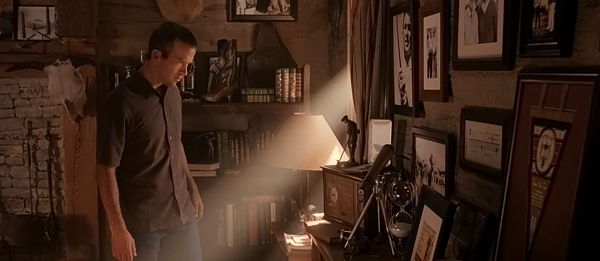
I have two questions concerning shafts of light...

Firstly, which is better for seeing the beam, hazers or foggers?

Secondly, without using a xenon or high powered hmi, do you need to bounce the lamp into a mirror? Or can you get away with just a joe-leko with a narrow lens, or a par can with a narrow bulb? Or if you take those units and bounce them into a 4x4 mirror board, or even a 1x1 mirror, will it just help enhance the beam even more, but isn't necessary?

Also, as far as creating the weathered look, as in old polaroid film or 70's photographs... besides wardrobe and production design, and maybe old lenses, is it wise to do the rest in post? As opposed to also adding filtration or in camera preset looks?

Thanks,
-dan
 
All the mirror does is effectively back up the light the distance between the lamp and the mirror, for when you can't physically back up the light any more -- and the farther you can get the lamp, the sharper the beam (but also the greater the fall-off in intensity). So the mirror is not magic in terms of sharpening a light (it may, however, allow you to reflect a beam of real sunlight into the room if you're lucky...)

The main problem with a Leko with a 19 or 26 degree lens is that it is such a small beam -- what I've done is gang some together, maybe three or four outside a window... as long as they are all angled the same, it looks like one beam just being broken up. In this shot in a movie I did, I had three Source-4 Lekos outside with 26 degree lenses:
utopia23.jpg


Hazers make it easier to disperse the smoke more evenly -- a fog machine blasts out a cloud that needs to be broken up and dispersed, otherwise there isn't much difference unless one is an oil-based fog and the other is a water-based fog... the oil-based fog hangs much longer and thus is easier to maintain an even haze, but can leave a residue on things and is worse to breathe in the long term.

If you are shooting on a Red camera, then a preset look doesn't affect the raw file anyway, it's just metadata. Same with an ARRI Look file in an Alexa if you record Log-C but monitor Rec.709 with the look applied. So if you need to play with color saturation and black level to get that faded look, then go ahead and play with the camera's settings.

If part of that look includes a halation (glow) around bright areas, fogginess, I'd be inclined to use a camera filter rather than do it digitally in post to every set-up. Just don't overdo it because you can always increase the effect in post but it is hard to reduce it later. An old lens may be enough without the filter.
 
"lookin' larger"

"lookin' larger"

Hi David,

I'm going to assume that you've been thrown into the situation of shooting in a small location, but the director (or you) wants the space to look larger than it is. Is the better solution to shoot with wider lenses, maybe even on close-ups? Or is it better to shoot on tighter lenses overall, and not really shoot any wides; in order to never really show the audience the entirety of the space (and how small it is). Or will shooting on longer lenses really just compress everything, and make the space feel even smaller, and thus counteract the goal. Maybe I've answered my own question. But I guess my thought is that if you do shoot with only wider lenses, you'll show that the space is indeed small.


As always, thanks for your insight.

-dan
 
Back
Top