Welcome to our community

Be a part of something great, join today!

  • Hey all, just changed over the backend after 15 years I figured time to give it a bit of an update, its probably gonna be a bit weird for most of you and i am sure there is a few bugs to work out but it should kinda work the same as before... hopefully :)

Ask David Mullen ANYTHING

Hey David

I've been a long time reader of this thread, so thanks for all the awesome insight!

Anyway, I've been planning a shoot that has a scene that takes place at night on a high school football field. In the story, there would be no stadium lights on.

I'm basically trying to figure out what is the smallest units we could get away with and make this work. The shoot will have 2 1.2k or M18 HMIs for the rest of the shoot, but I'm thinking I may need to augment the lighting package for this scene, but unfortunately am working with a very tight budget.

Any thoughts?

Thanks!

-Alan

You only have two choices, a big moonlight effect or some small security lights that were left on to justify some scattered lighting around the field. The big moonlight effect may look similar to a metal halide stadium light look, just darker and more contrasty, but it all depends on the mood you want to create and the color tones you want. If you go for the big moonlight effect, yes, you'd need some big HMI way up in the air on a crane or at the top of the stadium if you can frame that out (though placing it at the top of the steps may put too bright a spill down on the seats closest to the lamp. You can also try raking the stadium from the ends as if the parking lot lights were spilling into the stadium. But you should be thinking BIG if you want a single source effect that lights a whole football field from outside on a crane, like an 18K HMI.
 
You only have two choices, a big moonlight effect or some small security lights that were left on to justify some scattered lighting around the field. The big moonlight effect may look similar to a metal halide stadium light look, just darker and more contrasty, but it all depends on the mood you want to create and the color tones you want. If you go for the big moonlight effect, yes, you'd need some big HMI way up in the air on a crane or at the top of the stadium if you can frame that out (though placing it at the top of the steps may put too bright a spill down on the seats closest to the lamp. You can also try raking the stadium from the ends as if the parking lot lights were spilling into the stadium. But you should be thinking BIG if you want a single source effect that lights a whole football field from outside on a crane, like an 18K HMI.

Thanks for the advice!

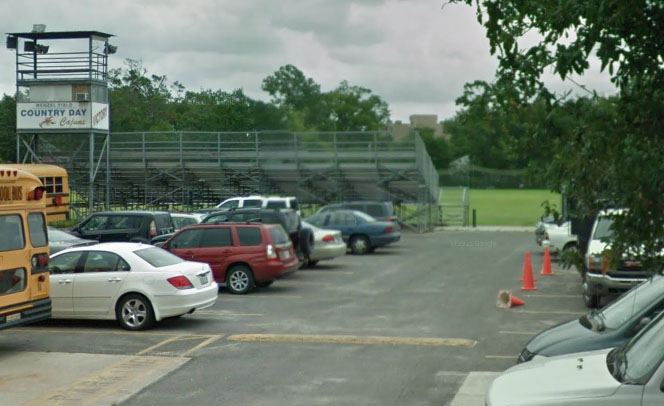
I think we had really wanted to go with moonlight for motivation, and I was afraid it would require an 18K. I guess I had hoped we could cheat it with our two smaller units and maybe a couple more units that we could power from the school's house power.

Football.jpg


That's an idea of the location, and is actually a fairly similar angle to what the wide shot would look like. Two subjects would be in the foreground and another two would be in that tower. The foreground actors could probably be motivated by parking lot lights. And I was envisioning the bleachers and actors in the tower to be edged by hard moonlight and just enough light on the field and far trees to not end up with a black void.


I guess we'll just have to figure out how to budget to rent the big lights we'll need for this scene as it is the climax of the film.

Thanks again for your help!

Cheers,
-Alan

If you have to frame in the high tower, I would probably give up on the moonlight idea, it would have to be coming in from the right side, not a backlight, and would have to be high enough to not be lighting the tower from a lower direction than makes sense, which means a condor. I would go with lots of small lights as if there is some security lamps and street lamps, unless this takes place during a power failure. You could uplight the far trees with some orange sodium vapor effect and have a few orange units along the back row of trees pointed into the lens as if a sodium security lamp. Then you'd light the parking lot with some more units. Either way, it's going to take some power due to all the small units working, and some time to pre-light, unless there is usable parking lot lights I just don't see in the photo. You can hide a Kino tube or something in the tower. You could put some tall standing pipe poles with halogen lights on top for parking lot lights.
 
Dear mr. Mullen,

I'm building a cyclorama green screen studio for a film project. The sides of the cyclorama are about 20 meters each, with three walls in a U-shape. I'm thinking of using 6kw spacelights to light the cyclorama. How many do you think I would need?

Best regards,
J.M. Puntervold
 
Depends on what spacing gives you an even amount of light across, maybe a grid where each light is 2 meters apart? You'll want to have control over each globe at the dimmer board or at least be able to go to half speed (three globes) because 6K may be too much light for some purposes. The main thing is that the distance from the space lights to the cyc wall and between those space lights are consistent & even so that the light on the cyc is even.
 
Full Blue correction loses 2-stops of output, Full Orange correction loses 2/3-stop, so it is more efficient to gel a daylight LED to tungsten than to gel a tungsten LED to daylight, particularly because tungsten-lit interiors tend to be lower in light level than daylight situations, so you generally need the output more in daylight.

Now when it comes to gelling daylight fixtures versus using an actual tungsten lamp (not an LED), real tungsten lamps are full spectrum, no green spike, and are consistent between fixtures, and put out a nicer color on skin tones, but I don't think there is any color advantage with 3200K LED's versus gelling a 5600K LED to 3200K.

Sure, use Steel or Straw if you have them, but they are not absolutely necessary. Straw (CTS) is just a bit more yellow than Orange (CTO) but that's also something you can time for in post. Not sure what shade Steel is, but you can add a bit of Plus Green to CTB and create a shade of cyan that is probably similar.

Thank you so much again, David!
 
Hi David

Im shooting with a Red Scarlet, and we have a lot of exterior daylight scenes
I want to rate the camera at 800iso, so I get the most range out of the sensor.
How ever the only filters I have access to are 85 NDs that we are getting for free from a film co op.

So my question is, do you think I would be better off not using the 85NDs and just lower the iso which will decrease dynamic range, or use the 85NDs keep the iso at 800
But since I'm blocking the blue light from entering the sensor wouldn't I also be losing dynamic range?


I really got to do some tests, but if you have any experience or thoughts on this, it would be awesome :)
 
You need to find some regular ND's, it's silly not to. The Sunny 16 rule says that at 50 ASA, you'd be shooting at f/16 with a 1/50th shutter speed in direct sunlight, and you don't want to lower the ASA of the camera way down to 50 ASA just to avoid using ND filters. So the 85ND filters are better than nothing, but that's about it. You'd gain in the sense that at 500-800 ASA, you'd have a good dynamic range, but with the 85 filter, you're underexposing the blue channel and increasing noise there (unless you left the orange 85 filter effect in for a very warm look.) Not bad, and I suppose you could compensate by rating the camera more in the 320-400 ASA range to improve the blue channel noise but then with some mild loss of DR in the high end. So you should find some regular ND filters, or and add a blue filter to the 85ND's (which is also a bit silly but would work if you have the light level, a full 80A filter is almost 2-stops of light loss right there...)
 
Thanks David

since this is a tight budget short film, Im having a hard time getting anything extra, and we are getting the 85NDs for free
of course that's because no one wants them anymore haha
I'll push harder for proper NDs, and if I cant get my way I suppose I will slightly overexpose the sensor to get less noise, like you said maybe rate at 400, and just watch my levels
 
Big Sur

Big Sur

David,
I read your article in this months American Cinematographer, and really enjoyed the look you created for Big Sur!
I played around in DaVinci and was able to make something similar, but still is missing that special something that makes it painterly. I essentially keyed the blacks, put a glow on it and overlaid a desaturated version, and one with the glow in the blacks. Then I combined that with a more saturated key of the skin tones. REALLY COOL.

Anyways, just wanted to give you props.

Well done!
~D
 
Hi David!

Thanks for taking the time to read these! I have more of a career question. If you feel your not a good fit for a project do you turn it down? The obvious answer is "Yes!" except life is more complicated than that. Finances and building yourself as a freelancer take time and as many on this site will agree, most quit this industry long before that happens.


Specifically when your starting your career, how adaptable are you? Do you stick to your guns constantly and weed out the projects that are a good fit for you, all the while balancing the finances as best you can. Or do you take the projects and learn what you can while "getting better" at your craft?

the problems I'm having relate to:

1. little to no prep time with director
2. no shotlist
3. sometimes no script or story background in writing etc..
4. asking for shot without providing equipment to deliver that shot (asking for jib shots but no jib... etc..)
5. not giving crew needed (ac's gaffers, grips etc..)


essentially I'm being hired as a cameraman not a dp, but credited as a dp. My day rate is paid but for "budget reasons" i'm continually put in situations where I'm set up to fail. This is a reoccurring client that does not understand why the above items are necessary.


Thanks for any input. I'm a big fan of the book "Outliers" where Gladwell discussing logging 10,000 hrs to become a master of anything. The Beatles played clubs in Hamburg Germany perfecting their craft before ever going anywhere.

Thats how I've been operating up to now with these kinds of projects, chalking it up to "logging hours in Germany". - But I'm beginning to question where that logic is actually taking me...

Wow David! Thanks for posting this question. I never thought I was the only one with these issues but I did feel alone. "Being set up to fail" rings true with me as well. I'm looking forward to Mr. Mullen's response.

Matt
 
Hi David!

Thanks for taking the time to read these! I have more of a career question. If you feel your not a good fit for a project do you turn it down? The obvious answer is "Yes!" except life is more complicated than that. Finances and building yourself as a freelancer take time and as many on this site will agree, most quit this industry long before that happens.


Specifically when your starting your career, how adaptable are you? Do you stick to your guns constantly and weed out the projects that are a good fit for you, all the while balancing the finances as best you can. Or do you take the projects and learn what you can while "getting better" at your craft?

the problems I'm having relate to:

1. little to no prep time with director
2. no shotlist
3. sometimes no script or story background in writing etc..
4. asking for shot without providing equipment to deliver that shot (asking for jib shots but no jib... etc..)
5. not giving crew needed (ac's gaffers, grips etc..)


essentially I'm being hired as a cameraman not a dp, but credited as a dp. My day rate is paid but for "budget reasons" i'm continually put in situations where I'm set up to fail. This is a reoccurring client that does not understand why the above items are necessary.


Thanks for any input. I'm a big fan of the book "Outliers" where Gladwell discussing logging 10,000 hrs to become a master of anything. The Beatles played clubs in Hamburg Germany perfecting their craft before ever going anywhere.

Thats how I've been operating up to now with these kinds of projects, chalking it up to "logging hours in Germany". - But I'm beginning to question where that logic is actually taking me...

There's no easy answer, I find myself being asked for shots all the time that I don't have the equipment or crew to pull off, it's just that the bigger the budget, the bigger ambitions of the director, which is natural. I just completed two seasons of a complex TV show where I was the only DP so no prep with the directors. Some asked for shots on the shooting day where I questioned why they didn't bring that up on the tech scout that I couldn't attend, with the best boys, AD, and line producers standing around... at that point someone could have ordered the right equipment. Do you what you can and most directors understand that, sometimes there is a clever solution on the day that gets them something that is close enough to their original, more ambitious, idea.

You're right, you have to pay your dues and build experience, although if this is the same producer putting you in this situation over and over again, you have to ask yourself if this will lead to more work with other producers in the future, or if this is ultimately a dead end once you've accumulated the experience from working with this guy. I was lucky when I got out of film school to hook up with a production company making B-movies for cable with decent budgets and post work, but after seven genre features I had to start turning them down, even though it meant a drop in salary as I went to work with smaller indie guys -- it seemed a good time to re-steer my career in the original direction I wanted. So I started doing some more artistic indie movies with an attendant loss of income compared to what I was making before, but it paid off eventually.

There comes a point where you have accumulated enough practical real-world shooting experience and what you really need is work that can show off what you are capable of artistically. But obviously it isn't clear when that point comes... if you are lucky, an opportunity comes along to take more interesting work which allows you to gracefully bow-out from the previous work, claiming unavailability (you don't have to tell the previous employer that you are taking a pay cut to do something more interesting artistically...)

But I would say that most of my early career was spent learning to be flexible -- it's not hard to do good work when you are in complete control over the elements, but at some point, you have to learn to do good work in uncontrollable situations, or at least, learn to be fast, not just good. But then having learned those lessons, you have to find a way of getting on better productions, and that's the real career trick that I'm not sure one ever completely solves. Life is one long job interview in the film industry.
 
wow, great insight David. I really appreciate the feedback. I think your right that this industry is a never ending job interview. Maybe freelance work in general is. Sometimes I feel like is more of a game of chess than being an artist. Great to hear insights into how you played (and are playing) the game. Thanks!
 
Dear David,

first off, another huge thanks for your contribution in this thread. I've been reading it all the way from the beginning (at page 299 now) - what a stupendous wealth of information and insight!

A question about faking day for night in an interior: I'm DP'ing a short in which the script calls for a night interior scene in an office. However, due to limitations on when we can access the location, we need to shoot this during the day. I'll be framing against a window, and to create some depth in the shot, I'd like to leave the blinds open and have some points of light far away in the darkness outside, instead of just blacking out the windows and closing the blinds.

The idea would be to put some really heavy ND on the window (eg something like double 1.2) to grossly underexpose the view outside, point a couple of worklights straight into the window from a distance outside so that they would still punch through the ND (maybe gelled in a sodium yellow?), and avoid showing the sky which would give away the time of day. In the direction of the window there won't be any other bright lights visible. The interior will be lit in a warm, moody low-key style, motivated by a single practical desk lamp.

Do you think this approach might work?

Thanks in advance!
Thomas
 
I had a similar situation this year, a reoccurring room on the second floor of a warehouse with two small windows that couldn't be tented, but had to shot during the day for night. I could have just put a solid over the outside of it and closed the blinds, but I wanted some depth, so we put three layers of ND.90 on the windows, which gave us a very dim blueish view when the room was lit for tungsten at 800 ISO, usually to a T/2.8. The main problem is that wavy gel reflections were distracting if you looked too close; using acrylic ND hard gel would have been better. I had the blinds down and then the slats closed halfway, which took the curse off of it. We had some sky and some white construction cranes outside, so the three layers of ND.90 were necessary when the sun was out, but without such bright objects in the background, we probably would have used a little less ND.

Truth is that with that much ND, the window becomes a mirror (like it would at night) and your practical room lights will reflect more brightly than anything outside (which makes any rippling in the gel look obvious), but your idea of a few lights pointed into the lens from outside might work fine.
 
David!
This is my first post on here!
thank you so much for giving me this opportunity to be able to ask such an amazingly talented cinematographer my simple basic questions.


I am an aspiring cinematographer who will be shooting a short in the next two weeks in the red epic.

I am extremely nervous and have come here to seek advise.

there is a location that involves very low lighting conditions, and i am wondering how i can achieve the image i want with little to no digial noise?
here is the exact lighting setup and location i lit, but it is a still taken from the 5d mark 3


528169_10200983978306904_297575143_n.jpg


how can i achieve this exact image without any noise?
THANKS SO MUCH FOR YOUR IMPUT!

sorry for such a large image.
 
While at NAB I had to text my AC, "I spy David Mullen!" I wanted to come over and say Hi, but you looked engrossed in a conversation. What I would have said is just... thanks for the wealth of information you share here. So, thanks!

Cheers,
CB
 
While at NAB I had to text my AC, "I spy David Mullen!" I wanted to come over and say Hi, but you looked engrossed in a conversation. What I would have said is just... thanks for the wealth of information you share here. So, thanks!

Cheers,
CB


As that AC, I promptly texted back "Tell him I'm an awesome AC!"

I also want to thank you, I've read through this entire thread at least once.

And Christopher...I swear I'm not stalking your REDUser posts.
 
Back
Top