Welcome to our community

Be a part of something great, join today!

  • Hey all, just changed over the backend after 15 years I figured time to give it a bit of an update, its probably gonna be a bit weird for most of you and i am sure there is a few bugs to work out but it should kinda work the same as before... hopefully :)

Ask David Mullen ANYTHING

David-
Just had the chance to watch the YouTube video of the talk you did at AbelCine. Just wanted to say a huge thanks to you. One hour of watching hearing you talk and seeing the examples you offered felt like the most education I've every gotten in just an hour. Very much appreciated.
Best,

-Harry

Thanks for mentioning it Harry. I didn't know about this video. Everyone should watch it! It's really great.

It's an incredible amount of great information David. The Manure stuff is fantastic. Really creative. I remember you posting stills from it back in the day but I never actually seen the film. In a quick google search I see the title was changed to The Smell of Success. That may be why I never came across it. I will make sure to watch it now.
You were mentioning shooting with available light on the streets and that sometimes the camera is even too sensitive. Are you shoot 800ASA on Smash or higher? The native ASA is 800 on the Alexa right?
I never shot with the Alexa but shooting 800ASA with other cameras such as the F3, AF100 or 7D and 5D I didn't find 800ASA all that sensitive. So I found your comment interesting and made me wonder about which ASA or ISO you use.
Loved the funny comments about actors thinking they are not lit enough too.

Overall it was a great presentation and went by so quickly. That hour felt more like 10 minutes because it was so interesting.
 
I try to shoot at 800 ASA but often go to 1000 ASA for night exteriors, or even 1250 ASA now and then. One reason is just that to save time, I try to stick to our zoom lenses, which need a T/2.8, even though I carry T/2.0 primes.

At 1250 ASA, the light levels are often lower to the eye than they look on the monitor, which is a bit disconcerting.

Sure, there are available light situations that could require higher than 1600 ASA, but I'm not shooting a documentary... I'd only do that if it created some interesting visual effect for the scene.
 
Thanks for the info.

At 1250 ASA I can see what you mean. It really starts seeing in the dark. At 800 ASA, at least the cameras I have used, still pretty much need quite a bit of light at night externals.
But I honestly would be nervous shooting at anything but the native ASA of a camera. After all every camera really has just one ASA and the rest is just good old renamed video gain.
But then again with the Alexa I'm sure it's different specially shooting ArriRaw. The trailer for Smash looked great! The lighting was really nice, moody and fitting. The days that theatrical features looked better than TV because they used better equipment are long gone, I know. But some TV shows are looking better than some features already.

The shot you showed from the Big Love backyard, if I had seen a picture only I would have thought you just shot outdoors. Impressive the level of realism you were able to achieve with that. I think it's a curious trade off. You have to work hard to get the realistic outdoors feeling, but at the same time at least you don't have to fight the sun, and have no problems with getting your set ups before the daylight is gone. Having the budget and resources I think I would rather shoot in a studio as you did. Maybe it's just because of my independent filmmaking experience and being sick of having to hurry up to get all shots in a short day before sun is gone, or being driven nuts by the sun changing positions every minute.

By the way, have you shot with the Genesis or F35? I hear they are not very good for night exteriors and we have a new project on the pipeline that we were thinking of using them. But for our budget we were actually recommended to shoot it with F3s because of the night street stuff. We just got a good deal on the big camera but if it will require a larger lighting package and crew it may not be worth it.
 
I have shot with both the Genesis (three years on "United States of Tara") and the Sony F35 (on a short film) -- they are more or less the same, though the F35 has a few more features.

I'm not so sure it's all-important to shoot at the "native" ASA rating for a digital camera, it's just a question of noise vs. highlight information. My DSLR goes from 100 ASA to whatever, I'm not sure what its native ASA is.

I come from a movie film background, so anything faster than 500 ASA seems fast to me. The Genesis / F35 is a roughly 500 ASA camera, but you can gain another stop of speed by boosting the gain by .5-stops and opening the shutter angle to 270 degrees. That works well for night exterior work. With a Sony F35 and PL-mount you can use Master Primes and get even more exposure if shooting at T/1.4 (with the Genesis you'll probably have to use T/2.0 Primos or older Super Speeds.)

I think you can get away with even higher ASA ratings on the newer cameras though.
 
Hi David,

As all note here, I really appreciate your generous feedback to all these questions and hopefully the good karma from that will pay you back in more / better work somehow.

I have a question about how you lit the interior tungsten scenes in "Jennifer's Body" at the bar which burns up. In general for interior night scenes with a lot of people, what is your usually key light source to cover a spread of people? 5K / 10K bounced off muslin or ???.

Another qestion - In the scene where Jennifer kills boyfriend Chip, in a kind of water or sewage pool, there's a lot of shots where the light source is not defined - a.k.a. no directional light source but yet lit and contrasty. For example, when Jennifer is levitating above the water she's just flat lit bluish and the image still looks very nice. Was that just fill lighting with Kino flo's or ???.

Lastly, pertaining to your experience with the Genesis. I know you've rated and shot with the camera at 400 / 500 ASA, but were there instances where you shot night interiors or exteriors at 800 ASA or 1200 ASA? Were the noise levels acceptable to your taste when rated that way shooting with a 180 degree shutter?

Many Thanks.
 
I have shot with both the Genesis (three years on "United States of Tara") and the Sony F35 (on a short film) -- they are more or less the same, though the F35 has a few more features.

I'm not so sure it's all-important to shoot at the "native" ASA rating for a digital camera, it's just a question of noise vs. highlight information. My DSLR goes from 100 ASA to whatever, I'm not sure what its native ASA is.

I come from a movie film background, so anything faster than 500 ASA seems fast to me. The Genesis / F35 is a roughly 500 ASA camera, but you can gain another stop of speed by boosting the gain by .5-stops and opening the shutter angle to 270 degrees. That works well for night exterior work. With a Sony F35 and PL-mount you can use Master Primes and get even more exposure if shooting at T/1.4 (with the Genesis you'll probably have to use T/2.0 Primos or older Super Speeds.)

I think you can get away with even higher ASA ratings on the newer cameras though.


So you feel that the difference between 270° and 180° is subtle enough as not to be noticeable?
To me, at least 360° looks too smooth and start looking like video, for lack of a better term. I remember for example since we're talking about Genesis, that Apocalypto had some shots with 360° and it looked pretty "off".
 
So you feel that the difference between 270° and 180° is subtle enough as not to be noticeable?

Depends on how much motion is in the frame -- I was mostly shooting dialogue scenes so there wasn't a lot of fast motion to giveaway the longer shutter time. But 360 degrees is way too smeary for me, but you can get away with 240 or 270 degrees if it is just a talking head scene.
 
I have a question about how you lit the interior tungsten scenes in "Jennifer's Body" at the bar which burns up. In general for interior night scenes with a lot of people, what is your usually key light source to cover a spread of people? 5K / 10K bounced off muslin or ???.

Another qestion - In the scene where Jennifer kills boyfriend Chip, in a kind of water or sewage pool, there's a lot of shots where the light source is not defined - a.k.a. no directional light source but yet lit and contrasty. For example, when Jennifer is levitating above the water she's just flat lit bluish and the image still looks very nice. Was that just fill lighting with Kino flo's or ???.

Lastly, pertaining to your experience with the Genesis. I know you've rated and shot with the camera at 400 / 500 ASA, but were there instances where you shot night interiors or exteriors at 800 ASA or 1200 ASA? Were the noise levels acceptable to your taste when rated that way shooting with a 180 degree shutter?

Many Thanks.

Since the bar had to burn up, I had to rig it with a lot of practical lamps so that the wide shots would be semi-self-lit -- the closer shots either were lit with a paper lantern for dialogue moments or a light through a diffusion frame, probably a 2K, with some color on the backlights. I think I used a lot of 4'x4' frames of 129 or Full Grid for close-ups, sometimes larger frames.

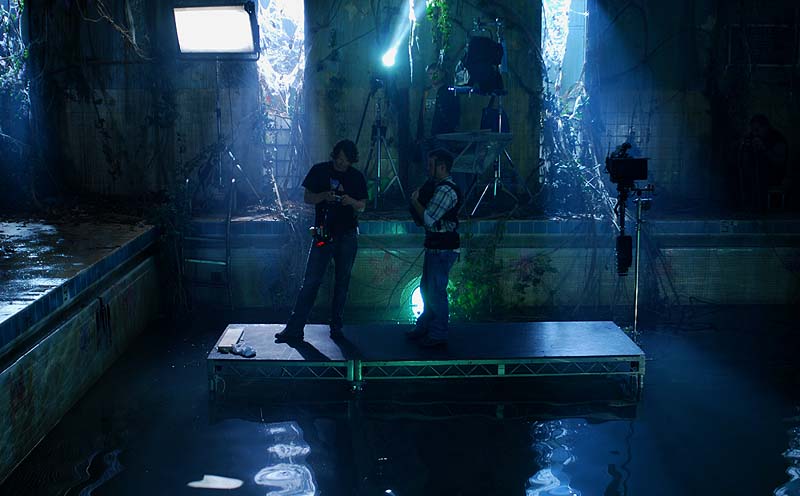
The pool had Cool White fluorescent tubes hanging around the sides, and the original mercury vapor pool lamps, and I also bounced a small HMI off of the water to get a rippled pattern, and we also had to this weird rig where an open-faced 2K, with a blue gel, was pointed into a water pan that was mirrored, and had a dripping water faucet leaking into it to create the ripples. I had HMI's shining through the windows (I think 2.5K), and used daylight Kinos for fill, and also bounced an HMI Source-4 Leko off of the ceiling for ambience:

jb38.jpg


The ripple effect maker -- though ultimately I got a better effect by taking a 1.2K HMI down at the other end of the pool and skipping it off of the surface while someone stirred the waters:
jb39.jpg


You can see a daylight Image-80 Kino here, an HMI Source-4, the water reflection gag, and the HMI light coming through the window, plus the pool's mercury vapor lamps:
jb42.jpg


The noise from a 1-stop gain boost on the Genesis was acceptable for television work -- keep in mind that 500 ASA 35mm film has grain levels in that range so a bit of noise is not the end of the world.
 
Last edited:
The lighting in JB's bar scene, seemed so consistent and even that I guessed there was some large bounce source lighting the shots multiple people. But thanks for the info on how you must have used multiple sources.

The pool scene was definitely one of the most memorable scenes of the movie! Thanks again.
 
...But I honestly would be nervous shooting at anything but the native ASA of a camera. After all every camera really has just one ASA and the rest is just good old renamed video gain.

ISO/ASA ratings for digital cameras are hardly standardized and nowadays there are many very different camera designs that further complicate the matter. Lately a lot of digital cinema cameras (RED, Alexa, BMCC) have fixed gain amplifiers designed to run only at the setting for optimal read noise and dynamic range, so you may be surprised how differently "good old video gain" is implemented in these cameras and how little "native" ISO means. Adjusting your DR distribution, which is essentially all ISO changes on these cameras, can be a powerful tool if you need an extra stop of highlights or just want to minimize noise. RED is a great example, many people have very different ideas of its ideal or "native" ISO but no one is right or wrong, just so long as you know what works for you or for the shot.

DSLRs are another thing, is the "native" ISO the one with the most DR or the ISO setting that sets the gain amplifiers for the lowest read noise? It's just a very different (and historically more common) design that favors flexible ISO/gain over maximum system DR.


Also, David, I was lucky enough to attend the Abel Cine event you spoke at, and I was, as I often am, inspired by your eloquence and openness with sharing all your experience and extensive knowledge. Some of those lighting techniques you shared will definitely come in handy.
 
push in

push in

Hi David,

I have a shot coming up that takes place in a moving car. Due to the usual budgetary constraints I can't do a process trailer or shoot it in a studio with green screen. The issue I face (which would be much easier in those previous scenarios mentioned) is that the camera needs to push-in to the person in the back middle seat of the car. Since I would have to do this with a smaller budget I thought about the idea of using a hood mount, a zoom lens, and a wireless zoom control to very slowly zoom into the character in the back seat.
Firstly, are there any specifically good wireless zoom control models that you know of? Also, I originally thought of just using a wireless follow focus on the zoom ring of the lens because of a friend that owns one... is the biggest downside to that option the lack of a consistently slow-moving servo motor?
Also, due to the zooming in, someone also brought up the issue that as we zoom and increase our focal length, we'll begin to slowly notice the camera shake from bumps in the road shaking the car. Any ideas for stabilizing this? Or best bet is shooting wider and stabilizing slightly in post. I don't think it should be too bad, maybe only slightly noticeable. We'll be shooting on the Scarlet, so maybe starting on a 14mm to see both front passengers and then zooming to a C/U on the middle character in the back, so a 35mm or 45mm maybe?
Any other issues you think I would run into, or better ways to solve these issues?

Thanks as always,
-dan
 
ISO/ASA ratings for digital cameras are hardly standardized and nowadays there are many very different camera designs that further complicate the matter. Lately a lot of digital cinema cameras (RED, Alexa, BMCC) have fixed gain amplifiers designed to run only at the setting for optimal read noise and dynamic range, so you may be surprised how differently "good old video gain" is implemented in these cameras and how little "native" ISO means. Adjusting your DR distribution, which is essentially all ISO changes on these cameras, can be a powerful tool if you need an extra stop of highlights or just want to minimize noise. RED is a great example, many people have very different ideas of its ideal or "native" ISO but no one is right or wrong, just so long as you know what works for you or for the shot.

DSLRs are another thing, is the "native" ISO the one with the most DR or the ISO setting that sets the gain amplifiers for the lowest read noise? It's just a very different (and historically more common) design that favors flexible ISO/gain over maximum system DR.


Also, David, I was lucky enough to attend the Abel Cine event you spoke at, and I was, as I often am, inspired by your eloquence and openness with sharing all your experience and extensive knowledge. Some of those lighting techniques you shared will definitely come in handy.

Thanks. Yes, the thing is that I mostly shoot with cameras such as the F3, AF100 and DSLRs in most jobs I do. I have used a RED a couple of times but the need for it doesn't come up as often. So with these other cameras I think one should worry about native ISO, whatever that may mean. For example, if I'm shooting with a camera which the native ISO is 400, even under harsh daylight I would rather shoot ISO400 with an ND than shoot ISO200, because that is the same as -3db gain and cuts the dynamic range. At the same token, if there's not a lot of motion, I would rather use a 240-270° degree shutter as David recommended than bump the ISO to 800, which will definitely bring more noise up. If the noise is acceptable or not depends on the camera and what you see on screen. With Alexa, Genesis, F35, F65, RED and these higher cameras I understand it may be different. But I have never shot with the first four, and the times I shot with RED were all during the day.
 
Depends on how much motion is in the frame -- I was mostly shooting dialogue scenes so there wasn't a lot of fast motion to giveaway the longer shutter time. But 360 degrees is way too smeary for me, but you can get away with 240 or 270 degrees if it is just a talking head scene.

Thanks.

I see. I guess even if it's a wider shot, as long as they are just standing and talking it could work. But I tried 360° at night once in downtown, with people walking and cars driving by and it looked off somehow. Maybe the 270° or 240° would be ok even if cars are driving by?
 
Hey David, I have been hired to shoot a low budget kid's feature film in a few months that has a lot of night scenes in it. Talking with the 1st AD today, he and the director were talking about doing day for night because evidently I have shot some DFN for this director before that he was happy with (all I remember is shooting dusk for dusk and night for night, so not sure what he's looking at.)

They are leaning towards this because our 4 leads are 10 year old kids and having them work through the night a bunch of nights isn't going to give as good results. Plus, needing lots of lights for a night shoot when we have a small budget and the fact that the audience is children and therefore a less discerning audience. So while i am not totally crazy about this idea, I am looking into it more. So here are my questions.

Is Day for Night something you ever do for outdoor scenes? I've seen a ton of it in older westerns, war movies, and a few epics, but I can't think of anything shot in the past 20 years that I've seen which used DFN. Do you know of any modern movies that are still shooting that way for some scenes? What are the pitfalls that I should be concerned about? I know that direct sunlight, at least to me, is a dead giveaway in the worst possible way. Are there other things that I need to consider?

Thanks.
 
I think it's the other way around. Modern movies are shooting more and more DFN because post production is so advanced these days you can get the look much closer. Often when I'm watching movies I see things that look DFN. But the modern DFN from grading looks quite different from the old western DFN, obviously.
 
Back
Top