Welcome to our community

Be a part of something great, join today!

  • Hey all, just changed over the backend after 15 years I figured time to give it a bit of an update, its probably gonna be a bit weird for most of you and i am sure there is a few bugs to work out but it should kinda work the same as before... hopefully :)

Ask David Mullen ANYTHING

Is there a specific lighting ratio for low key set up?

"Low key" just means that the frame has a preponderance of areas below key exposure (i.e. shadows) -- a few small areas may be at key or even brighter than key, but the overall effect is of something moody, shadowy, etc. No, there is no specific lighting ratios. Some people would describe a dim, murky, soft-lit scene as being "low key" even though it is quite low in contrast.
 
David,

Do you have a favorite set of lenses or zooms for digital camera's like the Epic?
 
David,

Do you have a favorite set of lenses or zooms for digital camera's like the Epic?

Depends on the job. Right now, for TV work, I use the lightweight Ang. Optimo's most of the time, and my primes are Primos, being a Panavised package.

In the abstract, I'm very fond of the Arri Master Primes. However, I'm also fond of the old Ultra Speed Panavision lenses from the 1970's due to the flare characteristics (i.e. they flare a lot.)
 
Is it possible to rent out Panavision lenses on an epic yet? They've dominated the industry for so long, most of my favorite films where shot with their glass. I know it's a closed shop but is anyone doing it? What does Panavision do with all these old lenses anyway?
 
35mm anamorphic is usually the base format for the production, to get a 2.40 image in the theaters. The other option in 35mm is to shoot Super-35 spherical (3-perf or 4-perf) and compose for cropping to 2.40. Ultimately if you need a 35mm print, then it would be anamorphic (i.e. "scope"), so the Super-35 footage would go through a D.I. and output as 4-perf 35mm anamorphic (digital projection is spherical so a squeezed image on the DCP version is not needed, it would just be a 2.40 file.) It's possible if you shoot 35mm anamorphic to do a traditional photochemical finish and make prints off of the 35mm negative for scope projection.


Now as for why the larger film formats get used in a production that is mainly being shot in 35mm anamorphic. Larger formats have less grain and more resolution/detail and use spherical lenses on the cameras. For efx work, in the pre-digital days, using larger formats for efx work helped offset the loss of resolution and increase in grain that came from compositing elements in an optical printer using dupes. Copying a piece of film multiple times will cause an increase in grain, contrast, and a loss of resolution. So the larger negatives helped mitigate that somewhat. Also it allowed the efx elements to be shot with standard, non-anamorphic lenses, which makes life easier in a number of ways, most particularly if you want better depth of field for shooting miniatures.

But since digital compositing came along, the grain issue is less significant so there are a number of efx shots done on the same format as the rest of the movie. However, it is still useful to use a larger negative for efx work because it is easier to crop and resize the image as needed. This is why VistaVision (8-perf 35mm spherical) is often used for efx plate shooting for a 4-perf 35mm production. And a VistaVision negative is 1.50 : 1 so allows some recomposing and resizing to create a final 2.40 composite efx image. And it uses spherical lenses.

As for the next size larger, 5-perf 65mm (Super Panavision / Todd-AO) -- the format that entire movies like "Lawrence of Arabia" and "2001" (and now "Samsara") were shot on -- it also gets used for efx work but less often than VistaVision. 65mm cameras have the advantage of being designed for shooting dialogue (i.e. they are quieter than unblimped VistaVision cameras) but the negative is 2.20 : 1 so there is less ability to reframe the image in post compared to cropping VistaVision to 2.40. An unblimped VistaVision camera is also a bit lighter and smaller so an efx shot that needs to be done on a Steadicam is more likely to choose VistaVision over 5-perf 65mm (though anything is possible -- "The Dark Knight" movies put a giant IMAX camera on a Steadicam....)

Then even larger is 15-perf 65mm (IMAX) which has around a native 4x3 negative frame. It's not used so much for efx work meant for a final 35mm anamorphic production unless they need to do a lot of cropping and repositioning and don't want to stitch together frames. It's been used to shoot whole sequences for that immersive big picture quality when an IMAX release is planned.

Now in the case of "The Dark Knight" obviously they are mixing 35mm anamorphic and 15-perf 65mm IMAX in the movie, but they aren't necessarily hiding the jump in quality when the IMAX footage is used, they aren't blending and dumbing it all down to 35mm anamorphic quality as would happen in most efx movies. But obviously you will be looking at different levels of resolution in the movie. The VistaVision and 5-perf 65mm footage is more for efx plate work that would be blended into the 35mm anamorphic scenes, the IMAX scenes would try whenever possible to shoot everything in IMAX and scan that negative for efx shots and output back to IMAX.

Now a few people shooting a movie in 35mm anamorphic occasionally feel that shooting a wide shot, like of a landscape or an epic crowd scene, in a larger negative format, will show more detail even when converted back to 35mm anamorphic in post. Malick did some of that in "The New World".
 
David,

To go through 5 years worth of threads would have driven me nuts.

So with Fallen Angels being one of your favorite Doyle films I would ask what about it first drew you to it? I actually used this film for the reason why people need to look at Doyle's work. For me the film is more a visual painting then it is a film. Not only that, but his handheld work was and still is one of the best. IMO.

Out side of that, what is one thing that someone who has just left film school do to help find a position on a film helping out a Gaffer or be apart of a camera crew? I ask because I have not struck luck at doing this and I bet it's me that is doing something wrong.

Love USoT by the way.

Andrew
 
What hits you the hardest about "Fallen Angels" is how well it captures the night life of Hong Kong, both in terms of mood (emptiness and activity), but also in terms of colors, light, etc. You don't feel any separation from interiors versus exteriors, which is not unusual for cities that are closer to the equator, the open windows, etc. -- that room where the hitman goes to with the key on the outside of the window and the roadway below is a great example of being both a night exterior and interior all at once. The film is also a textbook about using mixed lighting sources too.

As far as getting on crews, I don't really know, I never did it -- I just shot my own movies for years and then started shooting for other people after they saw my work, I've only worked a few times while in film school as a crew member for other people. I guess you just have to make friends with someone who can get you on a crew.
 
Hey David i dont know you answered this before, whats your reason to shoot with Panavised Alexa on Smash? and why panavision lenses instead of regular pl ones.whats the advantages of using panavised mount?
What are the pros and cons of alexa over red epic?
 
The pilot was shot by someone else using the Alexa from Panavision so that was more or less a given when I was hired, though I didn't object as long as Panavision could get me the Angenieux lightweight Optimos I needed.

Panavision mostly rents PV lenses, so that's why I'm using PV-mount lenses.

We shoot ProRes 4444 to SxS cards, which are small and fairly fast to download and back-up. I think shooting 5K RAW compressed on the Epic is a bit more data to manage... though I could be wrong. But I don't think that's much of an obstacle one way or the other.

Two of our producers just did "Steel Magnolias" for cable TV using Epics and were very happy with the results.

I don't really want to go into the pros and cons too much on a Red site. Suffice to say, the most obvious difference is resolution, the Epic having more of it. The Alexa, to me, seems to have another stop of DR over the Epic. As Geoff Boyle said regarding Alexa vs. Sony F65 being like working with Agfa vs. Kodak color negative stocks, I feel the same way -- Alexa has that creamy Agfa softness and low-contrast look whereas the Epic image seems snappier to me right out of the box, though of course you can push either to look like the other.
 
Hey David,

Looking at investing in a simple lighting kit and wanted your opinion on the matter. I've got a budget of $3,000 and shoot a ton of different scenarios from simple interviews to music videos to commercials. I'm really leaning towards buying a Kino gaffer kit of two 4'x4 fixtures. I feel it would offer me the most versatility and would prevent me from having to place an order at the G/E rental house for smaller shoots such as interview. Plus the bulbs can be removed on bigger sets where the kit would be supplementing a lighting package and used to light walls, etc.

In your opinion, what would you do? I currently only own a few smaller tungsten hotlights, jem balls, etc.
 
Yes, two 4' 4-bank Kinos are very useful for a lot of things. When I used to shoot EPK's and infomercial stuff, I always brought two 4-banks along. The only disadvantage is that they are a bit bulky, but that's also why they are a nice soft source.
 
Dear Mr Mullen
For along time, I carefully watch your posts trying to analyze them. Iappreciate your valuable input since I've learned a lot from it.
I came upon thisthread:
http://www.reduser.net/forum/showthread.php?57027-Big-Sur/page6
andI've been trying to figure out the position and direction of the filllight.
In this photo:
bigsur7.jpg

Iassume that the fill light is on axis with the key light. Is thereany rule that tells where to put the fill light? I'm asking becausein several sources I've found the information that it should be offaxis and the same angle as the key light.
My goal is to learn howto use the fill light in such a way that it looks natural, that islike in your setups.
I'm especially interested in the setups whereyou use source4 bounce of ceiling, like, for instancein:
http://www.davidmullenasc.com/bigsur22.jpg
http://www.davidmullenasc.com/bigsur16.jpg
http://www.davidmullenasc.com/bigsur18.jpg
Iwould be grateful if you could tell me, what angle and where to putthe fill lights. What size of the shape should it cast on a ceiling?

Best regards
Howard
 
Yes, two 4' 4-bank Kinos are very useful for a lot of things. When I used to shoot EPK's and infomercial stuff, I always brought two 4-banks along. The only disadvantage is that they are a bit bulky, but that's also why they are a nice soft source.

Thanks! I appreciate your input.
 
There are no rules for whether the fill light should come from directly behind or underneath the camera, or on the key side or on the shadow side. Just depends on the look you want and practical considerations of where the fill light can go. Sometimes it is nice to fill from the key side so you are just basically wrapping the key light further around but still leaving a little of the face falling off to black. Fill from below or above the lens may affect how much you fill-in bags under the eyes versus how much you fill-in under the chin, etc. Now in this case, I may have had the fill above the cameras because passing foreground extras would block the fill if it were below the lens.

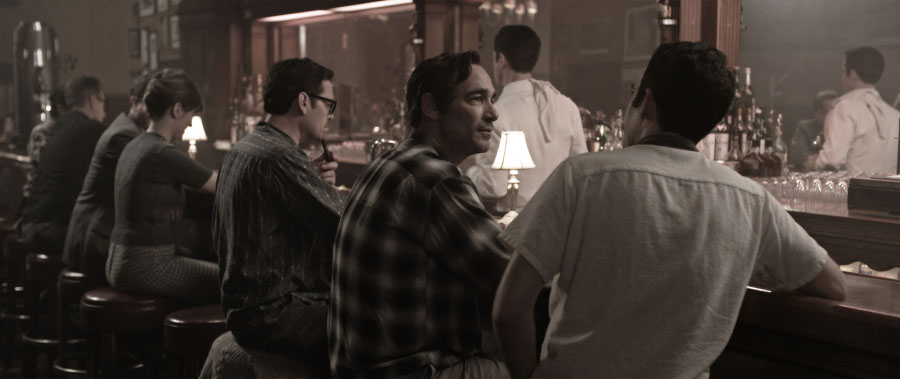
bigsur17.jpg


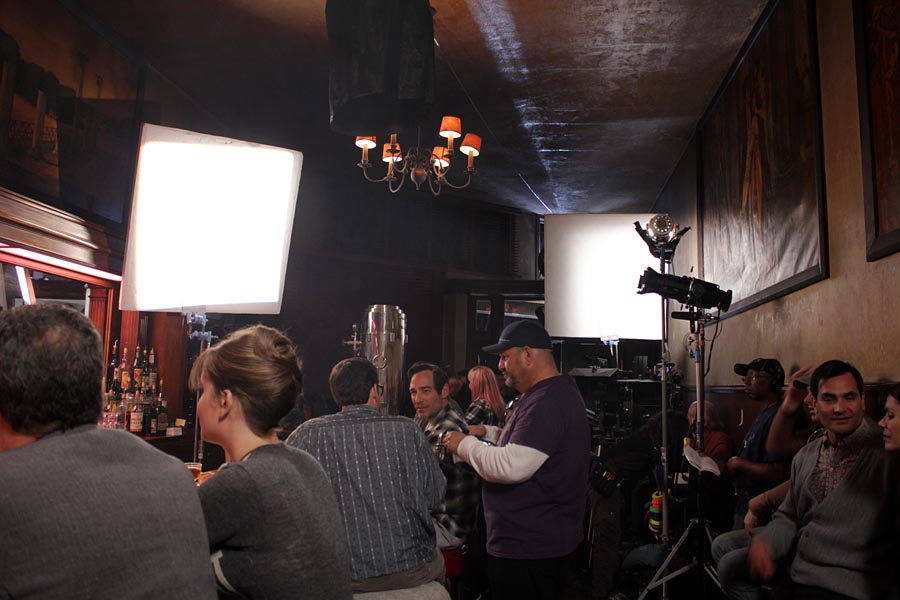
This was a bar that was hard to rig anything to, so I keyed the actors from just off camera with a bounce into a card.
 
Last edited:
There are no rules for whether the fill light should come from directly behind or underneath the camera, or on the key side or on the shadow side. Just depends on the look you want and practical considerations of where the fill light can go. Sometimes it is nice to fill from the key side so you are just basically wrapping the key light further around but still leaving a little of the face falling off to black. Fill from below or above the lens may affect how much you fill-in bags under the eyes versus how much you fill-in under the chin, etc. Now in this case, I may have had the fill above the cameras because passing foreground extras would block the fill if it were below the lens.

bigsur17.jpg


This was a bar that was hard to rig anything to, so I keyed the actors from just off camera with a bounce into a card.

Looking at that image and the BTS in the original post I have some questions about what you did here. I understand the source four and the fill, however I am wondering about very heavily skirted china ball, the back kicker, and the general ambiance light.

For the china ball, what was the purpose and what wattage did you use? Seeing how far the skirting went down on it, the light had to be pretty directional and I don't see obvious play. Seems like any light that I am seeing hitting them is from the key or fill. What I am missing there?

For the back kicker that I am seeing it is hitting harder on the extras toward the back and pretty low on the main talent. Did you just do another bounce card back there, or was it more directional light coming straight through diffusion? And is there any reason you didn't scrim some of that light off the extras so it was a little more equal from the background extras to the talent? I understand a still might not do the moving image justice or for blocking you may have had to do.

As for general ambiance, what did you do? I see the lights over the liquor bottles are on. The bar top practicals are on. And it looks like back to the right of the urn there is either a house light on, or did you bounced some light into the celling?

Thanks.
 
The china ball was just to get some light on the people further down the row, the real chandeliers were too dim to do that. I don't remember what the kicker was from, probably a Woodylight on a stand (small 1K chimera). Ambience was just from the fill and the practicals. The bar owner was very restrictive so I was limited to what I could rig, I couldn't put up any wall spreaders and there were no beams to clamp onto.
 
Back
Top