Welcome to our community

Be a part of something great, join today!

  • Hey all, just changed over the backend after 15 years I figured time to give it a bit of an update, its probably gonna be a bit weird for most of you and i am sure there is a few bugs to work out but it should kinda work the same as before... hopefully :)

Ask David Mullen ANYTHING

David is there a reliable way that you use to calculate roughly what size light units you'd need for particular outdoor scenes.

For instance, let's say you are shooting outdoors in a big field and you obviously know you need HMI's for mediums and closeups, do you at this point just choose units based on experience and by eye? Or do you actually use foot candle/lux calculations to determine how much throw/exposure you'd need at a given distance etc to determine which type of unit you'd need i.e. whether a 6k or 18k or etc.
And do you ever just rely on getting a bigger unit than you'd think you'll need just to be on the safe side?
I remember Roger Deakins said he calculated the foot candles needed etc for the big outdoor night mosco light set up in No Country For Old Men, but I wonder if that's just a special circumstance because that was such an ambitiously grand/rare shot to light, and whether most DP's just order units based on instinct for such circumstances or do you actually look up photometrics of a unit and choose based on your calculation of required footcandles at a given distance etc.?
 
Hi David,

Your are the man with the best info and I have a big dilemma.

This short film I am working on the director wants to shoot in a really dark alley. We do not have access to any of the buildings to place lights, and we only have 1-1.2khmi, 4-arri 1ks, and 4 lekos.

The action is a father and son walking in this "dark" alley, but I need to seem them in the distance (300') as we jib down. They can be in and out of the shadows, but do you think this is enough lights to make it work, and how do you not make it look "lit" when you can only get so high on stands in the alley and not on any rooftops?
I have dumpsters and telephone polls to hide the stands.

Thanks for the help!
 
You could try doing a raking backlight on one side of the alley with the 1.2K HMI, hidden around one corner at the end of the alley, assuming you can't get a condor to get it above the end of the alley. You could, even just point the 1.2K HMI straight down the alleyway from the background, it would reflect off both sides of the alley, but then you may want to block the actual lamp head to camera, either with the actors' bodies as they approach or with some sort of object like a parking sign. This would look rather stylish however, not necessarily realistic.

If you can't get to the rooftops, the other idea is to put some practical lamps into the alleyway, like some sodium or metal halide fixtures, or some security lamps on walls. You can do a combo of all of these ideas, rake the background where the actors begin in dark / backlit, then have them eventually get into the light of a practical lamp.

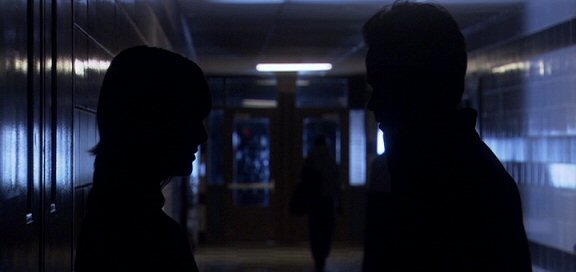
If the walls have some shine to them, a small light right in the middle in the background would glance off of each side, making it seem brighter than the actual light would suggest. I lit the background corridor walls in this shot with a single vertical Kino tube hidden behind the split in the glass doors in the background; the tube reflected off of the walls of the hallway:
quiet2.jpg
 
David is there a reliable way that you use to calculate roughly what size light units you'd need for particular outdoor scenes.

For instance, let's say you are shooting outdoors in a big field and you obviously know you need HMI's for mediums and closeups, do you at this point just choose units based on experience and by eye? Or do you actually use foot candle/lux calculations to determine how much throw/exposure you'd need at a given distance etc to determine which type of unit you'd need i.e. whether a 6k or 18k or etc.
And do you ever just rely on getting a bigger unit than you'd think you'll need just to be on the safe side?
I remember Roger Deakins said he calculated the foot candles needed etc for the big outdoor night mosco light set up in No Country For Old Men, but I wonder if that's just a special circumstance because that was such an ambitiously grand/rare shot to light, and whether most DP's just order units based on instinct for such circumstances or do you actually look up photometrics of a unit and choose based on your calculation of required footcandles at a given distance etc.?

You can get the photometrics from the manufacturer for a really big job where you aren't sure -- I seem to recall that they ended up getting three Muscos for that scene in "No Country for No Men"...

Generally it's just experience from you and your gaffer, plus some hedging... you can always drop in a scrim if you are a bit too bright, just don't be too far off in your guess. Most DP's have lit a street many times and know what sort of stop they'd get with an 18K HMI on an 80' condor from a block away, and they can always spot or flood a bit if needed.
 
You could try doing a raking backlight on one side of the alley with the 1.2K HMI, hidden around one corner at the end of the alley, assuming you can't get a condor to get it above the end of the alley. You could, even just point the 1.2K HMI straight down the alleyway from the background, it would reflect off both sides of the alley, but then you may want to block the actual lamp head to camera, either with the actors' bodies as they approach or with some sort of object like a parking sign. This would look rather stylish however, not necessarily realistic.

If you can't get to the rooftops, the other idea is to put some practical lamps into the alleyway, like some sodium or metal halide fixtures, or some security lamps on walls. You can do a combo of all of these ideas, rake the background where the actors begin in dark / backlit, then have them eventually get into the light of a practical lamp.

If the walls have some shine to them, a small light right in the middle in the background would glance off of each side, making it seem brighter than the actual light would suggest. I lit the background corridor walls in this shot with a single vertical Kino tube hidden behind the split in the glass doors in the background; the tube reflected off of the walls of the hallway:
quiet2.jpg

That's exactly what I did for an alley in my student film. No condors for these budgets. It turned out alright I think.
http://matthayslett.com/?portfolio=misdirection
 
Hey David,

I have a pretty major shoot coming up I am shooting - it is to be an underwater greenscreen shoot on Epic. That is, the subject will be in a tank, the camera dry, outside the tank. Behind the subject, on the other side of the tank, a green screen. We will also possibly do this in slow mo.

My Lighting set up will be a diffused 5K HMI to one side as key, then 2x 2K HMIs on the other side as an edge light (of sorts). Additionally I would like to have a slight fill coming from beneath, more or less in front but clearly this would be seen in any reflection.

David - I have never shot underwater before, let alone underwater greenscreen... my question is, do you see any issues in my set up, and what advice could you give me that would help this go smoothly and avoid any issues in post prod?

Thankyou in advance,

Ivan
 
David,

Question about 45 degree shutter. It's used in Gladiator & Saving Private Ryan. Is it used in all of the scenes or just used in the action bits?

I sometimes have trouble getting enough light for 1/180 in the woods. I love the look. Using natural / outdoor lighting maybe I should look into faster lenses? Even gaining a more few stops from than my current F2.8, it doesn't seem like it can makeup for the exposure drop from 1/48 to 1/180.

Thanks in advance,
 
Hey David,

I have a pretty major shoot coming up I am shooting - it is to be an underwater greenscreen shoot on Epic. That is, the subject will be in a tank, the camera dry, outside the tank. Behind the subject, on the other side of the tank, a green screen. We will also possibly do this in slow mo.

My Lighting set up will be a diffused 5K HMI to one side as key, then 2x 2K HMIs on the other side as an edge light (of sorts). Additionally I would like to have a slight fill coming from beneath, more or less in front but clearly this would be seen in any reflection.

David - I have never shot underwater before, let alone underwater greenscreen... my question is, do you see any issues in my set up, and what advice could you give me that would help this go smoothly and avoid any issues in post prod?

Thankyou in advance,

Ivan

I haven't done something like this; the main thing as always is getting a saturated and evenly-lit green screen that doesn't spill too much onto the subject, so getting the green screen farther back is generally a good idea. You may want to make sure that the sides of the tank don't reflect the green screen back into the rear glass.
 
David,

Question about 45 degree shutter. It's used in Gladiator & Saving Private Ryan. Is it used in all of the scenes or just used in the action bits?

I sometimes have trouble getting enough light for 1/180 in the woods. I love the look. Using natural / outdoor lighting maybe I should look into faster lenses? Even gaining a more few stops from than my current F2.8, it doesn't seem like it can makeup for the exposure drop from 1/48 to 1/180.

Thanks in advance,

Just the action scenes -- the need for more light is the reason why in the first battle in "Gladiator" the shooting went from 45-degree stuff to under-cranked and skip-printed stuff (steppy & smeary) in order to keep shooting into twilight (you'll note that the fires are a lot more exposed too).

You need more light for a 45 degree shutter that's all, whether a mix of a faster lens, more lights, higher ASA, etc. A 45-degree shutter angle is a 2-stop loss compared to a 180 degree shutter angle. So opening up one-stop and cranking the ASA by one-stop may be enough to compensate.
 
I haven't done something like this; the main thing as always is getting a saturated and evenly-lit green screen that doesn't spill too much onto the subject, so getting the green screen farther back is generally a good idea. You may want to make sure that the sides of the tank don't reflect the green screen back into the rear glass.

Thankyou David... I will certainly keep an eye on all of that. Although I have no idea how I am going to kill the spill on the front pane of glass... Perhaps I could suggest a white background and doing a luma key? If I blow out the background enough it could serve as a reasonable, albeit rather even) backlight as well? Or is this asking for trouble?
 
Last edited:
Thankyou David... I will certainly keep an eye on all of that. Although I have no idea how I am going to kill the spill on the front pane of glass... Perhaps I could suggest a white background and doing a luma key? If I blow out the background enough it could serve as a reasonable, albeit rather even) backlight as well? Or is this asking for trouble?


I wouldn't do a luma key unless they are black fish. Just do a green screen -- you may go for it a bit darker if you are having trouble with bounce back, but talk to whoever is doing your efx compositing.
 
I wouldn't do a luma key unless they are black fish. Just do a green screen -- you may go for it a bit darker if you are having trouble with bounce back, but talk to whoever is doing your efx compositing.

Yeah, I will do that... I have had good results with dimming the green before in other situations, so this may work too. Cheers!
 
candlelight

candlelight

Hi David,

Two questions for upcoming low lit scenes.

1) I'll be shooting a scene involving fireflies. With the idea of not digitally adding fireflies later, and doing it with real fireflies, my thought was magic hour would be the best time due to having some overall exposure. Or even if we shoot at night itself and provide some illumination, is there really any way of metering the luminance of a firefly? At least to the degree of making sure it will show up visibly on the image, so that I can add some degree of fill, without overpowering the light emitted from these bio-luminescent creatures? Also, my thought is, a green LED is probably the best bet to mimicking this light for closeups, no?

2) We're shooting a candlelit scene, where supposedly the only light in the room is the candle. Even with production getting some of the "hollywood", thick-wick candles to provide extra illumination, the surrounding background will be muddy and grainy unless some light is pumped into it. In order to get some minor exposure, I would need to provide some degree of fill on the background. But then of course, my contrast between the light on their faces from the candles and the fill in the rest of the scene will be adjusted to not as dramatic of a ratio. Thus, I would need to add film lights to augment the candle light. In your opinion, there's no way around this right? And so my best bet is maybe a skirted chinaball from above, or a small bulb hidden behind the candle itself.

Thanks for your time.

There's no point in metering the light output of a firefly, nothing is really going to be illuminated by that except maybe a hand if one lands on it, in a limited area. If you are going to try to record real fireflies while also seeing some surrounding detail, either you'd need to shoot in late twilight or light to a very low level, at a high ASA, and accept some noise, to get as much exposure from the fireflies as possible. Here's some footage that someone posted on YouTube:
http://www.youtube.com/watch?v=pHtOW4DkHNA&feature=related

A yellow/green LED in the hand may simulate the glow of someone holding a cupped firefly but I wouldn't light a face as if the fireflies were lighting it, that would be a stretch, I'd probably go for some soft dusk or night light that is a bit dim and then see the fireflies in that environment. I mean, I suppose you can try dimming up & down an off-camera LED bulb moving on the end of a stick to suggest a bit of interactivity with the other ambient light.

There are lots of ways to add soft dim warm light for ambience in a room with real candles, too many ways to repeat -- a dimmed-down bounce off of a bed sheet for example, or racks of Christmas tree lights strung on frames, which is what "Marie Antoniette" did.
 
You could try doing a raking backlight on one side of the alley with the 1.2K HMI, hidden around one corner at the end of the alley, assuming you can't get a condor to get it above the end of the alley. You could, even just point the 1.2K HMI straight down the alleyway from the background, it would reflect off both sides of the alley, but then you may want to block the actual lamp head to camera, either with the actors' bodies as they approach or with some sort of object like a parking sign. This would look rather stylish however, not necessarily realistic.

If you can't get to the rooftops, the other idea is to put some practical lamps into the alleyway, like some sodium or metal halide fixtures, or some security lamps on walls. You can do a combo of all of these ideas, rake the background where the actors begin in dark / backlit, then have them eventually get into the light of a practical lamp.

If the walls have some shine to them, a small light right in the middle in the background would glance off of each side, making it seem brighter than the actual light would suggest. I lit the background corridor walls in this shot with a single vertical Kino tube hidden behind the split in the glass doors in the background; the tube reflected off of the walls of the hallway:
quiet2.jpg

Excellent ideas.. Thank you so much..
 
hey David, fun question here: do you believe in astrology? I noticed alot of the top/best DP's are all cancers (i.e. late june to late july birthdays).

looking at imdb birthdays the ones I can think off top of my head

David Mullen - june 26
Janusz Kaminski - June 27
Vittorio Storaro - June 24
Wally Pfister - july 8
Matthew Libatique - july 19
Conrad Hall - june 21

kind of a who's who list of cinematographers, wonder what you think about that
 
David,

I've got a challenging shoot coming up where I need to shoot a fountain at night which is backlit and under lit by bright tungsten lights. In the background is a dimly lit sculpture which needs to be seen in the final product. I cannot use any artificial lights at all to supplement the sculpture. My question is one of exposure and possibly HDRx. 1) Would it be better to expose for the dim sculpture and have say four stops of HDRx deal with the water (a lot of motion involved). 2) Use exposure check and not clip the water and deal with the sculpture in a color correction suite. 3) Set the exposure right in the middle, use a modest amount of HDRx (2 stops) and let the DR of the Epic and a powerful color correction balance it all out.

Any suggestions would be very much appreciated, I'm going to try and shoot some test the day before we shoot, but even with that I won't have the ability to take it into a post suite beforehand.
 
Back
Top