Welcome to our community

Be a part of something great, join today!

  • Hey all, just changed over the backend after 15 years I figured time to give it a bit of an update, its probably gonna be a bit weird for most of you and i am sure there is a few bugs to work out but it should kinda work the same as before... hopefully :)

Ask David Mullen ANYTHING

Hey David, I got asked by the director I am currently shooting for about a setup that we did yesterday in a decent sized kitchen and how to equalize the light. The setup was with three characters, one of them walking inside through a propped open door. Due to it being full sun outside, when I went to get the MCU of the man walking inside, the outside was pretty blown (about 3 stops hotter) Normally, I would try to gel the glass, but an open door doesn't allow for that. Or ,I would try to put a double net behind the talent to get at least one more stop in the highlights. But that wasn't going to work for this because I saw his feet coming in, which means an 8x8 frame would be seen. Plus, I am not super crazy about doing that if I don't have to due to the loss of contrast from the net.

So my question is, how do you go about building up lighting inside to try and equal outside? If only one or two close ups see outside, do you just build it up for those shots, or try to do it for the entire scene? What size heads do you normally try to use for that? I pretty much only have budget currently for 2 1.2k's and 2 575's (boostable 800 watts) Though, I think the director was wondering if budget for future shoots needed to be more allowing for larger for stuff like this. This is just an area where my knowledge is lacking and I want to get better about.

I will get our DIT to get me stills this morning from what we did shoot and post them this afternoon so you can see what I did get.)
 
That's a classic problem that is hard to solve. Sometimes you can attach the double net so that it wraps around the bottom of the net frame so you can run it to the ground and just see that clean bottom edge rather than the gaps and tie-downs.

Yes, the other solution is to raise the light level inside, but that also depends on being able to do it so that it looks natural. In some ways, it's easier with bigger lights because you can make them softer and further away rather than spottier and harsher if trying to get enough output from them. But all of this also depends on where the windows are, how high the ceiling is, etc. Some spaces are hard to use bigger HMI's in.

You have a big challenge because if you see hard sunlight out there, well, the Sunny 16 rule tells you that it gives you an f/16 at 50 ASA and a 1/50th of a second shutter speed. That's a lot of light to match to, but of course that's just the brightest highlights in frontal sunlight, you can get away with exposing more than that. But you still need to think big if you are going to compete with that.

Other tricks:

Place dark greenery outside, since that reflects less light than bright-toned objects -- you'd be amazed at how much you can overexpose a dark green plant.
Pray for overcast weather.
Shoot when the background is backlit or heavily shadowed.
Design a camera move that allows you to bury a stop-pull.
Shoot with the widest latitude camera there is.

Truth is that sometimes you just have to accept a blown-out background, you see it in movies all the time actually.
 
One doesn't apply for ASC membership. The ASC is an honorary society. Prospective members must be invited to join.
 
Hi David, I've been enjoying your work on Smash. Great job! I just was watching the scene where Julia and Michael Swift meet up on the street at night and he tries to apologize for the affair - it's in the episode "Hell on Earth" (Episode 9). I noticed an effect where there seemed to be some sort of unconventional flare coming in at at the sides of the frame. It looked like the lights of the city, but it was exaggerated. It looked too large and obvious to be incidental, and I was wondering how you pulled that off. It was a cool effect! Wondering what your process was in deciding to do it as well. Thanks in advance and thanks for making yourself available here!
 
We used a 1'x1' piece of clear acrylic plastic, 1" thick, sort of like a thick window pane, mounted on a c-stand and placed near the edge of the frame to blur that part of the image and reflect off-camera lights, etc. This was a technique that the director Paul McGuigan brought to the table, he used it a lot on the BBC "Sherlock" series that he did. He loves odd bits of optical artifacts and other in-camera effects. In some other scenes, we tried also using older Panavision Ultra Speed lenses to get more flares from headlamps (the scene where Tom crosses a street at night and talks to Sam sitting in front of Ivy's apartment.) We also used those lenses, plus GlimmerGlass filters, in the liquor store scene where we hid Kino tubes on every shelf to create a heavenly glow emanating from the bottles (Ivy is wearing an angel costume as you recall).

In the "Heaven & Earth" musical show on Broadway, I tried putting fingerprints on the corners of the filters to blur the edges, but it was a bit subtle to catch. We also tried putting some monofilament line in front of the lens and behind the lens to create some odd anamorphic-like flares for a scene that was cut.

We used the glass blocks also in the diner scene with Tom & Sam, the effect looks like there is some glass deli counter or something in the foreground. There are some other scattered shots here and there that used them too. It was a trick that McGuigan liked to try when the backgrounds were a little bit boring, by reflecting other elements into part of the frame, or causing a double-image of the actor to appear. We tried to pick scenes where it made sense, places with window panes and other glass elements. It also worked better on longer-lensed shots, otherwise the glass block was too in-focus. I also found that the glass would reflect off-camera parts of the location so you had to clear more of the set from crew and equipment to get some good reflections.

The other thing that helped that scene with Julia and Michael was that we had a light rain during it, making the streets wet.

I own a lensbaby that I was going to try out on the shot of Ivy when she is in her dressing room having her meltdown, but at the last minute I realized it was a PL-mount and we were shooting with Panavised Alexas with PV-mounts. Since then, I've converted at lensbaby to a Panavision mount, just haven't found a shot to use it on. For that scene with Ivy, I ended up doing some blurring on the edges in post for a subtle swing-tilt lens effect instead.

Like I said, director Paul McGuigan loves doing things in-camera. He told me about an effect in the "Hounds of Baskerville" episode of "Sherlock" where Watson sees a light on a hilltop at night that appears to be flashing Morse code, and you see ghostly letters appear on the screen translating the flashes of light -- those words were etched onto glass filters in front of the lens and when the light caught the glass, they would rack-focus to the filter so the words would be readable. It's very organic-looking.

Since that episode, I used the glass blocks a few more times, and tried a few other tricks.
 
Hi David,

I am due to shoot a feature in the next six months. A good part of the feature is set in a garden. It involves a garden being set up for a garden show with the plants and trees being in various stages of growth. We are thinking of shooting this in a studio and getting all of the plants and flowers made of silk. How would you approach lighting this in a studio? The garden will be around 40 foot by 40 foot. We may blue screen the sides or erect walls or hedges to contain the shot. Obvioulsy I need the ability to achieve different looks. I'd really appreciate your feedback.

Again thank you for being so generous with your knowledge,

Cathal
 
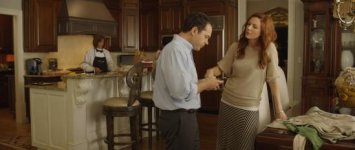
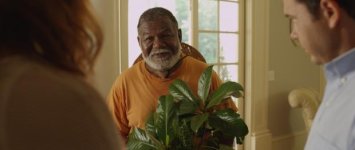
Hey David, here are the photos from that scene that I shot the other day. As you can see, outside the door is just blazing (I did shoot it HDRx on the Epic at 3 stops, so there should be some more detail in post.) It didn't help that there where white columns in the background and that we did need to see that it was sunny outside to match some other shots.

Here's what I had setup to light this. (looking from the wide two shot)

To their right through double doors (like the one in the background of the gardener) I had a 1200 HMI shooting through 1/4 grid. To the right of them, a 4 bank kino diva shooting into the ceiling to bring up levels in the room-along with another diva behind the counter to bring the dark cabinets up some. To the left of them in the living room I have a 575 HMI bouncing into a 4x4 ultra bounce. Also a 1k, a 650, and some ceiling tungsten lights gelled with 1/2 CTB to bring up some back rooms/hallways.

When I moved to get the CU of the gardener, I took the diva and made it a left side for him since my 1200 through the 1/4 grid was a little too back key for his dark skin (which was another issue.) So he looks fairly good matching the other two characters for look, but that outside just went bad. So what size HMI through how big diffusion (4x4, 8x8?) do you think it would take to get him up 3 stops to try and match the background? Would it be something as simple as a 575 through something like 216 or bouncing off 4x4 white card and then add some level on the inside background to match?

I may in reality not been able to do much differently. There was a kitchen table I couldn't move, and only about 4' between the table and the wall. But I want to be able to figure out the best ways to bring levels up and things looking better.

Thanks so much for helping people learn how to light better.
 

Attachments

  • V028_C010_050471.0000321.jpg
    V028_C010_050471.0000321.jpg
    15.3 KB · Views: 0
  • V027_C008_0504AT.0000986.jpg
    V027_C008_0504AT.0000986.jpg
    16.5 KB · Views: 0
  • V028_C003_0504EL.0000923.jpg
    V028_C003_0504EL.0000923.jpg
    15.3 KB · Views: 0
  • V027_C007_0504T3.0000754.jpg
    V027_C007_0504T3.0000754.jpg
    20.3 KB · Views: 0
  • V028_C010_050471.0000695.jpg
    V028_C010_050471.0000695.jpg
    16.9 KB · Views: 0
Since you only had one angle looking right out the door, that's the only one where you'd need to boost the light levels. Truth is that I'd probably use a 4K or 6K HMI for a soft side key light (softened how depends on the space), and 1.2K's bounced for fill, or maybe an Image 80 Kino. I may have used another 6K HMI outside the door for a soft kicker when he comes through the door. I'd also have tried to get the art department to break-up the white columns with some tall plants.

Or I would have scheduled that one angle for when the sun wasn't hitting the background so much. Since the far background had greens that didn't burn-out to white, it's really the mid ground that is too bright, so I wonder if flying some 20'x20' solids over it would have helped take down the brightness.
 
Hi David,

I am due to shoot a feature in the next six months. A good part of the feature is set in a garden. It involves a garden being set up for a garden show with the plants and trees being in various stages of growth. We are thinking of shooting this in a studio and getting all of the plants and flowers made of silk. How would you approach lighting this in a studio? The garden will be around 40 foot by 40 foot. We may blue screen the sides or erect walls or hedges to contain the shot. Obvioulsy I need the ability to achieve different looks. I'd really appreciate your feedback.

Cathal
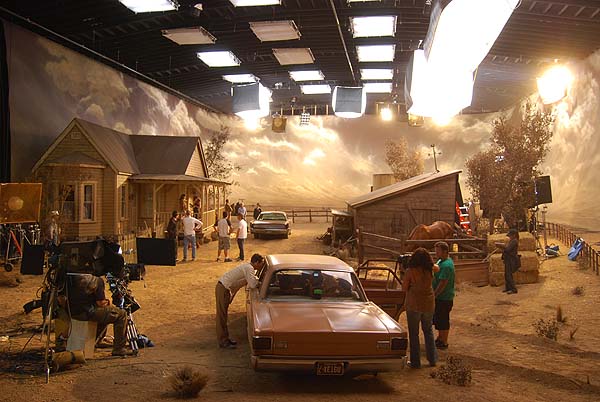
If you want this to look realistic, you want to recreate a very soft blue-ish overhead skylight and then warmer hard sunlight. Having some trees or architectural items that break-up the sky in theory (if off-camera) will help not having to recreate a single source effect of one hard light covering the whole backyard because that's very hard to do. But if something could logically be breaking up the sunlight, then you can have pools of hard sunlight from a couple of units.

I'd suggest using daylight fluorescents for the soft overhead effect, maybe from banks of 6'x6' blanket lights, or lots of Image-80's or Lumapanels. Then I'd set the camera for something like 4300K so that the overhead light was somewhat cool, then use strong tungsten units for warm sunlight, perhaps with 1/4 Blue on them for midday light, then warm them up more and more for the sun setting. For a sharp sun, you may need to use a 20K, for strong backlight where the shadow pattern isn't an issue, then a 12-light Maxibrute may work, maybe with some spot globes.

You may want to review my posts on shooting "Manure" where I did a lot of faking daylight inside. I used a mix of daylight Kino blanket lights overhead plus some HMI balloon lights, then 12-lights for the warm sunlight. However, since the movie was timed so warm and desaturated, you don't see the blueness of the shadows compared to the warmth of the sunlight:

manure%20set1.jpg


900manure2.jpg


If you do have some sky in the background, I suggest overexposing it -- I had to pound that sky backing an 18K HMI on a stand to get it to look hot since it was painted a medium brown.
 
David,

What an amazing set! The image is really beautiful. Thanks for the really helpful solid advice. I am looking forward to reading your Manure blog and seeing the finished film which looks incredible.

Really appreciate it. Cathal
 
Thanks for the reply David! I'm really inspired by the amount of care you are able to put into your work. I shot my 2nd feature last fall - 2 Alexas with Optimo zooms and old Zeiss standard speeds - I've been noticing the varying levels of halation on Smash and was wondering what your approach was - good to know - and always motivated I think. The scene where Ivy has her breakdown I though was really amazing. The golden light with the multiple mirror reflections and that overhead view of her waking in that angel costume. In episodic television you don't see that kind of emotive cinematography all the time. The visuals had a real presence of their own. How quickly do you guys have to work? On the feature that I shot we were averaging 4-5 pages per day and it felt like all we could do to get really solid images on screen, much less some of these more esoteric things. How do you find the time and energy to keep up with everything?
 
We have to average about 6 pages a day in episodic TV, which is not easy when you have musical numbers to shoot within that schedule. We also stick to a 12-hour day.

It's always the same problem, if you take more time on "x" you have to subtract some time on "y", and probably drop "z". TV crews, mine in particular, are very fast and efficient, which makes a lot of this possible. Those dressing room scenes were always easy to light because the lightbulbs around the mirrors do 99% of the lighting -- but a room wrapped in mirrors is time-consuming in other ways that counteract the time gained from not having to do much lighting. And some of those rooms are not only tiny, but even though they are sets with some pullable walls, as soon as you pull a wall, you see it missing in one of the mirrors, so that doesn't help much.

One advantage in TV work is that half the time you work on existing sets that you return to once an episode, so you get a lot of chances to light the same space over and over again and learn what works best -- there is less time spent figuring things out.

And the more that the directors can give me advance warning of complicated set-ups that need a wall pulled or a special piece of equipment, the more likely that we can get it set-up in advance. Since we don't alternate DP's on the show, I don't have any pre-production time spent with the director, so I rely on the AD and the director to tell me what they have planned, and the best boys who go on the tech scouts. But there is also a certain amount of winging it on the day, so it helps to be fast and flexible, on everyone's part.
 
Thanks David for the advice on equalizing inside/outside light last week. You made me feel much better about what I told the director what I thought we'd need to make the outside not so hot when you mentioned 4-6k HMI's, because that's what I told him from my gut. Now, does that mean I'll have those large lights on his next shoot? Probably not, but I have a much better idea on how to minimize the issue via the art department and more careful planning!

So this is what I am wondering now. How do you approach the 180 rule? The director and I from this last shoot really wanted to push the 180 line more and more so we get more of the room in a scene, keep a scene fresher, and allow the talent more freedom to make the scene come alive. But I kept running into the issue with the director saying, "I don't think that would cut" (which that applied to more than just the 180 rule, but that's a whole another question I have.) So how do you work with directors when it comes to blocking, and framing shots so the audience is not confused? Are you the type (and it may depend on the director that you are working with) that stays on top of the director for visual direction of the line? Do the directors you work with have a good sense of that, or none at all?

For example, we had a scene in a soup kitchen where two characters start with one walking up to another and then sitting down and having a conversation. We shot it with a wide from one side, creating the line and then moving in for OTS's. At one point I wanted to jump the line for a wide shot from the other side that he could cut into later in the scene for variety and then could either switch back to the OTS's on the original side of the line, or switch to new OTS's on the "wrong" side of the line. Maybe I was just crazy, or the fact that I've seen it done and it didn't seem weird to me that made me want to try it--though we didn't in the end.

I want to be more daring in this aspect and help the directors I work with explore more since it's easy to work yourself into a corner by staying on one side of the line. So along with what I kinda asked above how you approach it, do you have any books, articles, etc. that talk about this and any movies where the director & dp did a good job beautifully crossing the line?

Thanks,

Matthew
 
You have to learn if things will cut or not and tell the director. Now sometimes a more conservative script supervisor may disagree and you'll have to convince both of them, but in general the script supervisor should be your collaborator in helping the director regarding the 180 rule.

In general, the line mainly matters in intercutting close-ups of people looking at each other. Otherwise, as long as people aren't confused, then you can do what you want (and if you don't mind them getting confused, then it doesn't matter, cross the line as much as you want.)

For example, if two people are established sitting in the front seat of a car, one driving and the other is a passenger, you can pretty much cover them from any angle, no audience member is going to be confused as to who is driving and who is the passenger and who they are talking to. At that point, the only argument for keeping the line in close-ups that will be intercut is that it will create a stronger emotional bond between the characters if the eyelines are tight to the lens and have the correct screen direction.

But as for cutting to a new wide shot in a room that crosses the line, go ahead, it's a wide shot.

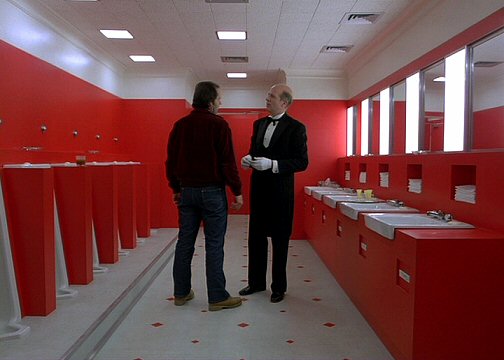
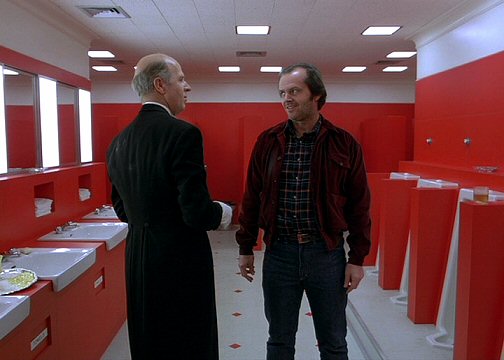
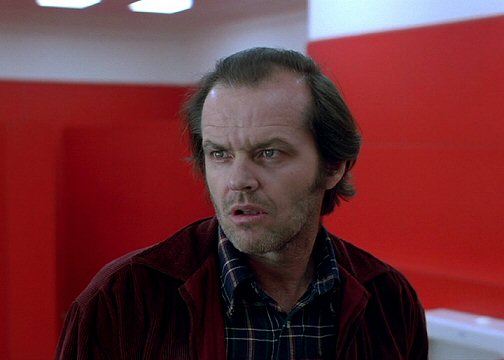
Look at this scene from "The Shining". Kubrick shoots a wide shot from both directions that are dead opposite angles in order to stay symmetrical to the room, so people cross the line. But in the close-ups, he picks a line to match the reverse angle close-up to:

shining1.jpg


shining2.jpg


shining3.jpg


shining4.jpg


You look at the first two shots where the 180 line is crossed and it's clear who is talking to who, there's no confusion and the two shots intercut fine.
 
i guess jack is talking to himself on that sequence..he s looking at the mirror actually

Mr.Mullen Did you test anamorphic lenses on Red Epic? Do you think you ll shoot anamorphic movie in future (on digital)
 
David,

Advice that one reads all over the internet and hears from a lot of people in regards to getting into the industry and learning the tricks of the trade is to get on sets and ask a lot questions, "pick the crew's brains." This summer I will have the opportunity to be on set of an independent feature in the budget of about 10 million dollars, it will be my first time on a "real" set. I think this is a great place to learn a lot of things I haven't had access to yet in my experiences filming. Not too big, not too small. My question is how does one approach a DP, first AC, gaffer, etc to ask things without getting in the way or being annoying? I know I will be learning a lot by observation, and I know the answer to my question varies depending on the individuals. How do you deal with interns/PAs/other crew members approaching you and what do you think is the best way to establish some sort of communication?
I know you hear it a lot, but sincerely I want to thank you for your on going dedication to the filmmaking community. I have learned a lot from your posts here and the Roger Deakin's forum, and subsequently watching films you have worked on trying to keep in mind the information you post.
 
Back
Top