Welcome to our community

Be a part of something great, join today!

  • Hey all, just changed over the backend after 15 years I figured time to give it a bit of an update, its probably gonna be a bit weird for most of you and i am sure there is a few bugs to work out but it should kinda work the same as before... hopefully :)

Ask David Mullen ANYTHING

Hi David,
We are working on a scify show and we would like to use a water tank to create some VFX elements to supplement 3D work. Think Tree of Life or CLose Encounters, but not as ambitious! Do you have any suggestions or resources we could look at? We'd like some help with inks/chemicals, frame rates, lighting strategies, etc.

Thank you!
 
hi david,

a short i'm shooting in the near future talks about a pulsating light above a doorway as a character walks towards it. now pulsating or flickering (on to off) seems like can only be done with a faulty connection. so my thought is to just have the connection of the light barely connected and just continue to barely create the connection between male and female ends of the plug. is there any other way of creating an effect like this that you can think of? my thought is a flickerbox will cause the light to just dim and never go out.

-dan
 
A Magic Gadget type flicker box allows you to set the high and low levels of the light during the flicker, and the rate, but I guess the question is how random it has to look, and do you see the light itself and why is it flickering / pulsing. Is it a tungsten light bulb on camera or a fluorescent tube? Or some sort of metal halide or sodium lamp? Or is it off-camera? If so, I find it better to blend two or three lights through some diffusion into one source so each can have its own flicker rate and intensity, or one left normal, so the effect is more random and subtle. And personally, I ultimately prefer something done by waving fingers or hands in front of the light because it feels more organic. For example, I recently did a fireplace effect by bouncing an orange-gelled Source-4 Leko into a card and having someone randomly wiggle their fingers in front of the lens of the Source-4.
 
sorry, i should have been more specific. the light is in frame. it would be a hanging practical above a doorway (or something similar to that effect). my thought was to run my own power from that practical, along with a film light above this lamp to intensify the kick it gives to the actor as he walks to the door.

and so i'm looking for a strong flicker of mostly on and off. so that's why i think that a magic gadget wouldn't work because it will just flicker in between your highs and lows that you set on the dials instead of mostly fluctuating between on and off.

my thought was to use a tungsten bulb for the practical, but i suppose a 2' flourescent could also work.
 
I guess someone who knows a bit of electronics and electricity could very easily build a relay controlled by a programmable microcontroller (e.g. an Arduino). You could even use it to control it with a notebook over USB.

Cheers

Erik
 
A flicker box can make the highs and lows fairly extreme, it's just that it starts to look like someone is just switching the light on and off, which you can do easily at a switch. To feel more organic, a flicker should vary in its peaks and valleys otherwise it's sort of strobe-like, as if you are at a disco.
 
David, what are your thoughts on a DFN effect?

Specifically, I am looking at trying to do DFN because I need a scene to occur in a vast remote outdoor location that could not be lighted otherwise. Do you think they look cheesy or can they be done well? What is your preference?

A few options I've been noodling...
-The DFN filter
-Formatt Monochrome Day for Night
-Combination of 80A (to saturate the blue channel), ND (to underexpose) and maybe some diffusion and then tweak in post
-normal NDs and then do it all in post
-Bail on the idea...restage the scene to only be closeups and therefor being able to film with smaller lights at night
 
I think DFN can be done well, but it will always be a stylized night effect, though big HMI's on condors is also a form of stylization, it's just that the audience knows that it was shot at night no matter how badly lit the scene is. The best DFN I have seen has involved some post work to replace the skies in wide shots. I would consider blue filters + ND (and maybe Polas and ND grads), diffusion only if I wanted that effect.

You may want to pump some light or reflectors through diffusion for close-ups so that once you darken the shot enough to look like night, you can still see your actor's faces.
 
Hello David,

I'll be directing a short film this August where the climax of the film will occur during a house fire. I have a general idea of how I want to approach this but wanted to know your thoughts.

From my research, the smoke of house fires is often white in color. However, having fortunately escaped from a burning building myself I remember the smoke being quite black in color. There's not really any way to modify the color of smoke from smoke machines is there? So should I simply count on flooding the set with as much white smoke as possible and hope that using enough negative fill will give the scene the dark disorienting look I'm after? Or is there an option I'm unaware of to get black smoke from a smoke machine? Does either option leave lots of residue (from the smoke machine) on the walls and furniture of the set?

Second part of my plan was to use interactive lighting rigs to simulate flickering fire. Haven't drawn up exact plans for these yet and not even entirely sure these rigs would be necessary.

Thirdly, I was planning on obtaining three 4' propane bars to hide in the shot and to create flickering flames in the foreground. Would I be able to substitute my fire-lighting gags with just one of these bars for lighting? I have never shot with these before, so any general advice on their use would certainly be welcome.

Finally, should I be completely ruling out the possibility of shooting this on a practical location? We're still in the early stages of scouting right now, and still looking for an empty house that could be used.

Do you think I am stretching the abilities of these instruments too far to create a realistic burning interior?

Thanks very much for your time.
 
I am loathe to give advice to someone doing something this dangerous, I'd be talking to your licensed fire efx and stunt people. Yes, flame bars can be used as light sources if that's enough exposure for you -- often they are used for close-ups but wide shots sometime need something bigger using lights to simulate firelight, unless the fire itself is enough light. The issue is mainly how much do you want to expose for the bright flames versus the people lit by the flames. If your camera has enough dynamic range, you can usually capture detail in both, but otherwise, you sometimes set the exposure for the fire and then bring up the light level on the actors to balance the two, you just don't want to overdo it. It also depends on how deep an orange you want the flames to be versus how hot and bright.

As for black smoke, I don't know what the current safety rules are for that since it is rather toxic and damaging to lungs. In the old days, some movies used to burn rubber tires for black smoke in the background of war scenes, but that was outdoors and often they still ran afoul of locals and safety issues, etc. I don't know how black smoke can be created safely on an interior if anyone has to breathe it.
 
David, I was just checking out some grabs on your website and was amazed by many of the shots, but in particular the one from Manure. Camera is under the overhang of the motel looking towards the sign. The framing and lighting is just so surreal as with many of your films. Do you have any BTS shots of this?! I would love to see how you achieved that amazing look..
Do you have a BTS page? I would love to get a link if you do..

Thanks for your time..

-- Justin
 
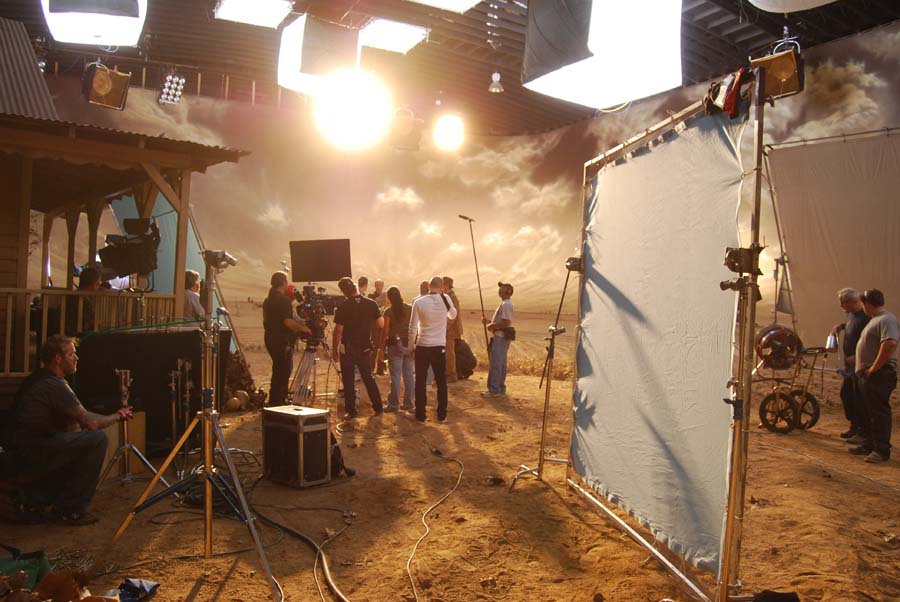
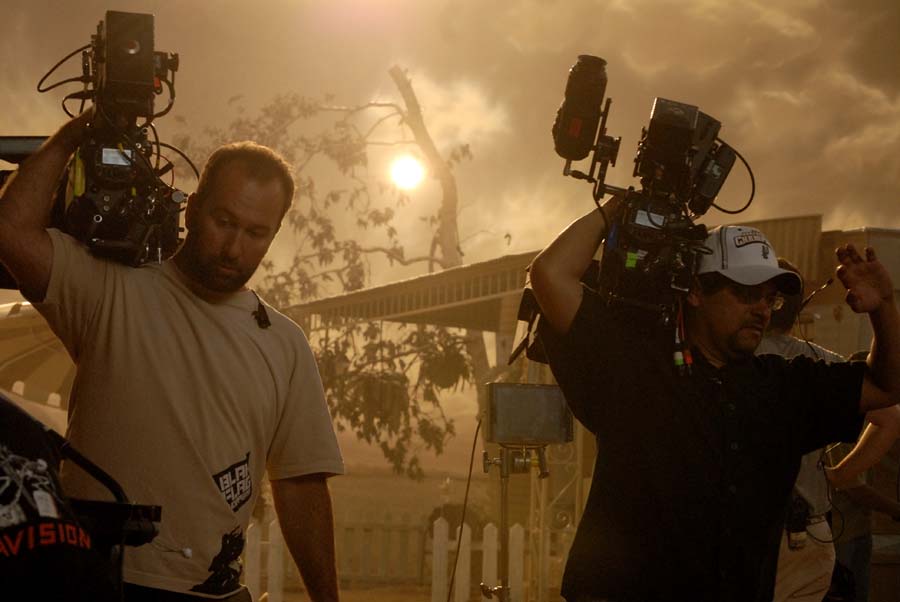
I don't think I have a photo showing the BTS of that particular shot, but the trick was similar to the other shot of the mobile home, where I hung a 2K in a tree branch pointed into the lens to make it look like the sun was in the sky.

In this shot, a 5K was placed on the ground at the base of the set where it met the sky backing:
manureset3.jpg


Here's a shot of the farm set:
manureset4.jpg


Here's a photo of my AC's with the mobile home set in the background, you can see the 2K hanging in the tree behind them.
manureset5.jpg
David these are amazing! So amazing because even though it's a set it still looks real in the BTS pictures! Absolutely amazing, thank you very much for the stills and detailed info..
 
David,

What is your favorite method for defusing kino's? I am not having the best luck with the egg crate and don't want to choke the light too much.

Also, I am reading 'Film Lighting, Talks With Hollywood's Cinematographers and Gaffers' and was delighted to see you in there.

Thanks,

-Erik V.
 
What is your favorite method for defusing kino's? I am not having the best luck with the egg crate and don't want to choke the light too much.

Egg crates are not for diffusing sources. They are designed to reduce sideways spill from soft sources, thereby making them more directional.
 
Back
Top