Welcome to our community

Be a part of something great, join today!

  • Hey all, just changed over the backend after 15 years I figured time to give it a bit of an update, its probably gonna be a bit weird for most of you and i am sure there is a few bugs to work out but it should kinda work the same as before... hopefully :)

Ask David Mullen ANYTHING

What kind of light is behind the diff frame in this photo, do you think, and why was it chosen:

http://www.anlimara.com/ashecliffe/shutterislandfirst.jpg

The pattern on the frame looks very hard and the spill is not bad. I would guess a zip light based on shape, but the shadow is too precise on the frame for it to be a soft source, unless it is just extremely close to the frame. Quick question, just curious since I like the soft offside key look and you seem to use this style, too. Any general advice for using this style? Any tricks hiding fixtures or strengths of diffusion you prefer? Thanks.
 
What kind of light is behind the diff frame in this photo, do you think, and why was it chosen:

http://www.anlimara.com/ashecliffe/shutterislandfirst.jpg

The pattern on the frame looks very hard and the spill is not bad. I would guess a zip light based on shape, but the shadow is too precise on the frame for it to be a soft source, unless it is just extremely close to the frame. Quick question, just curious since I like the soft offside key look and you seem to use this style, too. Any general advice for using this style? Any tricks hiding fixtures or strengths of diffusion you prefer? Thanks.

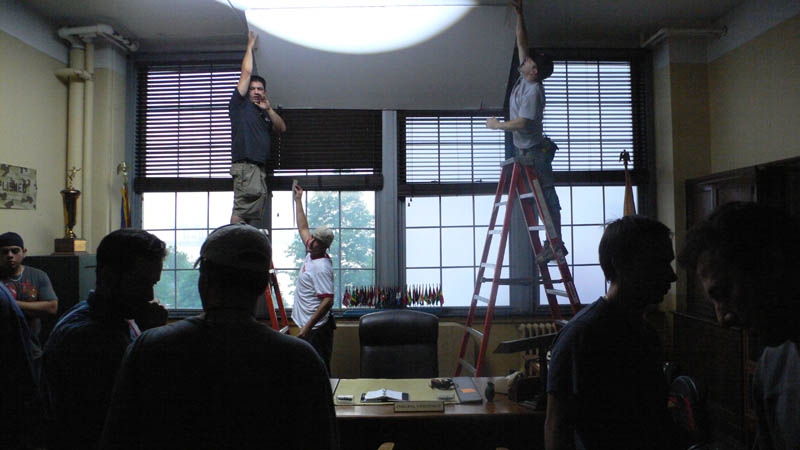
It's an ETC Source-4 Leko (probably the 750w tungsten version) bounced into the white board with the top & bottom louvers/slides cutting into the projected circle. I use them all the time. This is a shot from one of my shoots where I was using a Joker 800 HMI adapted for a Source-4 Leko:
assassination3.jpg

(In the photo we hadn't tilted the projected circle yet into the card and then cut it because the grips were still rigging it -- I had it tipped partly into the ceiling as a work light because the daylight was fading.)

Here's a photo of a ETC Source-4 Leko:
http://www.prolightingdepot.com/ETC-SOURCE-4-LEKO_p_176.html

You have to use all sorts of strengths of diffusion because every situation is different.
 
Thank you David.

Given I plan on shooting at ISO 800 on my EPIC when I get it,
what sort of HMI would you suggest I use for creating a Blue Moonlight
type effect where the fixture is outside of the set/room at say 40 ft away?

I ask because I keep thinking that I need a very bright HMI, like a 4K etc.,
but now with only roughly 6 fc needed (I'm generalizing) I'm thinking
a 1.2K HMI would do it.

Also, is 40 ft away far enough to make the light falloff look natural?
A 1.2K HMI 40ft away sounds about right for hard moonlight effect thru a window. Sort of depends on how much stop you want and whether the moonlight is mixed with other sources on in the room. If the moonlight is falling in a room with other sources (like candles, a fireplace, etc.) then it probably should look fairly dim, whereas if the moonlight is the only source of light in the room, it can be a bit brighter -- it's almost more like lighting a day interior in terms of technique. How big an HMI you use depends on the stop you want, the size of the windows, the distance of the lamp, etc. If I were doing a big action scene in moonlight, I'd probably opt for more light level and stopping down to make life easier for the focus-puller.
 
So that's not a diffusion frame at all but an 8x4 of beadboard (both in your set up and the one in Shutter Island)? Do you generally use direct bounce in these situations or add some diffusion? Have you ever used the shiny side of the board to simulate more direct light? I'm guessing the window on the right in that photo has diffusion (or 1000H?) covering it and I think I see what you're getting at with this set up.

The advantage of the leko is simply that you can use the in-light shutters to cut the beam to exactly the same shape of the bounce card and not spill since it's sharp, right? Or is it also that the bounced light has a slightly different quality? Am I correct in guessing that the source 4 is on a pigeon plate or mini baby stand (to use the polite terminology in both cases) angled up from below camera?

I imagine you can't use smoke in these kinds of set ups because the light on the ground would blow up, but otherwise this seems like a great approach for day interiors and night interiors alike...bead board seems much easier to rig than a soft box, for instance, and I love the quality of light from bead board.
 
Last edited:
I can't tell in the "Shutter Island" photo what was used, it could even be a diffusion frame with the Source-4 behind it, though unlikely looking at the wall behind the white shape, it's probably a white card of some sort and the Source-4 is hitting it frontally.

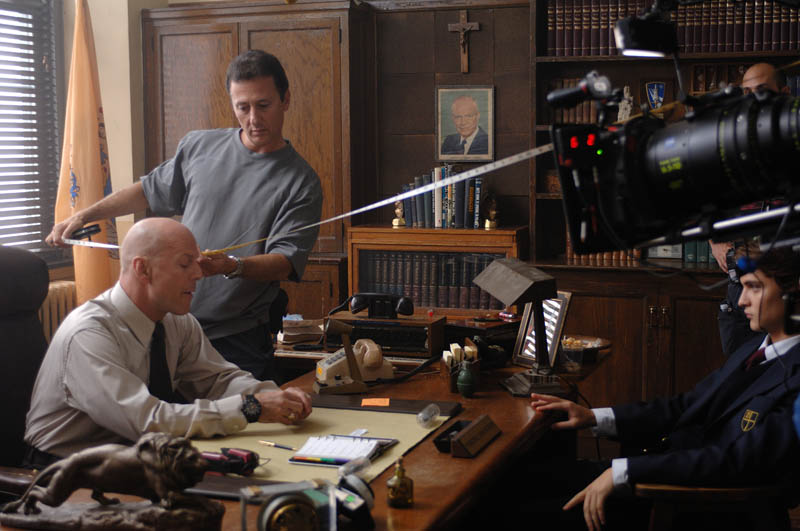
In that photo from my shoot, we were in the middle of covering the windows with 1000H in order to blow it out with an HMI after it went dark outside, then I dropped the blinds down over the whole thing. The bounce above the window was to create a soft backlight as if the windows were lighting the desk. Here's another angle shot after it was night outside:
assassination4.jpg


Yes, when using Source-4 Lekos, you have to be aware that they will create a beam of light in a smoked set. In my case, the light was high on a stand so the beam was above the frame.

Whether to use a beadboard bounce or a soft box all depends on which is easier to rig and which is easier to shoot around -- if I had to do a 360 degree camera move, then I probably would have rigged a soft light of some sort rather than a bounce rig, unless I could have rigged the light hitting the card to the ceiling as well, but at that point, it might be simpler to just rig the soft light.
 
A 1.2K HMI 40ft away sounds about right for hard moonlight effect thru a window. Sort of depends on how much stop you want and whether the moonlight is mixed with other sources on in the room. If the moonlight is falling in a room with other sources (like candles, a fireplace, etc.) then it probably should look fairly dim, whereas if the moonlight is the only source of light in the room, it can be a bit brighter -- it's almost more like lighting a day interior in terms of technique. How big an HMI you use depends on the stop you want, the size of the windows, the distance of the lamp, etc. If I were doing a big action scene in moonlight, I'd probably opt for more light level and stopping down to make life easier for the focus-puller.

THANK YOU DAVID!
 
Thank you, that's tremendously helpful. I hope you don't mind if I just ask about two more details:

What lens do you use with the leko? Or do you bring a few lenses with you?

Do you find that there's a substantive difference in quality of light between a bounced 750w leko and, say, a chimera soft box or even a couple lightly diffused 4x4 kinoflos above the windows? For whatever reason the bounced light in the set up you posted looks nicer, more directional to me than what I'm used to with soft boxes, which spill like crazy, but that also might have to do with who's doing the lighting and some deficits I should own up to in a few things I've tried...

Anyhow, thanks again.
 
Last edited:
The softness of the light is determined by the size of the source (the source being the illuminated diffused area) relative to the subject. So if a light fills a 4x4 beadboard frame evenly, it shouldn't look much different than a light that fills a 4x4 diffusion frame evenly. All that different heavinesses of diffusion does is determine how evenly the light fills the frame versus having a hot spot in the center or allowing specular light to leak through. And some bounce surfaces can be shinier than others. As for spill from the soft light or a bounce, that would be the same unless you cut the soft light in some way with flags, eggcrates, etc.

Of course, there can be textural differences when using different materials for bounce or diffusion (plus color casts) but that is mainly just due to how much specular light comes through and how unevenly the light is diffused.

I alternate all the time between bounced light and diffused light, it's mainly a practical issue, a time issue, etc. For me it's generally easier to rig a white card to a ceiling or wall than an electrical fixture, but as I said, you have to factor in the placement of the light being used for the bounce, which ends up in front of the surface instead of behind it. Sometimes it's easier to hide a Kino tube, for example, behind a piece of furniture than a card and a light to bounce into it, sometimes it's the opposite, the card is easier to hide and it's possible to hide the light hitting it elsewhere off-camera. I like bouncing tungsten when possible mainly because it's easier to dim if necessary, if you tape a Kino tube to a wall, it's hard to knock it down in half-stop increments, for example (I use things like ND gel, bobbinet, and black paper tape to do that.)
 
Awesome, thanks for the insightful reply. I'm amazed by how clearly you articulate this stuff (and of course the footage looks great, I now have to rent this movie after seeing so many nice frame grabs).
 
Last edited:
Hi David,

I love the Lomo Anamorphic look in this short by Alexander Alexandrov :
http://vimeo.com/32437922

Could you recommand another lens that gives a similar soft and beautiful look (as I would like to avoid cropping) ?

Thanks in advance.
 
Hi David,

I love the Lomo Anamorphic look in this short by Alexander Alexandrov :
http://vimeo.com/32437922

Could you recommand another lens that gives a similar soft and beautiful look (as I would like to avoid cropping) ?

Thanks in advance.

Panavision C-Series and High-Speed anamorphics, JDC anamorphics, Todd-AO 35 anamorphics -- all a bit hard to find or require a Panavision mount to use.
 
Panavision C-Series and High-Speed anamorphics, JDC anamorphics, Todd-AO 35 anamorphics -- all a bit hard to find or require a Panavision mount to use.
Thanks for your answer, David.

I was looking for non-anamorphic lenses in order to avoid the cropping. Could a similar soft look be found with other standard lenses ?
 
David,
On the issue of flashlights on screen, I know that usually there are those special high powered cinema flashlights. However, recent advancements in LEDs have created some extraordinarily bright pro flashlights (those selling in the $100-$400 range). Have you tried any of these?
 
Thanks for your answer, David.

I was looking for non-anamorphic lenses in order to avoid the cropping. Could a similar soft look be found with other standard lenses ?

But if you shoot with spherical lenses, won't you be cropping to achieve a 2.40 image? Almost all formats require cropping of some sort of another, so I don't see why it is so important to avoid cropping. I shot my last Epic movie at 2:1 framed for a 2.40 crop using spherical lenses.

It's hard to find old spherical lenses that are soft enough without using filters, but you could try Super-Speeds wide-open if you can't find really old lenses like Baltars and original Panchros, etc. Panavision has some old "Ultra Speeds" which are fairly soft wide-open. Otherwise, you could try some 1970's Cooke or Angenieux zooms but you won't get that shalliow-focus look except at the longer focal lengths of the zoom. But even with those zooms, I might suggest some filters to help "milk up" the image a bit.

I think older but FAST primes are your best bet because the shallow-focus will help a lot in terms of getting that anamorphic lens feeling. And of course, there are Blue Streak filters...
 
David,
On the issue of flashlights on screen, I know that usually there are those special high powered cinema flashlights. However, recent advancements in LEDs have created some extraordinarily bright pro flashlights (those selling in the $100-$400 range). Have you tried any of these?

Not yet, but I'm sure they'd work... the main problem I have with LED flashlights is that most of them are daylight-balanced, so you get a blue-ish beam in a 3200K situation. I guess more and more viewers will be fine with that, but I come from a generation that expect flashlights to put out a 3200K beam. The other problem with LED flashlights is that you don't often get that classic circular pattern (the ghost circle with the hot center spot) on a wall from them -- again, that may just be a generational thing, these days you can justify almost any beam pattern on a wall from a flashlight.

It may be more of a design issue, whether a character should feel like they are carrying an "old school" flashlight versus a modern "high-tech" flashlight in terms of the quality and color of the beam.
 
But if you shoot with spherical lenses, won't you be cropping to achieve a 2.40 image? Almost all formats require cropping of some sort of another, so I don't see why it is so important to avoid cropping. I shot my last Epic movie at 2:1 framed for a 2.40 crop using spherical lenses.

It's hard to find old spherical lenses that are soft enough without using filters, but you could try Super-Speeds wide-open if you can't find really old lenses like Baltars and original Panchros, etc. Panavision has some old "Ultra Speeds" which are fairly soft wide-open. Otherwise, you could try some 1970's Cooke or Angenieux zooms but you won't get that shalliow-focus look except at the longer focal lengths of the zoom. But even with those zooms, I might suggest some filters to help "milk up" the image a bit.

I think older but FAST primes are your best bet because the shallow-focus will help a lot in terms of getting that anamorphic lens feeling. And of course, there are Blue Streak filters...
Very good point about the cropping. I didn't see things that way... until now.

Thanks again for you answer and your time, David.
 
Not yet, but I'm sure they'd work... the main problem I have with LED flashlights is that most of them are daylight-balanced, so you get a blue-ish beam in a 3200K situation. I guess more and more viewers will be fine with that, but I come from a generation that expect flashlights to put out a 3200K beam. The other problem with LED flashlights is that you don't often get that classic circular pattern (the ghost circle with the hot center spot) on a wall from them -- again, that may just be a generational thing, these days you can justify almost any beam pattern on a wall from a flashlight.

It may be more of a design issue, whether a character should feel like they are carrying an "old school" flashlight versus a modern "high-tech" flashlight in terms of the quality and color of the beam.

You're right, the modern LED flashlights are high kelvin. But personally, I think flashlights should be bluer, it at least looks cooler. But you're right, that might be a generational thing.

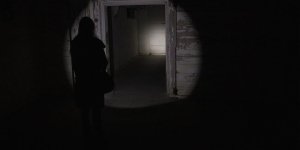
I used a 600lumen flashlight on an Epic shot and here's the frame grab, it did have the classic circular pattern of the ghost circle with the hot spot in the center.
 

Attachments

  • EpicFlashlight.jpg
    EpicFlashlight.jpg
    19.2 KB · Views: 0
Hi David
Do you have any specific advice to offer to someone just building a reel? Is it ok to do pro bono work? If yes, what is the best way to go about finding local business that may be interested in short promotional pieces?
 
Hi David
Do you have any specific advice to offer to someone just building a reel? Is it ok to do pro bono work? If yes, what is the best way to go about finding local business that may be interested in short promotional pieces?

Anything that allows you to shoot footage for your reel is a good thing. Not sure about how to find such opportunities though; I made dozens of my own shorts before I went to film school and in film school I photographed over 16 thesis projects, so I had plenty of material for a reel when I graduated.
 
Back
Top