Welcome to our community

Be a part of something great, join today!

  • Hey all, just changed over the backend after 15 years I figured time to give it a bit of an update, its probably gonna be a bit weird for most of you and i am sure there is a few bugs to work out but it should kinda work the same as before... hopefully :)

Ask David Mullen ANYTHING

Hi Sir David, i just want to verify it to you as one of the best moderator here at reduser.net.. Im just curious about how you handle the false color assistance on red. Our attention as usual was concentrated whenever the orange color in the histogram appears. I just wanna know whats the real deal with it. From color violet to orange. thanks
 
hi david,
i have to buy double fog filter but in circular size i have found only formatt filter that have different numeration from 1 to 5.
do you know wich grade(comparing to tiffen double fog filter) are the formatt 1 and 2 double fog in terms of look and foggy?
are like 1/8 and 1/4 tiffen that i know?
thanks
 
Hi Sir David, thanks for the concern.. My next question is how can we cure the telescopic focus of the red one camera, when we magnified/zoom in is focus, but when we zoom out it was soft. And my last question is, Are you concerned with the red cam lens/back focus calibration?


godbless!
 
Hi Sir David, thanks for the concern.. My next question is how can we cure the telescopic focus of the red one camera, when we magnified/zoom in is focus, but when we zoom out it was soft. And my last question is, Are you concerned with the red cam lens/back focus calibration?


godbless!

Well, obviously if you focus at the telephoto end of the zoom and then zoom out to wide-angle and the image goes soft, you have a back-focus problem. The Red One allows you to adjust back-focus yourself. There are standard methods of adjusting back-focus with a video zoom that would work with the Red, i.e. put something like a Seimens Star chart in front of the lens at, let's say, 4', set the lens to 4', then adjust back-focus until the peaking in the viewfinder shows that the star is sharp, then check it in the wide-angle and the telephoto position.

Sure, I'm concerned with back-focus which is why I check it during the camera prep when renting. Sometimes the problem is with the lens mount, sometimes it's with the camera mount.

I have a theory that the weight of the 24-290 Ang. Optimo zoom, around 24 lbs. I think, is enough to tweak the back-focus sometimes, I've had trouble with various cameras with that lens.
 
How's This Look Achieved?

How's This Look Achieved?

Hello Mr. Mullen,

Sorry if this has been asked already.

I've seen this look in various commercials where cars and the landscape look like miniatures. How's this done, strictly in post or do you have to shoot it a certain way?

Thank you in advance.
 

Attachments

  • Miniature Look.jpg
    Miniature Look.jpg
    20.6 KB · Views: 0
It's mainly done in post with selective defocusing to give the illusion of the shallow depth of field when doing macro photography (though I suppose some swing-shift / tilt-focus lenses would also help.) It's enhanced by making the motion look pixelated, like stop motion puppets, by reducing motion blur (probably by shortening the shutter speed) and by also speeding up the motion somewhat.
 
Hello again David,

Can you name a few famous movies that were shot with
Zeiss 2.1 Standard Primes?

Also, what is your opinion on these lenses?

Thanks ahead of time.
 
Hello again David,

Can you name a few famous movies that were shot with
Zeiss 2.1 Standard Primes?

Also, what is your opinion on these lenses?

Thanks ahead of time.

The only movie that comes to mind is "Fear and Loathing in Las Vegas" though I'm sure a lot more were shot on those lenses. I just remember Nicola Pecorini specifically mentioning those lenses for that Gilliam movie, so maybe he used them on "Tideland" as well.

They are good lenses, interesting flare characteristics. I think Evin Grant on this site owns some so ask him. I haven't shot much with them.

I also recall David Watkin talking about how he liked them, using the Super-Speeds in low-light and Standard-Speeds in sunlight... so maybe they were used on "Out of Africa."
 
Okay.........thanks, will do.
 
Mr Mullen

I would be extremely grateful if you could offer me some advice in relation to an upcoming project I am shooting on a Canon 5D.

It’s a short film set almost entirely in a school, its classrooms and corridors. The director has told me he wants the film to have a natural look and requested that it not look like it is lit at all. I had decided to light most of the scenes with 2 x 2.5K HMIs positioned outside and directed through the windows, with suitable diffusion between light and window to soften the source, supplementing and filling the interior with Kinos and/or bounce board. Would this be a good method of achieving the soft daylight look that the director is after in your opinion, or is there a more suitable alternative? I assume this approach is bound to blow the windows out?

If we are unable to find a location on the ground floor I will be forced to rethink things, as we have a small budget and there is no chance of erecting a scaffold tower to light through the windows. In your experience is it possible to augment the existing daylight with some strategically placed Kinos, or would I struggle to get a base exposure this way? Do you always light through windows if possible? Besides the obvious issue of lighting continuity, what are the advantages of faking daylight in this way over going with that which Mother Nature provides? If I can’t get a big light outside, would I be better off bouncing an HMI from within the room rather than using lots of smaller units with shorter fall-off? Am I right to assume that it would look more unnatural to light from inside the room? I guess it would increase the chances of seeing detail outside the window?

Sorry for all the questions, but I have not worked in spaces of this size before (around forty to sixty square feet) and I am particularly concerned about how to go about controlling the light in such a way that it looks natural but doesn’t flatten everything out.
 
Hi David; missed you at the ASC open house yesterday. Was hoping to shake your hand in person and thank you for all your generosity and contributions. Maybe next year!
 
Mr Mullen

I would be extremely grateful if you could offer me some advice in relation to an upcoming project I am shooting on a Canon 5D.

It’s a short film set almost entirely in a school, its classrooms and corridors. The director has told me he wants the film to have a natural look and requested that it not look like it is lit at all. I had decided to light most of the scenes with 2 x 2.5K HMIs positioned outside and directed through the windows, with suitable diffusion between light and window to soften the source, supplementing and filling the interior with Kinos and/or bounce board. Would this be a good method of achieving the soft daylight look that the director is after in your opinion, or is there a more suitable alternative? I assume this approach is bound to blow the windows out?

If we are unable to find a location on the ground floor I will be forced to rethink things, as we have a small budget and there is no chance of erecting a scaffold tower to light through the windows. In your experience is it possible to augment the existing daylight with some strategically placed Kinos, or would I struggle to get a base exposure this way? Do you always light through windows if possible? Besides the obvious issue of lighting continuity, what are the advantages of faking daylight in this way over going with that which Mother Nature provides? If I can’t get a big light outside, would I be better off bouncing an HMI from within the room rather than using lots of smaller units with shorter fall-off? Am I right to assume that it would look more unnatural to light from inside the room? I guess it would increase the chances of seeing detail outside the window?

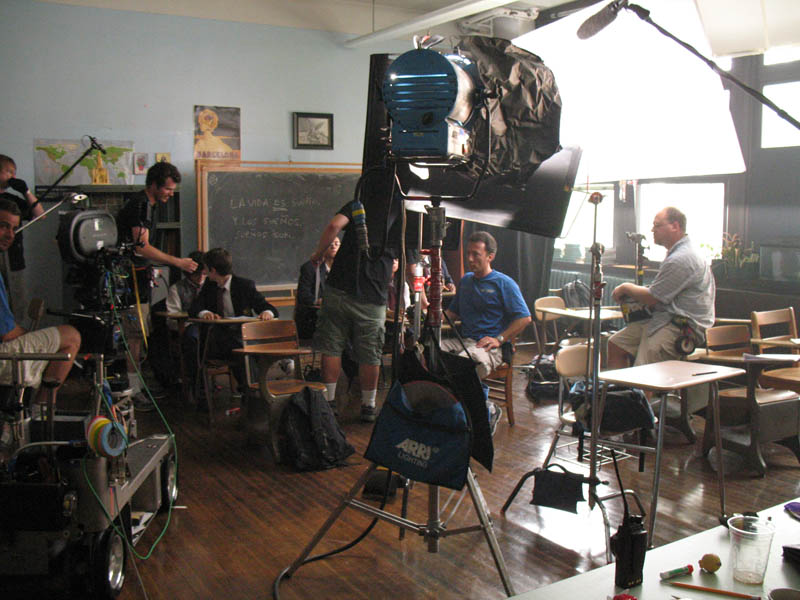
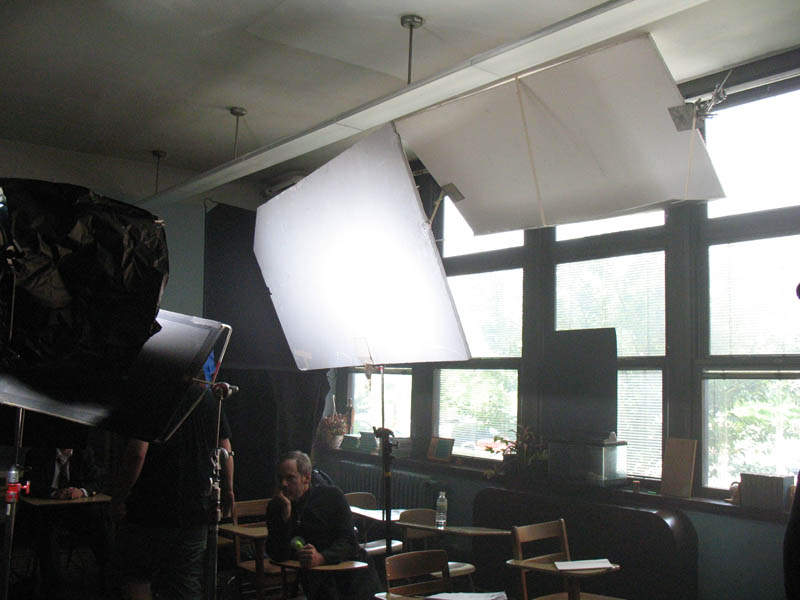
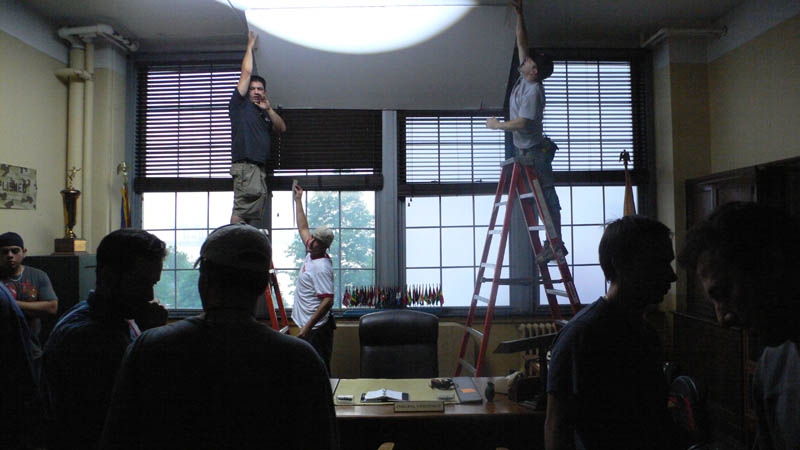
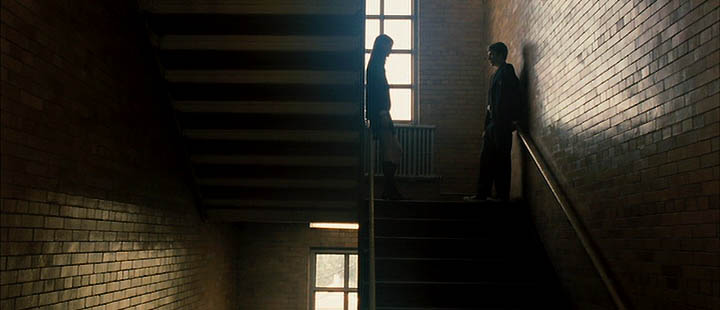
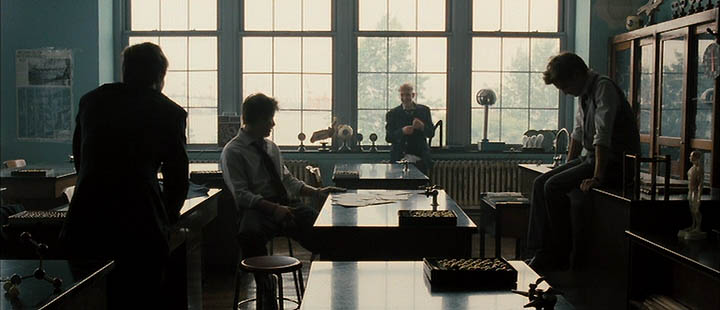
I did a high school movie like that called "Assassination of a High School President" -- I used a lot of available light from windows and just augment it with bounce lighting off of white cards above the windows to extend the window light effect deeper into the room. I mostly use Joker 800 HMI Source-4 Lekos, sometimes 1.2K's and 4K's. I only went outside the windows when I needed to, like when the sunlight was failing.

Here are some behind the scenes shots:

assassination1.jpg


assassination2.jpg


assassination3.jpg
 
This scene was lit with just natural window light and a small Kino next to the window:

assassination11.jpg


assassination12.jpg


This just had a bounce above the windows and a Kino off to one side:

assassination14.jpg


But in these cases, I was relying on the dynamic range of film; with a Canon HD camera, you can be pretty sure your windows are going to blow-up if you expose for the interior.
 
Hi David; missed you at the ASC open house yesterday. Was hoping to shake your hand in person and thank you for all your generosity and contributions. Maybe next year!

I'm in Vancouver shooting a TV pilot -- I'm sorry I missed the Open House (and the awards banquet). Yes, hopefully next year!
 
David, I know you're not a sound guy, but I see the mics in your first shot. any idea why one mic would be blimped while the other isn't all in the same room? Thanks
 
Actually the mics look the same, it's the pole connectors that are different.
 
Hi David,

Young DP once again requesting help.

I'm shooting a short thriller set in a small suburban house. 95% of the shooting is interior night, and as per the narrative the power to the house gets cut very early on.

This means the director wants the film to look 'night time' without having any sources motivating the light, so I've concluded through what he's said to me that he means a steely 'moon lit' look. I'm just a bit apprehensive on how best to achieve this? We are shooting on a Canon 5D.

I've ordered a 1.2k/575w, some smaller tungsten units (1kw/650w/300w and dedo set), a few kinos and plan on bouncing a lot of low key, cool light. I'm going to try and tap into the fact there could be motivated light coming through windows from outside sources as well.

My main concern is that we might end up flooding scenes with flat, soft lighting. What are your thoughts on this? Do you think the HMI's are overkill for the interior night stuff?
 
Back
Top