Welcome to our community

Be a part of something great, join today!

  • Hey all, just changed over the backend after 15 years I figured time to give it a bit of an update, its probably gonna be a bit weird for most of you and i am sure there is a few bugs to work out but it should kinda work the same as before... hopefully :)

Ask David Mullen ANYTHING

Flashing is just adding an overall layer of weak light to the film, like fogging it. It looks like what you'd think it looks like.

When used in very low amounts on the negative, the loss of true black is not too noticeable because of the gamma of the print stock, etc. but it can lift low-level detail into greater visibility. The basic idea is that some information is on the threshold of visibility and just needs a bit more strength (or density on the negative) to cross that threshold. It is related to latensification, the notion that adding some weak overall light gives some barely-exposed silver halide grains enough photons to become developable into silver. Though flashing is more about lifting the blacks; more than a very weak amount (like a 7% flash) and you've gone beyond increasing shadow detail into merely milking the blacks and giving the impression of lower contrast. Flashing also softens color, plus reduces sharpness a bit because it reduces contrast, and contrast and sharpness are interconnected.

There are films that were flashed mildly for a flashed look, and then films that were flashed but then printed using a silver retention process to restore the black, thus canceling the flashed look. The reason in this case for flashing was to counteract the increase in contrast that silver retention printing causes.

"McCabe and Mrs. Miller" was flashed, as was "The Long Goodbye". "The Little Princess" was flashed about 10%.

Then there are the movies that were flashed through the lens using a Lightflex or Varicon, such as some movies shot by Freddie Francis -- "Dune" for example. Often the flash was colored, imparting a tint to the shadows. "Dune" for example used different colors in the Lightflex for the different planet, mostly a brown flash for the desert planet scenes.

The thing is that it's hard to show on a still frame because it's mainly about the black level, and I can't tell if the video transfer messed around with the black levels to get rid or, or reduce, the flash effect, and I can't know what the black levels are like on your computer monitor.

If you look at the Blu-Ray frames here:
http://www.dvdbeaver.com/film3/blu-ray_reviews51/dune_blu-ray.htm

The image has mostly been corrected for normal blacks, but in a few frames probably some of the details in the black or dark green costumes are more visible due to the Lightflex flashing.

This review of "The Long Goodbye" has some frames that show the flashed look of the movie:
http://www.dvdbeaver.com/film/DVDReviews21/long_goodbye_dvd_review.htm

The DVD contains a reprint of the 1973 American Cinematographer article on the movie - it's a great article because it has strips of the movie print reprinted labelled by the amount of flashing used for each example.
 
Thanks David,
I also want to ask if you shot the promo pieces for "Tara", and if you did how do you handle green screen so that the reflected green is minimized. I use back lighting from two or three positions to get a rim of light around the subject. When a moody look is required what do you suggest?
 
I didn't shoot the promos for "Tara". Well, for moodier lighting, you can try just weak, soft backlighting to wash-out any green spill, but it helps to reduce the problem by backing the greenscreen as much as possible and using blacks around the sides off-camera to minimize the amount of green bouncing back at the subject.
 
David hope you don't mind a non cinematography question:

Recently I've been on some very high stress sets that have devolved into chaos.
What do you feel are vital to the smooth running of a set and production.
Quality AD's/Producers, de-stressing on set somehow etc. just generally looking to pick your mind on what makes a happy set run well.
 
The tone of the set is really set by the AD, DP, and Director since those three affect the nature of the work that has to be done that day and the amount of time allotted for it, etc. So any one of those three can also create a more stressful set by their attitude, their tone, their flexibility and organization, or lack of it.

So I can be as calm and as prepared as I want, but if the director comes in screaming or is totally unprepared, he can create a level of stress that is hard to counteract.

But certainly in a stressful environment, it's up to the individual to constantly ask himself or herself if they are contributing to the tension, or helping to work to deflate it.

I'm a quiet person and I try to have a quiet set, and I try to know what I want for the set-up -- in detail -- once I've figured it all out after the blocking rehearsal, if not already in prep. That helps keep some level of tension down. A director who works with me, and vice-versa, to figure all of this in a professional manner, well, that helps.

When things really go south, let's say the sun is dropping and now it's starting to rain, etc. then the key is to listen to your crew and understand their problems and give them reasonable instructions, not say "I don't care HOW windy it is, I need that 20'x20' silk up NOW!"

But s--t rolls downhill and to some extent, I become the bringer of bad news as I convert the director's ideas into instructions for the crew under me.

Humor helps.

I try to maintain a sort of calm but focused energy on the set, keep things moving fast as a general basis (because you have to) so a little tension is a good thing probably, keeping people on their toes. The more you and your keys can think ahead and get a jump on something, the better it will be. But it's also about understanding your manpower limitations and not get overly clever trying to do several things at once.

Thanking people at the end of a hard day (or any day) is a good habit, at least everyone knows nothing is personal and that we are all professionals here, and tomorrow hopefully will be better.

Here's my bad habit: I have trouble learning names of people on the set because I meet them at a time when my mind is filled with thoughts of the day. So I'm running around trying to figure stuff out and someone says "I'm Frank the boom op" and I say hello but three hours later, I can't remember Frank's name. Not to mention that on the first day of shooting, you meet the grips & electricians as a group on the first set-up and it's hard to tell which is a grip and which is an electrician. All this to say that it takes me awhile to learn names, for which I apologize (if any of my crew is reading this...) Funny because I can remember the name of some DP who shot some minor movie sixty years ago... and what film stock it was shot on!
 
David, How do you feel about Directing and Photographing a project at the same time? Not necessarily a feature but also something short like a commercial.
 
Mr. Mullen,

Have you ever shot a fight scene and if so, how do you approach it? Do you use storyboards for coverage? Do you work closely with the fight choreographer (if he's called that)? Who really has the vision for what coverage is needed so it cuts well during editing? By cutting well I mean so the action doesn't look fake. Sorry if this has been answered in previous threads. Thank you in advance.
 
David, How do you feel about Directing and Photographing a project at the same time? Not necessarily a feature but also something short like a commercial.

Some people can do both well, some can only do one well. It's probably easier to do both on a commercial when you are following boards anyway, where it's not acting-intensive so you can spend more time behind the camera.

Some actors resent directors who go off and deal with camera issues trying to do their own cinematography, while other actors like the fact that the director/DP is that close to them, shooting an intimate scene behind the camera.

You just don't want it to turn into that "Jack of all trades, master of none" sort of situation where you do a mediocre job in two categories rather than do one job really well. But as I said, some directors have a talent for shooting their own material -- Soderbergh for example.
 
Mr. Mullen,

Have you ever shot a fight scene and if so, how do you approach it? Do you use storyboards for coverage? Do you work closely with the fight choreographer (if he's called that)? Who really has the vision for what coverage is needed so it cuts well during editing? By cutting well I mean so the action doesn't look fake. Sorry if this has been answered in previous threads. Thank you in advance.

Yes, it helps to storyboard a fight and even shoot rehearsals on video. A good fight choreographer / stunt coordinator is key. You basically tell him what the intent of the fight is stylistically, emotionally, and what you hope to do with the camera, even show some preliminary boards, and then have him go off with some stunt people and then the actors and work it out. Usually they come back with some videotape of the rehearsal so you can see how it is working for the camera. Then you make some adjustments, perhaps redesign the storyboards to match. And on the shooting day, you make further changes.

There are standard tricks that you have to fall back on because you can't really have an actor making serious contact with their fists onto the other actor, except maybe in body areas that can be padded. Otherwise, you learn to line-up the camera so that the fake swing & hit "sells" for that angle, and you do it over and over again until it works, which is why you generally break-up a fight into three or so choreographed moves per angle, so you can quickly repeat them until you get it looking right. That gets harder and harder in longer takes where the actors have to get several moves right in one shot without a cut. Of course, if that's the style you've chosen, to minimize cuts and play it in one long take, then you need more rehearsal or actors better at doing stunts.

Have you seen this Tony Ja fight scene that happens in one continuous take?
http://www.youtube.com/watch?v=yXIGP6_fNZk
 
Mr. Mullen,

Thanks for your response regarding shooting a fight scene. You truly are one of the best things on this forum. I've learned a lot reading your posts. May God bless you with many good things.

Have you seen this Tony Ja fight scene that happens in one continuous take?
http://www.youtube.com/watch?v=yXIGP6_fNZk

And yes, I have seen this clip. One of my favorites.

:smile:
 
David, in filmmaking, what practical senarios would require use of super telephoto lens (300-800mm). Thank you.
 
The main reason for a super telephoto is to enlarge something very far away. A common example is when you want the Moon or the Sun to fill most of the frame while still containing the full circle -- that usually happens at around 1000mm in S35 more or less. Or you want a close-up of a lion in the wild.

The second reason is for the compression of space, like to shoot something running towards the camera but taking a long time to get any larger in frame, or to make two objects look closer together than they really are (like a person standing on some railroad tracks as a train is approaching behind them.)

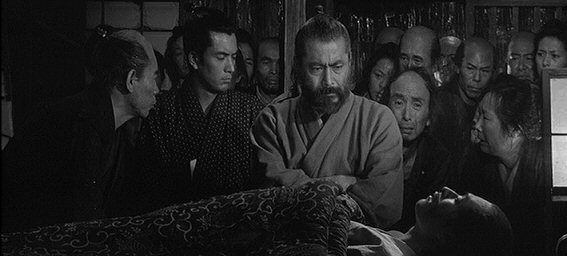
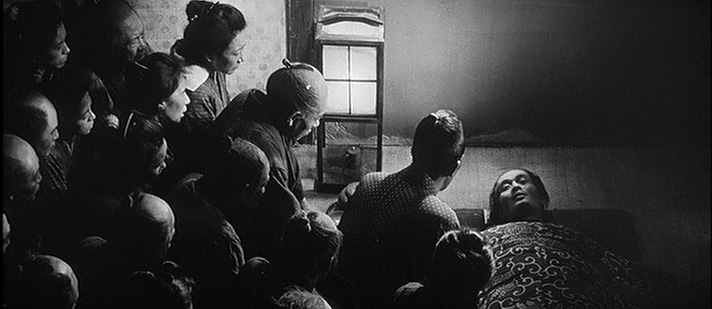
Long lenses also have the effect of making a group of people in a crowd look similar in size, rather than have the closer people much larger in size than the further people. These telephoto shots from Kurosawa's "Red Beard" show that affect (it helps that they stopped down the lens for deeper focus):

redbeard1.jpg


redbeard2.jpg
 
The movie was shot in 3-perf Super-35 on 320T Kodak stock, underexposed often (but degrained digitally in the D.I.), looks like a layer of smoke on the set -- those elaborate moves were shot in pieces and linked with CGI elements and other blending techniques in post. The bannister railing that the camera passes through, for example, was a CGI element, perhaps even most of the drop down through the floors was CGI until it got near the bottom floor, there probably was a couple of elements for the push through the keyhole shot too, all combined in post.
 
Hi David,

I was looking at that shot (Panic Room) and what I liked about it was it gave a feeling of the space involved, where things were and so on. But at the same time I really don't like to be aware of the camera, I almost feel self-conscious and it takes me away from the drama. Maybe younger audiences don't feel that, I don't know.

But it did make me think about another question, semi-related and it's about the frame. Have there been times when you have advised the director of how things should be organised in the frame to heighten the tension or subtly indicate tension between two characters for instance? Or even between character and object?
 
David Fincher said something once about "The Game" being a complicated tale being told as simply as possible and "Panic Room" being a simple tale told as complicatedly as possible. Seems like a wise strategy; basically "Panic Room" is a simple premise, a gimmick almost, and what it rides along is style.

Sure, I discuss how to heighten tension all the time with the director. When I did "Solstice", which was essentially a ghost story, with Dan Myrick (who had directed "Blair Witch Project"), we used to joke about shooting "Unmotivated Tension Theater", i.e. shooting every ordinary scene as if something horrible & scary was about to happen, like shooting a dialogue scene from the POV of a killer in the bushes, even if there were none.

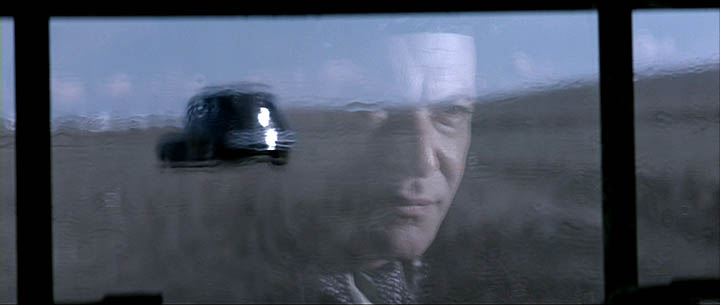
But that's the general idea, you create tension by creating anticipation in the framing that something is about to happen, or you create visual conflict that mirrors psychological conflict. A classic example, if somewhat of an extreme case, would be the end of "Lady From Shanghai" shot in a House of Mirrors. Confusion, fear, fragmentation, disorientation, separation, isolation, etc. are all symbolized by the use of mirrors in that sequence. A simpler version of that would be shooting something in a broken mirror or through a broken glass, but an even more subtle idea would be to use some reflection of the face.

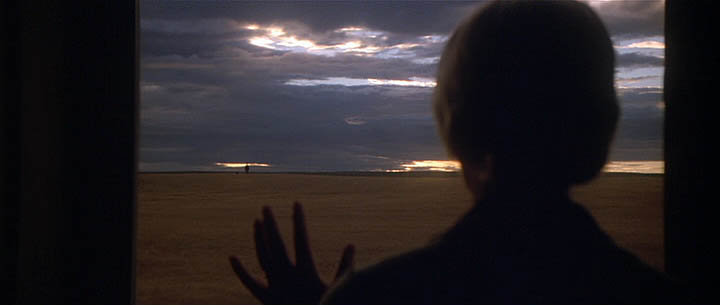
I did this shot in "Northfork" after a scene where two men search an empty house that feels haunted; they drive off and we then see a face in the window watching:
northfork3.jpg


But sometimes it can be something as simple as shooting a dialogue scene between two people and only using clean singles to create a sense of isolation from each other. Apparently the whole first half of "Kiss of the Spider Woman", Raul Julia and William Hurt are never in the same frame together despite being in a jail cell together.

Even in this scene in "Superman" where Clark Kent is saying goodbye to Ma Kent, their separation is foreshadowed by the fact that the close-ups are kept clean from each other:

superman31.jpg


superman32.jpg


superman33.jpg
 
Last edited:
David, I know you've talked about the use of haze before in this thread, but I was wondering if you would ever use haze in a office scene? If you are not trying to get beams of light coming in from the windows, or have a dusty/steamy look, do you feel there is a need to add any haze to the room?

It would be great to see an article from ASC members talking about when they do and do not use haze, because I've found that it really helps many of my shots add that "something" that was missing without the haze.

Matthew
 
Back
Top