Welcome to our community

Be a part of something great, join today!

  • Hey all, just changed over the backend after 15 years I figured time to give it a bit of an update, its probably gonna be a bit weird for most of you and i am sure there is a few bugs to work out but it should kinda work the same as before... hopefully :)

Ask David Mullen ANYTHING

Not on the first, because that was with a fellow film school graduate directing. But on my second, yes. I got a lucky break on that one -- I met the director back when he was looking for funding, when he thought it might be a $100,000 or less budget, maybe even shot on video (which would have been usual back in 1993.)

So he hired me and then he managed to get nearly a $1 million dollar budget. The producers were successful Broadway theatrical producers but had not really produced a feature before, so they were fine with me being hired too, they didn't know better. But the line producer made somewhat of a stink about me getting the job because she felt it was a disaster to pair a first-time director with a second-time DP. So I took a pay cut because she claimed she'd have to spend more on the gaffer and key grip to compensate for my lack of experience.

Anyway, it all worked out fine -- I was really prepared, I knew what I wanted (I had shot over twenty short films by that point, not to mention one feature, and I storyboarded the entire feature for the director), I was fast and it looked good. She later apologized for doubting me.
 
Day for Night Advise

Day for Night Advise

David,

It is an honor to correspond with you...! I am shooting a short next week in FL, and we intend to shoot everything during the day, and apply the "day-for-night" technique to the footage since this is a no-budget short (read, no much equipment to shoot this properly during the night). It is to help my son and a classmate that are studying film. Any advice as a cinematographer? Mainly I am thinking shooting from 10:00 AM to 2:00 PM, so no shadows are casted. All will be shot on location, and is around a lake, or by the lake.

Thanks,
 
Thanks for the reply David! I've been trying to nab my first feature for about a year now (1 year and 9 offers later, all which had funding fall threw, very aggravating), and I have one within my grasp, but the director is a first time feature film director (who I've worked on several short films with)... Does your typical first time director not get to pick their DP? I'm hearing that the decision will probably be made by the executive producer.
 
I think luck has a lot to do with how you get all your jobs, not just the first.

You'll basically get a break when you work with a director who has enough clout to insist on hiring you over any protests. Some directors go to bat for their favorite DP's and some don't.

Directors pick the DP's but it often has to be approved then by the producers. So it depends too on the relationship between the director and the producer.

Of course, if the project is small enough, probably no one is going to object to hiring you.
 
The moon casts shadows like any other light source. Mainly you want to shoot in backlight because it generates more shadows in the frame. You want to avoid the sky (which is hard around water since it both reflects the sky and often the sky is just above the water.) Using ND grads and Polas combined can help darken the sky, but ND grads limit some of your camera moves.

Underexpose and then use bounce cards and reflectors to bring out whatever is in the dark that you still want to see -- as if you were lighting a night exterior scene.

Try to use ND filters so that you aren't shooting too stopped down; the excess deep-focus look is a bit unrealistic for night.

Most people try to go for a blue-ish look.
 
Thank, David. Very much appreciated. We were going with the blue tint since is a Si-Fi, so the subject matter will fit well with the blue tone.

Thanks again!
 
Not sure if this got lost in the noise, or you simply deemed it not very interesting to answer, but in hopes it's the former, I'll re-quote the question - I'd very much value your insight, if you've got a moment...

Hi David, I was wondering if I could pick your brains about night looks?

I'm up for a fairly well funded short at the moment (~$16k for a 14 page script, 4/5 day shoot), of which fairly large parts take place at night, in the woods, with either no or limited (i.e. a flashlight here and there) justifiable sources - yup, that old chestnut!

Both myself and the director are keen to avoid the cliched "moonlight backlight" look and go for something more "natural" - problem of course being natural means no light! The shots can be for a full moon phase (probably not literally, but figuratively), so a low-level bluish light of some kind is probably on the cards, but I was just wondering if (a) you had an ideas from your previous work or any thoughts you'd had about how you might approach such a scene and/or (b) knew of any particular shots (or good sources for such shots, be it photography or a film you liked the night work of in that sort of style) that might point me in an interesting direction for research?

I'm pushing to try and keep some practical light in at least most of the shots (preferably all), if only to allow low key light levels without the frame looking muddy, but any other tricks and tips you (or anyone else, of course) can think of would be much appreciated...

Cheers,
Dom.
 
Obviously you can keep the brightness of your moonlight down so low that it barely reads and let the flashlights provide more of the exposure -- just that you run the risk of having some very dark frames now and then, depending on where the flashlight is pointed. You can also augment the flashlight bounceback effect either by pointing them into cards or panning another tungsten light into cards now & then.

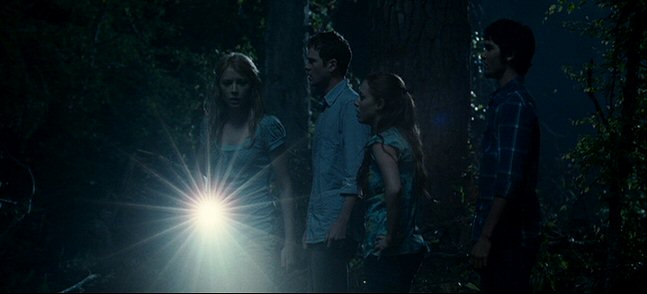
In the woods, often multiple lights are better than one big one because of the blockage from the foliage. I've done things like string Chinese Lanterns up high in the trees with blue photofloods (or daylight compact flos would work) or clamped Kinoflos high up tree trunks above frame. For bigger shots, I've had to go with a balloon light or a condor with an HMI and find a gap in the trees to work from.

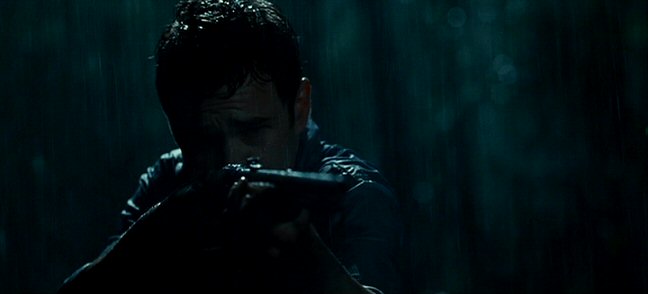
This first shot from my work used a lighting balloon overhead with some HMI backlight, all underexposed about two stops. The second was lit more conventionally, but there was no flashlight in the scene.

solstice12.jpg


solstice13.jpg
 
Hi David,

Thanks for the answer, very much appreciated!

I actually really like that second frame, although more conventional in style. That said, I think the rain makes a lot of difference (which we won't have on our shoot, unless the weather gets fun)...

Having seen those two frames, I'm thinking it might be nice to try and split the difference between night and twilight, and try to keep some fairly high (relatively speaking, of course) fill level light in the BG. For the first frame, did you have smoke to pick up the light in the BG? For the second shot, you've got some blue filtration on the low key, correct? I very much like that look, the more I study it.

Did you have any particular influences for night looks (either particular or varied) that you could recommend as I'd love to do more research!

Thanks as always...
Dom.
 
Thanks again David - top info...

If I get the gig I'll report back and hopefully post some frames if the producers will let me. Lot's of DPs up for it though, and I'm outgunned by quite a few of them, so might well not come off, but here's hoping!...

Cheers,
Dom.
 
David, do you agree with the consensus of keeping video destined to print to film within a 2:1 contrast ratio because the process of transferring to film adds contrast or do you risk going over that?
 
No, every shot lit to 2:1 would be horribly boring and repetitive. That's not the way you think about lighting and contrast. What if the scene took place in a room where the power was out and someone shined a bright flashlight in someone's face? Would you light that to 2:1? What if someone was on a stage facing a single spotlight or holding a single candle? What if you wanted someone silhouette against a window? There are lots of dramatic scenarios where you may end up using no fill light at all and want the shadows to go black.

Lighting for digital is more about placing exposure and contrast in such a way that you can work with it in post, but that doesn't alleviate your need to think about how you want the scene to be lit -- you can't just flat-light everything and then create all the mood in post. You can work with more than a 2:1 contrast range if you need or want to.

It's more about controlling bright highlights to avoid clipping if you need the detail there for post color-correction, and using enough fill when necessary to give you shadow detail that you can work with. But two-stops under on the fill side is quite conservative and doesn't work in every scenario.
 
Hi David. Good post on "lighting in the woods." Indeed, small balloons work wonders for night forest/woods. The balloons give a soft ambient light that look natural, and comes from the top. Hopefully the branches will hold the balloon in place. The cable can drop straight down. I like using the small tungsten balloons. I agree with you on the flashlights. I always wear a white shirt for those scenes. Then get the actor to shine the light on me, or a card. F
 
you can't just flat-light everything and then create all the mood in post.

Please see the work of Paul Debevec at USC's Center for Creative Technologies for using computer graphics to relight scenes. Relighting has been used as effects plugins for some time in packages such as After Effects, however, the work at CCT at USC is quite interesting. It's exciting and perhaps one day filmmaking can make use of such techniques.

Ref.: Paul Debevec, Virtual Cinematography: Relighting through Computation, Computer, vol. 39, no. 8, pp. 57-65, August 2006.
 
smoking an exterior

smoking an exterior

Hi David,

So when you smoke an exterior location such as that forest, is there any particular technique one can use to control the smoke? Or does it only work when there is no wind? I've taken to using smoke on HD, but I've never tried it outside.
 
Hi,

You talked in a previous post about the visual style where one shot is very wide-angle and the next one very telephoto, typical of Michael Bay. You say that it's an aggressive style which isn't very subtle.

Like many people there are things I don't like in the Michael Bay style, like the ultra-fast cutting (seems to me that it's confusing and distracting) or the heavy metal type of music (not my thing).

However I don't see what's wrong with that visual style itself: especially in Transformers, when the spatial relationships have to be established, he uses a very wide-angle lens, and for close-ups or other shots where the space is already established, he uses very telephoto lenses which tend to look good to me.

Maybe the problems of that style are not apparent to me. Could you give your opinion on the drawbacks (and advantages?) of that style, and what you would do differently?

Thank you.
 
Back
Top