Welcome to our community

Be a part of something great, join today!

  • Hey all, just changed over the backend after 15 years I figured time to give it a bit of an update, its probably gonna be a bit weird for most of you and i am sure there is a few bugs to work out but it should kinda work the same as before... hopefully :)

Ask David Mullen ANYTHING

How do we explain or prove that white and grey are neutral in colour?

White or grey are neutral in color by definition. If they had a color bias then they wouldn't technically be white or grey. As for whether a grey or white card is pure enough in grey or white, that's why you buy an expensive 18% grey card instead of a cheap piece of grey art paper, because it's supposed to be neutral. Finding pure white paper is easier. On the other hand, it's just white balancing, it's not that critical that you get it perfect, you can always color-correct further later in post.
 
White or grey are neutral in color by definition. If they had a color bias then they wouldn't technically be white or grey. As for whether a grey or white card is pure enough in grey or white, that's why you buy an expensive 18% grey card instead of a cheap piece of grey art paper, because it's supposed to be neutral. Finding pure white paper is easier. On the other hand, it's just white balancing, it's not that critical that you get it perfect, you can always color-correct further later in post.

Appreciate your patience taking off so much time in explaining this to a beginner like me. I thank you so much. Regards and all the best to you. May I know what is your current shoot if it is not a secret?
 
Hey David. I own 2 Kino 4 banks and 3 Arri 650s. I've used them on every single project I've shot. I was wondering what other lights should I invest in that will always come in handy. I don't know if i can afford HMIs after that last EpicM purchase. I mostly shoot narratives and commercials.

I still can't believe I can just ask the guy who shot Amanda Seyfried and Megan Fox make out a question like this. Not to mention DEBS, Assassination of a High School President, and the Quiet.

My next question.. How do you pick your movies?
 
Well, what do you feel is missing? What lighting effects are you not able to do with those lights?

In general, what you need is the ability, in 3200K and 5600K, to create soft and hard lighting on a small scale and sometimes on a larger scale. So one element you might want to add is a stronger hard 5600K light to create sunlight effects, like a hard slash of light, on a mid-sized shot. Something like a Joker 800 HMI, or a Joker adapted to a Source-4 Leko for starters. That keeps you under the 20amp limit of most circuits.

Another light might be a 1.2K tungsten "firestarter" Par or Parcan, an incredibly punchy light for not a lot of wattage.

On the smaller end, you may want some small lights for accent lighting, small hot spots on things, etc. Something like a 150w Dedolight kit, or ARRI or LTM Peppers in that wattage.
 
supplemental lighting

supplemental lighting

Hi David,

How often do you augment your own sources to enhance the effect you're getting from a practical? Do you always add to what the practical is giving you? Are there situations when you won't add your own lights because it's too hard to enhance a believable source and not get double shadows?

-dan
 
Hi David,
In lighting, do you think it is a good practice to set kickers whenever possible or base on the real scene demand? Quite often I was asked why the kicker if there was no logical source of light in the scene.
 
Hi David,

How often do you augment your own sources to enhance the effect you're getting from a practical? Do you always add to what the practical is giving you? Are there situations when you won't add your own lights because it's too hard to enhance a believable source and not get double shadows?

-dan

It depends on the practical, how close the actor is to the practical, the intended look, the needs of the shot, etc. If an actor is close enough to the practical and I like the light it produces on their faces and I have enough exposure, then I often just use the practical. But often I have to augment it from off-camera because the actor is farther from the practical and thus too dark, or their face is actually slightly foreward of the practical and thus not side-lit but slightly backlit instead. One way to minimize double shadows is to use softer light. I also try to use a minimal level of extra light and a brighter bulb in the practical so it does most of the work.

This is a typical example of a shot I did in "Big Love" with a bright bulb in the practical and a little bit of soft light coming from off-camera to augment:
biglove22.jpg


But a few days ago, I had a scene were an actress crosses into the corner of a small room to look at a painting on the wall and the only way to light her was to put a practical with a nice lampshade next to her since there was no other angle to hit her with light that wasn't too toppy and thus uncomplimentary. But when the actor is close enough to the practical, often they are lit fine by it. This is why the selection of practical lamps in the scene can be so critical.
 
Hi David,
In lighting, do you think it is a good practice to set kickers whenever possible or base on the real scene demand? Quite often I was asked why the kicker if there was no logical source of light in the scene.

It depends on the visual style you've chosen. If it's meant to look natural, then you have to make your kickers either motivated logically (though you don't always have to show where the light is coming from, it just has to feel like it could happen in real life) or soft and subtle so that no one thinks about it.

You also want to avoid overdoing an effect because it can get repetitive, like always backlighting people in a scene. I might do that in a night interior where the light could be coming from some practical that you never see, but I rarely have a backlight in a day interior lit by windows when looking away from the window direction when the window light would be frontal - to also backlight them would make it feel like the room lights were on in the daytime. Unless that is motivated.

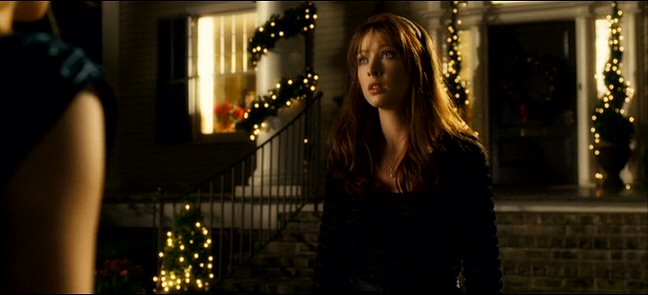
Here would be an example of my work where I used a kicker at night but it was motivated by the house behind her head:
solstice16.jpg


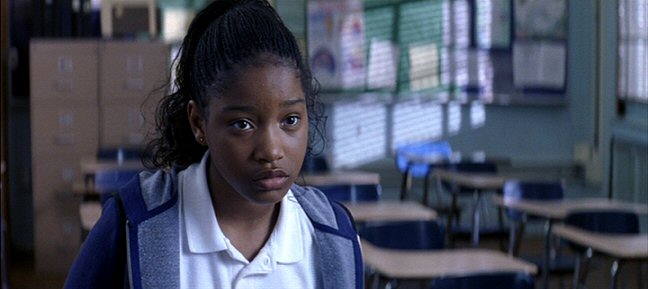
Here is an example of a soft kicker that is not too bright in a day interior, I just wanted to make sure I created some soft separation with the background:
akeelah1.jpg
 
Last edited:
I'm curious, what were you using for the kicker in this shot? Was it bounce from the key, or a separate unit?

This was shot some years ago, so I'm trying to remember... being a day interior, odds are high that the kicker was from a Kinoflo. The early section of "Akeelah and the Bee" had a cold cast, and one trick in many scenes was to add a blue-ish kicker from a daylight Kinoflo.

The soft key may have also been a larger Kinoflo, or a small HMI through a frame (but probably a Kino) -- the background was lit with an 18K HMI outside. For most shots, I had a row of daylight Kinos rigged just above the windows inside the room.
 
I read a lot of pages but I didnt see anyone who asked you this?
What do you think is your best work? best scene even or shot?
Did you ever think about making a move to directing?
Im sorry if this has been asked before.
 
Hey David, I'm curious as to what you think of the Ikonoskop? It seems Gary Oldman, the actor, bought one.
 
That camera looks impressive, and the utilization of super 16 lensing is much more affordable than quality 35mm glass. I just don't know about USB 2.0 as the only way to get uncompressed raw footage off the memory.
 
That camera looks impressive, and the utilization of super 16 lensing is much more affordable than quality 35mm glass. I just don't know about USB 2.0 as the only way to get uncompressed raw footage off the memory.

@Greg: Yeah, the 2.0 usb to get the uncompressed footage into your comp seems a step backwards, although the company says they are going to release perhaps an esata solution to get the footage transferred more quickly. I kind of feel though it is not the worst case scenario, if the footage is what it is in terms of filmic. I know that David usually, if not always, goes for film vs. digital, so my concerns are more or less, is uncompressed 1080p, good enough for the future? I replay footage everyday almost of this camera, and somehow, maybe it's my imagination, but the kodak ccd seems to offer Leica like colors depending on the conditions of the filming. It seems to have great dynamic range but you have to keep the camera at 0db to get good results. I really have been impressed with the digital cameras of late, but this one that has a kodak ccd, just feels like film to me when I've seen some good examples that more often than not, are using super 16 glass, the best of the best s16 glass has to offer. Just wondering David's thoughts since I'm curious with all the high priced digital cmos cameras available, why perhaps, Gary Oldman, the actor, went with this camera?
 
I haven't really looked carefully at the Ikonoskop so I can't comment, but for my line of work, that type of small 1080P camera would be useful for select shots like in an action sequence, with quick cuts, as opposed to shooting everything on it. But on the other hand, if everything is at the same quality level, the viewer's eye often gets used to it. I'm looking forward to the Scarlet as that kind of small action camera.
 
I read a lot of pages but I didnt see anyone who asked you this?
What do you think is your best work? best scene even or shot?
Did you ever think about making a move to directing?
Im sorry if this has been asked before.

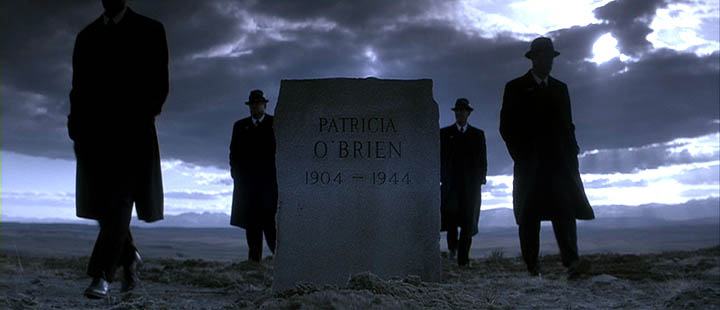
This may be my favorite shot from what I've photographed, from "Northfork":
northfork36.jpg


A lot of elements came together quickly to make that sequence work, on a low-budget movie.

I've thought about directing but not seriously, perhaps someday some TV show I'm shooting will allow me to direct an episode...
 
Overexpose by 1/2 to a stop if shot on negative film and underexpose 1/2 to a stop if it is on digital. What say you David?
 
Back
Top