Welcome to our community

Be a part of something great, join today!

  • Hey all, just changed over the backend after 15 years I figured time to give it a bit of an update, its probably gonna be a bit weird for most of you and i am sure there is a few bugs to work out but it should kinda work the same as before... hopefully :)

Arri Locaster LED Lights

Thanks for the suggestions.

By the way, does anyone know what 50W of LED lighting is the equivalent of in terms of light output? (how much would that be in tungsten lighting equivalent?)
 
Anyone have any experience using Arri's Locaster LED lights? Are they worth the money or should I just stick with kino flow?

I would stick with Kino Flos. While LED Lights are getting brighter, they are still not comparable to other Light sources and a 50W LED is not going to throw very far. In my opinion, LED lights are still only a special purpose tool and not suitable for general production. They make a great Obie light and are great for lighting car interiors at night. Like every other DP & Gaffer, I have put together my favorite lighting package based upon my more than 20 years operating a lighting rental and production service company. For my package, I have picked lights that I feel offer both the highest output (lumens/watt) and the best production capability and have combined them with distribution technology I've developed that enhances the production capability of the new Honda Inverter Generators. As yet, I have not found a LED lighting fixture that warrants inclusion in my package. Trust me, I have looked at all of them (including this Arri) and some still to come. Here are a few of my reasons why I prefer fluorescent lights, especially the Kino Flo Parabeam fixtures, over LED Panels for many of the applications that LEDs are being marketed for and it has to do with more than just their poor CRI.

In HD Digital Cinema, the quality of light is more critical than ever. In High Def every detail of “on-camera” talent is rendered clearly on the screen – even the imperfections. Where LED and traditional hard light sources can exaggerate textural details, it is my opinion that fluorescent soft light is better for lighting talent in High Def productions because it can subdue those same textures and render a more cosmetic appearance. Primarily for this reason, I prefer the Kino Flo fixtures, over LED Panels, to serve as a Key source. For dramatic productions (non-interview), I especially like the Kino Flo Parabeam fixture because they offer a number of advantages over LEDs and even other Kino fixtures.

What distinguishes the Parabeam fixtures from LED Panels and other fluorescent lights is their throw, power efficiency, and the innovative accessories Kino Flo makes available for the fixtures. Accessories include barndoors, a gel frame, a diffusion panel, and Honeycomb Louvers. These features enhance the production capabilities of the Parabeam fixtures and make them suitable to serve as a key, or even backlight, source where conventional fluorescent movie lights and LED light panels are not.

HD_PP_DemoCU.jpg

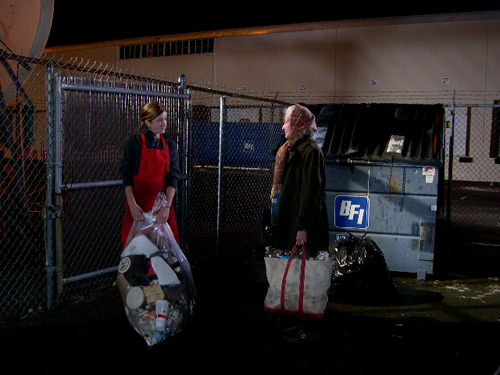
Two Shot of Night exterior scene lit with our HD P&P Pkg

Both conventional fluorescent movie lights (Kino Flo’s included) and LED light panels have a very broad light output that is hard to control. These lights also tend to drop off rapidly which means that to serve as a Key source, the units need to be positioned close to the subject they are lighting. These characteristics make them best suited to serve as Key sources in documentary interview set-ups where the Keys are typically positioned close to the interview subject. In that capacity conventional fluorescent lights and LED light panels (with heavy diffusion) can generate a wonderful soft light that wraps around the interview subject without wilting them. But, given these characteristics, conventional fluorescent movie lights and LED light panels have only limited applications as fill sources in dramatic set lighting.

HD_PP_DemoWS.jpg

Wide Shot of Night exterior scene lit with a pkg. consisting of PFC 2.5 & 1.2 HMI Pars, PFC 800w Joker HMI, Kino Flo Flat Head 80, 2 ParaBeam 400s, and a ParaBeam 200 powered by a modified Honda EU6500is.

The ParaBeam fixtures, on the other hand, have computer aided designed (CAD) parabolic reflectors that focus their light output where it is needed most for lighting dramatic scenes - at a medium distance – making them better suited as a Key source for HD Digital Cinema. If you compare the photometric tables of the Parabeam 400 and the Diva 400 (which uses the same four lamps), you will notice that at 16’ the Parabeam 400 puts out almost three times the light level (28FC) than the Diva 400 (10FC) even though they both use the same tubes. You can always diffuse a Parabeam to create a soft source, but nothing you do will make a Diva 400 or LED light panel punchier.

HD_PP_Demo_SetUp_Night.jpg

Note Distance at which the two ParaBeam 400s are serving as Keys.

In fact, a Parabeam 400 generates as much light at 16’ as the 4’ 8-Tube Kino Flathead 80 fixture, yet uses less than a quarter of the power (2 Amps verses 9.2 Amps.) While the seven amp difference is not a major consideration when using house power, it can make a difference when your power is limited (coming from a portable generator) because you can use four Parabeam 400s for the same power as a 4’ – 8 Bank Kino Flathead 80. And unlike the ballasts of Kino Flo’s fixture that use the T12 tubes, the Parabeam ballasts also include Power Factor Correction to reduce the return of harmonic currents into the power stream and improve their power efficiency. This makes them an especially efficient fluorescent light source that is comparable to the power efficiency of LED light panels. For instance a Parabeam 400 puts out considerably more light than even Zylight’s new high output LED light panel yet draws just .2 Amps more power.

LED_Non_PFC_Waveforms.jpg

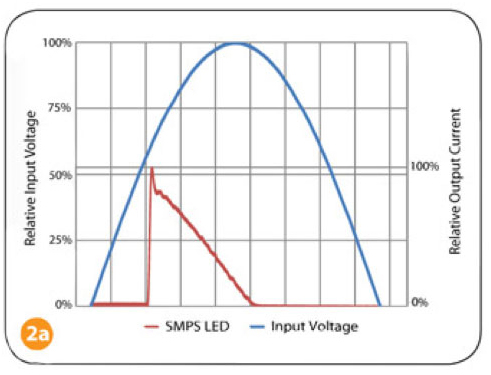
Figure 2(a): Voltage and Current waveforms generated by SMPS type AC-to-DC Converter used to drive AC LEDs.

By comparison, the Switch Mode Power Supplies (SMPSs) used to operate LEDs on AC draw a very distorted current, and can result in current that is significantly phase-shifted with respect to the sinusoidal voltage waveform. Although values vary widely, the SMPSs used in AC LEDs generally have a Leading Power Factor and high harmonic distortion (THD upwards of 68.1%). Power Factors for AC LEDs range from 0.54 (Litepanel 1x1s), to 0.85 (Litepanel Sola Fresnels). As such, High Power LEDs can have an adverse effect on power quality similar to that of CFL bulbs. (Use this link - http://www.screenlightandgrip.com/html/ema...generators.html - for a detailed description of the adverse effects that LEDs can have on portable generators.)


LED_1by_Har_Distri.jpg

Distribution of harmonics generated by the power supply of the Litepanel 1x1 LED Fixtures. Note: predominance of the 3rd, 5th,
7th, and 9th harmonics that don't cancel on neutral returns.

While the newest LED light panels (that use the higher output LEDs) approach the Parabeams in output, the Parabeam fixtures are more easily controlled – an essential requirement in a Key source. Parabeam fixtures are controlled by interchanging Kino Flos’ innovative Honeycomb Louvers. Louvers are available in 90, 60 and 45 degrees. Swapping louvers provides beam control similar to that of swapping lenses on an HMI Par. These features enhance the production capabilities of the Parabeam fixtures and make them suitable to serve as a Key or Backlight source where conventional fluorescent movie lights and LED light panels will spill all over the set.

The power that I save by using Parabeam 400s for key sources in my package, enables me to power more lights on the enhanced 7500W output of my modified Honda EU6500is generator. Using a 60A Full Power Transformer/Distro on my modified Honda EU6500is I am able to power a lighting package that consists of a 2.5kw, 1200, & 800 HMI Pars, a couple of Parabeam 400s and Parabeam 200s, and a Flat Head 80. Given the light sensitivity of the camera like the Epic, this is all the light you need to light a large night exterior.

Compared to LED fixtures, Kino Flo Parabeam fixtures are nearly as power efficient but offer greater versatility and output. Able to interchange different color temperature tubes, and vary beam spread with their interchangeable honeycomb louvers, the Parabeam fixture can do what it takes four different LED Litepanel fixtures to accomplish – Spot and Flood in both 5500K and 3200K. Offering better light quality, output, beam control, and versatility, the Kino Flo ParaBeams make for a better key or back light for HD cinema production.

Guy Holt, Gaffer, ScreenLight & Grip, Lighting & Grip Rental in Boston
 
Don't know about a 50w LED, but Litepanels 30w LED fresnel has the output of a 250w tungsten fresnel. I played with one of these at Infocomm. Personally I would love to have a dozen of them for fine control in tight interiors.
 
Thanks for the suggestions.

By the way, does anyone know what 50W of LED lighting is the equivalent of in terms of light output? (how much would that be in tungsten lighting equivalent?)

They are not directly comparable due to different characteristics.
Luminous efficacy is generaly about 50%-100% higher than that of photographic quality halogen lamps. So a 50W LED would be equivalent to about 75W tungsten halogen.

Halogen lamps have the luminous afficacy of about 40lm/W.
LED and fluoro lamps go to about 90 lm/W.

The comparison is difficult due to different colour temperature characteristics, CRI and direction of light.

I did have a play with the Arri LED light and they are very nice and compact and probably equivalent to about 80W thungsten.

There is a lot of marketing hype and plain vanilla bull shit advertising of LEDs like, for example, "this light produces 250W of light" when describing a 30W LED fixture. LEDs have some advantages, but they are not perfect and not necessarily better than fluoro, HMI and good ol' tungsten halogen.

After some research I decided to go fluoro for topside and halogen underwater because, in my opinion, LEDs are not there yet.
 
If anyone is interested in my .02, I think LEDs and the MX sensor are a perfect match. I use a bunch of the cheap 500 LED units available on ebay. The color temp matches daylight/hmis very well. It has taken a little getting used to how bright they are. I set up a 575 par bounce into a 2x2 bead board. I was surprised when it wasn't as bright as the LED unit. I also have and love the rosco litepads.

Nick
 
We have the bigger CoolLighst LED - it was cheap and we use it in about 1/2 our set-ups in some capacity. UJust get diffusion (for when it's close) and 01/4 green gel (for all the time)
 
I like my Arri Lo Casters, they have +/_ green and 2800k to 6500K adjustment knobs as well as 0 to 10% dimming. They are really nice and great build quality.
 
I was playing with one the other day. I really like them as a small color tunable fill. To be able to throw something up quickly and dial in temp was very cool. Not very bright though. Seems like they would have a hard time in a bright situation unless they were close. I was told they make an add on that focuses the light for a longer throw and you should definitely get it with the unit. Scratching my head on the "is it worth the money" part.
 
Anyone have any experience using Arri's Locaster LED lights? Are they worth the money or should I just stick with kino flow?
While the better LED light manufacturers rely on careful binning practices to provide as accurate and consistent color performance as they can; this approach to white light with LEDs has an inherent limitation: as you can see from the spectral power distribution graphs below, regardless of how tight the bin parameters are set, by their nature the spectral distribution of even high CRI White LEDs is less than optimum for motion picture lighting applications.

LED_Comp_Sprectrum.jpg

A spectral power distribution of a lamp indicates how much energy is present in each part of the spectrum. Natural sunlight and incandescent lamps have a continuous spectrum. Given how they produce white light, even high CRI White LEDS have a discontinuous spectral quality that is unlike that of natural daylight, HMI, or incandescent light. In the case of the 3200K White LEDs above, the phosphors added shape the spectral distribution by enhancing certain colors in the spectrum to simulate the spectral distribution of incandescent light. As a result, the spectral distribution of White LEDs resembles a series of peaks and valleys. If you look at the spectral power distribution of even a high CRI white LED (above left) you will notice a big spike at about 465nm (the blue LED) and a broader bump between 500 and 700nm produced by the phosphors. Even though the spectral power distribution has these peaks and valleys, the human eye perceives the light as white light.

While the discontinuous spectral distribution of high CRI White LEDS (far left) may appear white to the eye, and the color of objects illuminated by it appear natural to the eye, to film emulsions and digital imaging systems designed to reproduce accurate color under continuous spectrum light sources (like daylight or incandescent lamps), the color of the same objects will appear unnatural on screen. That is, the hue of an object being illuminated by this "apparent white light" can be drastically different than expected when it appears on the screen. For example, below is a "Macbeth chart" contrasting the resulting effect upon different color swatches of studio tungsten light and a representative high CRI White LED lighting instrument.

LED_Macbeth_Tungsten-WhPhos.jpg

Split Macbeth chart: each color patch shows the visible effects of studio tungsten light in the top half of the patch, and a representative Phosphor White LED lighting instrument in the bottom half.

A common test chart used for assessing color performance of motion picture imaging systems, the chart above would be more accurately called a "split Macbeth chart" because each color patch shows the visible effects of the two light sources – studio tungsten in the top half of the patch, and the high CRI White LED lighting instrument in the bottom half. Although your computer display is not likely to be a calibrated reference monitor, the wide variations in color patch hue caused by the discontinuous spectral distribution of the White LED lighting instrument should be readily apparent.

What accounts for these results? First, as you can see from its' spectral power distribution above, White LEDS, compared to continuous light sources, have no output at wavelengths shorter than about 425nm, which means that violet colors don't render well. Second, there is minimal output in the medium blue-cyan-turquoise range from about 465-510nm, which is why the aqua-type colors don't render well either. Lacking these complementary colors within the spectrum, skin tones and warm, amber-yellow colors don't stand out. Third, with the long-wavelengths cutoff in the high-600 nm range, pinks, reds, oranges, and other long wave-length colors tend to look a little dull under Phosphor White LEDs, compared with how they look under continuous spectrum light sources (daylight, HMI, Tungsten) which extend all the way out on the long-wavelength end. Finally, as you can see from the gray scale at the bottom, this particular Phosphor White LED Luminary has an overall magenta bias. While you can white balance out this magenta bias in digital video cameras, the camera is not able to replace the parts of the spectrum that are missing all together. Given these results, you can see that simply by nature of its' discontinuous spectral distribution, even high CRI White LEDs will never accurately reproduce colors on screen regardless of how tight the bin parameters are set in sorting.

The CRI ratings published by LED manufacturers can be misleading. Where the CRI index indicates the ability of a light source to reproduce to the eye only 8 colors faithfully (a different 8 colors are used in Europe) they should be taken with a certain amount of skeptism. In the case of LED luminary manufacturers, for instance, it is possible to tune their output to the limited color range of the CRI color scale and deliver good color rendering to the eye while delivering generally poor color reproduction on the screen.

For a cost effective alternative to high CRI Leds that delivers a full spectrum consider Light Emitting Plasma (LEP) lamps. LEP lamps have a CRI of 94+. More important than their high CRI ratings, is the fact that LEP lamps generate light with a continuous color spectrum. If you compare the spectral power distribution graphs (below) of natural daylight and LEP lamps (available at http://www.screenlightandgrip.com/html/emailnewsletter_generators.html#anchorHigh%20Output%20LEPs) you see that, except for very brief drop outs at approximately 425 nm and again at 475 nm, the light output of LEP lamps is almost identical to natural daylight.

Plasma_vs_Mole_LED.jpg

And, as also can be seen in their spectral distribution graphs above, Plasma lamps have a much more continuous color spectrum than even the best LED luminaries on the market today. For instance, LEP lamps, unlike LED lamps, generate light at wavelengths shorter than 425nm. Unlike LED lamps, LEP lamps also output in the medium blue-cyan-turquoise range from about 465-510nm And LEP lamps extend all the way out on the long-wavelength end, well beyond the 600 nm cutoff of LEDs. Capable of a fuller spectrum colors look more vibrant under LEP light where they tend to look a little dull under LEDs.

As a continuous spectrum source, colors not only appear more natural and vibrant under LEP lamps than under LED lamps, they also reproduce more accurately on the screen since, as is also evident by their spectral distribution graph, the output of LEP lamps is almost an exact match to the spectral sensitivity of daylight film emulsions and digital sensors. Plasma lights will deliver the same true-to-life color rendition previously achievable only with full-spectrum Daylight or HMI sources. As an added bonus, color meters, like the Minolta III F, that make their calculations of the Color Temperature (CT) based on a light sources continuous spectrum, are able to generate accurate reading of the CT and Green/Magenta of LEP lamps where they are almost completely useless with LEDs.

At present there are three motion picture LEP lamp heads on the market: the Photon Beard Nova 270, the Helio 270, and Hive Lighting’s Hornet 180. All three lamp heads use the same Luxim Plasma Emitter behind Fresnel lens. The Photon Beard Nova 270 and Hive Hornet 180 can be operated on batteries at 28 Volts or off a Universal (90-305Vac, 50/60Hz) AC power supply (the power supply is separate in the case of the Photon Beard Nova 270. The Helio 270, by comparison is a stripped down, more robust location production instrument that offers a built-in 120V/60Hz AC power supply (no DC option) with near unity (.99) Power Factor. As such, the Helio 270 is nearly half the price of the other two heads.

For our company newsletter I have put together an overview of the technology and what LEP products are available for motion picture lighting (available at http://www.screenlightandgrip.com/html/emailnewsletter_generators.html#anchorHigh%20Output%20LEPs.) In this newsletter article I have tried to cut through some of the hype surrounding both LEP and LED lights.

Guy Holt, Gaffer, ScreenLight & Grip, Lighting Rental & Sales in Boston
 
Back
Top