Welcome to our community

Be a part of something great, join today!

  • Hey all, just changed over the backend after 15 years I figured time to give it a bit of an update, its probably gonna be a bit weird for most of you and i am sure there is a few bugs to work out but it should kinda work the same as before... hopefully :)

Arri Alexa color and Redcode

I think the particular number on the brightness is more of a perceptual than a measured thing, and probably relates to the precise nature of the curve and the RGB gamut issues, along with the DSC chart's 50% saturation (which keeps it nicely clear of gamut issues in general use). You'll find our gamma curves (and please use RG4 - it's lovely) work very similarly. What we're seeing here with Art's experiments is not so much something special on the ARRI, but actually something rather special on the Sony.

Graeme
 
Exactly. Like you I am trying to discern whether or how R3D files can accomplish this chroma desaturation process, or as Graeme suggests, it isn't really necessary.

In most systems it comes free by the very nature of things. In this case Sony wanted to put extra code in their image processing to deal with saturation over brightness very differently. It's also a valid approach but does lead to a very different look and feel on the image.

Graeme
 
From what I understand you're right - cell phones are indeed tuned differently for different regions.

Graeme
 
To me this is nonsens, a camera should be linear nothing else. Then what grade / gamma curves / luts / 3D luts you want to apply is all done in post. RCXP features "base light" tools which I think is good, no need to complicate things, but then offcourse it would not hurt to be able to import 3Dluts in into RCXP. Then if implemented, please make it so that the lut is last thing in the pipeline so we grade / change color science etc under that 3Dlut. I know it would not take you more than a few hours to make such feature Gaeme. We allready got alchemy and those other features that is not in the sidecar or availble in camera so why not slide in a little 3Dlut importer right at the bottom for the next release :thumbup1:

And while you are at it... a little lut exporter aswell.
 
"To me this is nonsens, a camera should be linear nothing else." - the camera is. But nothing else we use images with expects linearity, and we have to be able to view images appropriately. It's no good to just hand that over to the end user because most don't know how to properly deal with linear images. That is why linear is always an option, as is RLF which is just a correct cineon log encoding of the linear data.

Graeme

Yes we think the same there but what I mean is asking for the linear image to be "desaturated in highlights in camera" is not such really a good idea I think if it's baked onto the savd file. But doing it in post or for client viewing or such, is a different thing.

question Graeme is there no possible way to get a 3D lut into camera / is it just possible to alter curves ?

If thats the case I think red actually should make a low cost 3Dlut box to use on outgoing signal.... The perfect thing would be a +1 module that had a memory card slot, a SDI out and a touch out, and the ability to take luts over the SDK / wifi or as files on small memory cards.


Then we could have 3D lut grades on one screen and tweak the curves / gamma etc under neath it on the other screen and such. Kind of building a little colorist suite right on the back of the camera... :)
 
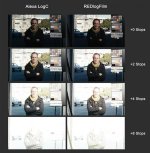
For those who wanted an example - as long as the data's there, if you gain up/down the exposure underneath the Display LUT, the results are identical.

In this case, the sRGB LUT is handling the highlight/saturation rolloff:

attachment.php


SOURCE: http://www.cinematography.net/edited-pages/NZCS-Contrast.html
Alexa: http://www.cinematography.net/NZCS/Alexa-000091336.dpx
Epic: http://www.cinematography.net/NZCS/Epic-000092331.dpx
 

Attachments

  • highlight_rolloff.jpg
    highlight_rolloff.jpg
    88 KB · Views: 0
"Yes we think the same there but what I mean is asking for the linear image to be "desaturated in highlights in camera" is not such really a good idea I think if it's baked onto the savd file. But doing it in post or for client viewing or such, is a different thing." - the linear image has no rendering intent applied. There is no desaturation in camera or baked into the saved file.

In the case of the typical display LUT making it appear that the highlights are desaturated (which is sorta what we're discussing here) there is actually no explicit desaturation. If you invert the LUT back out, you get back to your unadulterated linear starting point.

Graeme
 
To me this is nonsens, a camera should be linear nothing else. Then what grade / gamma curves / luts / 3D luts you want to apply is all done in post.
And yet it's interesting to note that in the past 10 years, the color and saturation from different kinds of film negatives also looked different in terms of gamma, highlights, and so on. Even more different between Kodak and Fuji (though they gradually got more similar than different towards the end).

As far as I'm concerned, the look of BMD, Red, Sony, Alexa, AJA, and so on are just more choices for the cinematographer, like choosing an emulsion. The color science takes this a step further, but Arri strikes me as a company that was extremely patient and took a lot of time to make some very deliberate choices, particularly after the D20 and D21. I've pointed out before that Glenn Kennel over at Arri goes way, way back to the dawn of digital imaging with the Cineon system when he was at Kodak in the early 1990s, then the development of DLP at Texas Instruments. He's the only guy I know of that knows film color science, LUTs, color space, projectors, and cameras. I think very little was left to chance with the Alexa, particularly in terms of color science and fidelity.
 
Back
Top