Welcome to our community

Be a part of something great, join today!

  • Hey all, just changed over the backend after 15 years I figured time to give it a bit of an update, its probably gonna be a bit weird for most of you and i am sure there is a few bugs to work out but it should kinda work the same as before... hopefully :)

Are you still shooting RED 3D with a beamsplitter?

Clyde DeSouza

Well-known member
Joined
Aug 13, 2009
Messages
104
Reaction score
0
Points
0
Location
Dubai, UAE
Website
www.realvision.ae
That link does not work. I don't understand how you can cheat IO on shots that require a IO smaller then a side by side would allow. Do you have any frames that we can see?
 
Interesting....I'd also like to know how you get away with changing IO in software. There must be a down side.

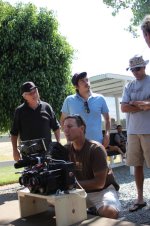
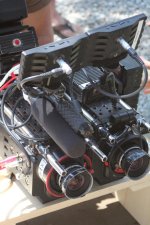
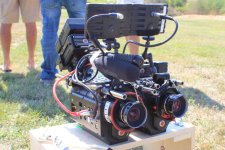
That said, this I came up with a down and dirty 3d parallel rig solution for $12usd. Convergence was set to just about 18' as i recall. And stereo YES, did work. My final upgrade was a strap to allow me to Run and Gun with two REDS Parallel. Now....if the software actually works?? Very promising. Yeah...i know, does not look great, but worked as a lat minute solution.
 

Attachments

  • IMG_4516.jpg
    IMG_4516.jpg
    96.3 KB · Views: 0
  • IMG_4536.jpg
    IMG_4536.jpg
    93 KB · Views: 0
  • IMG_4600.jpg
    IMG_4600.jpg
    96.5 KB · Views: 0
Interesting....I'd also like to know how you get away with changing IO in software. There must be a down side.

That said, this I came up with a down and dirty 3d parallel rig solution for $12usd. Convergence was set to just about 18' as i recall. And stereo YES, did work. My final upgrade was a strap to allow me to Run and Gun with two REDS Parallel. Now....if the software actually works?? Very promising. Yeah...i know, does not look great, but worked as a lat minute solution.


"Run and gun with 2 reds..." I'm sorry but I had to have a chuckle with this statement. I hear it from producers all the time too. Right now nothing about 3D production is very run and gun.....especially if your talking about a 65lbs camera.

You can shoot alot with 6" IO, just ask Eli Jarra, he's shot hours of material like this. I've seen the SGO Mistika software alter IO in post and it's a 300k dollar tool.

It can work okay is some situations but the technology is limited. I would never shoot like this on purpose by choice.

Beam splitters are what we live on and will be living on at least for a few more years until someone comes out with a proper purpose built 3D camera that is flexible.
 
Funny indeed, but it worked and i could move easily from one location to the next and not be nailed to a tripod under the conditions i was shooting....which were skydivers---moving fast from air to ground....yeah, it's a joke i know...but for $12usd and not $90k or $300k it worked. Was merely an idea i had and when shooting 2d and thought to get two reds working onset while the two SI-2k's were working in the air.
 
That link does not work. I don't understand how you can cheat IO on shots that require a IO smaller then a side by side would allow. Do you have any frames that we can see?

The link should be working.
Anyhow here's a shorter version of the link: http://bit.ly/bYfWi3

As a few have asked for examples, I've uploaded one case scenario and updated the article with it.

There was no way possible (or at least it would be extremely cumbersome) to maneuver a Beamsplitter and do sharp turns down alleyways in this run n gun type SlumDog millionaire shoot.

Regards.
 
Johnny Friday,
I salute you! Seriously I have all admiration for people who break or bend the rules when it comes to innovation.

Great looking rig.
While it's true that you get what you pay for... it can also be said, that never before in the history of Cinematography has technology and falling prices reached such a (cliche phrase coming up)..."tipping point".

Rigs and methodologies are evolving rapidly. The only people who will suffer, will be those who refuse to evolve mentally.

Regards
 
The link should be working.
Anyhow here's a shorter version of the link: http://bit.ly/bYfWi3

As a few have asked for examples, I've uploaded one case scenario and updated the article with it.

There was no way possible (or at least it would be extremely cumbersome) to maneuver a Beamsplitter and do sharp turns down alleyways in this run n gun type SlumDog millionaire shoot.

Regards.

Hi

How close can a subject get to the lens when using this method - will it actually replace Beamsplitter rigs most of the time?
 
Brian,
I don't expect it to completely replace a beam-splitter. I am optimistic yes, but I will refrain from saying it's a sure fire thing.

The best advice I would give is, do a short take of the scene, and feed the clip through a good powered laptop running CS5 in-the-field. Adobe CS5 reads Red Raw natively, so it's easy to test.

You will quickly be able to see what's possible. Actually the Previz crew can do this before hand while at the blocking stage.

What I normally recommend is a combination of different techniques.

1) The right tool for the job - If it's an Si2k mini.. then use it.
2) If the scene can be covered with a pair of Parallel Reds (ie you don't need to get extremely close to the talent) then use Reds.
3) getting really close to the subject does have pitfalls in 3D - ie Exaggerated or deformed looking noses, eye sockets or curvature on objects if shot with primes...so if you anyway shoot with a zoom lens to avoid this effect... then shoot with the "shortest" long lens so that they don't take too much physical space when placed side by side, back up a bit, and nudge the zoom to taste.

then, with proper framing in mind, and techniques like H.I.T, floating the window, and the fact that you can now re-shape 3D volume, it could work for many shots.

All the best!
 
Agreed....won't completely replace beam-splitter, but certainly gives you a variety of options when you NEED to look at a shot or replace a shot. I recently got off of a shoot using SI2k's in parallel for skydiving. That was what we were there to shoot for a feature test. BUT i took it upon myself to take our two REDS and make a quick parallel setup for shooting from the ground as our skydive team approached. Might not have been the most ergonomically designed nor most functional rig Pedro--in fact ugly as hell and not something that would likely ever work on a feature set---in fact never i'm sure. But it did work and we got our 2 shots.....that we never even expected or proposed. And yes, running around with it---yes, "running" i was able to accomplish what i set out to do. What certainly is or has been an issue though is the rolling shutter and actually syncing the left/right eye perfectly---something i am not very familiar with, or why....however seems to be a new fix with build 30.6 i hear. Anyway.....my cents and i think innovation on the fly is good to see on a shoot. We've all been there with duct tape and crazy ass ideas to get a shot. I don't work much (if ever) in feature world....all nat. history, so there's a lot of duct tape and bailing wire in my kit.
 
I don't want to contradict Pedro, he's been one of the first contributors to the 3D section and he's constantly working on 3D projects, so his knowledge and wisdom is not something to dismiss...But, I also disagree that 3D can only be shot a certain way, and for as many advantages as beamsplitters have, they have tons of disadvantages as well. I've always been one of those not to accept commonly accepted wisdom if it doesn't make sense, preferring to put it to the test instead. Shooting underwater for the last 8 months or so, and always with side-by-side configurations, I've learned a lot actually.
If you have a good way to adjust convergence in post then shooting SbS actually works surprisingly well for a very large percentage of situations. If you manage to replicate that magical 2.5-3" humanlike IO, this setup will result in "normal" parallax perception that, by simulating the separation between our eyes, yields images that feel "right", no matter the distance to the subject. Remember, our eyes don't move in or out in our skull as we look at different planes of depth, the adjustment happens in the brain, much the same way we adjust when looking at images shot within that under 3" IO. And no amount of argument from experts will convince me otherwise, I have the images to prove it.
So far, I've been shooting with a couple of Canon HF-S10 AVCHD cameras that have a minimum IO of 2.65", pretty much letting me cover anything from 7 ft to infinity.
To overcome the crappy format, I've hooked the cameras to dual Nanoflash recorders and gotten much, much higher quality, and I will start using a Cinedeck 3D recorder soon, which is specifically designed for the task, recording both streams as an already muxed file. I've tested dual Sony EX-1's as well, and although the IO is about 4.2", anything from 10 ft onwards looks great. I'm hoping that Scarlet or Epic will come in at somewhere
similar to the EX-1 and most likely even smaller, probably around 3.5", in which case you'd only need a beamsplitter for things closer than 8 ft or so. HOWEVER, and this is very important, you can use any of the above rigs and IO distances to shoot anything way closer than that, the only drawback being that to merge the images, you need to zoom in considerably, loosing resolution. I've shot some macro experimental work in this manner with my cameras just 5" from the subjects, and the results look great in anything up to a 40" plasma. Of course, for feature work, you'd need something with far more resolution to spare, not miserable 1/3" sensors, but that is the forte of RED, isn't it? Just saying that although a lot of the established rules of 3D hold on their own, like most rules, they can bent, flexed, modified and rewritten just so long as you're willing to try...
 
What are the limitations (or advantages) for overall 3d work using this revision plug in vs. The dashwood plugin or cineform 3d neo3d?

Rudi, glad to hear it is working well, with my ear surgery I haven't been able to do much. (should get clearance monday).
 
Rudi,
I like your approach to stereoscopy.

>>If you have a good way to adjust convergence in post then shooting SbS actually works surprisingly well for a very large percentage of situations.

This is true. Especially on large cameras like the RED, Shoot full sensor, and this will allow you enough crop room to do H.I.T (image translation and crop)."think TV safe" like the old days.. and use those on-screen guides to frame your shot.

You can also float the stereo window for some shots..
Then there's reshaping of the 3D volume using tools from Nuke/Ocula, Mistika and now lastly a cheaper option of a 600$ plugin and after effects.

>>..." If you manage to replicate that magical 2.5-3" humanlike IO, this setup will result in "normal" parallax perception that, by simulating the separation between our eyes, yields images that feel "right", no matter the distance to the subject"....

However, beware, there may be too much positive parallax on background objects, that while easier to "fuse" on a 42 inch plasma or even a 15 foot projection screen...may be quite a challenge for the eyes to fuse when projected on a 40 foot cinema screen. This is one of the reasons that people shoot with a less than 6.5cm interaxial on cameras. (interocular when referring to normal human eyes and being "victorian" about stereo lingo)

>> ...."So far, I've been shooting with a couple of Canon HF-S10 AVCHD cameras that have a minimum IO of 2.65", pretty much letting me cover anything from 7 ft to infinity."...

This is one of the reasons you are blessed with sharp stereo that is easier to fuse at interaxials of 3 inches or thereabouts.
The fact is that the lenses on these cameras when focussed at infinity do not exhibit depth of field blur...AND the cams have an (advantage?) of small sensor size, This helps in keeping everything pin sharp.. a.k.a Stereo3D loves the pin-hole camera.

we all know the downside: less dynamic range, latitude, fixed glass, more light needed and no creative usage of depth of field or what I call.. circle of Isolation:
http://realvision.ae/blog/2010/07/circle-of-isolation-shooting-good-stereoscopic-3d-for-live-sports/

>>..."To overcome the crappy format, I've hooked the cameras to dual Nanoflash recorders and gotten much, much higher quality, and I will start using a Cinedeck 3D recorder soon"...

I love this approach! It's exactly what I would do, to squeeze extra bitrate encoding to overcome AVCHD compression limits.

some tips (ignore if your already aware of them). Since your shooting with Canon AVCHD, I'm assuming those particular models work with a LANC sync unit?

I would suggest you try the SONYs. The reason being on the Sony's, both the lanc port and the HDMI output are on the back of the cameras. This means you can get the cameras closer together side-by-side. I think on the canons the ports are on the sides?

One good LANC sync unit is from www.digi-dat.de
At least it allows a minute or two or very good sync (not compared to genlock) before it drifts off...

>>..."Just saying that although a lot of the established rules of 3D hold on their own, like most rules, they can bent, flexed, modified and rewritten just so long as you're willing to try"...
:rant:

Amen! Also what some people don't realize is that for the first time ever (barring the past fads) in the history of Cinema, we can record "spatial resolution" ..something that no one has yet done conclusive experiments on; i.e a comparison of the perceived "resolution" of an image simply by pixel count of say a 2k image versus the "Spatial resolution" of a 3D image on the brain even if its 1920 x 1080.

This does not mean that we should go about comparing AVCHD output at whatever bitrate to a Red 4K image...

...what we can do is experiment with the RED's overscan ability to create great 2k images on the sensor.

Then use a Ken burns horizontal slide to get that much coveted "smaller interxial" look!
:rant:

Regards
 
What are the limitations (or advantages) for overall 3d work using this revision plug in vs. The dashwood plugin or cineform 3d neo3d?

No, I believe the Dashwood plugin does H.I.T (horizontal image translation) to re-converge the images.

This then needs cropping the edges (you lose image data from the left/right sides), and/or floating the stereowindow.
If you keep your framing within safe guides, no reason not to use HIT.

Also the Dashwood plugin implements a lot of other stereoscopic tools in a very intuitive interface.

Regards
 
Clyde,

I would much prefer to use Sony than Canon, but the equivalent size Sony cams, the 500 and 520, don't have any progressive modes, only interlaced, and that's a no-no when recording for 3D as you can imagine. The Canons have the SF progressive modes that are not truly progressive but don't have any interlace lines just the same when the pull down is removed. Yes, the Canons have the plugs on the side but there is still space for the mini HDMI plug since the cameras have a separation of about 3/4 inch between them due to the wide angle lenses at the front pushing the cameras out just that much...what I am really looking forward to is Epic or Scarlet, that should be something!
 

when I first contemplated using a pair of small Canon camcorders or even a pair of EX-1's, my options for jam syncing the cameras were basically non existent, save for some very expensive and not really proven dual infrared trigger units. A few experts told me I would not be able to get decent 3D unless I solved that problem, and understandably my heart fell to the floor, since those same experts told me unless I used a beamsplitter, I could not use a pair of RED side by side either since their IO was too big. It seemed my 3D career was dead in the water before it even took off, so since I had already had a housing made, I went anyway and tried to sync the cameras through that old method...what's the name...of yeah, a clapper. And what do you know, through the use of a clapper and sound syncing, I can get my cameras within half a frame of each other, and specially when shooting at 30 frames, that difference is basically of no consequence. I know what some will say, that even those minute, intraframe separations will create a mess in post, but I cannot think of a more difficult medium than underwater, with fish that can twist from left to right in one frame, or corals swaying in the current constantly or the sun reflecting on and off on the sand the whole time. And despite all that, I've shown my converged footage to a couple of experts and first thing they asked is how I managed to sync those cameras perfectly :-) It's not perfect, but if there's a will, there's always a way to get things done acceptably well...
 
Back
Top