Welcome to our community

Be a part of something great, join today!

  • Hey all, just changed over the backend after 15 years I figured time to give it a bit of an update, its probably gonna be a bit weird for most of you and i am sure there is a few bugs to work out but it should kinda work the same as before... hopefully :)

Anyone seen footage from sony F65?

it looks great. super legit..

also a boat anchor

I suppose that's one person's description. I would say that certain decisions were made by its designers that were tradeoffs between specific features and size/weight considerations, just like Red, Arri, and other camera manufacturers do. In Red's case, the smallest size and weight possible was part of the design goal, which led to a camera that's uniquely suited for rigs and shooting situations where that's an advantage, such as stereoscopic 3D, small mounts, and hand held configurations. It was also designed the way it was because the stated goal was a camera that could be used for both motion and still photography. In Arri's case, they wanted to design a product that would work well in both studio configurations and hand held, but not necessarily be appropriate for small 3D rigs. They also had no intention of presenting their product as a stills camera. In Sony's case, they wanted to include things like a color wheel and a mechanical shutter option, which require physical size and a different weight target. They also wanted to be able to record different formats directly, hence the need for a separate, dockable recorder. They built a product that is very much at home in a studio, on a dolly or crane, but not as comfortable for hand held work. Their answer for stereoscopic work will likely be a T-head version of the camera, which will allow for more flexibility at the expense of having a tethered central control unit (Arri did the same thing with the Alexa M).

One of the things about a maturing industry is that different manufacturers will design different products for different purposes, each from its own manufacturer's unique perspective. The one thing they will all have in common is great images, which we're already seeing. All other considerations are specific to the user and the project, and by having choices, everyone benefits. While all of these products can produce excellent results in almost all conditions, each has some unique things that it brings to the table. And having these choices drives competition, which in turn drives innovation. For anyone to dismiss any one of these or other future players with disparaging descriptions like "boat anchor," is to ignore the unique advantages that each of these devices bring. What might be right for you on a specific project might be wrong for someone else on a project with different needs and considerations. Just as it's true that not everyone wants to drive a tiny car every day, not everyone wants to shoot with the smallest camera on every project. Sometimes a bit more heft is a good thing. Sometimes it's not.

Choices.
 
Mike, you raise some valid points, like the mechanical shutter requiring more space, but the general trend of electronics is toward smaller and more powerful products. Cinema cameras will NOT be an exception to this.

Do you think someone could come out with a phone like this and still be a legit player in today's cell phone business?

cellphonee.jpg


Believe me, engineers at Arri and Sony are scrambling right now to reduce the size of their cameras.
 
Mike, you raise some valid points, like the mechanical shutter requiring more space, but the general trend of electronics is toward smaller and more powerful products. Cinema cameras will NOT be an exception to this.

Cinema cameras are not consumer electronics and are not subject to the same kind of consumer demands. Often in studio production, smaller and lighter does not equal better. And while it's true that an Epic can be built up to have a bit more weight, it is not its normal configuration. For the same reason that dollies are not all Peewees and door dollies, smaller and lighter is not always what is desired for every situation. Having a bit more weight is useful in situations where inertia is your friend, like slow tracking shots of someone's face. And although cinema cameras are becoming more and more electronic, they are not "electronics" per se. They are optical capture devices, ones that use high quality optics - which themselves require some size and weight.

Do you think someone could come out with a phone like this and still be a legit player in today's cell phone business...

Believe me, engineers at Arri and Sony are scrambling right now to reduce the size of their cameras.

If we were talking about consumer devices, I would probably agree with you. But we're not. I agree that Sony would probably like to trim the size and weight of the F65 in future updates, but I also feel that their target is not likely the size and weight class of Epic. More like Alexa in all likelihood, at least in a studio configuration.
 
Cinema cameras are not consumer electronics and are not subject to the same kind of consumer demands. Often in studio production, smaller and lighter does not equal better. And while it's true that an Epic can be built up to have a bit more weight, it is not its normal configuration. For the same reason that dollies are not all Peewees and door dollies, smaller and lighter is not always what is desired for every situation. Having a bit more weight is useful in situations where inertia is your friend, like slow tracking shots of someone's face. And although cinema cameras are becoming more and more electronic, they are not "electronics" per se. They are optical capture devices, ones that use high quality optics - which themselves require some size and weight.

Haha, we'll see about that! I remember the fine folks at cinematography.com telling us that cinema cameras were going to be immune from the changes that took place with DSLR digital still cameras. Guess what, every cinema camera manufacturer on earth now is racing to make digital RAW cinema cameras. If you need extra weight for your cinema camera, strap a brick on it.
 
Haha, we'll see about that! I remember the fine folks at cinematography.com telling us that cinema cameras were going to be immune from the changes that took place with DSLR digital still cameras. Guess what, every cinema camera manufacturer on earth now is racing to make digital RAW cinema cameras. If you need extra weight for your cinema camera, strap a brick on it.

You're talking about internal camera capabilities, of course those will change and evolve. Mike is talking about how each mfg. is deciding to direct their external camera designs, IE ergonomics, in different directions. And if I need to strap a brick to a camera to make it balance properly for hand held it is not a well designed camera for hand held configurations.

FYI Mike, the F65 does not have an internal color wheel for white balance.

It does it electronically like the Alexa and other non-Red cameras because they feel doing that in camera produces a cleaner image than doing it in post due to their heavy duty electronics inside the camera. It is also natively balanced to 3200K, not daylight balanced, like Red's cameras or the Alexa. I thought that was an interesting note... I guess they found if they designed their CFA to 3200K then just electronically balance to daylight etc again it produces a cleaner image vs. balancing closer to daylight to the sensor and shifting the white balance in post.

Having different choices for different projects is great. I still don't see any camera system out right now that is suited perfectly for every situation. Despite Red owners saying the Epic is that camera. We need the promised modules to be shipping for that to even be a relevant conversation.
 
Cinema cameras are not consumer electronics and are not subject to the same kind of consumer demands. Often in studio production, smaller and lighter does not equal better...


Sorry Mike, while I agree with you on all else, and I do like the Sony 65, I just would never use it having the choice to use EPIC of course, but that is an other story all together, my point of STRONG DISAGREEMENT with your statement, is that I don't only know hollywood better then most (no pone intended) I know the world of Cinema that were Hollywood is just a fraction of the Machine, and believe me, and you'll understand at a later time when I'll make an important announcement, I KNOW what I'm talking about it, when I say that EVERY ONE IN HOLLYWOOD and Global Filmmaking facilities, want the size of EPIC, as it offers INSANELY huge benefits, 3D applications been the absolute most beneficiary of such smaller size, but same goes for 2D.
 
Talk to any ASC-level DP and they will all tell you the same thing about F65. "Great picture, but it's fucking HUGE. Have you seen it?" Exact same words from every single DP, without fail.

Anyone who thinks digital cinema cameras are somehow immune from the laws of consumer electronics is fooling themselves. You can always add weight or volume to something, if your complaint is that it's too small. The same thing could have been said about an iPhone versus that Gordon Gekko-style cell phone I posted above. "Oh you can't have a phone of the size of a deck of cards.. no one will be able to use it! The mouthpiece doesn't even reach your mouth..." and so on and so forth.
 
3D folks certainly benefit from the size of the Epic, I agree. But not all 2D productions benefit from that form factor. ...unless this hidden knowledge you posses says that we don't need: Cinetapes, lockit boxes, FIZ, wireless audio receivers and we won't be shooting hand held anymore... You must know some crazy info!
 
in my opinion, the proof is in the pudding. wally pfister is shooting the next dark knight on imax because he believes it is the superior choice, in quality, and to achieve the look he wants. that is his choice and he deals with how big the camera is. The choice will always be about what images you are getting out of the camera and how it makes or break your day. each camera does make and break your day in its own way. size and weight is always a factor, but not the end all be all. but I think the goal of any electronics company is to try to make their product smaller and more power efficient.

this time around Sony choice the primary specs first and foremost, and this is as small as the cam can get under these specs. Next iteration it might be the size of an Epic or even smaller. I'm just happy there are so many great options these days.
 
The laws of electronics: Things get smaller and more powerful. If you need the camera to be larger, build a box around it and add some lead weights. Or do whatever else you need to in order to satisfy your desire for a larger or heavier camera.

Anyone who thinks that digital cinema cameras will not continue to get smaller and more powerful will be in for a surprise. Let's check this thread in 3 years and see who got it right, and who got it wrong.
 
This has been bugging me for some time:

The F65 sensor is not 8k in the way we all would expect 8k to relate to the "existing" resolutions. Sony is even aware of this and the first papers put out announcing the F65 listed it as 6k x 3k, which is more accurate.

It's a good camera with VERY respectable specs, that are being hidden by some bullshit marketing.
 
I agree with you Tom that cameras will get lighter and certainly more powerful. But the cameras we use for general purposes shouldn't get too much smaller than what we have now, a bit smaller sure but not too much. We need the cameras to be a certain size to work with them. We're not shooting home videos here so cameras the size of an iPhone isn't useful.
 
Let's check this thread in 3 years and see who got it right, and who got it wrong.

What I am reading is that F65 does 120fps at 2K or ½ of vertical res at 4K.

BTW I was always wondering why Kodak didn’t survive sudden technological shift.

Is this always like this that the fittest dies when climate changes?

I am betting man but in 3 years I think Sony Company will be still around but Sony cine camera business will not.
Not the way it is progressing right now.
This whole F65 project looks to me like “we can do it as well”
 
The vitality of the colors was probably the most striking attribute to the image. It was a little noisier than I was expecting @800, it's cleaner than the Epic but not as clean as the Alexa. Of course it's hard to make a completely fair judgement of something like that without shooting them side by side.
 
Talk to any ASC-level DP and they will all tell you the same thing about F65. "Great picture, but it's fucking HUGE. Have you seen it?" Exact same words from every single DP, without fail.
Actually, I think once you hang a viewfinder, a Redmote, rails, a big battery, and a Pix on a Red Camera, it's about the same size. Check this out:

Sony-F65-Camera1.jpg


I saw the camera back in June at the Sony booth at Cinegear Expo, and it didn't strike me as gigantic. I think it certainly didn't feel bigger, really, than the Alexa. Hell, the lens is still bigger than the camera in a lot of cases. I agree with Adam above that you need the camera to be a certain minimal size just to handle lenses, mounting hardware, handheld configurations, and so on. Even if it were the size of a pack of cigarettes, you still have to contend with viewfinders, batteries, rails, audio, timecode, follow-focus gears, and other accessories. Even now, the F65 is a lot smaller than a comparable old-school news camera.

I don't think the cost of the camera is going to be an issue for Hollywood films and TV shows, simply because 90% of them rent their cameras and lenses. The reality is, the camera is only a very small part of the cost of rented camera gear; I think lenses, storage, batteries, and mounts are as great an expense, especially a full-blown $100K lens package.
 
Everybody else is playing catch up right now. and there is a confirmed 120 fps mode coming out soon, just not activated yet. It will be doing a horizontal crop on the top and bottom of the frame sort of like RED's 2:1 aspect, but they decided not to doing any kind of windowing on the sensor itself so you always maintain a 4k image.

According to Sony's representative at recent SMPTE meeting the 120 fps mode is 4K x 1K... not sure that still counts as a 4K image..
 
Actually, I think once you hang a viewfinder, a Redmote, rails, a big battery, and a Pix on a Red Camera, it's about the same size.

Not so, the Sony is considerably bigger than EPIC when configured with those accessories.

Beside's which why would you hang a PIX 240 on an EPIC if comparing to an F65?
 
Just because a camera is bigger or smaller compared to another doesn't mean it has an overall superior ergonomic design for many of the general shooting situations we're in. A balanced camera is greatly more important, we need the ability to attach all the various AKS we need to attach and be able to maintain the balance and function of the camera.

Stuart you might be forgetting that if you add the IO Module the Epic might be a similar length. The F65 has those ports built in already so of course its going to be larger to accommodate those vital functions. A larger body also helps with keeping the sensor and electronics cool which is important so extra noise isn't added to the image.
 
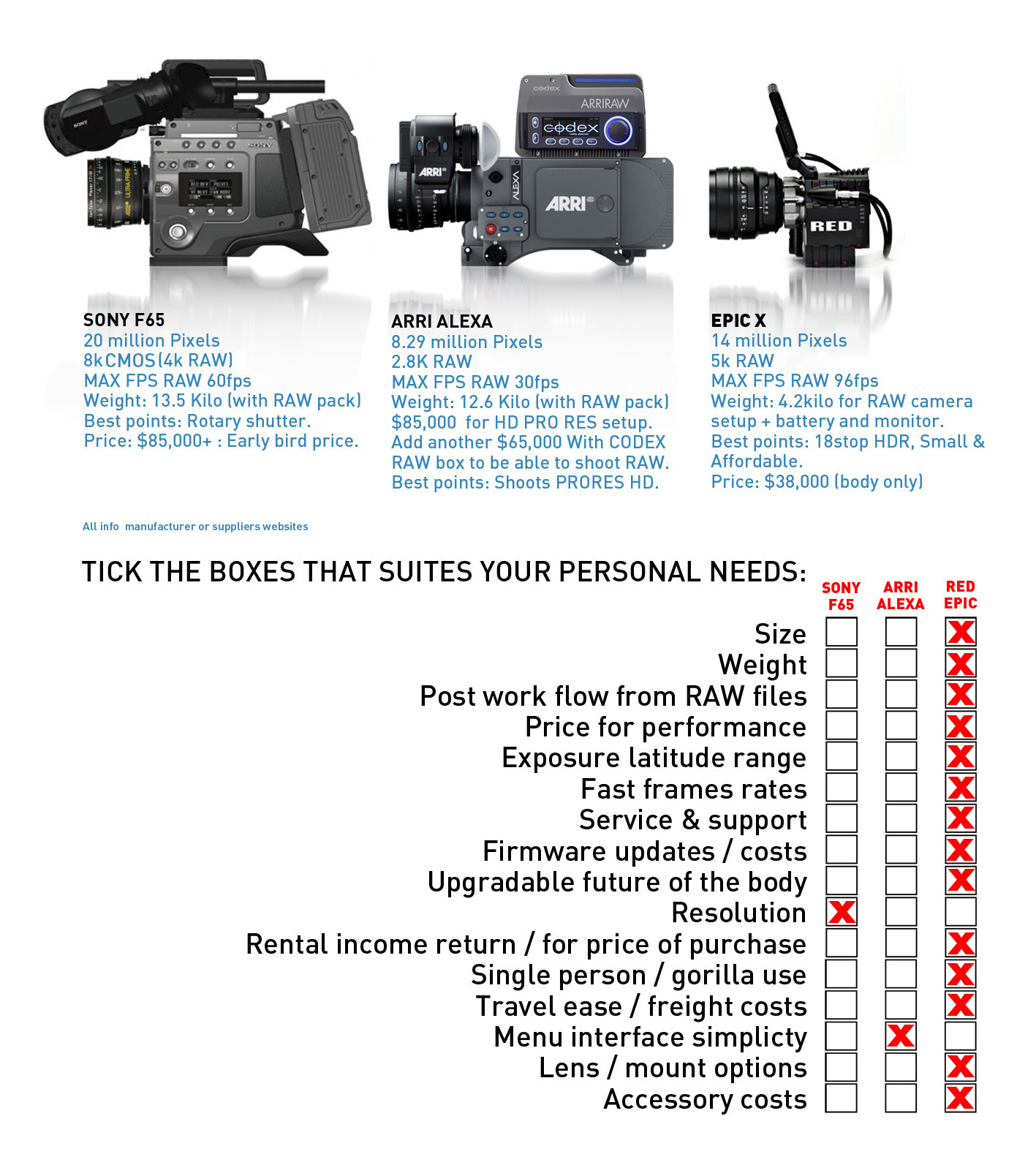
I just look at the facts and tick the boxes that suite my needs. As simple as that.

Everyone has different requirements from a camera package or is capabilities. With a lot of people liking brand names over practically and price... or there perception of image quality over other cameras.
Post production workflows become as deciding factor as well.

Everyone has a different list of boxes to tick. These are just mine...

Sony_Arri_Epic_2.jpg
 
That little chart of yours is cute and all but it does leave out several items and is miss checked on a few things. It is also is skewed towards Epic so it's not exactly a fair explanation.

My version of this list would go:

-Size- Epic
-Weight- Epic
-Post workflow- Alexa
-Price/performance- that's difficult to asses because if you're on a TV series that edits in ProRes then Alexa might be the best way to go, or if you're doing 3D then maybe Epic, or if you're shooting an VFX heavy show then the F65 might be best for you.
-Latitude- Alexa (HDR doesn't count because of the motion artifacts it introduces)
-Frame Rate- Epic (but they all have 120FPS capability which is pretty darn good)
-Service and Support- good across the board so again that's irrelevant in this comparison
-Firmware updates/costs- they are all equal because basic firmware updates are free from all of them (you're talking about features which weren't originally promised to be free so that's kinda of a loaded comparison)
-Upgradable- We've been told the Alexa is also designed for future upgrades so the jury is still out on that
-Resolution- F65
-Rental/return- Depends on the market you cater to
-Single person- Alexa
-Gorilla use- Epic
-Travel ease- Epic
-Interface- both the F65 and the Alexa are on par with eachother and are both easier to use than Epic's menu
-Lens mount options- Alexa also has Canon and Nikon mounts but they are made by 3rd party co.
-AKS- they all use the same AKS

Things you left out:
-Balanced for HH- Alexa
-Mechanical shutter- Both F65 and Alexa
-Uses existing AKS- Both F65 and Alexa
-Optical viewfinder- Alexa
-Cleanest Image @800ASA- Alexa
-Battery life- Epic (w/red brick)
-Recording Time- Epic

By my count the check list would total:
Epic-9
Alexa-11
F65-4

Thanks for the propaganda which does nothing more than add to the huge amount of more misinformation floating around out there about each camera system's capabilities, very productive. :emote_headwall: How long did it take you to make that check list?
 
Back
Top