it looks great. super legit..
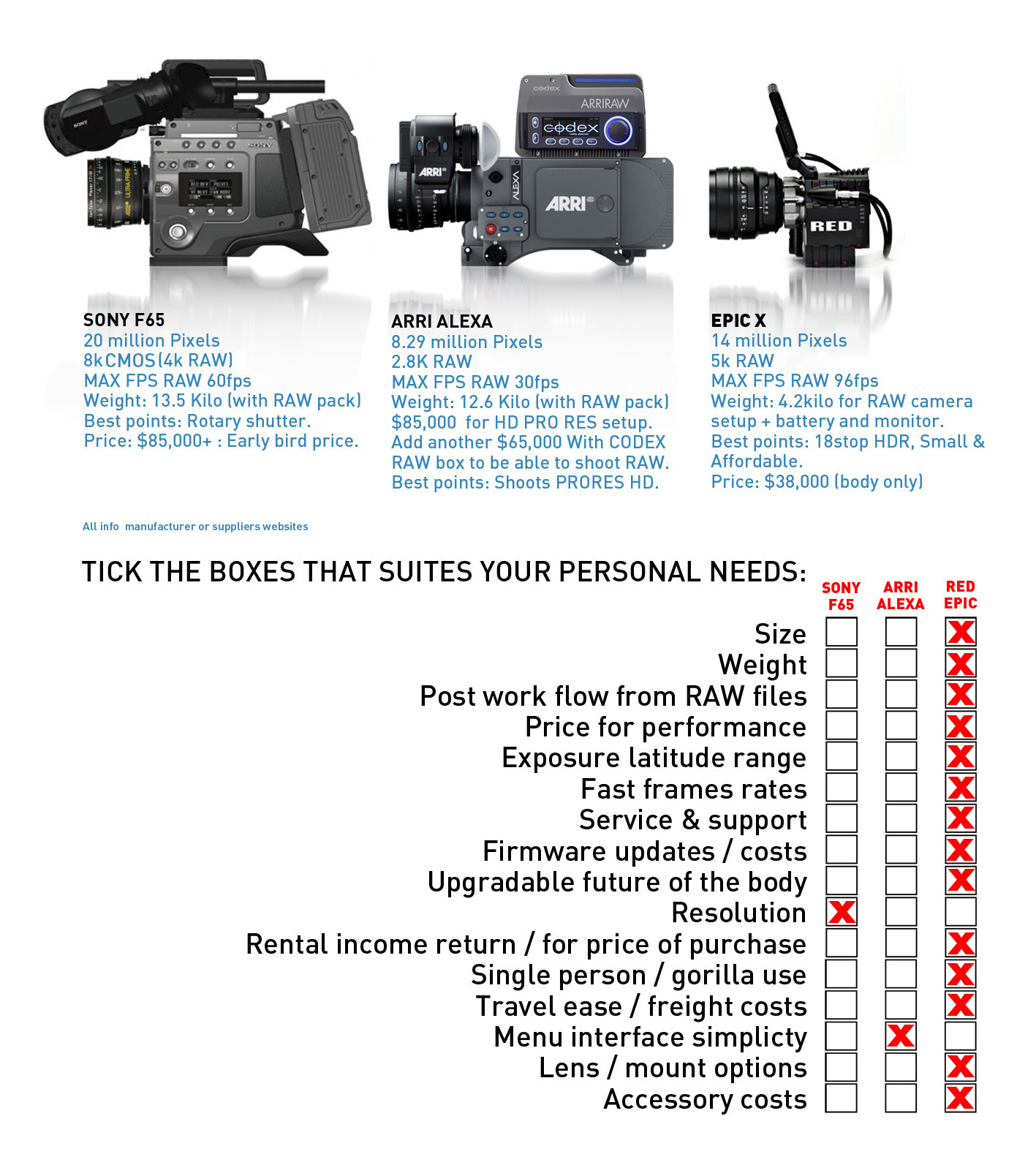
also a boat anchor
I suppose that's one person's description. I would say that certain decisions were made by its designers that were tradeoffs between specific features and size/weight considerations, just like Red, Arri, and other camera manufacturers do. In Red's case, the smallest size and weight possible was part of the design goal, which led to a camera that's uniquely suited for rigs and shooting situations where that's an advantage, such as stereoscopic 3D, small mounts, and hand held configurations. It was also designed the way it was because the stated goal was a camera that could be used for both motion and still photography. In Arri's case, they wanted to design a product that would work well in both studio configurations and hand held, but not necessarily be appropriate for small 3D rigs. They also had no intention of presenting their product as a stills camera. In Sony's case, they wanted to include things like a color wheel and a mechanical shutter option, which require physical size and a different weight target. They also wanted to be able to record different formats directly, hence the need for a separate, dockable recorder. They built a product that is very much at home in a studio, on a dolly or crane, but not as comfortable for hand held work. Their answer for stereoscopic work will likely be a T-head version of the camera, which will allow for more flexibility at the expense of having a tethered central control unit (Arri did the same thing with the Alexa M).
One of the things about a maturing industry is that different manufacturers will design different products for different purposes, each from its own manufacturer's unique perspective. The one thing they will all have in common is great images, which we're already seeing. All other considerations are specific to the user and the project, and by having choices, everyone benefits. While all of these products can produce excellent results in almost all conditions, each has some unique things that it brings to the table. And having these choices drives competition, which in turn drives innovation. For anyone to dismiss any one of these or other future players with disparaging descriptions like "boat anchor," is to ignore the unique advantages that each of these devices bring. What might be right for you on a specific project might be wrong for someone else on a project with different needs and considerations. Just as it's true that not everyone wants to drive a tiny car every day, not everyone wants to shoot with the smallest camera on every project. Sometimes a bit more heft is a good thing. Sometimes it's not.
Choices.