
Navigation
Install the app
How to install the app on iOS
Follow along with the video below to see how to install our site as a web app on your home screen.

Note: this_feature_currently_requires_accessing_site_using_safari
More options
Welcome to our community
Be a part of something great, join today!
You are using an out of date browser. It may not display this or other websites correctly.
You should upgrade or use an alternative browser.
You should upgrade or use an alternative browser.
Anamorphic and non-amorphics
- Thread starter Bryce W.
- Start date
Oliver Maximilian Kraus
Member
yes it will, but believe me - postpro is also possible to create it.
Steven James Eaton
Member
It's a strange thing. I've often wondered about what exactly the oddity of an anamorphic lens brings into the picture. I've seen and done the "post-anamorphic" look done, and I can pick that up immediately, and not only does it not bring in the same feel, there's an artificiality to it better suited to (I think) short-form work, such as shorts, music videos, etc. I truly hope the lenses become more and more available and also (IMHO, more importantly) not too perfectly-made versions of those lenses (C-Series lenses, as opposed to Lomos and such, which are still cool lenses, just not as anamorpy, to coin a phrase). I think much like film grain, and lens blooms, I think anamorphic lenses unconsciously remind the audience that they're watching a piece of art. As a personal preference, I think the 2.35 image is also often a neat compositional choice, but not through cropping and other means (super 35, etc.) that's not anamorphic-specific. I've seen I guess it may also be the technical bits, enhanced depth of field, wider image capture, but really, who knows. It's a darned good discussion to have.
- Moderator
- #4

- Joined
- Apr 19, 2007
- Messages
- 13,392
- Reaction score
- 796
- Points
- 113
- Location
- Los Angeles
- Website
- www.phfx.com
Flare is indeed one of the more telling signs and often the reason for people to choose anamorphic lenses. But there is another reason that is harder to explain as each lens has a slightly different feel.
Certain anamorphic glass has what I would call an "anamorphic swoop" and across the frame it can give you the sensation of almost pulling the subject towards you.
If you look at older anamorphic optics where there's almost fisheye distortion across the frame it potentially tells you the tale of why this is happening. However, the effect is still noticeable with modern day optics where barrel distortion has been minimized. It's hard to describe, but it's there. Really difficult to notice or describe unless you've spent some time behind the glass "feeling the difference". This to me is why "fake anamorphic" looks fake still. I'm sure there are others who have logged way more time behind anamorphic glass who could chime in.
I do have a couple of example images to look at though. Not exactly apples to apples here in terms of FOV and also slightly different times of day.
35mm Aspherical on FF35 - bigger

100mm 2X Anamorphic on FF35 - bigger
I could go out and make a test with a 35mm and Iscorama 50mm 1.5x and that would be closer. Thought I had one laying around somewhere. I'll dig a bit.
Certain anamorphic glass has what I would call an "anamorphic swoop" and across the frame it can give you the sensation of almost pulling the subject towards you.
If you look at older anamorphic optics where there's almost fisheye distortion across the frame it potentially tells you the tale of why this is happening. However, the effect is still noticeable with modern day optics where barrel distortion has been minimized. It's hard to describe, but it's there. Really difficult to notice or describe unless you've spent some time behind the glass "feeling the difference". This to me is why "fake anamorphic" looks fake still. I'm sure there are others who have logged way more time behind anamorphic glass who could chime in.
I do have a couple of example images to look at though. Not exactly apples to apples here in terms of FOV and also slightly different times of day.
35mm Aspherical on FF35 - bigger
100mm 2X Anamorphic on FF35 - bigger
I could go out and make a test with a 35mm and Iscorama 50mm 1.5x and that would be closer. Thought I had one laying around somewhere. I'll dig a bit.
- Thread starter
- #5
Have you ever used Lomos or Kowas...if so do you recommend them in terms of giving a p.t. anderson look?
Flare is indeed one of the more telling signs and often the reason for people to choose anamorphic lenses. But there is another reason that is harder to explain as each lens has a slightly different feel.
Certain anamorphic glass has what I would call an "anamorphic swoop" and across the frame it can give you the sensation of almost pulling the subject towards you.
If you look at older anamorphic optics where there's almost fisheye distortion across the frame it potentially tells you the tale of why this is happening. However, the effect is still noticeable with modern day optics where barrel distortion has been minimized. It's hard to describe, but it's there. Really difficult to notice or describe unless you've spent some time behind the glass "feeling the difference". This to me is why "fake anamorphic" looks fake still. I'm sure there are others who have logged way more time behind anamorphic glass who could chime in.
I do have a couple of example images to look at though. Not exactly apples to apples here in terms of FOV and also slightly different times of day.
35mm Aspherical on FF35 - bigger
100mm 2X Anamorphic on FF35 - bigger
I could go out and make a test with a 35mm and Iscorama 50mm 1.5x and that would be closer. Thought I had one laying around somewhere. I'll dig a bit.
- Moderator
- #6
- Joined
- Apr 19, 2007
- Messages
- 13,392
- Reaction score
- 796
- Points
- 113
- Location
- Los Angeles
- Website
- www.phfx.com
They will give you the "anamorphic look", but if memory serves correctly P.T. Anderson has used in the past the older Panavision C and E anamorphic glass. More barrel distortion and more prone to flare. Likely higher overall image quality compared to older Lomos. I haven't done a side by side test to really say for sure. I'm way more familiar with Panavision anamorphic glass. I don't have too much experience with Kowas minus a custom lens with some optics machined by Panavision no less, which is what you are looking at above.Have you ever used Lomos or Kowas...if so do you recommend them in terms of giving a p.t. anderson look?
In terms of getting the P.T.A. "look" each one of his films looks different to me in terms of style and color grading. There's a lot that comes into play when describing how a motion pictures looks. Much comes from the lighting, quality of light, cinematography style, lens selection, recording medium, digital color correction, color grade, etc. Hard to nail exactly what you're after here. It's easier to deconstruct exact lighting setups in a specific shot than describe how an entire film looks.
- Thread starter
- #7
Sorry for not being specific. I'm thinking primarily of There Will be Blood with shots like Daniel Day Lewis' character talking in a meeting while his son stands behind him; it's in the trailer. Do you think anamorphic glass other than panavision could pull off the feel found in these type of shots considering all other things stay the same?
- Moderator
- #8
- Joined
- Apr 19, 2007
- Messages
- 13,392
- Reaction score
- 796
- Points
- 113
- Location
- Los Angeles
- Website
- www.phfx.com
Sorry for not being specific. I'm thinking primarily of There Will be Blood with shots like Daniel Day Lewis' character talking in a meeting while his son stands behind him; it's in the trailer. Do you think anamorphic glass other than panavision could pull off the feel found in these type of shots considering all other things stay the same?
Just looked up the shot. I'm assuming it's this one here:

There's going to be three different answers to this question.
1. One cinematographer will tell you that you can achieve a similar shot even with aspherical glass.
2. Another cinematographer will tell you absolutely. Any equivalent anamorphic focal length will work.
3. And another cinematographer will tell you, nope. That's a Panavision C look and nobody does that.
Compositionally speaking this shot can be recreated with any lens system. However, I do see some signs of the anamorphic glass here in terms of it's "bowing" effect which produces an interesting field of focus. It's a nice suble effect. Without doing tests going head to head against the glass used it's really hard to tell if anything would come close. There are likely other people on the board who might know more about this shot and comparable anamorphic glass from other manufacturers. In my experience Panavision optics look like Panavision optics and nothing else really. Which is a good thing in my world. I'm close to Panavision Woodland Hills and know where they get their anamorphic elements made as well as the rest of their glass. That combination provides a certain look that others don't "hit".
I would however bet a pretty penny though when it comes to color, contrast, and sharpness those old Kowas and Lomos won't look like this under the same lighting. However, probably correctable in post with a good colorist if you had to make a match.
Steven James Eaton
Member
Thanks for all the info Phil, and I have an odd question, as far as the difference in look, it doesn't seem enormously different on first look. Do you think most filmmakers who swear by them is because of the tangible differences like flare and bowing and such, or do you think it could be the difficulty that comes with a lack of lenses and carefulness in use it takes to use the C-Series for example? I think sometimes the discipline and meticulousness it takes to use them can result in a better looking project. The many projects which came out beautifully, the forementioned There Will Be Blood for example, people look at, thinking that the lenses are an "I Win" button which immediately will take your project up a notch. I've never used anamorphic on a project personally, but I've seen work that was done anamorphically which really could have been done spherically and I don't think anyone would have noticed, save for the odd flare here and there.
- Moderator
- #10
- Joined
- Apr 19, 2007
- Messages
- 13,392
- Reaction score
- 796
- Points
- 113
- Location
- Los Angeles
- Website
- www.phfx.com
@Steven James Eaton - Good points and observations. I'll use a quick analogy. I have a great deal of talented oil painter friends and many of them swear by a particular brand of brush and nearly all of them use the same paint. If your goal is just to get the paint on the canvas, being picky about which brush you use may not be high on your agenda. However, oil paintings take a long time to make and often somebody will find it very special. If you're going to have a brush in your hand and do anything that you any strong feelings towards, you may be a bit more picky about what you're holding.
I think there are some who are most interesting in capturing the material, but I do think there is a tangible difference in use and on screen with anamorphics. How important that is to you and whether that's a subtle thing or major thing will be up to the cinematographer. Personally I like the look and feel of both anamorphics and aspherical for different reasons. If I was shooting an epic fantasy or heavy drama I'd likely reach for anamorphics as their overall look with flare, bowing, and out of focus area can really add flavor to a shot. If I was shooting a romantic comedy or light hearted drama I would likely choose aspherical and produce a more "natural look".
There is certainly no "I Win" button though when it comes to glass. There is no lens out there that suddenly makes the content of the movie better. Still need solid actors, lighting, good shooting techniques, and compelling compositions to really have a winning combination. I mentored a couple students through The New York Film Academy a few years ago and it seemed the more and more they learned or knew about motion pictures and the more in love with a specific individuals work they had more desire to use specific lenses. However the good thing is they didn't have access to real high quality glass and do have to focus on making their movie their way and work with what's in front of them. (Super8/Super16/HD Camcorders at the time)
I'm no big cinematographer, but have been fortunate to play and shoot on major motion pictures for some time. I've also picked the brains of many of the DPs that I've worked under. The one solid piece of advice that I can safely give when it comes to glass is to experiment, observe, study, and really feel what's going on in your tests. If you end up have a specific preference overall, than that is likely your path. If you end up liking different glass for different scenarios then make a note of that and use it when it's called for.
- Moderator
- #11
- Joined
- Apr 19, 2007
- Messages
- 13,392
- Reaction score
- 796
- Points
- 113
- Location
- Los Angeles
- Website
- www.phfx.com
*edit - Dug around and found another good example of anamorphic "swoop" from some camera tests.

- On the above the car seems to almost "crawl" into the frame.

- Here we can see the effects of the swoop and barrel distortion.

- Especially when composing diagonally you can really bring out that swoop effect.

- The above is an absolutely boring shot. However, it does provide a good example of the "epic" style that anamorphics produce.
- On the above the car seems to almost "crawl" into the frame.
- Here we can see the effects of the swoop and barrel distortion.
- Especially when composing diagonally you can really bring out that swoop effect.
- The above is an absolutely boring shot. However, it does provide a good example of the "epic" style that anamorphics produce.
Steven James Eaton
Member
Couldn't agree more Phil, thanks for the response. I think the Brush metaphor was particularly apt, in fact, I've often heard people refer to digital for example as the acrylic of film, and I think your example was a better version as such. You can use digital or spherical lenses, and some may see them as inferior, but if you treat them as something which CAN be just as beautiful, and you attempt the proper love and care, the differences can disappear.
- Thread starter
- #13
Steven James Eaton
Member
I think the point Phil was making is you could get that look through a few different means. For an anamorpic lens package besides Panavision, which you can get fairly filmic with, I think they shot Sunshine with Lomos and that was a really gorgeous film. I don't know how much experience you have shooting, but I'd get out there and practice man. Get used to using a lot of lenses, and learn your grading suite well. You had a post around, asking about how Anderson, Tarantino, etc. get their look. They are amazing filmmakers, and they work with amazing filmmakers, cinematographers, actors, etc., my point being, it ain't all the camera. Or the lenses.
- Moderator
- #15
- Joined
- Apr 19, 2007
- Messages
- 13,392
- Reaction score
- 796
- Points
- 113
- Location
- Los Angeles
- Website
- www.phfx.com
Steven pretty much nailed that. I agree that Sunshine was gorgeous. Wonderfully shot, great style, great grade, creative cinematography, nice edit, good acting. Highly underrated film. For me, the best sci-fi film release of 2007.

David Mullen ASC
Moderator
I posted these before, but you can see the difference between anamorphic and spherical on the same sets by looking at "Star Trek V" (anamorphic) versus "Star Trek VI" (spherical):

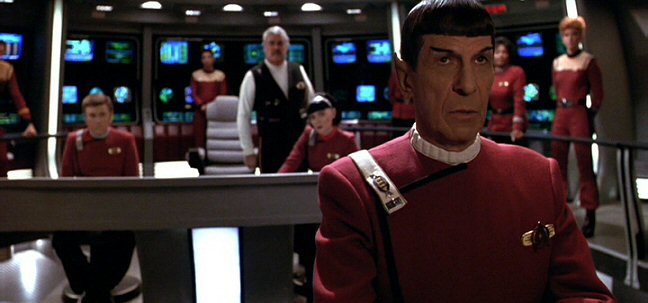
Anamorphic artifacts increase as you open up the lens and reduce depth of field, so it's harder to tell a difference with spherical in day exterior shots made with lots of light, but in low-light scenes, the differences are very obvious.
Anamorphic artifacts increase as you open up the lens and reduce depth of field, so it's harder to tell a difference with spherical in day exterior shots made with lots of light, but in low-light scenes, the differences are very obvious.
charles lim yi yong
Well-known member
- Joined
- Aug 9, 2011
- Messages
- 405
- Reaction score
- 0
- Points
- 0
hey phil, great to see you here. I got myself a red epic . perhaps u know me as deadfish in dvxuser or mataikan in anamorphic vimeo group.
- Moderator
- #18
- Joined
- Apr 19, 2007
- Messages
- 13,392
- Reaction score
- 796
- Points
- 113
- Location
- Los Angeles
- Website
- www.phfx.com
hey phil, great to see you here. I got myself a red epic . perhaps u know me as deadfish in dvxuser or mataikan in anamorphic vimeo group.
Congratulations Charles! I remember you
 You're probably already having crazy fun!
@David - That is sort of the perfect example. I remember it from your thread. Beyond typical out of focus effects from spherical, the added bonus from the anamorphic glass really simplifies the subject in the frame. There's still a lot going on back there, but nowhere near as distracting to the viewer as the spherical glass.