


Patrick Grossien
Well-known member
I stumpled over this via redshark. An amazing example of what the right minds can achieve if they start rethinking given patterns.
Maybe it's not only about future lenses, but also with the existing lenses, image correction in post could profit heavily from this - given the calculations from the prior pattern shots can be automated.
But if this also means that future lenses don't need to be extremely heavy any more, because they can loose all the optical correction glass, count me in
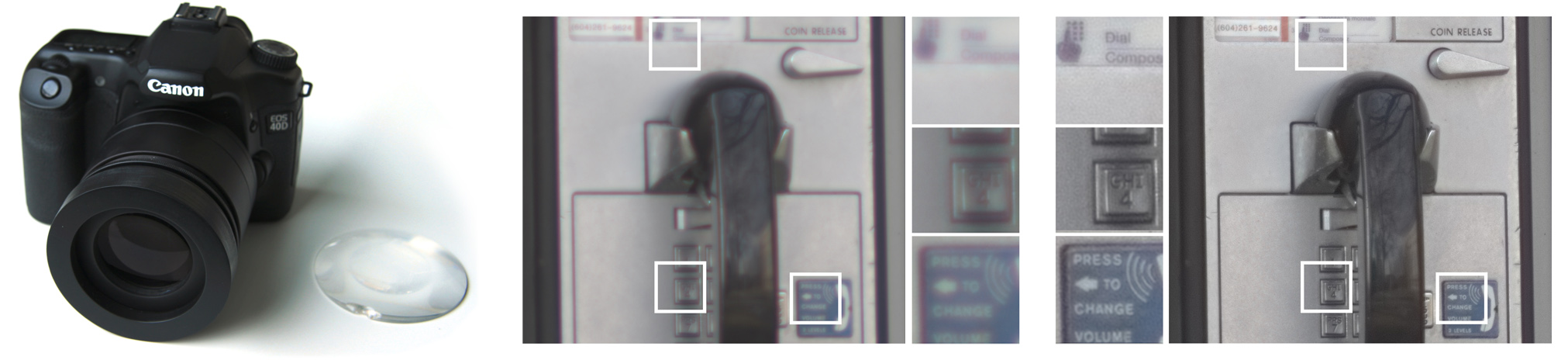
http://vimeo.com/61495125
Here's their website
http://www.cs.ubc.ca/labs/imager/tr/2013/SimpleLensImaging/
Maybe it's not only about future lenses, but also with the existing lenses, image correction in post could profit heavily from this - given the calculations from the prior pattern shots can be automated.
But if this also means that future lenses don't need to be extremely heavy any more, because they can loose all the optical correction glass, count me in
http://vimeo.com/61495125
Modern imaging optics are highly complex systems consisting of up to two dozen individual optical elements. This complexity is required in order to compensate for the geometric and chromatic aberrations of a single lens, including geometric distortion, field curvature, wavelength-dependent blur, and color fringing.
In this paper, we propose a set of computational photography techniques that remove these artifacts, and thus allow for post-capture correction of images captured through uncompensated, simple optics which are lighter and significantly less expensive. Specifically, we estimate per-channel, spatially-varying point spread functions, and perform non-blind deconvolution with a novel cross-channel term that is designed to specifically eliminate color fringing.
Here's their website
http://www.cs.ubc.ca/labs/imager/tr/2013/SimpleLensImaging/


