Welcome to our community

Be a part of something great, join today!

  • Hey all, just changed over the backend after 15 years I figured time to give it a bit of an update, its probably gonna be a bit weird for most of you and i am sure there is a few bugs to work out but it should kinda work the same as before... hopefully :)

About to go onto the risky side of shooting

Antonio Ribeiro

Well-known member
Joined
Dec 11, 2008
Messages
407
Reaction score
0
Points
0
Location
NYC and London
Hi guys,

I've been invited to DP a shoot where I'll be using probably an Alexa and shooting for the large part from the back of a motorbike facing backwards.

Grateful if I can have some tips from the forum on the optimal rig and overall safety.

Thanks

Antonio
 
Why do you have to be on a motorcycle would be the first safety question?

Second would be is the camera going to be handheld or hardmounted?
 
Using an Alexa in that situation is ridiculous. If you were shooting film, nobody would suggest putting a Panavision millenium on the back of a motorcycle. You would use an eymo or a 2c or something small. Use an epic. there is absolutely no reason to use that giant pig beast of a camera in this situation.

Nick
 
Why do you have to be on a motorcycle would be the first safety question?

Second would be is the camera going to be handheld or hardmounted?

Hi Eric,

Good question. The reason why I will be on a motobike is that there is an element of filtering through traffic and I am shooting another motorbike, so the shots have a connection in terms of angles, action feel, etc.

My thoughts about being handheld are of course, what is the procedure in terms of safety strap/belt, etc. Hard mounted sounds like a great option though.
 
Using an Alexa in that situation is ridiculous. If you were shooting film, nobody would suggest putting a Panavision millenium on the back of a motorcycle. You would use an eymo or a 2c or something small. Use an epic. there is absolutely no reason to use that giant pig beast of a camera in this situation.

Nick

I couldn't agree more and that was my first question to the UK producer. It seems the director wants to retain the feel of what was already shot.
 
I used to do this a lot a long time ago when I had the Ironman contract. I also ride. All my crew who went on bikes had a pretty strict procedure we followed.

There are a few important things to consider.

1. Clothing - wear a proper jacket and pants for riding.
2. Communication with the driver - get someone experienced
3. Larger bikes are better - Honda gold wing, etc
4. Make sure the bike is designed for this type of shooting and that you have foot pegs, etc.
5. If you are pulling focus with your left hand then your right hand on a grip with a strap is good (like an ENG lens)
6. Do some test rides without the gear first to get oriented facing backwards and get a feel for the rider and his style.
7. Then do a few rides with the gear on your shoulder (see how it feels with the padded jacket, etc.)
8. No sudden movements by you. The bike is like a surfboard, ride the wave.
9. Your safety and the driver's safety comes first.
10. Don't stand on the pegs or move unless you have worked things out ahead of time.


there are purpose build bikes for this type of filming now, like for the Tour de France, etc.

david
 
How's your life insurance?

I would shoot an email to Mike McGowan if I was in your situation, and ask for advice. http://www.mikemcgowan.net/hypercam.html

And either offer for production to hire him with his gear or see if you can rent some of the gear he has designed for exactly the situation. Sometimes it's not just about having the right tools, it's having the right experience.

Essentially, with his device, you hard mount a steadicam arm, then mount his camera cage, which rides on some sort of dampened ball joint, to the arm. That way the arm is working to take out the road bumps, your hands are directly on the camera to operate it, and if god forbid the whole thing wrecks, you aren't attached to the bike or the camera in anyway and you'll hopefully skid away to safety and not be crushed by either.
 
I would not recommend shooting from a motorcycle unless it is on a process trailer or rigged onto some other platform. I know you want the feel but putting an Alexa on your shoulder on a bike that is presumably going at moderate to fast speeds is potentially asking for trouble in my opinion. put safety above getting a great shot. Having said that one of the camera ops on the movie i'm on now strapped an Alexa to himself and operated while parasailing. so people do crazy things. But we have top tier rigging team. makes a big difference.

What ever you end up doing, have fun, be safe and make sure to post your results if/when you can.
 
The safest way to do this and for the best effect is to hard mount a steadicam rig onto a proper camera car that you are strapped into. This gives the best results.

Waay to dangerous to sit on the back of a motorbike these days and your insurance would probably not cover you for doing something so stupid

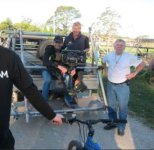
I just attached a picture of the safe method of shooting in this style. This was taken when i was attending the Steadicam Gold training course a couple of years ago in Australia.
 

Attachments

  • Screen Shot 2013-07-28 at 8.56.11 AM.jpg
    Screen Shot 2013-07-28 at 8.56.11 AM.jpg
    16.2 KB · Views: 0
Last edited:
I used to do this a lot a long time ago when I had the Ironman contract. I also ride. All my crew who went on bikes had a pretty strict procedure we followed.

There are a few important things to consider.

1. Clothing - wear a proper jacket and pants for riding.
2. Communication with the driver - get someone experienced
3. Larger bikes are better - Honda gold wing, etc
4. Make sure the bike is designed for this type of shooting and that you have foot pegs, etc.
5. If you are pulling focus with your left hand then your right hand on a grip with a strap is good (like an ENG lens)
6. Do some test rides without the gear first to get oriented facing backwards and get a feel for the rider and his style.
7. Then do a few rides with the gear on your shoulder (see how it feels with the padded jacket, etc.)
8. No sudden movements by you. The bike is like a surfboard, ride the wave.
9. Your safety and the driver's safety comes first.
10. Don't stand on the pegs or move unless you have worked things out ahead of time.


there are purpose build bikes for this type of filming now, like for the Tour de France, etc.

david

Hi David,

Thanks for the tips and very useful check-list. Starting to have one or two second thoughts on this, but I think the main thing is ensuring they take safety seriously as well. I have worked with this producer before and things are usually quite tight. Thanks once again.

A
 
How's your life insurance?

I would shoot an email to Mike McGowan if I was in your situation, and ask for advice. http://www.mikemcgowan.net/hypercam.html

And either offer for production to hire him with his gear or see if you can rent some of the gear he has designed for exactly the situation. Sometimes it's not just about having the right tools, it's having the right experience.

Essentially, with his device, you hard mount a steadicam arm, then mount his camera cage, which rides on some sort of dampened ball joint, to the arm. That way the arm is working to take out the road bumps, your hands are directly on the camera to operate it, and if god forbid the whole thing wrecks, you aren't attached to the bike or the camera in anyway and you'll hopefully skid away to safety and not be crushed by either.

Interesting rig, thanks for sharing.
 
I would not recommend shooting from a motorcycle unless it is on a process trailer or rigged onto some other platform. I know you want the feel but putting an Alexa on your shoulder on a bike that is presumably going at moderate to fast speeds is potentially asking for trouble in my opinion. put safety above getting a great shot. Having said that one of the camera ops on the movie i'm on now strapped an Alexa to himself and operated while parasailing. so people do crazy things. But we have top tier rigging team. makes a big difference.

What ever you end up doing, have fun, be safe and make sure to post your results if/when you can.

Which I am not entirely sure it's the case here... So lot's of checking to do...
 
The other thing to remember if you are on uncontrolled public roads is other roadusers' safety. Handholding a camera potentially means it falling on the road which becomes a road hazard. Ideally it should be hard mounted for this reason. At the least it needs tethering.
 
There are some good options that have already been touched on here - hard mounted steadicam arms, purpose built bikes, hiring skill-specific crew, but the simplest and safest thing would be to simply shoot from a convertible with the top down. Rent a zippy little sports car, seriously - it's not worth the road rash and broken bones.
 
There are so many problems with what you are proposing.. but here's my advice

There are so many problems with what you are proposing.. but here's my advice

1) the shooting platform should NOT be another motorcycle.

2) if you are shooting traffic, then all photographed vehicles need to be under control of a trained precision driver.

3)this is something that should so not be operated by you. You should be the DP, and light it, and if you are good at operating a hot head, then operate it.. or a MoVi at the end of a mount on a quadrunner, with wireless link to monitor and operate..

4) The more I think of this, it is so absolutely the province of A list resources, I have no idea why you are even considering doing it.

I have worked on giant projects, like Fast 5, and on Flight, and AD'd car to car photography on a Nascar track for Mello Yello commercials with pro drivers....
your scenario scares the piss out of me. Not the result desired, but the question about handhold operating this follow shot on a motorcycle.

Do it with the right tools and support... or pass on the job entirely
 
The safest way to do this and for the best effect is to hard mount a steadicam rig onto a proper camera car that you are strapped into. This gives the best results.

Waay to dangerous to sit on the back of a motorbike these days and your insurance would probably not cover you for doing something so stupid

I just attached a picture of the safe method of shooting in this style. This was taken when i was attending the Steadicam Gold training course a couple of years ago in Australia.
That's the kind of rig I was thinking of.

You can never be too safe with this stuff. If production company balks on it and wants to put you in danger, I would consider moving on from the project. Not worth the paycheck.
 
steadicam_am_1_zps6d764019.jpg


How about custom SteadiCAM-AM?
 
Last edited:
If you decide to go through with this, strap yourself tightly to the driver and tell him "We are not going to get one another hurt, are we?
 
Tour de France TV coverage proves good hand held can be achieved from a rearward facing camera with experienced, skilled, trained crew working within governed and controlled traffic.

I'd suggest employing the camera/rider team that does your local bike races.
If not available, check with your insurers as to the experience qualifications they require of rider and camera op. Make a realistic judgement if you and a rider can satisfy the insurers and if so test and train.

If the above options don't workout, then shoot using a rear facing locked off camera on a hard mount on the lead bike.


If budget permits try a stabilised mount on the rear of a bike, if you have time try one of the new low cost stabilised rigs like Movi.
Intercut with other tracking shots from a compact city car or a professional tracking vehicle.
Shooting from the ground using middle of the road traffic islands can produce some dynamic angles of traffic passing close to camera.
Shooting from the top deck of an open double decker bus provides a cool top angle in London, you can rent these buses. Can also install a crane on them if you are cheeky.


Mike Brennan
 
Back
Top