Welcome to our community

Be a part of something great, join today!

  • Hey all, just changed over the backend after 15 years I figured time to give it a bit of an update, its probably gonna be a bit weird for most of you and i am sure there is a few bugs to work out but it should kinda work the same as before... hopefully :)

A Dragon assesment...

Dragon with the new OLPF retains about 2 stops in highlights at ISO 800 compared to Mysterium-X at the same rating. The rest is found on the shadow side.

**edit, I'll add the highlight roll-off to clip is much, much nicer too.

So about 2 stops with the new OLPF, thanks. So, how much if I have the original v1 OLPF?
 
So about 2 stops with the new OLPF, thanks. So, how much if I have the original v1 OLPF?

It was about 1.3 stops less. That's more or less the difference overall in terms of sensitivity and texture between the two.
 
It was about 1.3 stops less. That's more or less the difference overall in terms of sensitivity and texture between the two.

THANKS PHIL. All of your comments are very much appreciated.
 
I feel like folks are not giving enough credit to what the vastly improved highlight handling means in terms of setting a stop. On M and MX I was practically the clipping police, determined to give the colorist a clean top end. With Dragon (OLPF V2) I am comfortable with letting the top end burn a bit as long as I get the exposure I want on key elements (general rule, yes there are exceptions). From a practical perspective, this gives me more control over the exposure choice as I don't get stuck having to underexpose a key element trying to avoid the clip.

Available/low light shooting on Dragon vs MX isn't the degree of improvement many were hoping for, but as long as you have enough light it really does add 3 usable stops of DR. YMMV.

Cheers - #19
 
, this gives me more control over the exposure choice as I don't get stuck having to underexpose a key element trying to avoid the clip.

But technically, isn't the highlight protection of Dragon the same as underexposing ( to prevent the photosites from clipping) ?
The RED user interface might not represent the situation as underexposing to the operator, but that is what is happening in there. Otherwise you would have clipping ;)
That's just how sensors work. The other factor is that the sensors are linear but there is a curve put on the response that may mimic film more in the way there is more highlight saturation resistance there. Again all derived from a linear sensor signal. Dragon has more bits so more drastic LUTs can be applied, so that helps.
But 65,000 electrons out of , a what, 5 micron photosite ? Rrrrighttttt .... ( 65K = 16 bits ).
So to simulate Dragon on MX , you shoot at ISO 800 therby underexposing and gaining the highlight protection. A crunchier ( more quantized ) post LUT tonality range , yes.
Now of course, you have to look at the details you want to use that have been pushed further into the black and how recoverable are they.
 
Measured Dynamic Range tested under identical circumstances and methods:

Red Epic Dragon = 16+ for the reasons described above.
Arri Alexa = 14+ (due to the 14.1-14.25 nominal results as there is a hint of detail measured but it's not a clear stop of information)

Thanks so much Phil for the detailed response.

Bottom line - are you saying Red Dragon has TWO more usable stops of dynamic range than the Arri Alexa?

Thanks!
 
Thanks so much Phil for the detailed response.

Bottom line - are you saying Red Dragon has TWO more usable stops of dynamic range than the Arri Alexa?

Thanks!

"Usable" is ultimately up to the user to decide, because even if there is more info there you might not use it in your grade.
 
OK. I'll rephrase.

Phil - do you think the Dragon has two more additional stops than the Alexa?

Individual grading tastes/preferences aside.
Thanks!
 
OK. I'll rephrase.

Phil - do you think the Dragon has two more additional stops than the Alexa?

Individual grading tastes/preferences aside.
Thanks!

If you are referring to sensitivity the V1 OLPF is indeed more sensitive than Alexa. The V2 OLPF places those values elsewhere. V2 favors and places tones in a more retained way from the midtones through highlights. Which is why in that most recent comparison video you are seeing "green" on Dragon at an equivalent exposure and "pink" on Alexa in the same areas. And there is a difference in log output between the two and it's not exactly an apples to apples comparison due to one additional variable that effects highlight and shadow information on the Alexa. This is "optical effect" is not something Dragon incorporates.
 
No, you're right. It depends basically if you start counting the next step up or start counting on the patch itself. Since this patch sequence is shot just at the moment before clipping that is indeed a stop of light and not full clip. Which is why some people may start on 0 or 1 respectively.

That doesn't make sense unless patch one is exactly 1 stop under white clip... Sounds like patch one was measured to be only a hair under white clip, right? So it's definitely 7 stops, not 8, from middle grey to clip unless patch 8 is not exactly middle grey.

If you are starting at 0 and 1 is only a hair, not a stop, under clip, you are essentially rounding up by a whole stop and counting a whole stop of detail that is not there.

Again, if you are measuring "totality" of how many fingers you have do you ignore the finger you start on and end up with 9, or go with 10 as they are all fingers. The 18% patch is a measured stop in the total range. Whether you choose to include it or not as a starting point of 0 or 1 is 100% up to you guys. I measured totality and also measure the current stop I'm on because um.... It's an important finger I'd miss.

One stop above the first patch is fully clipped and clipped I'm not counting as a captured stop of light. The first patch is fully retained detail across the patch.
 
If you are referring to sensitivity the V1 OLPF is indeed more sensitive than Alexa. The V2 OLPF places those values elsewhere. V2 favors and places tones in a more retained way from the midtones through highlights. Which is why in that most recent comparison video you are seeing "green" on Dragon at an equivalent exposure and "pink" on Alexa in the same areas. And there is a difference in log output between the two and it's not exactly an apples to apples comparison due to one additional variable that effects highlight and shadow information on the Alexa. This is "optical effect" is not something Dragon incorporates.

Hi Phil! Thanks for the answer.

I agree with your assessments regarding the different values placement of the Dragon's V2 OLPF compared to V1.
I'm also aware of that additional variable you allude to - the "low con" (presumably) filter incorporated in Alexa's OLPF.

But:

Measured Dynamic Range tested under identical circumstances and methods:

Red Epic Dragon = 16+ for the reasons described above.
Arri Alexa = 14+ (due to the 14.1-14.25 nominal results as there is a hint of detail measured but it's not a clear stop of information)

It's safe to assume you did the test above with a "regular" Alexa, sporting the "lowcon" OLPF, and - using identical circumstances and methods - you still found 16+ for Dragon and +14 for the Alexa.

So, without dancing around the question, can you say that Dragon has two more stops of dynamic range, compared to Alexa?

I'm not being ironic and trying to ask a trick question - on the contrary, I appreciate your contribution and your tests enormously.
I just want a straight question - yes or no - if possible.

Thanks!
 
Again, if you are measuring "totality" of how many fingers you have do you ignore the finger you start on and end up with 9, or go with 10 as they are all fingers. The 18% patch is a measured stop in the total range. Whether you choose to include it or not as a starting point of 0 or 1 is 100% up to you guys. I measured totality and also measure the current stop I'm on because um.... It's an important finger I'd miss.

One stop above the first patch is fully clipped and clipped I'm not counting as a captured stop of light. The first patch is fully retained detail across the patch.

No that doesn't sound right. When counting fingers you are counting the fingers directly. One patch is not one stop, it is a single point assumed to be one stop away from the next patch. You can count patches or stops but they are not the same. Your patches are points in the spaces between or beside fingers, and counting those will help you figure out how many fingers there are but only if you are very clear about the relationship between the points/spaces and fingers.

Your patches have one reflected value and tell you nothing about the what happens between each patch, which is where the stop of detail lies, so do not mistake them for a 'stop'. The 18% patch shows us only the point where an 18% grey lies and perhaps the range of noise at that point, it is a point on the curve, not a stop that can't simply be counted to count DR stops.

I'm leaning towards this assessment. As I understand it, stops of light are defined by the relationship of one brightness value to another (not to be confused with how a specific F/T stop is calculated on a lens). It ultimately requires two values; a start point and an end point.

If there's at least a halving or a doubling of intensity between them, there's at least one full stop. There can be 4 stops between the two measurements, for instance. For these purposes, we're marking each time we encounter a stop but it stills boils down to needing two values.

A single value on its own doesn't represent a stop. Therefore, it seems you couldn't count the value you started on as a stop (it totally counts if you end up on it coming from the other direction). But, it is important as the base value or starting point from which its relationship to the next measured value is determined.
 
Last edited:
A single value on its own doesn't represent a stop. Therefore, it seems you couldn't count the value you started on as a stop (it totally counts if you end up on it coming from the other direction). But, it is important as the base value or starting point from which its relationship to the next measured value is determined.

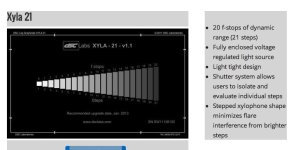
Phil is being a little disingenuous here Brian. I'm sure he knows that the DSC Xyla 21 STEP Chart allows one to measure 20 stops of dynamic range. You don't count the first STEP as a stop. Going from step 1 to step 2 is 1 STOP of difference.
 

Attachments

  • Xyla 21 Step Chart.jpg
    Xyla 21 Step Chart.jpg
    60.3 KB · Views: 0
Phil is not being a little disingenuous, he is saying that some count all chips and some count the steps.
 
Phil is being a little disingenuous here Brian. I'm sure he knows that the DSC Xyla 21 STEP Chart allows one to measure 20 stops of dynamic range. You don't count the first STEP as a stop. Going from step 1 to step 2 is 1 STOP of difference.

Well, I wouldn't go so far as to say Phil's being disingenuous. If his point is he's counting the totality of measured values within the DR of the sensor, each being 1 stop apart, you would include the first chip, like you would count fingers.

I don't, however, think it's the same thing as saying it has that many stops.

I agree, more likely Phil was just busy or preoccupied or confused as many are on the subject of measuring DR and on the difference between presenting measured data and presenting a conclusion from the analysis of that data. The patches can be interpreted into important data points, and analyzing that data to draw a conclusion about the DR of the sensor is only a small step, but it is a very important step because the data is not a conclusion, it is only data. This problem occurs frequently on this forum, where data or measurements are presented without context and the context is only presented later or not at all and it is assumed people will be able to draw their own conclusions, but most people miss the context or are not equipped to draw their own conclusions. This happens when Red posts just a picture of a chart and people conclude the chart is showing 20 stops of DR and that chart is circulated around the internet without any context and with many amateur, incorrect conclusions.

While you can count the patches and count patches that aren't there or patches that are full of noise, you really shouldn't do so on a forum since no one cares how many patches there are since patches are just data points that mean nothing unless analyzed in context, they only care how many stops of DR there are and so that's what they will read, people will and have read that patches=stops even though clearly that is not true. The data presented does not tell us exactly where white clip is or where the noise floor is, which are vital datapoints for precisely measuring DR. Presumably white clip is a hair above patch #1, but how big is that hair and how big is it for each of the R, G, and B, channels? And presumably the noise floor is somewhere in between patch #15 and #16, but is it just under #15 or just above #16? That's almost a one full stop of margin of error as one would expect from measurements that are done only in full stop increments, assuming the color channel clipping isn't an issue and the data was acquired with perfect precision.

Would you go on a finger counting forum and report how many spaces you count next to or between your fingers and then not say how many fingers you actually have? You will just confuse people and end up with headlines about how you have 11 or 12 fingers.
 
Well, I wouldn't go so far as to say Phil's being disingenuous. If his point is he's counting the totality of measured values within the DR of the sensor, each being 1 stop apart, you would include the first chip, like you would count fingers.

I don't, however, think it's the same thing as saying it has that many stops.

Well, maybe Phil can help us out. I have never read or heard anyone say that a camera has "x" amount of "steps" of dynamic range. Its always referred to as stops. He refers to alexa having 14+ which everyone assumes to be "stops". So, my question to Phil is, without counting pinkies, does he think the Dragon sensor has 16+ "steps" or "stops" of dynamic range?
 
Ah. Discussion. All day. Everyday.

The patches on my chart are not from a Xyla-21. However, they do sync up with the data that Stacey and Gavin shot on the Xyla-21. Again, I'm measuring from the point of exposed white through shadow to measure how many captured stops. I was trained to do this procedure this way by a Technical Academy Award winner. Same way we measured film. Same way we measured the Genesis. Same way I've measured everything since.

Actually, now that I think of it, measuring film was worse because we had 1/4 stop variances to keep track of. That was a pain in the butt. Made testing about a 4x longer experience.

Also, I'll add I test steps that are beyond the Xyla chart. Usually 24-34 depending on things.
 
Back
Top