


Nick Vera
Well-known member
So this is going to be quite an explanation. I recently had a bit of an epiphany in regards to using focal reducers on a Full Frame Sensor.
One night, I was randomly watching a bunch of videos on RED Komodos using focal reducers. (I guess the videos were recommended) I noticed that some FF lenses were vignetting a bit with the reducer on the komodo due to a slight wider field of view coming from the reducer. The reducer was exposing the image circle a bit. So I thought, "if that's the case with the Komodo, maybe with FF sensors I can see more of the vertical field of view within the image circle if I add a focal reducer."
You see one of my requests/wants for RED's next VV sensor is to make it taller so that you can use more of the field of view of FF lenses for tall aspect ratio content. Whether it be 4:3 or the horrific 9:16 content. I would like the sensor to be at least 26mm tall.
So thinking that, I bought Canon's Focal Reducer and slapped it on my VV V-Raptor. (Was going to buy the focal reducer anyway for slow mo content, since 600fps slow motion fps runs at 16mm mode)
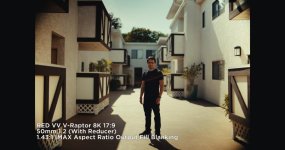
Welp there it was, I was seeing more of the image circle at 8K 17:9. I mean I was getting a ton of vignetting as you will see in the images. But, I was getting that vertical field of view. So in all, you can get a larger field of view horizontally and vertically with FF EF glass using the focal reducer. It's also bigger than the Mini LF or Venice area.
The only thing is you would have to crop which would cost a small loss of resolution. But nothing at all to freak about.
If you are framing for an IMAX project (1.43:1) this is a really good digital alternative. Effectively a F1.2 lens becomes a F.9. I'm not counting transmission of light, I'm counting equivalent aperture aesthetic. I believe transmission of light increases to T.8. If you shoot on 15-perf IMAX the fastest IMAX lens which is a T2 gives the same aesthetics of a T.9 on FF.
So this is a benefit of shooting with the regular V-Raptor. You can use a Focal Reducer and effectively increase your field of view, and also get an even more "medium format look" at faster apertures.
P.S. Apologies for the flare right in the middle of the focal reducer shot. That is one minor con to using the focal reducer. You are more susceptible to flaring. I can live with it though and next time I need to lower the eyebrow more.
Cheers!

One night, I was randomly watching a bunch of videos on RED Komodos using focal reducers. (I guess the videos were recommended) I noticed that some FF lenses were vignetting a bit with the reducer on the komodo due to a slight wider field of view coming from the reducer. The reducer was exposing the image circle a bit. So I thought, "if that's the case with the Komodo, maybe with FF sensors I can see more of the vertical field of view within the image circle if I add a focal reducer."
You see one of my requests/wants for RED's next VV sensor is to make it taller so that you can use more of the field of view of FF lenses for tall aspect ratio content. Whether it be 4:3 or the horrific 9:16 content. I would like the sensor to be at least 26mm tall.
So thinking that, I bought Canon's Focal Reducer and slapped it on my VV V-Raptor. (Was going to buy the focal reducer anyway for slow mo content, since 600fps slow motion fps runs at 16mm mode)
Welp there it was, I was seeing more of the image circle at 8K 17:9. I mean I was getting a ton of vignetting as you will see in the images. But, I was getting that vertical field of view. So in all, you can get a larger field of view horizontally and vertically with FF EF glass using the focal reducer. It's also bigger than the Mini LF or Venice area.
The only thing is you would have to crop which would cost a small loss of resolution. But nothing at all to freak about.
If you are framing for an IMAX project (1.43:1) this is a really good digital alternative. Effectively a F1.2 lens becomes a F.9. I'm not counting transmission of light, I'm counting equivalent aperture aesthetic. I believe transmission of light increases to T.8. If you shoot on 15-perf IMAX the fastest IMAX lens which is a T2 gives the same aesthetics of a T.9 on FF.
So this is a benefit of shooting with the regular V-Raptor. You can use a Focal Reducer and effectively increase your field of view, and also get an even more "medium format look" at faster apertures.
P.S. Apologies for the flare right in the middle of the focal reducer shot. That is one minor con to using the focal reducer. You are more susceptible to flaring. I can live with it though and next time I need to lower the eyebrow more.
Cheers!

