Welcome to our community

Be a part of something great, join today!

  • Hey all, just changed over the backend after 15 years I figured time to give it a bit of an update, its probably gonna be a bit weird for most of you and i am sure there is a few bugs to work out but it should kinda work the same as before... hopefully :)

Amazing! Simple Lens Imaging - high lens quality through computational methods

Patrick Grossien

Well-known member
Joined
Nov 20, 2008
Messages
2,987
Reaction score
0
Points
36
Location
Germany
I stumpled over this via redshark. An amazing example of what the right minds can achieve if they start rethinking given patterns.
Maybe it's not only about future lenses, but also with the existing lenses, image correction in post could profit heavily from this - given the calculations from the prior pattern shots can be automated.
But if this also means that future lenses don't need to be extremely heavy any more, because they can loose all the optical correction glass, count me in ;)
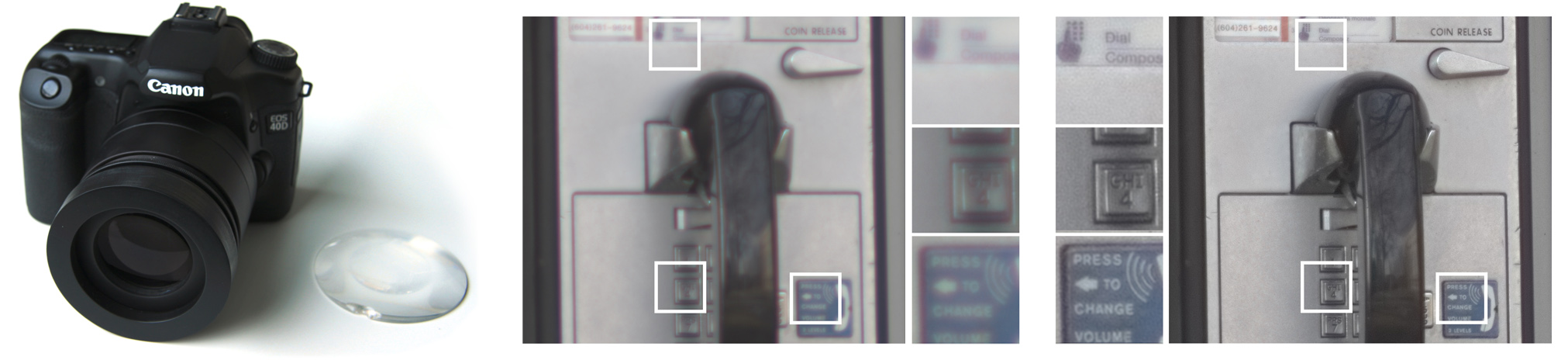
header_image.jpg


http://vimeo.com/61495125

Modern imaging optics are highly complex systems consisting of up to two dozen individual optical elements. This complexity is required in order to compensate for the geometric and chromatic aberrations of a single lens, including geometric distortion, field curvature, wavelength-dependent blur, and color fringing.

In this paper, we propose a set of computational photography techniques that remove these artifacts, and thus allow for post-capture correction of images captured through uncompensated, simple optics which are lighter and significantly less expensive. Specifically, we estimate per-channel, spatially-varying point spread functions, and perform non-blind deconvolution with a novel cross-channel term that is designed to specifically eliminate color fringing.

Here's their website

http://www.cs.ubc.ca/labs/imager/tr/2013/SimpleLensImaging/
 
Looks like a great post solution to save or enhance shots, but it won't help a focus puller trying to check sharps on a monitor or the camera op trying to focus in his viewfinder! At least not until processing power is fast enough to do this real time with moving pictures.

The maths is very impressive even so.

It's improving the quality of cheaper and lighter lenses through post processing and possible future realtime calculations, it's not meant to facilitate the art behind focus pulling.
[Sorry, don't want to be a smartass... just wanted to clarify]

There a quite a lot of "fast" lenses which suffer from CA and lack of sharpness at their widest apertures. If a software solution improves images like that, you could get away with smaller, lighter lenses and still get a great looking, sharp image. If I think about the weight and length of the f1.4 55mm Zeiss lens and also the huge effort it cost a big lens manufacturer like Zeiss to create a lens at this quality... this is awesome stuff.

And even more so for zoom lenses where it's even more difficult to get low apertures and crisp images.

...exciting ;)
 
I wasn't dissing it's usefulness at all. I just meant that practically we will still want to shoot with the best lenses we can afford or handle practically even with this technology in post because a single element lens will be too soft to judge focus on. Of course there's a middle ground where less than ideal cheaper existing lenses can be sharp enough for critical focus and their aberrations can be ironed out with this mathematical processing.
 
This is not really something new. Lens correction tools started in cineon back in 1996.... So Cromatic aboration and lens distortion etc are really something that can be 100% corrected in post since way back, not to many care to do it though.
 
This is not really something new. Lens correction tools started in cineon back in 1996.... So Cromatic aboration and lens distortion etc are really something that can be 100% corrected in post since way back, not to many care to do it though.

I know about lens correction, but not to this extent. Especially the gain in sharpness surprised me.
 
I wasn't dissing it's usefulness at all. I just meant that practically we will still want to shoot with the best lenses we can afford or handle practically even with this technology in post because a single element lens will be too soft to judge focus on. Of course there's a middle ground where less than ideal cheaper existing lenses can be sharp enough for critical focus and their aberrations can be ironed out with this mathematical processing.

Ok I get you :)
Using a better lens would always come first to me - at least for the time being. ;) Maybe that would change if it could be done in real time during preview and recording. Hehehe

There's always something about a TRUE, great lens - a lens aura sort of ;) I hope you know what I mean :)
And I believe I wouldn't ever want to miss that....!
 
Convolution and deconvolution its been used in digital audio processing for quite some time now.. Glad they are finally exploring this in graphics, since is the same principle..
 
Last edited:
Going from bad lens to acceptable is one "easy" step. But is the improovement still possible from an acceptable lens to a perfect post processed "lens"?

Will my Rokinon have that Leica-C look? LOL ;-)

Great tech BTW!

Pat

Ps: It would make sense If Red put this Tech in their Debayering process. Shoot the chart and let the camera (or RedcineX) process it.
 
Forgive my mathematical naïveté, but isn't this nothing more than a high-pass filter? There is no detail present in the sharpened image that isn't in the soft one.


Mind you, I did not watch the video. Something about watching Internet videos gives me the shits.

EDIT: I see DSLRs as anachronisms, devices using a paradigm necessary for film but redundant for digital sensors. Maybe with optics it's the same thing: expensive lenses were necessary for film use but are redundant for digital. With film, most corrections must be done before the image is taken. With digital, many can be done post-exposure.
 
As the calculations have been done in post, there's no more detail to bring back into the picture, as you can't bring back something that isn't there from the beginning.
It's just that the details that do exist are being improved.

This is "only" a paper which proves that the work that is being done "in-lens" could also be done in post (or in the future even in realtime, before recording the image)

The complex lens structures in the glass we all use, are there to improve and correct image "distortions". If a lot of these could be left out, lenses could get lighter and definitely less expensive, without compromising quality.
This doesn't mean that a good glass in front of the sensor wouldn't improve the image in the first place. Of course it does. But it's just taking a different turn on an old down-trodden path. And to me, that is definitely a good thing.

If it means I could actually take some of my shots @ f1.4, and get a result with less to none color fringing and blur, I'm all for it!
 
The complex lens structures in the glass we all use, are there to improve and correct image "distortions". If a lot of these could be left out, lenses could get lighter and definitely less expensive

...

If it means I could actually take some of my shots @ f1.4, and get a result with less to none color fringing and blur, I'm all for it!

Sony RX100 does this in camera, removing distorsion, CA and vignetting, to be able to have f1.8 zoom (wide end only) on a 1" sensor pocket camera.
 
Most of this stuff, and actually a lot more (like spherical aberration correction) is in nukex. You basically take some test shots (Phil has btw the most uber grid i've seen), that is saved to some nodes, then lens correction nodes are applied to the raw data. This software is never going to replace a cinema lens, is just to make cell phone photography less crappy when oily fingers get on the cell phone lens.
 
Back
Top