Welcome to our community

Be a part of something great, join today!

  • Hey all, just changed over the backend after 15 years I figured time to give it a bit of an update, its probably gonna be a bit weird for most of you and i am sure there is a few bugs to work out but it should kinda work the same as before... hopefully :)

The Composition thread - Show your work, share your thoughts

Michael Dalton

Well-known member
Joined
Jan 9, 2009
Messages
1,108
Reaction score
1
Points
0
Location
Toronto Canada
Website
www.digitalcrossing.ca
I was commenting on another thread, and had been looking at a bunch of stills from indie shorts etc and noticed a lot of weak composition or camera work that appeared that could have been better. Coming from a background in Animation and Matte Painting composition is pretty much everything. I thought I would start a new thread so people can discuss, share, and comment on the art of composition. As a matte painter I used to get a lot of professionals to critic my work, and I was always grateful for the artist that would rip my work apart, but in the process taught me a lot how to move an eye through an image by using the principles of composition.

As there are a lot of people here who are much better at explaining things, I invite them to weigh in here and share their knowledge. I encourage people to post their work, and for others to comment. I would also encourage only those who can take criticism to post their work. Lets learn.

I've been a huge fan of various directors, and cinematographers. I always like the composition of many Kubrick and Kurosawa films.

Sp_-Kubrick-gallery2.jpg

An amazing example of how a board room comes to life with perspective. Ellipses are always interesting but also unsettling. Brilliant use of light here.

tumblr_lg32vqYe3X1qak3sjo1_400.jpg

A nice example of light and dark, overlap, rule of thirds, and depth. The hand really adds to the tension.

(from Wiki) Some principles of organization affecting the composition of a picture are:
Shape and proportion
Positioning/Orientation/Balance/Harmony among the elements
The area within the field of view used for the picture ("cropping")
The path or direction followed by the viewer's eye when they observe the image.
Negative space
Color
Contrast: the value, or degree of lightness and darkness, used within the picture.
Geometry: for example, use of the golden mean
Lines
Rhythm
Illumination or lighting
Repetition (Sometimes building into pattern; rhythm also comes into play, as does geometry)
Perspective
Breaking the rules can create tension or unease, yet can it add interest to the picture if used carefully

pangrazio-jedi-2.jpg

S-curves. I love matte paintings, it's my favourite VFX, mainly because you have total control. Michael Pangrazio is one of my favourite. There is a nice subtle use of S-curves here that draw you eye thru the valley to the suns after taking in the main building (which uses foreground and thirds rule)

img_1285834428_8.jpg

Another example of a much stronger S-curve directing your eye through the image. Using light and dark, your told where to look.

I'll begin with sharing some of my work. I must say it is difficult to go from VFX where you have complete control over light to natural history where use available light, and are restricted on where you can get you shot. Sorry if you have seen these shots in the Natural History thread.

serengeti_D01a.jpeg

When shooting, I look for lines of movement. A relatively static shot like this has decent movement, you eye runs down the body and through the tail and back up.

serengeti_D05.jpeg

Some nice body position of the lions, combined with their eyes help direct this shot to cut to any animal shot latter.

Deleted image.

serengeti_D08.jpeg

An extremely pleasing composition IMO. Your eye continually moves through the image and does not hang. Lots of interesting elements including depth of field, and how you have the ability to follow the main branck back then through the image with light and dark.
 
Last edited:
Be fair; I think the OP's just wanting to start a discussion - its braver to do that with examples than to just pontificate. :)

I'm a stickler for composition, yet at the same time there's personal taste to consider. Lots of my work in corporate land is just talking heads - I'm amazed how much plain wrong framing (IMHO) I come across in this regard.

And in the OP's spirit, my showreel, permanently in need of an update is here for you to tear my framing apart LOL

 
I think this is an interesting idea...

And the analysis of the OP is interesting to read, to understand what exactly he thinks of the compositions and why he thinks they are good. Creates conciousness, even if one doesn't agree.

Conciousness is a good thing!
 
I dig the idea of this thread. Coming from a stills background, I often feel that composition is handled so carelessly on some motion work where people are rushing around doing dozens of setups a day.

Image 01: Nice, good fluidity. I would have liked it 30% wider, filling the frame with negative space and offsetting the lion to the right a bit. His mane is a bit close to the edge, causing tension that distracts the eye.
Image 02: Nice.
Image 03: The bit of tree bleeding out of the right edge bugs me. Also the low middle one just poking above the horizon does too. Maybe from further with a longer lens would have fixed this.
Image 04: Nice. I would have liked this wider too, completing the sun and giving space above it and then a bit more image to the right.
Image 05: I dig that.

All good stuff, I'm nitpicking of course.

Check out a thread I started along a similar tangent: http://www.reduser.net/forum/showthread.php?93728-Compositionally-Obsessive

One thing I do sometimes in my architectural work is to find an element or group of parallel elements within the scene and abstract them to create a strong vertical (sometimes horizontal) component to the composition. Sometimes this disorients the viewer, causing intrigue, other times it's more subtle. A selection of examples here: http://christopherbarrett.net/line/

CB
 
Hi Chris,

Thanks, would have to agree with you conclusions. I've always said that with motion you only have to have mediocre to look great. To get a great still from motion is tougher. I think I may have been inspired by your thread but thought I would open it up.


Here are some of Chris's images.

HC_Uncorrected_Geometry.jpg


HC_Corrected_Geometry.jpg


I love his linear vertical style Kinda looks kinda Kubrick like.

Edit; Chris, in this sequence, have your purposely chosen the blue suite to compliment the oranges in the set? It's interesting how the compliment really pops your character out.
 
@Christopher Barrett - I love your meticulous eye.

I can't explain how fascinated I am by composition and color theory. I spend a good amount of time imaging and observing different options. The majority of my friends are artists and I have a good pool of brains to discuss theory and concepts with. I've culled about 15+ years of notes from my own work and discussions with others. It's part of my curriculum over at Gnomon and I get asked to talk about both subjects a few times a year at individual workshops. Next one coming up is London from May 31st-June 3rd for a crowd of about 500.

It frustrates me when I see schools tackle the conversation on composition and really only showcasing central and the rule of thirds. They are tried and true. Industry wide they are "standards" that we all use. But there's just so much more to explore. Formal subdivision, informal subdivision, sacred geometry, weighting, negative/positive space, geometric grouping/framing/rhythm/balance, plane separation, tonal separation, color separation, etc... So much.

Then there's the fascinating variations and combinations that form from having a general rule set and how that overall influences framing choices. For example if you are inclined towards thirds yet notice that the negative weighting feels too empty or off balance, do you stick to thirds or go for the more balanced frame? I love that battle.

PHFX8563.jpg


horizon_Upper3rdc.jpg


horizon_MiddleC.jpg


horizon_Upper3rdb.jpg


XE0K5208.jpg


XE0K5148.jpg


BlueFoxDriveInTheater.jpg


I uploaded some select stills from The World After in the link below which show how I decided to play with the spatial relationships of the subject and point of interest from shot to shot. When developing the very quick storyboard thumbnails I was making decisions on where I wanted the viewer to remain in a constant or mobile state.
http://www.artbyphil.com/cgi-bin/phfx_cbslider.cgi?images=cinematography/theWorldAfter_Stills


Often on modern features we see harmonious/flowing compositions within a scene followed by mobile/roaming eye break to establish a new scenario. Unless the intent is to leave the audience slightly disoriented, in which case it might be more useful to keep the viewer's eyes moving until you establish a point of interest.

Bah. It's cool stuff. i'm crazy about it. Or just crazy. Can't tell. Institutionalized.
 
I think there are a couple of distinct kinds of compositional process at play. Firstly the conscious and intellectual precision which adds the very hard to find last few percent - as in Chris' case. This is something to strive for any time there's enough time to breathe, take a moment and plan your shot.

On a separate plane there's the instantaneous eye for viewpoint and framing subjects in real-time which I've also got great respect for. I try and keep my hand in at this firing off material just for me. DSMC makes it a little easier to get the moment, but the moment-to-moment framing is still in the operators hands.

Compositional 'blink and you'll miss it' stuff is satisfying to capture too:
8528474883_9e207c6e12_z.jpg

6275934511_e977d2bed0_z.jpg

7983424309_b5ef7c5a47_z.jpg

7677004232_ff5aa0325a_z.jpg

6276448890_2b57defdaf_z.jpg
 
Last edited:
Phil, thanks for your comments. I never cease to be amazed by you technical understanding and attention to details. You images are amazing. Any thoughts or discoveries on framing characters for dialogue in the stuff you've done or in one of your tests?

PHFX8563.jpg

Phil, I like the use of wardrobe colour here, the black really helps with separation and movement of the image.

I would rather agree that film school tends to teach an abbreviated version of composition. I opted out at the end of second year, and switched to Animation. I would highly recommend part-time animation classes in layout and perspective, colour, timing.

A film I have seen again recently that I love is Raiders. It's a beautifully framed film.

indy21.jpg
 
Phil, thanks for your comments. I never cease to be amazed by you technical understanding and attention to details. You images are amazing. Any thoughts or discoveries on framing characters for dialogue in the stuff you've done or in one of your tests?

I would rather agree that film school tends to teach an abbreviated version of composition. I opted out at the end of second year, and switched to Animation. I would highly recommend part-time animation classes in layout and perspective, colour, timing.

A film I have seen again recently that I love is Raiders. It's a beautifully framed film.


Cheers. Had to think about this answer for a moment.

The best I can say is that it's a "developing story". I've only done 3 long form narratives and they all happened at various stages of experience and maturity in my life. After I get about 5-10 more feature lengths under my belt I'll probably have some very strong and wise opinions developed through that experience.

The one thing I do have is the experience of being apart of a lot of productions and I've been fortunate to see a number of those from pre-production through post. Motion pictures for me started on a blank sheet of paper with drawing and creating worlds. I was very fortunate to land at a studio when I was still "fresh" (19) and not so tainted. Animators, concept artists, writers, directors, etc.... That was the golden egg in my life and my education happened while working for the most part.

Some of the projects I've worked on in the past have been very straight forward. A-->B-->C. Conditional. Somewhat linear with a bit of conflict. Mostly 3 act screenplays. I don't think that's necessarily where motion pictures end. It's a language we're all used to seeing and experiencing. I think back to 7th grade and my literature teacher, who often tortured me in a loving way via making me create short stories for him about once a week. When I played with toys as a kid and eventually to writing those stories it was all about the conflict and the characters. I didn't know that at age 5, but as I understood and learned these tools and how to apply them they became good friends.

The odd things on top of that are my personal tastes. I love a good reveal. I've had a few really powerful ones in my real life and I love the impact they can have emotionally. Most stories we come across have the beginning, middle, and end. I often think to myself does it need to "end"? Are we done yet? Should we finish? Is there power behind our resolve or is it more powerful to leave people with a slightly loosened knot? Do we hand the audience everything? Do we leave the door slightly open?

So how does that nonsense all effect me today from a production standpoint? Well, I do a lot of pre-visualization. I'll chew through a script and make my shot list/layout. I'll draw out those thumbnails/storyboards and play out the entire scene/movie/spot in my mind. I'll also draw a top down "birds eye" view of the room so I can see the space. See where maybe I could add some interest as I play things out. I try to get to place where I can imagine the world that the scene is set in. Full submersion if I can. Feel the texture of walls, temperature of the room, smell of the air. As the scene is unfolding before me I think of the cut. How shots are flowing together. How the camera moves either in a deliberate, reactive, or static way. Should there be a visual language developed with those moves? A pattern? A formula? What's the focus? What's in focus? Are we established or inside our subject? Do we need to be? Where are the characters in proximity to each other? Where's their focus? Their eye contact? Their motive? Are we in a candid moment? Should the camera become a character? Is it hiding? Is it the actor? What's the cameras perspective? How tall is it? Do we look down or up on the actors? Or simply play at their level?

Actors are tools in the process. Faces show a great range of emotion, but good actors act with their entire bodies. That will sometimes influence the type of shot. Sometimes I'll go mid or wide when the expected thing to do would be to be closeup just so we can see the whole person. A good example if you can play this out in your head, imagine somebody receiving some rather terrible news over the phone. That exact moment of impact, play that out as a CU and then play that out as a wide. What's more powerful? Why?

I would say that generally sums up what's going on in my mind prior to a shoot and framing a shot. The odd thing here, is anything can happen on the day - or even the tech scout. Shot on something last year with a great naturally cast shadow on the exterior of a building that pretty much redesigned the scene as it allowed a more powerful way to introduce the subject to their environment. It's one of those happy accidents that came from observation. Another thing I like to play with overall is transitioning between compositions within the shot as the camera is moving on wides and mids. I'm still experimenting with that. That requires a bit more foresight to the edit, but it's a powerful tool.

About a year ago I was hired to work on a fairly large budget screenplay with several writers that's going into production this year. As I was looking at the beats and playing things out the one thing I was observing myself doing was asking questions. A lot of questions. Similar to what's above. This is a fairly straight forward 3 act project. But, that "investigation" influenced my writing and ideas. What to add. What to take away. I probably made that entire movie 5 or 6 times in my head before turning in my first draft. I pretty sure I was the only writer who turned in a screenplay with boards. The producers seemed to like that. I know a chunk of my ideas are in the final project, which is a great feeling.

Something I've taken from my career in post is the concept of a "post-mortem" on projects. We usually tackle this with the entire team, but after a project I'll digest what went write, wrong, and could be better. If there were any discoveries along the way I certainly make note of that. It's a learning game and constantly changing. I'm certainly not the same person that I was 3 years ago. That influences me. 3 years from now, I hope to be a slightly different person. Familiar looking, but slightly more refined.

I also grew up on Spielberg's work. Whatever sauce they put in that water was good sauce. I can watch Raiders over and over both for entertainment and for research.


Lovely work Phil. As allways!

Thanks Gunleik. You've certainly inspired me to do more edgy work. For whatever reason I've done about 5 nude shoots to date. I'm working on a piece to be shot after NAB that in one way or another you inspired me to move forward with.
 
Whoa. Sorry about that wall of text. Sometimes my stream of thought breaks the dam. Damn.
 
No worries. It's an interesting wall! It's nice to see the process. I'm curious at how much some of the really young indie guys put into pre-production and pre-vis. Aside from story boards and blocking, how much of the visual style is known before going into shooting? Have you run composition tests or overall looks before principle photography begins to determine visual style, do you elaborate on storyboards into production art?
 
No worries. It's an interesting wall! It's nice to see the process. I'm curious at how much some of the really young indie guys put into pre-production and pre-vis. Aside from story boards and blocking, how much of the visual style is known before going into shooting? Have you run composition tests or overall looks before principle photography begins to determine visual style, do you elaborate on storyboards into production art?

I don't know really how it works for everybody out there. I know two of my assistants who I mentored through film school never saw that side of things. But, there's really no right or wrong answer though. I've worked under directors who don't even block scenes. It's just a different way of working, although for in camera continuity I can see that as trouble waiting to happen.

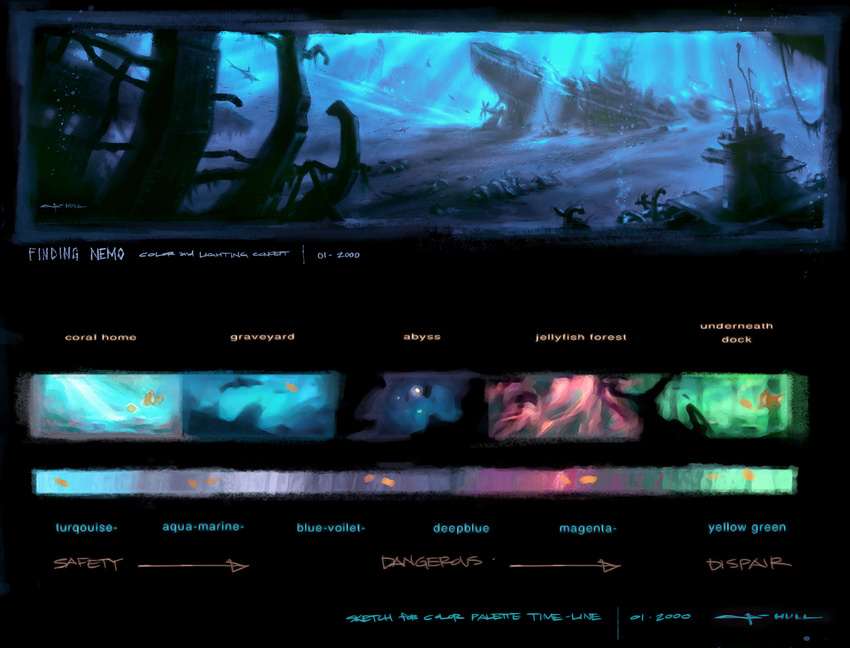
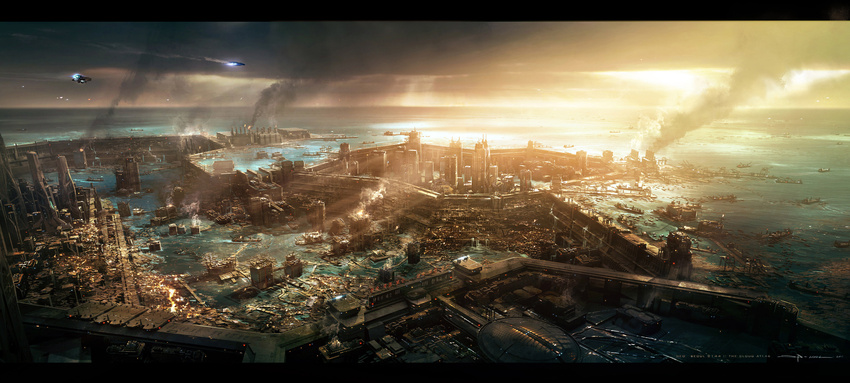
Typically on large budget feature films a great deal of development artwork is done. That can be a combination of concept, layout, mood abstracts, color keys, foam/paper miniatures, boards, or even full blown 3D animatics. Over the last 8 years or so of my career I've noticed a big push towards having the movie essentially "shot" before it's shot. Meaning a combination of 2D and 3D animatics are put together in a timeline for review.

Here are some good examples of various pieces of production artwork:

Concept art by David Levy for Tron:


Storyboards by Dan Milligan for 300:


Concept art by Steve Burg for Prometheus:


Storyboard/layout by Sylvain Despretz for Gladiator:


Concept art by George Hull for Cloud Atlas:


Also by George Hull, color keys for Finding Nemo:


Storyboards. layout, and key art are designed to be used to approximate the frame. However, often these days I see general concept art influence the framing and lighting, which is really nice if you're the artist who's work is chosen for that.

If you're a production that's burning a great deal of cash per day, specifically if you are pulling off VFX shots, the more you have planned out ahead of time protects you. I know personally on the narratives I've done in the past I like to add some "flavor" time to a show. I enjoy looking for opportunities when they arise. If it's a straight forward shooting day there's not too much reason for that, but if you're on a set where possible interest can be achieved through additional inserts or perhaps more elaborate setups I might try to plan for some time to grab some extra shots.


For me personally, I'll draw out thumbnails, which are essentially pretty quick storyboards. That allows me to experiment with my compositions well before the shooting day. Once I have a bunch together for a scene I'll compare them to each other and imagine how they flow together. If one stands out in a negative way, I'll revise them. If the shot is more complicated, like a VFX shot, I'll likely do a more refined board to see what sort of hurdles need to be jumped to get to my goal. If it's something I'm pitching to a producer for approval, I'll likely do a refined layout or paint up of a concept. Just depends on what I'm doing with the artwork really. If it's a visual note for me or the production, rough sketches are great. If it's something I need to sell, pretty polish and very clear artwork is more useful.
 
Back
Top