Welcome to our community

Be a part of something great, join today!

  • Hey all, just changed over the backend after 15 years I figured time to give it a bit of an update, its probably gonna be a bit weird for most of you and i am sure there is a few bugs to work out but it should kinda work the same as before... hopefully :)

Some tips for shooting the MOON

Will Keir

Well-known member
Joined
Sep 3, 2009
Messages
5,323
Reaction score
1
Points
0
Location
California
We've been Shooting the moon on the RPP 300mm the last few nights.

We've tried using NDs and opening up to T5.6(sound crazy right?), faster exposure speeds and shooting before it's totally dark. Our images in post don't have the same level of detail as when we shoot and see them in the LCD. We've added sharpness in RCX but the image is still poor quality.

We are trying to get a nice image of the FULL moon. A few weeks before, I was able to get a very nice shot of a new or crescent moon. This was taken a dusk, not in full darkness.

Any tips I might be missing to get this shot? Thanks in advance. We try again. Tonight.
 
Most lenses will be soft when you shoot wide open. Try stopping down to T8 and compare your results.
 
IMHO 300mm is too short a focal length to get a good shot of a full moon. Grab a cheap mirror lens and a 2x converter and use with a Canon mount for 1000mm+. Shoot 5k to get as many pixels in play as possible and make sure your shutter speed is high enough. Shooting 180 shutter will lead to motion blur - the moon moves faster than you think! I'd guess that a full moon at f16 needs 1/250 shutter or faster shooting ISO320, less if you use a teleconverter of course.
 
We used a Leica 400mm f2.8 lens with Apo doubler on it which looked pin sharp. We have not yet tried but could use a 1.4 and 2 x convertor on the lens or better a pair of 2 x apo doublers. There is no CA on this lens at all so I think it may be possible. Supporting the whole set up is quite an issue though.
 
How much is the local air quality a factor in the sharpness of images of the moon and stars?
 
Hi

I have had good luck with my 200LX Meade with the Canon adaptor on the telescope with the epic mounted. A plus is you get motor tracking of the moon or other objects in the sky you may be shooting.

The tele is f2.8 and I shoot at ISO 800 and 24fps and the shoots look good. I will post some stills when I have a chance

ron
 
I like to engage the exposure tool when shooting the moon to make sure I'm not clipping and also stop down a lot... With 70-200mm canon I got great footage of the moon. Specially when you crop to 1080p
 
This thread caught my eye. I just dropped off some moon elements to a studio. I've shot a good amount of moons for feature use over the years in a variety of situations.

As Matthew demonstrated it's pretty nice capturing a high quality still of the moon and handling it in post. That allows the most flexibility, especially if your scene has lighting ratios that would throw the moon's exposure out of whack. However, a post visual effect isn't always ideal and you can certainly shoot it to get that "natural" feeling.

Some tips for shooting:
The moon is actually fairly bright and a proper exposure can be achieved with a nice stopped down aperture. Depending on the lens I typically am aiming for f/8-f/11.
You're looking at super telephoto lengths when capturing the moon. I usually shoot between 200mm and 1200mm, but have gone up to 2400 for extreme nonsense.

As always when shooting with super telephoto lenses atmosphere, weather, light pollution, and smog come into play. I typically go to a nice mountain away from the city on a cool night. This combined with a clear sky will usually give you a nice contrasty image. Sometimes you may actually want some of those weird atmospheric distortion effects for your shot though. Shooting from LA for instance provides a "wobble and wave" effect that's fun. Even on the clearest evening you are likely going to experience a bit of that effect, which is why some prefer to fix it in post for a perfect "still" moon.

A sturdy tripod is a must. A quality fluid head also helps. The moon itself moves pretty quickly in a 1200mm frame and it needs to be tracked. You can actually adapt tracking heads from telescopes to assist with chasing the moon down over longer takes.


Here are some example images of the full moon at different focal lengths. These were all captured on FF35 format.

300mm
_MG_0670.jpg


600mm
_MG_0650.jpg


1200mm
_MG_0651.jpg


2400mm
_MG_0663.jpg


Like all things you'll have to pay attention to your lens and sensor size/capture format. At 2400mm on a FF35 still camera you can literally fill the frame with the moon. You are very zoomed in and certainly see more atmospheric artifacts, but on a good clear night combined with high resolution capture you can get a great image. For Epic and Scarlet cameras shooting with the Mysterium X sensor I find 800mm-1200mm to be real be real nice for 5K and 4K.


If you aren't looking for the perfect darkest night effect, you can get at the moon during the sunset and sunrise. That's actually my favorite time to shoot the bloody thing because you have added character of the sky color and the more exciting chroma possibilities for the moon itself.

sunsetfromthelot.jpg
 
How much is the local air quality a factor in the sharpness of images of the moon and stars?

Plenty. If you're shooting in an area near the jetstream (winter/chicago/midwest) then the stars and moon will lost LOTS of detail. Ordinarily the astronomers will go by the number of arc seconds/pixel. In the midwest, we are lucky to get a 2 arc second/pixel night. Now if it's summer and no jetstream overhead, then you can take some amazing pictures and videos. Focal length AND aperture (diameter of the lens, not the f/stop) is key.
 
On extreme telephotos, the moon climbs rapidly through fame so I find that over cranking helps and don't forget to turn off any image stabilisation (if you have it).

The Moon will move at about 12.2 degrees per hour IIRC. So, anything longer than a 200mm lens, you're going to see it travel very rapidly over a short period of time. On a 1000mm lens, it will move much faster due to the more narrow angle of view covered.
 
A mirror lens you will lose contrast due to the central obstruction of the secondary mirror. It's a quick and dirty way of focal length, but you will lose contrast and detail. Also, due to the columnar structure of the aluminum coating itself, light will scatter. This is on a microscopic level and does indeed affect the overall image quality. If you take a 1000mm (or equivalent focal length) APO corrected refractor, then the image will be much cleaner, better contrast, all the good stuff.
 
We used a Leica 400mm f2.8 lens with Apo doubler on it which looked pin sharp. We have not yet tried but could use a 1.4 and 2 x convertor on the lens or better a pair of 2 x apo doublers. There is no CA on this lens at all so I think it may be possible. Supporting the whole set up is quite an issue though.

Use a tracking mount with the proper weight capacity. They're available from many manufacturers. Astro Physics, Takahashi, 10micron, Vixen. It all depends on how stable you want the image and what the loadout capacity is. Also, the Leica 400 2.8 is one of the better optics in that it comes close to diffraction limits, about 0.8 strehl. A 1.0 strehl is considered perfect. If you can find yourself a used Astro Physics refractor (triplet/apo/newer model) or even one from Takahashi (triplet/fluorite), you'll be amazed at how much they'll completely trounce on the Leica. The AP and Tak scopes are .995 strehl. Each surface of the optic can take as much as a week to grind out and polish. Zero high speed polishing and special tooling with multi million dollar Rochester / aerospace machines.
 
http://www.skytrip.de/monvid355.htm

Here's a good image of the moon from a TEC 160ED. Exceptional quality optic. The ED is the mating glass and they actually have a TEC160FL that is a crystalline fluorite element, triplet design. Focal length of 1,280mm. The optical quality would make the Canon 1200 f5.6L EF weep and cry. The only real competition from a commercially made optic is Leica, but those are .7x strehl. We can always hook one up to a interferometer to tell if a mfgr is hyping numbers or telling the truth. :)
 
This thread caught my eye. I just dropped off some moon elements to a studio. I've shot a good amount of moons for feature use over the years in a variety of situations.

As Matthew demonstrated it's pretty nice capturing a high quality still of the moon and handling it in post. That allows the most flexibility, especially if your scene has lighting ratios that would throw the moon's exposure out of whack. However, a post visual effect isn't always ideal and you can certainly shoot it to get that "natural" feeling.

Some tips for shooting:
The moon is actually fairly bright and a proper exposure can be achieved with a nice stopped down aperture. Depending on the lens I typically am aiming for f/8-f/11.
You're looking at super telephoto lengths when capturing the moon. I usually shoot between 200mm and 1200mm, but have gone up to 2400 for extreme nonsense.

As always when shooting with super telephoto lenses atmosphere, weather, light pollution, and smog come into play. I typically go to a nice mountain away from the city on a cool night. This combined with a clear sky will usually give you a nice contrasty image. Sometimes you may actually want some of those weird atmospheric distortion effects for your shot though. Shooting from LA for instance provides a "wobble and wave" effect that's fun. Even on the clearest evening you are likely going to experience a bit of that effect, which is why some prefer to fix it in post for a perfect "still" moon.

A sturdy tripod is a must. A quality fluid head also helps. The moon itself moves pretty quickly in a 1200mm frame and it needs to be tracked. You can actually adapt tracking heads from telescopes to assist with chasing the moon down over longer takes.


Here are some example images of the full moon at different focal lengths. These were all captured on FF35 format.

300mm
_MG_0670.jpg


600mm
_MG_0650.jpg


1200mm
_MG_0651.jpg


2400mm
_MG_0663.jpg


Like all things you'll have to pay attention to your lens and sensor size/capture format. At 2400mm on a FF35 still camera you can literally fill the frame with the moon. You are very zoomed in and certainly see more atmospheric artifacts, but on a good clear night combined with high resolution capture you can get a great image. For Epic and Scarlet cameras shooting with the Mysterium X sensor I find 800mm-1200mm to be real be real nice for 5K and 4K.


If you aren't looking for the perfect darkest night effect, you can get at the moon during the sunset and sunrise. That's actually my favorite time to shoot the bloody thing because you have added character of the sky color and the more exciting chroma possibilities for the moon itself.

sunsetfromthelot.jpg

Gorgeous shots, Phil.
 
I've been chasing the moon this month, need to retry again for the next full moon.
Too much clouds this month GRRRRR.

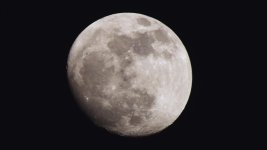
Vario tessar 100/300+Mutar II X2
5KFF 25Fps 1/250 F5.6 90%CROP (right click for full frame)
attachment.php

Cheers
B.
 

Attachments

  • LuneJ-2.jpg
    LuneJ-2.jpg
    48.4 KB · Views: 0
http://www.skytrip.de/monvid355.htm

Here's a good image of the moon from a TEC 160ED. Exceptional quality optic. The ED is the mating glass and they actually have a TEC160FL that is a crystalline fluorite element, triplet design. Focal length of 1,280mm. The optical quality would make the Canon 1200 f5.6L EF weep and cry. The only real competition from a commercially made optic is Leica, but those are .7x strehl. We can always hook one up to a interferometer to tell if a mfgr is hyping numbers or telling the truth. :)

What a remarkable image!
 
Back
Top