Welcome to our community

Be a part of something great, join today!

  • Hey all, just changed over the backend after 15 years I figured time to give it a bit of an update, its probably gonna be a bit weird for most of you and i am sure there is a few bugs to work out but it should kinda work the same as before... hopefully :)

Scarlet X Data Sheet

  • Thread starter
  • Moderator
  • #41
Thank you everybody! I've updated the 2k with the proper format information and also added an aspect ratio guide within Scarlet X's full frame of capture.

Phil, your posts are always so informative & this one you have excelled yourself. Your previous avatar I thought you where some sort of super hero swooping in to right production wrongs .LOL. This is one of the reasons I have bought into Red, a big thank you.

Minus the superhero bit, that's been my job for a long time :)
 
Thanks for doing all this work Phil, its useful to have it all in one place. I have a suggestion - it might be beneficial to remove the crop factors. The reason being is all of the crop factors (eg aps-c 1.6) refer back to the field of view for 35mm full frame, and 35mm full frame is not used in film or tv production. Its only relevance is to still photography. If anything the frame of reference should be to hollywood's s35 which makes aps-c a 1:1 crop factor! For example you might be watching a behind the scenes featurette on your dvd and the DP might say that a particular shot was using an 18mm and he would be referring to the field of view of an 18mm without a crop factor. Anyway its just an idea, good work anyways
 
Thanks for doing all this work Phil, its useful to have it all in one place. I have a suggestion - it might be beneficial to remove the crop factors. The reason being is all of the crop factors (eg aps-c 1.6) refer back to the field of view for 35mm full frame, and 35mm full frame is not used in film or tv production. Its only relevance is to still photography. If anything the frame of reference should be to hollywood's s35 which makes aps-c a 1:1 crop factor! For example you might be watching a behind the scenes featurette on your dvd and the DP might say that a particular shot was using an 18mm and he would be referring to the field of view of an 18mm without a crop factor. Anyway its just an idea, good work anyways

True, but...
What is your feeling regarding the ratio between Scarlets ordered with canon mount and PL mount.
The best (maybe not the best, but the most correct) thing to do would be to list crop factors starting from S35 format sensor, and another set of crop factors starting with FF35mm format sensors. While it will complicate things, it should raise awareness to the very fact you are so rithfully raising.
 
Last edited:
No ones seemed to have mentioned REDCODE any ideas what the sweat spot will be! on the Epic the default is 8:1 but if your shooting mainly corporate work going no larger than 1080 on the net can you get away with 10: or 12:1. I know very little about this aspect of image quality produced in relation to data rate. At present my default is ProRes 422 1080p
 
Hey Phil,

Liked your old with hat avatar better. Had a nice Bjork vibe to it.
Was wondering maybe for your Series II Ultra Edition for the above FF35MM Lens FOV chart you might also reverse the matrix to include date which would show what lens to use to maintain the same frame crop. Example: At a 50mm at 5K you will need to use a 12mm at 1K to maintain the same relative frame. This is important to the upcoming Scarlet users since the only way to increase frame rate is to window in on the sensor. If you have a locked down shot where you want to change frame rates, but keep the same perspective, then you have to change lenses to maintain the same scene. Of course that might introduce a whole different look caused by lens distortion - don't know since I never screwed around with this type of testing.

Unless I am just a complete idiot and maybe just read your matrix in reverse. IE: if 5K is 13mm and 1K is 64mm then . . . if shooting 5K at 64mm then I would need to use a 13mm at 1K to keep the framing the same. Do I get a cookie?

Thank you for the time and effort in producing this thread!
 
The phrase "crop factor" is already so strong in its contextual meaning that it is practically synonymous with still photography 36mm x 24mm. When I said 1:1 crop factor with aps-c I didn't intend for anyone to take me literally and start up a second chart, this would lead to confusion. So if someone must use the term keep it in relation to full frame stills. I personally try to use the phrase 'field of view' or FOV for short. example a 50mm prime on s35 has the same FOV as 20mm on a 2/3 sensor.

Remember there is no difference in field of view / crop factor when you compare a canon 50mm f1.2 prime to an aps-c lens like the 17-55/2.8 when its at 50mm or to a arri/zeiss 50mm ultra prime, the only thing that changes is the image circle and consequently the number of different sensors it can cover without vignetting.
 
Remember there is no difference in field of view / crop factor when you compare a canon 50mm f1.2 prime to an aps-c lens like the 17-55/2.8 when its at 50mm or to a arri/zeiss 50mm ultra prime, the only thing that changes is the image circle and consequently the number of different sensors it can cover without vignetting.

I cannot remember FOV facts as I have never learned them, but I tried to remember high school trigonometry and suddenly everything seems simple :-)
I consider that the quoted statement above is not correct. (might be a bed choice of words you used)
I actually believe (until proven differently :-) that FF 50mm f1.2 prime and APS-C lens 17-55/2.8 when set to 50mm give a different FOV. At first this might be confusing. But...

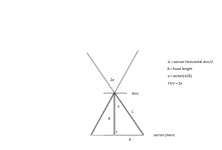
FOV is determined by: 1. lens focal length, 2. sensor size, 3. lens design for specific sensor format (this one is indirectly tied to sensor size - with this I will address the 50mm claim ) I attached an awful (paint made) picture to illustrate this.
Lets assume H is horizontal dimension of the given sensor.
Trigonometry gives us the following formula for the horizontal FOV we can record with a specific lens and sensor: FOV = 2*arctan( (H/2)/lens focal length)
From the formula it follows that both sensor size and lens focal length determine FOV. Everyone can try this out i.e . at http://www.calculator-tab.com/
Examples:
FOV for 50mm lens on FF35mm sensor = 2*acrtan( (36/2)/50) = 39.6° deg
FOV for 80mm lens on FF35mm sensor = 2*acrtan( (36/2)/80) = 25.36° deg

Above results can be double checked at: http://www.howardedin.com/articles/fov.html (use decimal format)

Now, the mystery of different FOV for FF35mm format and APS-C format 50mm lenses can be revealed. (claim 3.)
If we forget about the sensors and try to calculate FOV of the lenses. Let's assume that FF35mm lens projects a circle with the radius equal to half hypotenuse of FF35mm sensor h/2= 21.63mm ( for APS-C lens h/2 = 13.34, assuming 22.2x14.8mm sensor)
Formula gives FF35mm format 50mm lens FOV = 2*arctan(21.63/50) = 46.78°deg - this should be equal to the diagonal FOV of FF35mm sensor used with FF35mm 50mm lens
APS-C format 50mm lens FOV = 2*arctan(13.34) = 29.87° deg - this should be equal to the diagonal FOV of APS-C canon sensor used with APS-C 50mm lens

Mathematics show that same focal length lenses have different FOV depending on the format they were designed for.

Takeaway from this boring expose is that the FOV we record is dependent on the size of the (active part of ) sensor coupled with the focal length of the lens used.
How to compress this into simple and practical info is outside of the scope of this post :-)
 

Attachments

  • FOV.jpg
    FOV.jpg
    27 KB · Views: 0
  • Thread starter
  • Moderator
  • #55
A few quick answers.

Thanks for doing all this work Phil, its useful to have it all in one place. I have a suggestion - it might be beneficial to remove the crop factors. The reason being is all of the crop factors (eg aps-c 1.6) refer back to the field of view for 35mm full frame, and 35mm full frame is not used in film or tv production.

I agree, which is why you can use from FF35 to 1.3x (full frame 5k on Scarlet X, and not S35 standard) and 1.6x on the chart to reference S35 lenses and further down the resolution/crop lines. I made this to support up to FF35 as the Red Canon mount utilizes lenses from the FF35 still world. It's more of useful guide looking for a similar field of view or cone of vision to create similar frames across different formats.

No ones seemed to have mentioned REDCODE any ideas what the sweat spot will be! on the Epic the default is 8:1 but if your shooting mainly corporate work going no larger than 1080 on the net can you get away with 10: or 12:1. I know very little about this aspect of image quality produced in relation to data rate. At present my default is ProRes 422 1080p

Whenever I get my Scarlet X I'll be doing some heavy REDCODE tests. I only know for 4k feature delivery we've used 5:1-8:1 which post VFX houses "enjoyed". I believe if your finish is 1080p 10:1 and 12:1 are valid options, which should be useful for those doing event work. I can only go by what I know comes off of an Epic at the moment. Increasing your compression does effect your detail within the frame. For info coming soon basically.

Hey Phil,

Liked your old with hat avatar better. Had a nice Bjork vibe to it.

Unless I am just a complete idiot and maybe just read your matrix in reverse. IE: if 5K is 13mm and 1K is 64mm then . . . if shooting 5K at 64mm then I would need to use a 13mm at 1K to keep the framing the same. Do I get a cookie?

Lol. Nobody every sees the original Harry Potter Quidditch goggles in that photo, but I may pop that panda beanie back up :)

You are correct on your understanding when it comes to the crop factor. Zooms are going to play an important part of high end productions cutting between slow motion and at speed material between different formats.

Phil - just found this, maybe you might want to put it in your first post?

http://www.abelcine.com/fov/

Good idea. Doing that in 15 seconds.
 
Thank you Phil one more time.
Really usefull, i was waiting from Red specialist an answer about this.
 
I'm wondering if RED or a lens manufacturer could make a "Scarlet" scalable cinema prime set, with various adaptors for the various capture settings. (Kind of the opposite of a 1.4x teleconverter.) With smooth stops and focus gears, only fully electronic for data.
When we need to scale or window down to 3k or 2k, just change an adaptor or extension tube. Three lenses, (10mm, 20mm, 30mm) and 3 ratio adaptors (2K, 3K, 4k) would give us a lot of options. I suppose a 10-30 zoom and 2 ratio adaptors might work too, maybe.

Just don't try to cover 5K with them!
​
 
Last edited:
Good work, thanks Phil!:hurray:
 
Back
Top