Welcome to our community

Be a part of something great, join today!

  • Hey all, just changed over the backend after 15 years I figured time to give it a bit of an update, its probably gonna be a bit weird for most of you and i am sure there is a few bugs to work out but it should kinda work the same as before... hopefully :)

Why can bokeh be behind objects?

Joined
Mar 24, 2010
Messages
5
Reaction score
0
Points
0
Why can bokeh be behind objects?

Ok. That sounds like a beginners question. But I am not one of those - at least I thought so. I have a good basic knowledge about optics. Somehow I can - at least not spontaneously - explain why these nice round circles can be behind something. What we see is bright points getting to nice big circles if the circle of confusion is much larger than the resolution of the sensor.

But why is bokeh not overlaying the whole image? Why is it cut off by objects in front of it? In my mind it is an "artifact" of the optical system so how can it be behind anything?
 
The bokeh occurs in "out of focus" areas of the image. If the foreground objects are in focus there will be no bokeh in the foreground, but if the background objects in the same image are "out of focus", due to "depth of field", there can be bokeh in the background areas, behind the foreground objects. The out of focus light source causing the bokeh is behind the foreground object which is in focus.
 
Well ok, mabye my question was not accurate enough as this was not the answer I was searching for. Let me try again. (Sorry, this is where I get to a point where my English is not good enough.)

There is a bright point in the BG. The BG is out of focus. BUT out of focus happens because the light rays of that bright point are not focused on the sensor. That is why there is a big round unsharp thing which is as large as the circle of confusion. The bright light point is not behind anything so why can this unsharp thing be behind something. Why can there be circles which are in part occluded? If this is all happening at the lens+sensor stage there should be nothing there to occlude things.

But obviously I am missing something as it is happening.
 
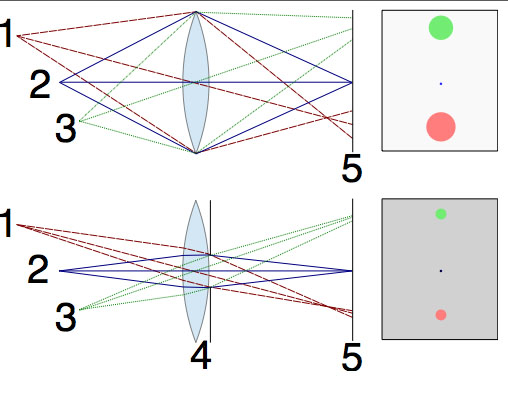
Looking at this illustration I'd say it's because the out of focus rays of a background object can't fall onto the focus plane area that the in-focus object takes up already.
focus.jpg


Now out of focus lights in the foreground -- let's say some Christmas tree lights -- do create large round shapes that expand over the in-focus subject. Essentially the light rays from background objects in the scene can't bend or get around foreground objects in the scene.
 
Ahhh. Alright.

Thanks David for the picture (and I feel honored that you reply to my post). I saw that sort of diagram a lot of times but it always helps to see it again. I just thought about the bright light and did not think about that the circle of confusion is there because the lens has a diameter beyond ... well ... a tiny point. So the light in the circle of confusion is already, as you Todd pointed out, masked by the FG object.

Why did I not think of that?! Thanks guys!
 
Yet another way to think about it is that around the Focal plane near the sensor, if it were possible to see the rays of light, would exist a Tiny upside down 3D version of whats infront of the lens. This is why, when you focus the lens, its essentially moving this tiny virtual 3D world of light back and forth ot hit the focal plane. This means that in actual space at any given moment the out of focus parts are physically "behind" he subject optically. The reason Light field cameras can refocus in post is that they capture vectors, and basically, capture all the light angles, and in essence, are recoding the tiny 3D upside down world behind the lens.
 
Back
Top