Ilya O.
Well-known member
Sometimes you can hear that any 50mm lens is Planar nowadays.
Zeiss papers on Planar 1.4/50 promote it is as "the most successful lens design ever conceived. This lens type is the basis of almost all professional "workhorse" lenses on earth – and in space."
Is that really so? Are all contemporary 50mils are really Planars? (NO)
What is Planar as a brand and as lens design?
Who is the father of all medium image field lenses?
Let's dive a little into the history of lens design and all these Gauss, Double Gauss, Planar, Opic, Speed Panchro, Biotar, Xenon...and find who is the pioneer.
Please participate and criticize, optical designers are WELCOME!
Despite the popularity of Planar brand now, not many people actually know what was Planar lens, for what purpose it was created at 1896 at Zeiss Jena and why it was NOT popular.
Was it really a breakthrough? Why every lens article traces Planar as a grandfather of all speed 50mms?
According to the Patents' (DE 92,313 of 1896; US 583,336 of 1897) preface, Paul Rudolph's of Zeiss general goal was to improve Gauss telescope lens to make it usable for the photographic use.
Gauss lens diagram (1817):
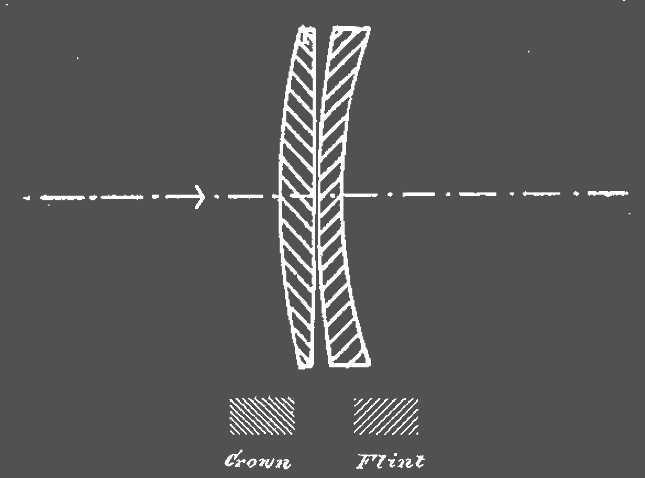
Gauss lens is well corrected for chromatic aberration (read: can focus only two colors in one plane), lateral CA, spherical aberration and coma. Still, and this is important for this review, Gauss lens can not correct distortion and astigmatism (and so has high image curvature). It is very slow being f/14 at best. Gauss achromatic doublet was never mass-produced because of its steep curvatures and thin lenses, centration and mounting difficulties: too pricey and unpractical compared to lets say Fraunhofer doublet.
So designers were playing with symmetrical lens design much at the middle of 1800-s since it corrects distortion and gives more speed (what was so needed for landscape and architecture shots).
Also, late symmetrical lenses are relatively good corrected for CA, spherical aberration and coma. So there were Rapid Rectilinear of Dallmeyer and Aplanat of Steinheil, 1866, both f/8-f/6:
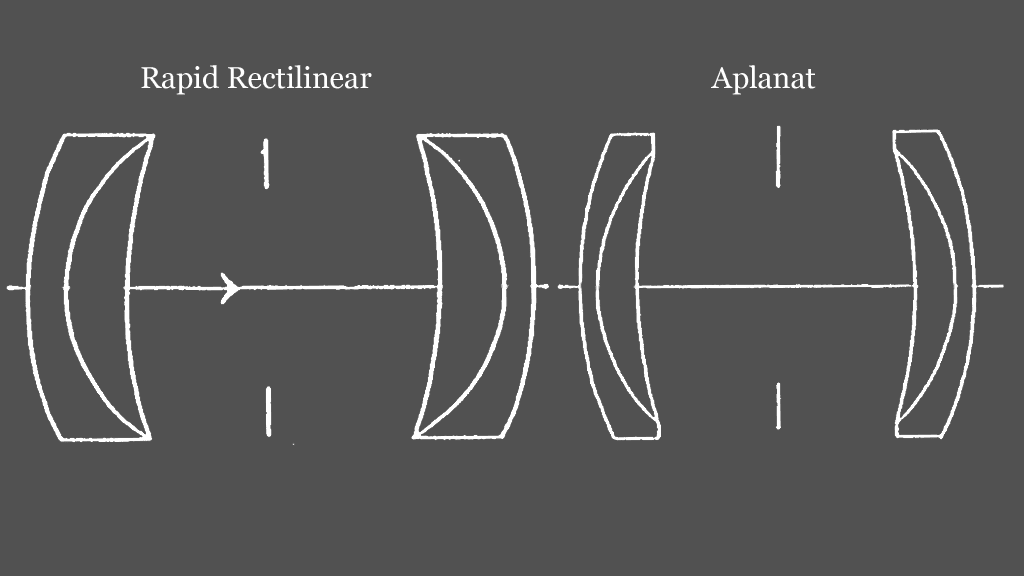
The unsolved problem of Recilinear/Aplanat was astigmatism and severe filed curvature: wide open these lenses gave the flat image field of only ~35deg and at best one can get ~60deg when stopped down to hell...So that Aplanats were again not really photographic lenses cause they had very little useful image field and slow.
Year 1888. Alvan G. Clark applied a patent (US 399,499) for Double Gauss Lens. Despite the hype everywhere in the papers now, the patent is not something optically new nor advanced in computing: Clark made an obvious move by simply placing 2 Gauss objectives of 1817 symmetrically in a nice tube. Here left and right parts are absolutely equal in lens' size and its curvatures:
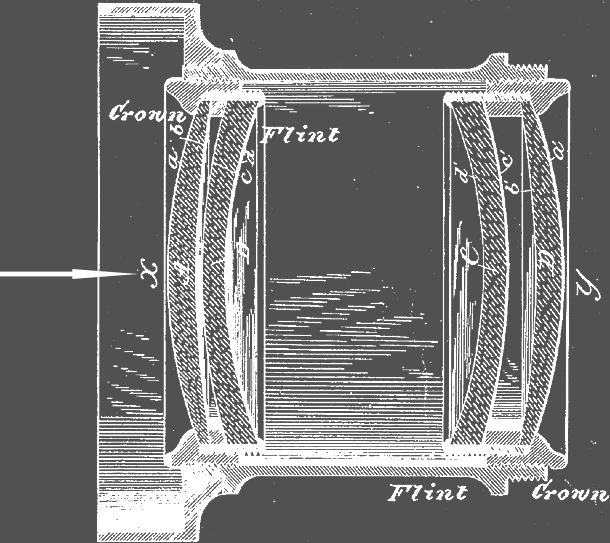
One can think from the draft that the spacing between the right lenses differs from the left, but it is not: the Patent says directly so. So Clark's 'invention' is in the fact that 2 Gauss telescope lenses (crown first mod) could become a photographic lens when placed in a tube! What he got was slow (~f/7.5-f/8) wide lens (covered 60deg image plane). Clark's Double Gauss lens shared the fate of Gauss lens, it was a poor seller, barely seen in Europe. Strangely enough, this Clark's Double Gauss lens is now considered as the basis of all modern fast Gauss lens designs, — I do not get it, guys.
1890. Conquering the photographic market, Paul Rudolph of Zeiss was trying to overcome Recilinear/Aplanat unsolved aberrations with its Anastigmat (=no astigmatism) lenses (Patents DE 56,109; US 444,714), known as Protar since 1900. Max speed was f/4.5. Utilizing revolutionary 'new achromat' glass types for achromatisation and low spherical aberration, he went unsymmetrical route where left component has positive astigmatic difference, and the right achromatic doublet, triplet or even quadruplet has negative so that one cell corrects the other for astigmatism, and overall lens' performance achieves image flatness over quite big field of view:
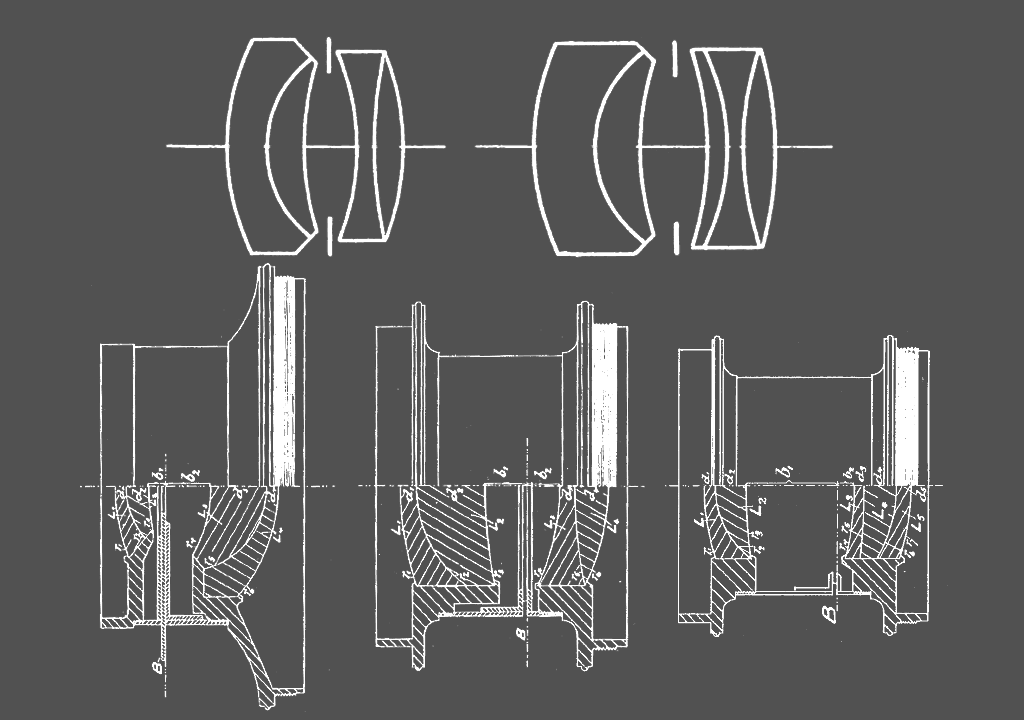
Mid 1890-s. When everybody was developing new unsymmetrical lenses utilising 'new achromat' glass types, and the ground braking Cooke Triplet f/3.7 of Harold Dennis Taylor was computed at 1893 (GB 22,607), Rudolph forgets his unsymmetrical Anastigmats and goes way back to the symmetry: he took Gauss lens of 1817 as a basis for new lens design! The symmetry allows to 'easy' correct coma, lateral CA and distortion.
So Rudolph relates not to Double Gauss lens of Clark (1888), but to Gauss telescope lens of 1817 which with its 4 lens curvatures and 2 glass types for play, gives nice correction of chromatic & spherical aberration and, what is not widely known, of spherochromatism — Gauss lens corrected the spherical aberration for 2 different colors (cause, you know, spherical ab. is different for different wavelength). OKAY then, but to make it suitable for photo use, Rudolph must make it faster, distortionless, with anastigmatically flattened image, also chromatic & spherical aberration free. So, step one from the famous Planar Patent (DE 92,313 of 12 Nov. 1896; US 583,336 of 1897; GB 27,635 of 1896) was this lens:
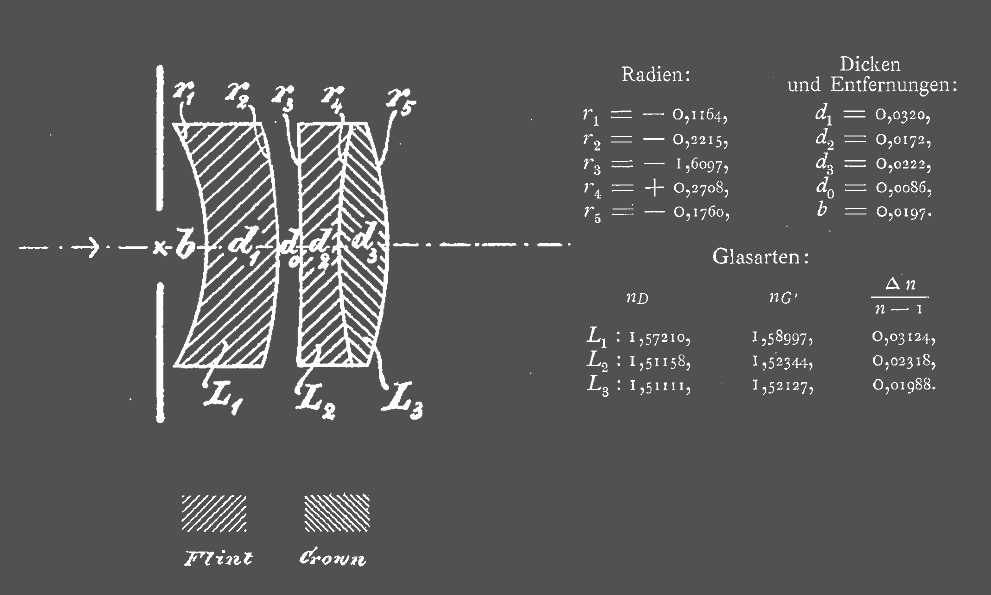
What Rudolph did here is make all lenses thicker, put the iris in front, use the outer curvatures to fight astigmatism and spherical aberration.
So now the curvatures and thickness are fixed and pre-determined, but how on earth then to correct chromatism?! Besides, with the glass types available that time, Rudolph could not make this design achromatic...but then took the genius idea he patented a bit earlier (6 July 1896, US 576,896): to split a meniscus into the cemented doublet made of glass with (nearly)identical refractive index but different dispersion. The outer radii are equal to the original meniscus, but now Rudolph got an additional curvature (or in "buried surface") inside the cemented doublet (r4)! Varying it and dispersion powers, Rudolph corrected the chromatism without touching the previously made correction of the spherical aberration and astigmatism (since they both only affected by refraction, which is equal in both parts of this compound lens(L2&L3)!
Step two. The lens above has barrel distortion since the iris is in front. And coma is not corrected. To eliminate it, Rudolph chose very simple way: put two described lenses symmetrically around the iris. That is how we all know Zeiss Jena Planar of Paul Rudolph was born, here is lens diagram:
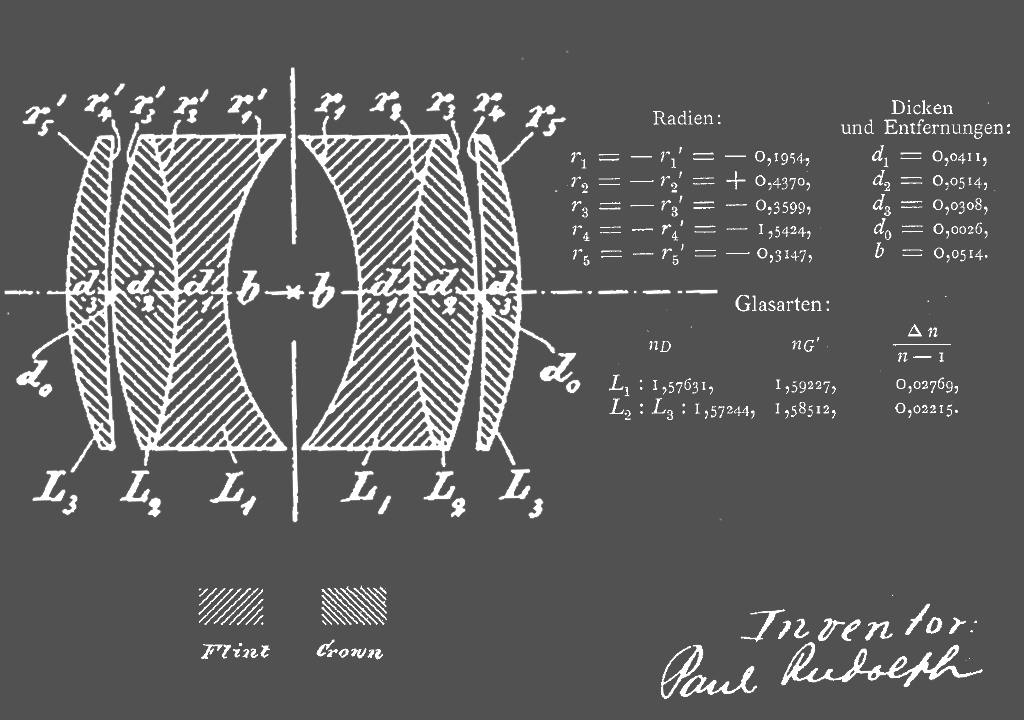
By the way, for some reason everywhere is written that the first Planar was f/4.5 — that is not true, the patent (DE 92,313 of 12 Nov. 1896) describes f/4 lens ('größte relative Öffnung 0.25'). The aperture of lenses in production was f/3.6 to f/5. Planar covered 52-72deg of image plane. Was it good? In a way, yes: when stopped down quite much (f/12 and more), it was the best lens on earth for reproduction, process work, for microscopy (you got flat field, unrivaled resolution and zero distortion). Can you imagine the Zeiss themselves did not recommended Planar for exterior shots?! They said better use Planar for portraiture work! Well, people were not since there were better and much faster lenses for that purpose...So Planar was not popular in photo/cine field. Wide open Planar was too glowy (coma is not corrected and can not be corrected in this symmetrical design, but Rudolph believed that), very low contrast, flare and mirror images due to the curvature's direction of the eight (8!) air-glass uncoated surfaces.
Well then, everybody (designers and users) forgot Planar design till 1920 when Horace William Lee (Taylor, Taylor & Hobson Ltd.) patented Cooke Series 0 (zero) lens (Lee Opic lens) as fast as f/2. That is, not Biotar/Planar, the father of all later built speed cine and photo lenses of medium image field because of being asymmetrical. Here is Opic lens diagram as patented (GB 157,040):
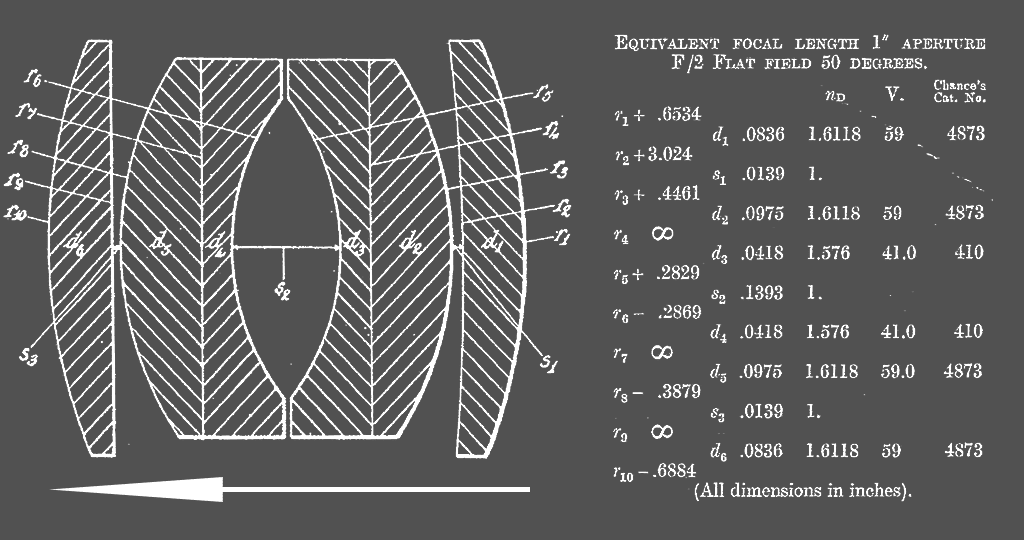
Looks symmetrical like the same old Planar, isn't it? No, it is not You can not take the right lens' part, duplicate it and put it flipped behind like it was possible with Planar cells. Look at the curvatures (10 radii, r1 to r10) — they are all different! While Planar had only 5 unique radii in the front cell, the back was a symmetrical copy. The only symmetry left in Opic lens is the glass types, check the nD (refractive index) on the right and mirrored to the left.
Yet, Opic is an anastigmat with flat image field and a successor of Planar, and Lee says that "the present invention is an improvement" over the Planar type. Lee Opic lens is 4 times faster and still has low spherical aberration, it is coma and CA corrected. Lee made it possible, first, when he left symmetry to have more radii for coma and other mono aberrations correction and to gain more speed; second, he chose other glass types: dense barium crown with high refractive index for all collective components and light flint glass for others (+made them thicker) to correct chromatic & spherical aberration.
TTH Cooke Series 0 Anastigmat had unrivaled speed and performance that time. Despite the 35 mm (1.375'') f/2 lens for 35mm silent movie, TTH considered Ser.0 lineup (50, 76, 108, 140mm) as large format still lenses for some time:
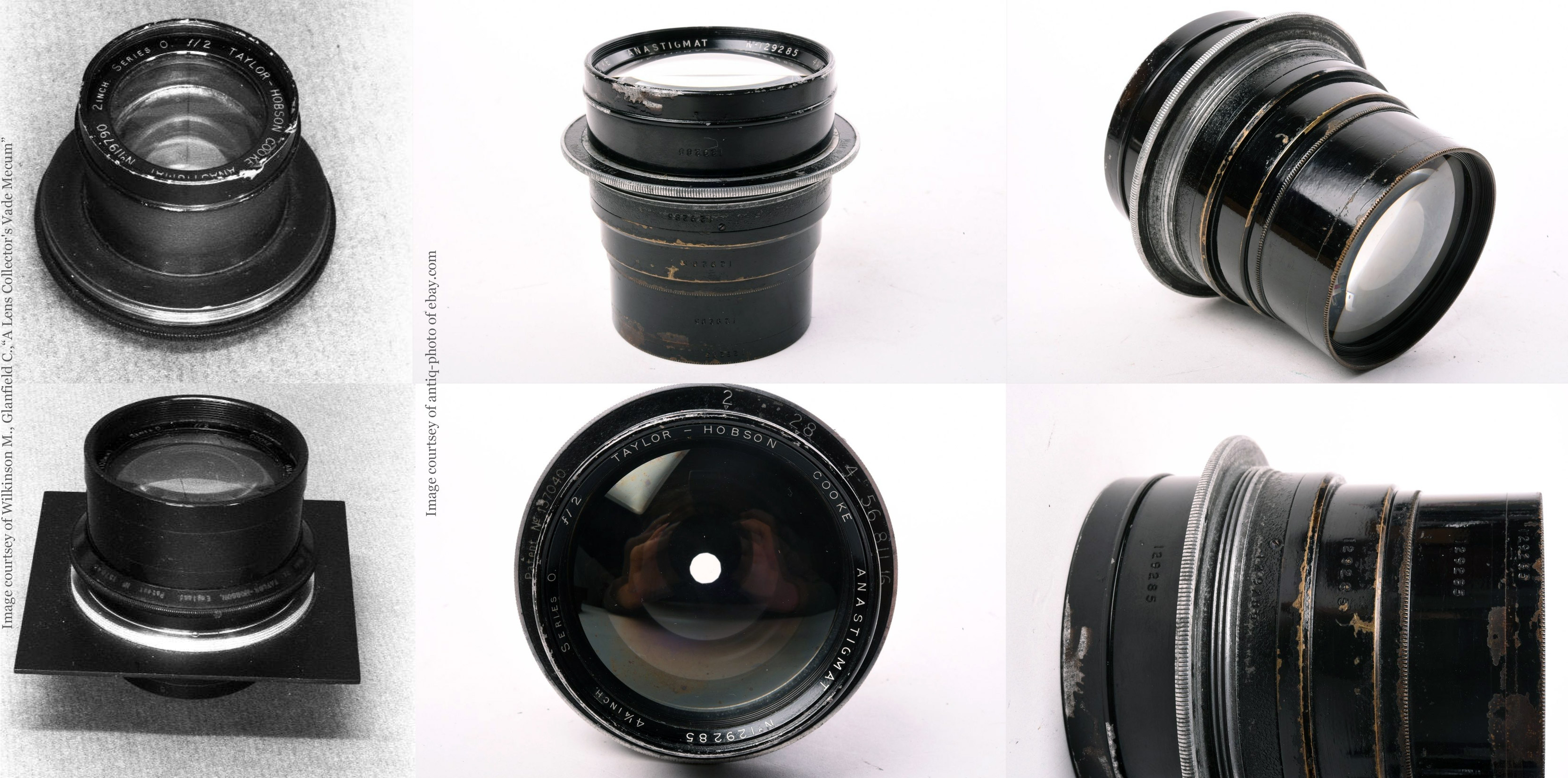
Now we know that was a big mistake!..
[end of part 1]
Zeiss papers on Planar 1.4/50 promote it is as "the most successful lens design ever conceived. This lens type is the basis of almost all professional "workhorse" lenses on earth – and in space."
Is that really so? Are all contemporary 50mils are really Planars? (NO)
What is Planar as a brand and as lens design?
Who is the father of all medium image field lenses?
Let's dive a little into the history of lens design and all these Gauss, Double Gauss, Planar, Opic, Speed Panchro, Biotar, Xenon...and find who is the pioneer.
Please participate and criticize, optical designers are WELCOME!
Despite the popularity of Planar brand now, not many people actually know what was Planar lens, for what purpose it was created at 1896 at Zeiss Jena and why it was NOT popular.
Was it really a breakthrough? Why every lens article traces Planar as a grandfather of all speed 50mms?
According to the Patents' (DE 92,313 of 1896; US 583,336 of 1897) preface, Paul Rudolph's of Zeiss general goal was to improve Gauss telescope lens to make it usable for the photographic use.
Gauss lens diagram (1817):
Gauss lens is well corrected for chromatic aberration (read: can focus only two colors in one plane), lateral CA, spherical aberration and coma. Still, and this is important for this review, Gauss lens can not correct distortion and astigmatism (and so has high image curvature). It is very slow being f/14 at best. Gauss achromatic doublet was never mass-produced because of its steep curvatures and thin lenses, centration and mounting difficulties: too pricey and unpractical compared to lets say Fraunhofer doublet.
So designers were playing with symmetrical lens design much at the middle of 1800-s since it corrects distortion and gives more speed (what was so needed for landscape and architecture shots).
Also, late symmetrical lenses are relatively good corrected for CA, spherical aberration and coma. So there were Rapid Rectilinear of Dallmeyer and Aplanat of Steinheil, 1866, both f/8-f/6:
The unsolved problem of Recilinear/Aplanat was astigmatism and severe filed curvature: wide open these lenses gave the flat image field of only ~35deg and at best one can get ~60deg when stopped down to hell...So that Aplanats were again not really photographic lenses cause they had very little useful image field and slow.
Year 1888. Alvan G. Clark applied a patent (US 399,499) for Double Gauss Lens. Despite the hype everywhere in the papers now, the patent is not something optically new nor advanced in computing: Clark made an obvious move by simply placing 2 Gauss objectives of 1817 symmetrically in a nice tube. Here left and right parts are absolutely equal in lens' size and its curvatures:
One can think from the draft that the spacing between the right lenses differs from the left, but it is not: the Patent says directly so. So Clark's 'invention' is in the fact that 2 Gauss telescope lenses (crown first mod) could become a photographic lens when placed in a tube! What he got was slow (~f/7.5-f/8) wide lens (covered 60deg image plane). Clark's Double Gauss lens shared the fate of Gauss lens, it was a poor seller, barely seen in Europe. Strangely enough, this Clark's Double Gauss lens is now considered as the basis of all modern fast Gauss lens designs, — I do not get it, guys.
1890. Conquering the photographic market, Paul Rudolph of Zeiss was trying to overcome Recilinear/Aplanat unsolved aberrations with its Anastigmat (=no astigmatism) lenses (Patents DE 56,109; US 444,714), known as Protar since 1900. Max speed was f/4.5. Utilizing revolutionary 'new achromat' glass types for achromatisation and low spherical aberration, he went unsymmetrical route where left component has positive astigmatic difference, and the right achromatic doublet, triplet or even quadruplet has negative so that one cell corrects the other for astigmatism, and overall lens' performance achieves image flatness over quite big field of view:
Mid 1890-s. When everybody was developing new unsymmetrical lenses utilising 'new achromat' glass types, and the ground braking Cooke Triplet f/3.7 of Harold Dennis Taylor was computed at 1893 (GB 22,607), Rudolph forgets his unsymmetrical Anastigmats and goes way back to the symmetry: he took Gauss lens of 1817 as a basis for new lens design! The symmetry allows to 'easy' correct coma, lateral CA and distortion.
So Rudolph relates not to Double Gauss lens of Clark (1888), but to Gauss telescope lens of 1817 which with its 4 lens curvatures and 2 glass types for play, gives nice correction of chromatic & spherical aberration and, what is not widely known, of spherochromatism — Gauss lens corrected the spherical aberration for 2 different colors (cause, you know, spherical ab. is different for different wavelength). OKAY then, but to make it suitable for photo use, Rudolph must make it faster, distortionless, with anastigmatically flattened image, also chromatic & spherical aberration free. So, step one from the famous Planar Patent (DE 92,313 of 12 Nov. 1896; US 583,336 of 1897; GB 27,635 of 1896) was this lens:
What Rudolph did here is make all lenses thicker, put the iris in front, use the outer curvatures to fight astigmatism and spherical aberration.
So now the curvatures and thickness are fixed and pre-determined, but how on earth then to correct chromatism?! Besides, with the glass types available that time, Rudolph could not make this design achromatic...but then took the genius idea he patented a bit earlier (6 July 1896, US 576,896): to split a meniscus into the cemented doublet made of glass with (nearly)identical refractive index but different dispersion. The outer radii are equal to the original meniscus, but now Rudolph got an additional curvature (or in "buried surface") inside the cemented doublet (r4)! Varying it and dispersion powers, Rudolph corrected the chromatism without touching the previously made correction of the spherical aberration and astigmatism (since they both only affected by refraction, which is equal in both parts of this compound lens(L2&L3)!
Step two. The lens above has barrel distortion since the iris is in front. And coma is not corrected. To eliminate it, Rudolph chose very simple way: put two described lenses symmetrically around the iris. That is how we all know Zeiss Jena Planar of Paul Rudolph was born, here is lens diagram:
By the way, for some reason everywhere is written that the first Planar was f/4.5 — that is not true, the patent (DE 92,313 of 12 Nov. 1896) describes f/4 lens ('größte relative Öffnung 0.25'). The aperture of lenses in production was f/3.6 to f/5. Planar covered 52-72deg of image plane. Was it good? In a way, yes: when stopped down quite much (f/12 and more), it was the best lens on earth for reproduction, process work, for microscopy (you got flat field, unrivaled resolution and zero distortion). Can you imagine the Zeiss themselves did not recommended Planar for exterior shots?! They said better use Planar for portraiture work! Well, people were not since there were better and much faster lenses for that purpose...So Planar was not popular in photo/cine field. Wide open Planar was too glowy (coma is not corrected and can not be corrected in this symmetrical design, but Rudolph believed that), very low contrast, flare and mirror images due to the curvature's direction of the eight (8!) air-glass uncoated surfaces.
Well then, everybody (designers and users) forgot Planar design till 1920 when Horace William Lee (Taylor, Taylor & Hobson Ltd.) patented Cooke Series 0 (zero) lens (Lee Opic lens) as fast as f/2. That is, not Biotar/Planar, the father of all later built speed cine and photo lenses of medium image field because of being asymmetrical. Here is Opic lens diagram as patented (GB 157,040):
Looks symmetrical like the same old Planar, isn't it? No, it is not
You can not take the right lens' part, duplicate it and put it flipped behind like it was possible with Planar cells. Look at the curvatures (10 radii, r1 to r10) — they are all different! While Planar had only 5 unique radii in the front cell, the back was a symmetrical copy. The only symmetry left in Opic lens is the glass types, check the nD (refractive index) on the right and mirrored to the left.Yet, Opic is an anastigmat with flat image field and a successor of Planar, and Lee says that "the present invention is an improvement" over the Planar type. Lee Opic lens is 4 times faster and still has low spherical aberration, it is coma and CA corrected. Lee made it possible, first, when he left symmetry to have more radii for coma and other mono aberrations correction and to gain more speed; second, he chose other glass types: dense barium crown with high refractive index for all collective components and light flint glass for others (+made them thicker) to correct chromatic & spherical aberration.
TTH Cooke Series 0 Anastigmat had unrivaled speed and performance that time. Despite the 35 mm (1.375'') f/2 lens for 35mm silent movie, TTH considered Ser.0 lineup (50, 76, 108, 140mm) as large format still lenses for some time:
Now we know that was a big mistake!..
[end of part 1]
Last edited: