Welcome to our community

Be a part of something great, join today!

  • Hey all, just changed over the backend after 15 years I figured time to give it a bit of an update, its probably gonna be a bit weird for most of you and i am sure there is a few bugs to work out but it should kinda work the same as before... hopefully :)

What is the native ISO for Scarlet X -Mysterium MX Sensor?

Low light should be good, but don't expect 5d see in the dark performance. Philip Bloom says its more noisy than F3 and AF100... (Epic)

AF100 might not be noisy but it seems to crush blacks pretty aggressively to stay clean. It doesn't reach into deep shadow very well for detail like an F3 or a Red can do. With Redcode Raw you have very fine control over how much detail vs noise you bring out of the shadows. More so than any video camera.
 
Authoritative answer on ISO is 800.

On low light - remember the very lossy compression performed by some cameras acts as brutal NR, removing noise and detail. On the other hand, the RED cameras respond incredibly well to post-NR because the compression is milder and has not thrown away the detail with the noise, and no shadow crushing has been performed.

As I mentioned in another thread I was getting better low light performance with my M-X than with my 1DmkIII in stills mode....

Graeme
 
This might be of some use:

http://bit.ly/mCwcoN

The "native" iso may well be 800 for the Epic, calibration seems to have been done @ 320, if I am not mistaken (Graeme?).
But it could've been calibrated at "any" ISO.

Technically, the test to find the "middle grey" is good, but practically, you would probably find that you'll experience it as the cam has a better DR by digging a bit into the lowlights (through rising the ISO a bit from the technical middle-point), especially with cams like Epic that are extremely noiseferee and precise in the low end of the exposure, thus giving you more highlightprotection through rising the ISO/EI when you shoot.

Cheers

G
 
Sensors don't have an "ISO" until you define the sensor processing. With M-X sensors the processing + sensor makes it 800.

Graeme
 
2rw4utc.jpg
this is a still of a live event from earlier this year Shot on the EPIC with a Cooke 28-250 (T-2.8) the ISO is at 2000. As you can see in the blacks there is a bit of grain but it's not really that bad.
 
Imaging resource style ISO testing?

Imaging resource style ISO testing?

I would love to see an image comparison at various ISO's in the style of the 'imaging resource' camera site.
They have a series of tests they run on a test scene, and let you download the images in a side by side manner, something they call the 'compareometer' .
They are still camera oriented, but that still mode would tell a lot about the noise performance of the Red.

How would the Red compare against my Nikon D3s , I wonder ? Or my Sony NEX 5 ? at ISO 3200 ?

-Les


Authoritative answer on ISO is 800.

On low light - remember the very lossy compression performed by some cameras acts as brutal NR, removing noise and detail. On the other hand, the RED cameras respond incredibly well to post-NR because the compression is milder and has not thrown away the detail with the noise, and no shadow crushing has been performed.

As I mentioned in another thread I was getting better low light performance with my M-X than with my 1DmkIII in stills mode....

Graeme
 
How would the Red compare against my Nikon D3s , I wonder ? Or my Sony NEX 5 ? at ISO 3200 ?

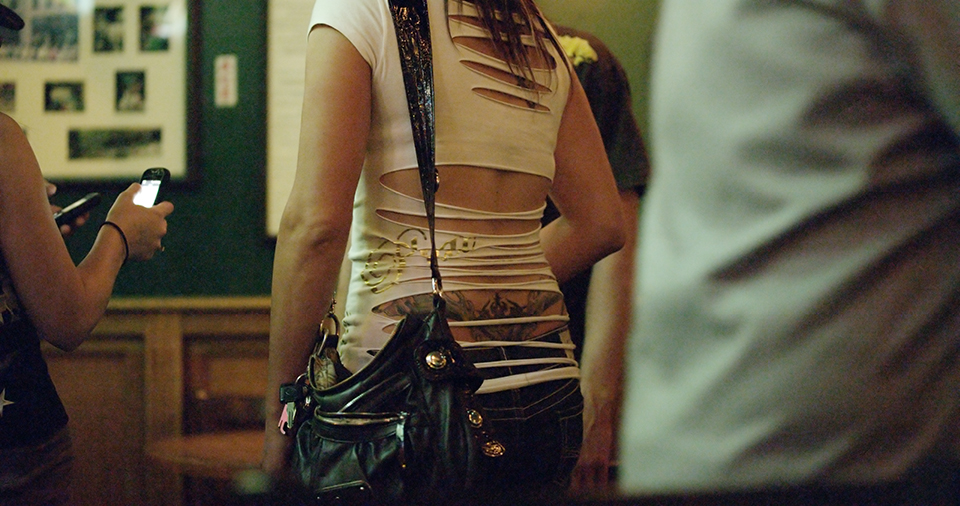
Owning both a D3s and NEX-5 myself, I can tell you that the EPIC smokes them. And presumably the SCARLET will too, just at lower frame rates than EPIC. Here's a shot from EPIC at ISO 12800. ;) It's boosted A LOT. I'll have to go back to the original clip (if I still have it) to see if I can grab a comparison of it at ISO 800. The light in this small pub was terrible, as in there was pretty much none. The two cell phones were the brightest things around. Set ISO to 12800 and exported a tiff. Image scaled and levels tweaked in photoshop.
stamped.jpg
 
Jeff,
Wow, if that's at ISO 12K , I am amazed!
So maybe I don't need to worry so much about the speed of my lens choices.

As a still photographer, I am a vampire, hence the need for the low light capable still cameras.
Looks like the Red will be good!
-Les


Owning both a D3s and NEX-5 myself, I can tell you that the EPIC smokes them. And presumably the SCARLET will too, just at lower frame rates than EPIC. Here's a shot from EPIC at ISO 12800. ;) It's boosted A LOT. I'll have to go back to the original clip (if I still have it) to see if I can grab a comparison of it at ISO 800. The light in this small pub was terrible, as in there was pretty much none. The two cell phones were the brightest things around. Set ISO to 12800 and exported a tiff. Image scaled and levels tweaked in photoshop.

stamped.jpg
 
That is wonderful news and a great image if indeed it was as dark as you say. I do a lot of low light work as well, and have been assuming (hopefully not in error) that the HDR functionality of Scarlet X would be useful in extreme situations where there is very little light otherwise punctuated by very bright light. Can anyone speak to the HDR capabilities of Scarlet?

Thank you!
 
Jeff,
Wow, if that's at ISO 12K , I am amazed!
So maybe I don't need to worry so much about the speed of my lens choices.

It's still pretty noisy. This image was brought way up in Redcine-X, ISO 12800 and about 1.8 FLUT, and color tweaked. Smoothed a bit in Photoshop and then downsampled from 5K to the size you see here It's still a pretty noisy image. ISO 12800 is pretty comparable to what you get on the Nikon D3/D3s, but a more "organic" noise or grain pattern, for lack of a better way to put it. The image above was shot with the 50mm RPP and I was wide open at T1.8.

Here it is as seen at ISO 800...
dark.jpg


That is wonderful news and a great image if indeed it was as dark as you say. I do a lot of low light work as well, and have been assuming (hopefully not in error) that the HDR functionality of Scarlet X would be useful in extreme situations where there is very little light otherwise punctuated by very bright light. Can anyone speak to the HDR capabilities of Scarlet?

I see no reason it would be different with Scarlet.

The HDRx functionality is for highlight protection. It does not dig into the shadows. If you're under-exposed, you're just under. If I were to have used HDRx in my example shot above, I could have kept the cell phone screens from blowing out, and that's about it.

With Scarlet, you will be shooting 4K for motion vs. 5K. And if you want HDRx, you will be shooting 3K. With that in mind, and that it crops into the sensor, the noise will be more noticeable as you can't scale the image down as far as you can with 5K.
 
Back
Top