Welcome to our community

Be a part of something great, join today!

  • Hey all, just changed over the backend after 15 years I figured time to give it a bit of an update, its probably gonna be a bit weird for most of you and i am sure there is a few bugs to work out but it should kinda work the same as before... hopefully :)

Urgent - Buying light kit

Yeah I have no idea what will happen when incandescent lights are replaced with CFLs. The energy savings are kind of illusory (in colder areas only) because the lack of heat CLFs generate relative to tungsten lights then has to be made up for by burning oil. Of course, if you're using air conditioning then CFLs are doubly more efficient.

I can't see tungsten film lights becoming obsolete overnight. There's no good, affordable alternative. LEDs aren't bright enough yet or even hard enough in most cases. There aren't many good 3200K discharge lamps. Kinoflos are strictly soft lights. I could be wrong, though.

Clint's list is awesome (excepting all the PFC stuff, maybe?, which confuses me, too) but it might be too expensive. If so, the extra set of Jokers and the 2.5k would be what I'd ditch. The other issue is that generally most grip houses are close enough in price that availability trumps price and so some people will choose one place over another specifically because they have some cool, new, unusual light. But not everyone wants the same weird light, as this thread makes clear. I'm no businessman so I don't know...

Anyhow, seems you must have already made up your mind. Just following through on my earlier post.
 
There have been some very recent advancements in the LED category. Brighter than most people think. No heat will let you place them closer to subjects if needed, won't warm up too much gear or people in confined spaces, can run off batteries, lightweight, bulbs last 50k hours, can be scrimmed with surfaces that would melt normally, won't be obsolete in 3 years, the epic won't need as much light. All of those factors combined, I'd start here: http://www.litepanels.com/

http://www.litepanels.com/lp/products/bicolor.html for bicolor.
 
Wow! Really interesting stuff Guy.... I don't have much knowledge of generators (until now) but I am curious now if the large diesel generators we see on sets everywhere also suffer from these current spikes and harmonics...Guy? Thanks again for educating me on the principles of electric generators and the importance on lighting systems we use in production today. I love Reduser:)

Voltage waveform distortion as a result of harmonic currents is not a practical problem on large film sets because of remedial steps taken in the design of form specific generating and power distribution systems engineered to remediate the adverse effects of harmonic currents. With 2/3 pitch windings, MQ Power studio (Crawford) generators are specifically designed to remediate the most troublesome of the harmonics generated by non-linear loads and as such have specifications for total harmonic distortion (THD) values of less than 7% under full linear load, and of not more than 3% of any given harmonic current. For this reason, and the fact that they offer a comparatively low sub-transient impedance value and are typically oversized for the load, harmonic currents do not cause substantial voltage waveform distortion.

However, it is an all together different situation when plugging a couple of 1200W HMIs into a small portable generator that is not specifically designed to remediate the effects of harmonics. Given the comparatively large sub-transient impedance of conventional AVR portable gas generators, and the high THD value of their inherent power waveform (19.5% under full linear load), you have a situation where even a small amount of harmonics being fed back into the power stream will result in a large amount of harmonic distortion in its’ voltage. Making the matter worse is that, given the increasing prevalence of non-linear light sources in production, it is likely that the percentage of the generator’s capacity taken up by non-linear loads will be very high given its small size relative to the size of HMIs typically used on these generators (575-2500 Watts.) Small portable conventional AVR generators present a perfect (electrical) storm
where the return of any harmonic currents results in a very high degree of voltage distortion.

It is now possible to remedy the problem of harmonics in small portable gas generators by starting with a generator with less inherent total harmonic distortion (THD) and by using ballasts with power factor correction (PFC). As the oscilloscope shots in my article clearly demonstrate, PFC ballasts operating on the nearly pure power waveform of an inverter generator creates virtually no voltage waveform distortion when compared to non-PFC ballasts on the distorted power waveform of a conventional generator like an EX5500 or the ES6500. What this means is that an inverter generator can be loaded to capacity with PFC HMI and Kino Flo ballasts and while safely powering sophisticated electronic equipment on the same supply.

- Guy Holt, Gaffer, ScreenLight & Grip, Lighting & Grip Rental in Boston
 
Thanks again Guy. I get it now. I do have a correction though...PFC doesn't stand for Power Factor Correction anymore. It stands for Pretty F*cking Cool :)

Clint
 
There have been some very recent advancements in the LED category. Brighter than most people think. .

While LED Lights are getter brighter, they are still not comparable to other Light sources. In my opinion, LED lights are still only a special purpose tool and not suitable for general production. When they are used in production they are used as Obie lights or to light car interiors at night. Like every other DP & Gaffer, I have put together my favorite lighting package based upon my more than 20 years operating a lighting rental and production service company. For my package, I have picked lights that I feel offer both the highest output (lumens/watt) and the best production capability and have combined them with distribution technology I've developed that enhances the production capability of the new Honda Inverter Generators. As yet, I have not found a LED lighting fixture that warrants inclusion in my package. Trust me, I have looked at all of them and some still to come. Here are a few of my reasons why I prefer fluorescent lights, especially the Kino Flo Parabeam fixtures, over LED Panels for many of the applications that LEDs are being marketed for and it has to do with more than just their poor CRI.

In HD Digital Cinema, the quality of light is more critical than ever. In High Def every detail of “on-camera” talent is rendered clearly on the screen – even the imperfections. Where LED and traditional hard light sources can exaggerate textural details, it is my opinion that fluorescent soft light is better for lighting talent in High Def productions because it can subdue those same textures and render a more cosmetic appearance. Primarily for this reason, I prefer the Kino Flo fixtures, over LED Panels, to serve as a Key source. For dramatic productions (non-interview), I especially like the Kino Flo Parabeam fixture because they offer a number of advantages over LEDs and even other Kino fixtures.

What distinguishes the Parabeam fixtures from LED Panels and other fluorescent lights is their throw, power efficiency, and the innovative accessories Kino Flo makes available for the fixtures. Accessories include barndoors, a gel frame, a diffusion panel, and Honeycomb Louvers. These features enhance the production capabilities of the Parabeam fixtures and make them suitable to serve as a key, or even backlight, source where conventional fluorescent movie lights and LED light panels are not.

HD_PP_DemoCU.jpg

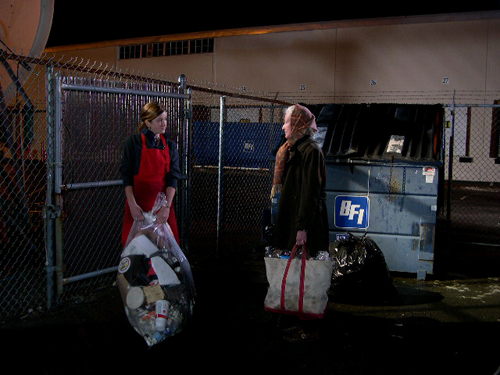
Two Shot of Night exterior scene lit with our HD P&P Pkg​

Both conventional fluorescent movie lights (Kino Flo’s included) and LED light panels have a very broad light output that is hard to control. These lights also tend to drop off rapidly which means that to serve as a Key source, the units need to be positioned close to the subject they are lighting. These characteristics make them best suited to serve as Key sources in documentary interview set-ups where the Keys are typically positioned close to the interview subject. In that capacity conventional fluorescent lights and LED light panels (with heavy diffusion) can generate a wonderful soft light that wraps around the interview subject without wilting them. But, given these characteristics, conventional fluorescent movie lights and LED light panels have only limited applications as fill sources in dramatic set lighting.

HD_PP_DemoWS.jpg

Wide Shot of Night exterior scene lit with a pkg. consisting of PFC 2.5 & 1.2 HMI Pars, PFC 800w Joker HMI, Kino Flo Flat Head 80, 2 ParaBeam 400s, and a ParaBeam 200 powered by a modified Honda EU6500is.​

The ParaBeam fixtures, on the other hand, have computer aided designed (CAD) parabolic reflectors that focus their light output where it is needed most for lighting dramatic scenes - at a medium distance – making them better suited as a Key source for HD Digital Cinema. If you compare the photometric tables of the Parabeam 400 and the Diva 400 (which uses the same four lamps), you will notice that at 16’ the Parabeam 400 puts out almost three times the light level (28FC) than the Diva 400 (10FC) even though they both use the same tubes. You can always diffuse a Parabeam to create a soft source, but nothing you do will make a Diva 400 or LED light panel punchier.

HD_PP_Demo_SetUp_Night.jpg

Note Distance at which the two ParaBeam 400s are serving as Keys.​

In fact, a Parabeam 400 generates as much light at 16’ as the 4’ 8-Tube Kino Flathead 80 fixture, yet uses less than a quarter of the power (2 Amps verses 9.2 Amps.) While the seven amp difference is not a major consideration when using house power, it can make a difference when your power is limited (coming from a portable generator) because you can use four Parabeam 400s for the same power as a 4’ – 8 Bank Kino Flathead 80. And unlike the ballasts of Kino Flo’s fixture that use the T12 tubes, the Parabeam ballasts also include Power Factor Correction to reduce the return of harmonic currents into the power stream and improve their power efficiency. This makes them an especially efficient fluorescent light source that is comparable to the power efficiency of LED light panels. For instance a Parabeam 400 puts out considerably more light than even Zylight’s new high output LED light panel yet draws just .2 Amps more power.

LED_Non_PFC_Waveforms.jpg

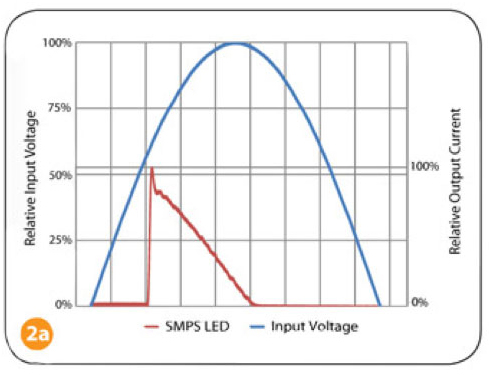
Figure 2(a): Voltage and Current waveforms generated by SMPS type AC-to-DC Converter used to drive AC LEDs.​

By comparison, the Switch Mode Power Supplies (SMPSs) used to operate LEDs on AC draw a very distorted current, and can result in current that is significantly phase-shifted with respect to the sinusoidal voltage waveform. Although values vary widely, the SMPSs used in AC LEDs generally have a Leading Power Factor and high harmonic distortion (THD upwards of 68.1%). Power Factors for AC LEDs range from 0.54 (Litepanel 1x1s), to 0.85 (Litepanel Sola Fresnels). As such, High Power LEDs can have an adverse effect on power quality similar to that of CFL bulbs. (Use this link - http://www.screenlightandgrip.com/html/ema...generators.html - for a detailed description of the adverse effects that LEDs can have on portable generators.)


LED_1by_Har_Distri.jpg

Distribution of harmonics generated by the power supply of the Litepanel 1x1 LED Fixtures. Note: predominance of the 3rd, 5th,
7th, and 9th harmonics that don't cancel on neutral returns.
​

While the newest LED light panels (that use the higher output LEDs) approach the Parabeams in output, the Parabeam fixtures are more easily controlled – an essential requirement in a Key source. Parabeam fixtures are controlled by interchanging Kino Flos’ innovative Honeycomb Louvers. Louvers are available in 90, 60 and 45 degrees. Swapping louvers provides beam control similar to that of swapping lenses on an HMI Par. These features enhance the production capabilities of the Parabeam fixtures and make them suitable to serve as a Key or Backlight source where conventional fluorescent movie lights and LED light panels will spill all over the set.

The power that I save by using Parabeam 400s for key sources in my package, enables me to power more lights on the enhanced 7500W output of my modified Honda EU6500is generator. Using a 60A Full Power Transformer/Distro on my modified Honda EU6500is I am able to power a lighting package that consists of a 2.5kw, 1200, & 800 HMI Pars, a couple of Parabeam 400s and Parabeam 200s, and a Flat Head 80. Given the light sensitivity of the camera like the Epic, this is all the light you need to light a large night exterior.

Compared to LED fixtures, Kino Flo Parabeam fixtures are nearly as power efficient but offer greater versatility and output. Able to interchange different color temperature tubes, and vary beam spread with their interchangeable honeycomb louvers, the Parabeam fixture can do what it takes four different LED Litepanel fixtures to accomplish – Spot and Flood in both 5500K and 3200K. Offering better light quality, output, beam control, and versatility, the Kino Flo ParaBeams make for a better key or back light for HD cinema production.

Guy Holt, Gaffer, ScreenLight & Grip, Lighting & Grip Rental in Boston
 
Essor, your 24 hr window has come and gone by now. But one aspect of your needs not addressed by anyone is how are you going to lug all this around? Do you have a truck? Are you storing all this in road cases and using production trucks to get from here to there? This is an expense as well.

That was a good post and we all got some great ideas from our Reduser family.
 
Back
Top