
Navigation
Install the app
How to install the app on iOS
Follow along with the video below to see how to install our site as a web app on your home screen.

Note: this_feature_currently_requires_accessing_site_using_safari
More options
Welcome to our community
Be a part of something great, join today!
You are using an out of date browser. It may not display this or other websites correctly.
You should upgrade or use an alternative browser.
You should upgrade or use an alternative browser.
Underwater Bubble Blowin' Users Group
- Thread starter Mark Thorpe
- Start date

Johnny Friday
Well-known member
- Joined
- Feb 11, 2007
- Messages
- 3,367
- Reaction score
- 0
- Points
- 36
- Location
- La Paz, Baja Ca. Sur, Mexico
- Website
- bajaproductions.com
Hmm, the Great White shot really seems to stand out in sharpness, both overall and edge-to-edge. What do you use to unwarp the image, After Effects?
Would you say that the Sigma 15mm overcomes most of the sharpness falloff behind a dome?
Amund
I guess i don't know what is "unwarp" Pretty much most all fisheyes will have same effect....regardless, you'll see quite a differenece using a fisheye at wide ends.
By unwarp I mean to correct fisheye image distortion to make curved lines straight(er). For still images you can use a software like DxO (http://www.kenrockwell.com/tech/dxo/optics-pro.htm), After Effects has a filter called Optics Compensation (http://lesterbanks.com/2012/06/removing-fisheye-distortion-in-after-effects/)
But maybe this isn't much of a problem underwater with the Sigma 15mm?
But maybe this isn't much of a problem underwater with the Sigma 15mm?
Johnny Friday
Well-known member
- Joined
- Feb 11, 2007
- Messages
- 3,367
- Reaction score
- 0
- Points
- 36
- Location
- La Paz, Baja Ca. Sur, Mexico
- Website
- bajaproductions.com
All i can say Amund is that i'm very happy with the 15 Sigma....regardless of an software to unwarp. But that might be even a nice effect to drop on to further compensate. But some don't like the 15 Sigma....check the "other" bubble forum for more info...but i do, and for me that is all that matters.....until i find a better choice. I have heard rumors of Gates working on something new with optics. That's about all i know.....so best to contact Gates.
Johnny Friday
Well-known member
- Joined
- Feb 11, 2007
- Messages
- 3,367
- Reaction score
- 0
- Points
- 36
- Location
- La Paz, Baja Ca. Sur, Mexico
- Website
- bajaproductions.com
check for yourself for sure....i know of someone else who said they thought it was unsharp, and a crap lens......so heck bubble group for other reactions.
Johnny Friday
Well-known member
- Joined
- Feb 11, 2007
- Messages
- 3,367
- Reaction score
- 0
- Points
- 36
- Location
- La Paz, Baja Ca. Sur, Mexico
- Website
- bajaproductions.com
Indeed. But not sure what the other Bubble group is?
http://www.reduser.net/forum/showth...Bubble-Blower-Thread&highlight=bubble+blowers

Tom Hamilton
Well-known member
- Joined
- May 17, 2009
- Messages
- 1,157
- Reaction score
- 0
- Points
- 0
- Location
- Port Orange
- Website
- www.redseapictures.com
check for yourself for sure....i know of someone else who said they thought it was unsharp, and a crap lens......so heck bubble group for other reactions.
After seeing your stuff Johnny, I'm pretty sure I got a bad lens. Looks very sharp to me. Maybe I should do the Ketch thing, buy three of the same lens, test the crap out of them, keep the best one, and send back the other two. B&H is very understanding this way.
Tom Hamilton
Well-known member
- Joined
- May 17, 2009
- Messages
- 1,157
- Reaction score
- 0
- Points
- 0
- Location
- Port Orange
- Website
- www.redseapictures.com
Congrats on your purchase Amund, you have to work really hard to mess up with a Gates ;-)
Re fisheye distortion, if you need to correct in post, then you probably should just go with a good rectilinear. Shooting at 5K, I use my Duclos 11-16 for that, pushed out to 14mm for sensor coverage, I like the results.
As Johnny's work clearly shows though, when you know how to use a fisheye underwater (isn't that what fish do?), that is, not shooting flat sandy bottoms, for example, the results can be spectacular.
Re fisheye distortion, if you need to correct in post, then you probably should just go with a good rectilinear. Shooting at 5K, I use my Duclos 11-16 for that, pushed out to 14mm for sensor coverage, I like the results.
As Johnny's work clearly shows though, when you know how to use a fisheye underwater (isn't that what fish do?), that is, not shooting flat sandy bottoms, for example, the results can be spectacular.
Thanks Tom, I know well about Gates now, having owned a Deep Red for a while. Their workmanship is really superior! The Deep Red feels like a tank now, but it still does the job.
Regardless of lens, the softness at edges is still quite apparent with the Duclos. Nothing to do with the lens, it is one of the very sharpest wide angle zooms out there - I have tested it to match the Zeiss Ultraprime 14mm in both sharpness and vignetting. The challenge is the dome's characteristics of curvature, which (from what I now understand) cannot align with a rectilinear lens's. Not being a lens designer I don't quite understand what is going on, but there seems to a sweet-spot in terms of focal length and position within the dome that most lenses will hit or not hit, depending. Fisheyes are, from what I gather, more likely to align with the dome's curvature.
Please stop me if I am totally off my mark here, but so far no one has been able to be entirely explain what can be done to avoid that sharpness fall-off with domes (rectilinear lens or not) , so these are just my layman's musings on the subject matter.
A.
Regardless of lens, the softness at edges is still quite apparent with the Duclos. Nothing to do with the lens, it is one of the very sharpest wide angle zooms out there - I have tested it to match the Zeiss Ultraprime 14mm in both sharpness and vignetting. The challenge is the dome's characteristics of curvature, which (from what I now understand) cannot align with a rectilinear lens's. Not being a lens designer I don't quite understand what is going on, but there seems to a sweet-spot in terms of focal length and position within the dome that most lenses will hit or not hit, depending. Fisheyes are, from what I gather, more likely to align with the dome's curvature.
Please stop me if I am totally off my mark here, but so far no one has been able to be entirely explain what can be done to avoid that sharpness fall-off with domes (rectilinear lens or not) , so these are just my layman's musings on the subject matter.
A.
Johnny Friday
Well-known member
- Joined
- Feb 11, 2007
- Messages
- 3,367
- Reaction score
- 0
- Points
- 36
- Location
- La Paz, Baja Ca. Sur, Mexico
- Website
- bajaproductions.com
10-4 Tom.
Another thing to be very very clear on that i have spent a LOT....i mean a LOT of time and attention is being VERY sure you set your backfocus properly...not just assume or think you got it set properly...but hook up to a large HDMI Television while using your 5" monitor and check close/far focus while adjusting backfocus...Many still lenses can be finicky and not hold a very good backfocus or just take a long time to find the actual sweet spot where backfocus holds BEST. Today i spent about 30mins just tweaking back and forth backfocus for my PL Tokina 11-16....it was a few turns off from where i originally thought it "should" have been set...so that i could shoot at my normal focus setting underwater and then shoot same lens topside.....Topside and at infinity is where i encountered the problem...and this, underwater or topside if set improperly or not verified 100% that it is set and sharp will yield sub-standard images that are well...., just soft.
Another thing to be very very clear on that i have spent a LOT....i mean a LOT of time and attention is being VERY sure you set your backfocus properly...not just assume or think you got it set properly...but hook up to a large HDMI Television while using your 5" monitor and check close/far focus while adjusting backfocus...Many still lenses can be finicky and not hold a very good backfocus or just take a long time to find the actual sweet spot where backfocus holds BEST. Today i spent about 30mins just tweaking back and forth backfocus for my PL Tokina 11-16....it was a few turns off from where i originally thought it "should" have been set...so that i could shoot at my normal focus setting underwater and then shoot same lens topside.....Topside and at infinity is where i encountered the problem...and this, underwater or topside if set improperly or not verified 100% that it is set and sharp will yield sub-standard images that are well...., just soft.
Johnny Friday
Well-known member
- Joined
- Feb 11, 2007
- Messages
- 3,367
- Reaction score
- 0
- Points
- 36
- Location
- La Paz, Baja Ca. Sur, Mexico
- Website
- bajaproductions.com
There is not much you can do....sure you can use a diopter but we've been down this road before...but you don't end up with what you ultimately want which is sharp corner to corner. Basically shoot with iris as closed down as possible f8 and higher if ever possible while keeping enough light on the sensor and many of these problems become minimal. Where you can suffer is wide angle and close up to subjects that fill the frame.
Found an interesting explanation and possible solution by Rudi Herbert over at the Gentlemen's thread:
http://www.reduser.net/forum/showth...Blower-Thread/page20&highlight=bubble+blowers
http://www.reduser.net/forum/showth...Blower-Thread/page20&highlight=bubble+blowers
- Banned
- #1,395

Pawel Achtel
Banned
- Joined
- Oct 12, 2007
- Messages
- 3,648
- Reaction score
- 0
- Points
- 0
- Location
- Tasmania
- Website
- www.achtel.com
Amund,
It all depends on what compromises you are prepared to accept and many of them would probably be shot or project specific.
In general:
1. Fisheye lenses, when properly aligned with the dome, do not suffer from significant deterioration of quality in underwater use. However, fisheye lenses are rarely "5k quality". I've been watching Howard Hall's humpback whale shots (I believe Tokina 10-17mm) and the contrast as well as sharpness (both are somewhat related) seem to be very compromised, even when watching at 2k. It is hard to tell, but I imagine that they were in focus, which would indicate rather poor lens performance. His latest images also exhibit quite strong veiling glare and flaring, which affect contrast even further.
2. If you chose to correct a fisheye lens in post, you would be stretching the edges and corners by a significant amount. The performance of fisheye lenses in the corners is not that great to start with. I did not find such correction satisfactory. In my view, better results can be achieved with non-distorting lenses.
3. Image plane curvature causes (among other things) loss of edge and corner sharpness. The loss increases exponentially with sensor size. The image plane curvature was not so much of a problem when using 2/3" sensors behind large, 9" dome ports, particularly when shooting in HD. The problem become very apparent with large sensors. To minimise the effect one can stop down the lens to f/11 - f/16. The images will be, of course, diffraction limited and overall sharpness will decrease, but corner sharpness will improve. However, the edge sharpness will never reach even half of the sensor resolving limit. Practically you can expect less than 1k. Most setups that I have tested resulted in only about 10% of the resolving power of the sensor, which is less than standard definition quality. In addition, the overall contrast also suffers.
The wider the angle the more problems you can expect. The sweet spot is about 90 degrees diagonally (about 14mm on S35 sensor). Beyond that you can expect increased astigmatism and chromatic aberrations in addition to image plane curvature.
4. Neither fisheye nor rectilinear lenses can produce good results behind a dome port when fully opened. This can be particularly limiting when filming large subjects that you can not fill in with light: sharks, whales, etc... The need for speed also increases when shooting at high frame rates.
There is no easy fix for image plane curvature caused by dome ports other than simply not use a dome port at all.
5. Which brings us to the fabulous Nikonos lenses that solve nearly all the problems of civilisation, including back focus issues that Johnny mentioned above
Hope it helps
Best fishes,
It all depends on what compromises you are prepared to accept and many of them would probably be shot or project specific.
In general:
1. Fisheye lenses, when properly aligned with the dome, do not suffer from significant deterioration of quality in underwater use. However, fisheye lenses are rarely "5k quality". I've been watching Howard Hall's humpback whale shots (I believe Tokina 10-17mm) and the contrast as well as sharpness (both are somewhat related) seem to be very compromised, even when watching at 2k. It is hard to tell, but I imagine that they were in focus, which would indicate rather poor lens performance. His latest images also exhibit quite strong veiling glare and flaring, which affect contrast even further.
2. If you chose to correct a fisheye lens in post, you would be stretching the edges and corners by a significant amount. The performance of fisheye lenses in the corners is not that great to start with. I did not find such correction satisfactory. In my view, better results can be achieved with non-distorting lenses.
3. Image plane curvature causes (among other things) loss of edge and corner sharpness. The loss increases exponentially with sensor size. The image plane curvature was not so much of a problem when using 2/3" sensors behind large, 9" dome ports, particularly when shooting in HD. The problem become very apparent with large sensors. To minimise the effect one can stop down the lens to f/11 - f/16. The images will be, of course, diffraction limited and overall sharpness will decrease, but corner sharpness will improve. However, the edge sharpness will never reach even half of the sensor resolving limit. Practically you can expect less than 1k. Most setups that I have tested resulted in only about 10% of the resolving power of the sensor, which is less than standard definition quality. In addition, the overall contrast also suffers.
The wider the angle the more problems you can expect. The sweet spot is about 90 degrees diagonally (about 14mm on S35 sensor). Beyond that you can expect increased astigmatism and chromatic aberrations in addition to image plane curvature.
4. Neither fisheye nor rectilinear lenses can produce good results behind a dome port when fully opened. This can be particularly limiting when filming large subjects that you can not fill in with light: sharks, whales, etc... The need for speed also increases when shooting at high frame rates.
There is no easy fix for image plane curvature caused by dome ports other than simply not use a dome port at all.
5. Which brings us to the fabulous Nikonos lenses that solve nearly all the problems of civilisation, including back focus issues that Johnny mentioned above
Hope it helps
Best fishes,
- Banned
- #1,396
Pawel Achtel
Banned
- Joined
- Oct 12, 2007
- Messages
- 3,648
- Reaction score
- 0
- Points
- 0
- Location
- Tasmania
- Website
- www.achtel.com
Johnny,...I have heard rumors of Gates working on something new with optics. That's about all i know.....so best to contact Gates.
I know you like Gates and John J Ellerbrock is a nice guy, but the rumour seems to be contradicting what he says:
...
•Underwater optics. Of course this is important. But…and this is my $.02…the discussions about optics on this forum are tinkering around the corners (pun intended). What we have now is working, and amazingly so. .... In other words: underwater optics are not the limiting factor for great images. Critical focus, composition, lighting, behavior…all the things that only you, the cameraman, can achieve.
...
Why on earth would they try to improve their optics if, according to John, what they have now "is working, and amazingly so"? He essentially says that it is the tradesman, not the tool, that's faulty. It doesn't make sense. Or, does it?
Of course, I respectfully disagree with John and this is why I decided to introduce my own housings to the industry.
The fact is that we were the first company that got serious about underwater optics. We were the first to measure the performance of various setups, compared them openly and were the first to point out that dome ports are not a satisfactory solution for large sensor wide angle cinematography. We did this despite having the best dome port in the industry: The CinePort.
We had a solution that produces outstanding results (better than the camera can resolve) for almost a year now. We can quantify the performance of our solution and guarantee that it is the only one worthy of the RED Epic sensor. Rudi recently mentioned that he is working on and will have an adapter (I believe for 14-24mm Nikon G f/2.8 lens) within 12 months that will overcome the problems introduced by dome ports underwater. While I'm skeptical about that, I remain open minded and awaiting any results he may like to share with us.
Johnny,
I know you like Gates and John J Ellerbrock is a nice guy, but the rumour seems to be contradicting what he says:
Why on earth would they try to improve their optics if, according to John, what they have now "is working, and amazingly so"? He essentially says that, it is the operator that is the limiting factor, not their dome port optics. It doesn't make sense. Or, does it?
Of course, I respectfully disagree with John and this is why I decided to introduce my own housings to the industry.
The fact is that we were the first company that got serious about underwater optics. We were the first to measure the performance of various setups, compared them openly and were the first to point out that dome ports are not a satisfactory solution for large sensor wide angle cinematography. We did this despite having the best dome port in the industry: The CinePort.
We had a solution that produces outstanding results (better than the camera can resolve) for almost a year now. We can quantify the performance of our solution and guarantee that it is the only one worthy of the RED Epic sensor. Rudi recently mentioned that he is working on and will have an adapter (I believe for 14-24mm Nikon G f/2.8 lens) within 12 months that will overcome the problems introduced by dome ports underwater. While I'm skeptical about that, I remain open minded and awaiting any results he may like to share with us.
Thanks Pawel, I am beginning to get the picture now (sharper and less distorted!) about domes and their inherent problems.
Yes, I also disagree with John about what the main limiting factors are, corrective measures for air-to-water optics is a MAJOR issue. The focus fall-off in the dome is a big problem for me, and I cringe when clients point it out because there is (or was!) nothing I could do about it. When I do underwater shots for topside cinematographers on feature films, music video a.s.o, using fisheyes is never an option, so I HAVE to sort out the lack of edge sharpness with rectilinear lenses. In most cases (working with DPs) I will use the flat macro port for the Gates housings, but with added port extenders, cine optics etc the camera becomes very front heavy and too cumbersome for anything but pool use. Also since the port is made of acrylic, the tiny scratches and lack of coating makes the port very prone to picking up and diffusing direct light, plus of course major reflection issues due to lack of coating on plastic. A very typical shot in a pool is where the director wants to shoot right into the HMIs on the pool edge to mimic sunlight. This simply looks horrible in an acrylic dome, which is why I went for the glass dome with coating. It is a big improvement, but it brings me back to the dome problems again. Ideally, I would like a flat, coated glass for cinema/pool work where direct light into the lens is a frequent request. John says coated glass can be ordered and fitted to replace the acrylic, but not sure of the cost yet.
I do use the flat front port in the open sea, but rarely for anyhing but macro because the extension makes the camera setup quite a bit heavier and unbalanced. Also there is the added "tax" of about 35% focal length increase, so wide angles lose their merit.
Have you done much testing with flat ports and do you consider them a better solution for maintaining image sharpness, despite their practical downsides?
Amund
- Banned
- #1,398
Pawel Achtel
Banned
- Joined
- Oct 12, 2007
- Messages
- 3,648
- Reaction score
- 0
- Points
- 0
- Location
- Tasmania
- Website
- www.achtel.com
Thanks Amund,
We have done many tests with flat ports using Master Prime 14mm. Unfortunately the performance is much worse than dome ports due to severe astigmatism and chromatic aberrations. In addition you need to deal with considerable geometric distortions (pincushion) and, of course, magnification.
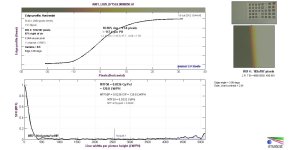
Here is typical MTF chart measured on the edge of the frame:

You can see that flat port does not resolve even 10% of the sensor resolving limit and overall contrast is very low.
As you can see in the attached MTF graph below, the MTF 50 (the resolution at which 50% of the contrast is lost) is about 120 line widths per picture height.

This is worse than a worn out VHS tape.The edge profile (the graph above that shows how many pixels is needed to make a transition from black to white) is 22 pixels! For comparison, Nikonos 15mm does it in less than 2 pixels and it is limited by the sensor resolution, not the lens! More than an order of a magnitude difference. Practically, you would start noticing significant image deterioration with flat port with angles of view of more than 20~30 degrees.
The second MTF chart below shows the performance of flat port just slightly off-centre of the frame (see the small red square, Region of Interest, in the right top corner in relation to the frame). You can see that the sharpness has deteriorated quite significantly already.

Hope it helps.
We have done many tests with flat ports using Master Prime 14mm. Unfortunately the performance is much worse than dome ports due to severe astigmatism and chromatic aberrations. In addition you need to deal with considerable geometric distortions (pincushion) and, of course, magnification.
Here is typical MTF chart measured on the edge of the frame:
You can see that flat port does not resolve even 10% of the sensor resolving limit and overall contrast is very low.
As you can see in the attached MTF graph below, the MTF 50 (the resolution at which 50% of the contrast is lost) is about 120 line widths per picture height.
This is worse than a worn out VHS tape.The edge profile (the graph above that shows how many pixels is needed to make a transition from black to white) is 22 pixels! For comparison, Nikonos 15mm does it in less than 2 pixels and it is limited by the sensor resolution, not the lens! More than an order of a magnitude difference. Practically, you would start noticing significant image deterioration with flat port with angles of view of more than 20~30 degrees.
The second MTF chart below shows the performance of flat port just slightly off-centre of the frame (see the small red square, Region of Interest, in the right top corner in relation to the frame). You can see that the sharpness has deteriorated quite significantly already.
Hope it helps.
Attachments

Tom Hamilton
Well-known member
- Joined
- May 17, 2009
- Messages
- 1,157
- Reaction score
- 0
- Points
- 0
- Location
- Port Orange
- Website
- www.redseapictures.com
Pawel,
In layman terms, and I know you are capable of explaining this, what is the Nyquist limit of a 5K sensor, in practical terms?
In layman terms, and I know you are capable of explaining this, what is the Nyquist limit of a 5K sensor, in practical terms?
- Banned
- #1,400
Pawel Achtel
Banned
- Joined
- Oct 12, 2007
- Messages
- 3,648
- Reaction score
- 0
- Points
- 0
- Location
- Tasmania
- Website
- www.achtel.com
Tom,
Nyquist limit is nicely explained in Wikipedia: http://en.wikipedia.org/wiki/Nyquist_frequency
In layman terms, it is a limit (the smallest detail) that the sampling frequency (pixels) can reproduce. The theoretical Nyquist limit for a sensor would be equal to 1/2 the number of pixels. For example, a 5k array of pixels can reproduce maximum 2.5k cycles (line pairs). At this limit the contrast (MTF) will be 0%.
There are, however various sharpening techniques that can go beyond this limit. For example, I was able to de-mosaic R3D (using RedCine) details beyond this limit. There are other techniques, both temporal and spatial that can reconstruct the detail beyond Nyquist limit. Of course, the optical detail has to be there to start with.
The Nyquist limit is only related to the sensor, specifically pixel count.
The resulting MTF is a product (multiplication) of the sensor contrast and that of the optics. It is only as good as the weakest link. Never better than each of link of the chain (as MTF ranges from 0% to 100%, so the product of two MTFs is always lower than each operand).
Lenses (both terrestrial and underwater) may or may not have higher frequency response (contrast at which small detail is reproduced) than the sensor. Or, in layman terms, the lenses may or may not out-resolve the sensor. They may do so across the entire frame, or only on a portion of the image. They may or may do so at some f-stops. Making all comparisons a bit more difficult.
In the example of flat port, you can see that the port performs well (out-resolves the sensor) only in the very centre. But, even a small distance away from the centre of the frame and the MTF chart (contrast) drops down to 0% well before reaching the theoretical limit of the sensor - the Nyquist limit. It means that all the signal (detail) is gone, and beyond ability to sharpen it or retrieve it in any way (in layman terms: no way to "fix it in post").
Maybe someone else could give a more digestible explanation. Most layman, but otherwise intelligent, people think I'm talking gibberish when I speak to them
Nyquist limit is nicely explained in Wikipedia: http://en.wikipedia.org/wiki/Nyquist_frequency
In layman terms, it is a limit (the smallest detail) that the sampling frequency (pixels) can reproduce. The theoretical Nyquist limit for a sensor would be equal to 1/2 the number of pixels. For example, a 5k array of pixels can reproduce maximum 2.5k cycles (line pairs). At this limit the contrast (MTF) will be 0%.
There are, however various sharpening techniques that can go beyond this limit. For example, I was able to de-mosaic R3D (using RedCine) details beyond this limit. There are other techniques, both temporal and spatial that can reconstruct the detail beyond Nyquist limit. Of course, the optical detail has to be there to start with.
The Nyquist limit is only related to the sensor, specifically pixel count.
The resulting MTF is a product (multiplication) of the sensor contrast and that of the optics. It is only as good as the weakest link. Never better than each of link of the chain (as MTF ranges from 0% to 100%, so the product of two MTFs is always lower than each operand).
Lenses (both terrestrial and underwater) may or may not have higher frequency response (contrast at which small detail is reproduced) than the sensor. Or, in layman terms, the lenses may or may not out-resolve the sensor. They may do so across the entire frame, or only on a portion of the image. They may or may do so at some f-stops. Making all comparisons a bit more difficult.
In the example of flat port, you can see that the port performs well (out-resolves the sensor) only in the very centre. But, even a small distance away from the centre of the frame and the MTF chart (contrast) drops down to 0% well before reaching the theoretical limit of the sensor - the Nyquist limit. It means that all the signal (detail) is gone, and beyond ability to sharpen it or retrieve it in any way (in layman terms: no way to "fix it in post").
Maybe someone else could give a more digestible explanation. Most layman, but otherwise intelligent, people think I'm talking gibberish when I speak to them