Welcome to our community

Be a part of something great, join today!

  • Hey all, just changed over the backend after 15 years I figured time to give it a bit of an update, its probably gonna be a bit weird for most of you and i am sure there is a few bugs to work out but it should kinda work the same as before... hopefully :)

Underwater Bubble Blowers User Group Thread NEW

Status
Not open for further replies.
point is Pawel, you've blasted folks like Howard Hall for lack of rez. But yet their story is what moves art. We all wish to have the BEST images possible, but that may not be possible due to any mirad of factors......least of all the fact we don't have the XXXX camera system. I'm not trying to get into a pee match with you pawel, but show us please.
 
...Show us rather than claim it...

The images I posted above are automated analysis of two frames: one shot with a dome port and the second with Nikonos. A thumbnail picture of those frames are in the top right corner. Below that thumbnail is a small picture of ROI (region of interest) selected from that frame. It is marked with little red mark. In both cases it is the corner sample. You can see a fuzzy edge rendered in the corner with a dome port. It takes over 10 pixels to transition from white to black. That edge appears much sharper on the ROI taken with the Nikonos.

What is important is that on the frame captured with Nikonos lens, the MTF goes right until the mid-point marked as Nyquist frequency limit. That's as much as the sensor can theoretically resolve.

Actually, I had an unfortunate sample of the Nikonos 15mm on this test showing about 2 pixel decentricity (blue colour fringe). All other samples of the 15mm Nkionos that I tested did not have that blue colour fringe. Anyway, it still resolved the sensor limit.

point is Pawel, you've blasted folks like Howard Hall for lack of rez....

I know Howard and Michele and highly respect their work. They inspired me and many others. And, when presented with the DeepX housing Howard responded:

"Excellent idea. Nothing makes sharper underwater images than those wonderful old Nikonos lenses." (his own words)

Of course, it doesn't replace a good story and Howard is very good storyteller. I'm sure I would watch his film even if it was shot on a GoPro.

Happy Fishes.
 
DEEP PULSAR / ATOM @ NAB

DEEP PULSAR / ATOM @ NAB

Hi all,

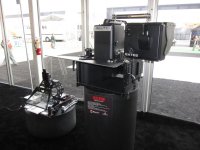
I'm at NAB with the 3Ality team (who are endlessly supportive and wickedly smart) and DEEP PULSAR / ATOM on display in their booth. On the left is the housing base with ATOM rig. On the right the main housing shell with Transvideo monitor housing. What you can't see behind the monitor is the underwater FIZ controller (which will be complimented by an IO/Convergence controller).

J-

IMG_2422.jpg
 
Hi all,

I'm at NAB with the 3Ality team (who are endlessly supportive and wickedly smart) and DEEP PULSAR / ATOM on display in their booth. On the left is the housing base with ATOM rig. On the right the main housing shell with Transvideo monitor housing. What you can't see behind the monitor is the underwater FIZ controller (which will be complimented by an IO/Convergence controller).

J-

View attachment 24140


Way to go John I am so excited that my Deep Atom is shipping in a couple of weeks!!!! The test footage looks so incredibly sharp edge to edge I am very impressed.
 
Hey Ron lovely images all looks beautiful and sharp edge to edge great job!
Thanks, Ross. Much appreciated. After 68 hours travel time to Indo I was able to capture the Bumphead Parrots on my first open water dive with the Deep Epic! Now, after a grueling return (missed flight by 10 minutes and had to wait another 24 hours, plus another hour delay for an incoming flight just now) at least I had some time to process and upload those images. There are many more good ones but I just grabbed the first few that caught my attention for camera tests! Now on my way to LAX and ultimately NAB...
 
Hi all,

I'm at NAB with the 3Ality team (who are endlessly supportive and wickedly smart) and DEEP PULSAR / ATOM on display in their booth. On the left is the housing base with ATOM rig. On the right the main housing shell with Transvideo monitor housing. What you can't see behind the monitor is the underwater FIZ controller (which will be complimented by an IO/Convergence controller).

J-


View attachment 24140

I've only seen the photos of your 3D system but it looks like a great rig and im sure it has the quality and craftsmanship as your others. I can't wait to get my hands on one!
Hey John, if you bring your deep epic and I bring my red epic to gatesfest im sure we'll have a blast diving with Dave!
 
At the moment, no. But that can change depending on the passenger profiles. But you'll be bringing your EPIC housing, right?

Yes, that is correct, may also have an interesting surprise with me. (No, not a Nikonos-equipped housing ;-)...)

Just got back from NAB, attended the Reduser party, not much to report other than really good appetizers and very expensive cocktails. The big announcements came later, looks like the 6K Dragon sensor is now alive and breathing.
 
Nikonos system allows you lens changes in senconds from wide angle to macro. It also offers big selection of macro extension rings and wet macro diopters. I'm not aware of any other housing offering such flexibility.

Sorry, can't help you with the story LOL

How does that work underwater?

With Nikon 14-24 we can do some excellent superwide (much much wider than possible with Nikonos -it's the difference between 14 and 20mm since the Nikonos 15 is really a 20) and decent macro all om the same dive. with other lenses like 16-35, 17-55, 17-50 sigma etc we can even have much greater range for macro yet still be wider than Nikonos 15 on the wide side.
 
The next technology is here and it is called DeepX as commonly used dome ports and flat ports struggle to resolve even 300 lines except in the centre of the frame,

Wow, 6k Dragon announced today....can't wait to put this reptile inside the DeepX and 3Deep. RED made my day with this announcement! Happy times.

6k dragon will be nice but it doesn't help with the major flaw with the deep x which is you are using a lens (nikonos 15 which is really a 20mm) which was designed to be decently wide on a full 36x24 still film frame (actually pretty wide in its day but most pros moved on to much wider lenses like the true 14mms when appropriate lenses and housings became available.) but the dragon for epic is still 1.3 crop factor APS-h size not the 6K full frame sensor that was on the original Epic roadmap.
 
Flat ports perform even worse. The chromatic aberrations in the corner using Master Prime 14mm lens and flat port measured about 17 pixels, which corresponds to about 150 lines per picture height. Mike Hastings has been trying to correct this CA for the last few weeks to demonstrate to us that he could obtain a sharp image out of it......and, we are still waiting. LOL


attachment.php


For comparison, Nikonos 15mm resolves right up to (and presumably above) the resolving ability of the Epic sensor.

If you have evidence contradicting these measurements you are welcome to share :wink5:

BTW, CinePort has been around for over 4 years and before RED One was even released. I believe it is still the sharpest dome port ever made. It measures 12" curvature limiting the amount of image plane curvature by more than 50% compared to smaller domes that are commonly used. I have shot about hundred hours of underwater footage with it and it was the best decision I have made. Of course, you can't use Nikonos lenses on HD-CAM camera, but things changed and we are now blessed with RED Epic.

Pawel, I never said anything about posting, just pointed out the fact that the major players and major productions were doing very serious CA correction and it is the norm for those productions.

Also, you are showing results at f5.6 and you know that a major factor is that the virtual image is curved with a dome and that at higher f stops The additional Depth of field dramatically improves the results. Even in the old slow film days f8 was the most common fstop and with modern sensors that is f11 or higher even with some color correction filtering. You can go a little higher fstop and trade some better corner resolution for some loss of overall resolution due to diffraction limiting.

There are tradeoffs in all of this but the disservice I think you are doing to the community - particularly those that may not be as conversant in underwater optics - is minimizing the drastic difference in shooting underwater at a 75 degree diag angle of view with the Nikonos 15 on epic (m-x or dragon) vs. 96 degrees with a true 14mm since normally the biggest loss is due to the inherent diffusion when shooting through even the clearest water. Wider angles get you closer so you get both better clarity AND (often more important than pure resolution) you get much better color saturation by getting closer. Your Nikonos solution doesn't really even get back to its design FOV until we get the true full frame sensor and of course then with our 14-24 we will be shooting at its design FOV of 106 degrees which gets us back to the norm we were shooting with HDCAM, Varicam, Z1, Betacam, consumer cams, etc. for the past 20 years.

Of course the ideal answer is to take one of the best super wide angles ever made - like the Nikon 14-24 - and combine it with a true underwater correction optic - stay tuned.

I know some of this is repetitive but as long as you hammer on your flawed "Nikonos/corner resolution is everything" mantra I'm going to repeat the basic truth of underwater motion pictures which is to go as wide as you can and minimize the amount of water you shoot thru as much as possible (and also minimize the effects of camera shake)
 
Enjoyed it, thanks Ron.
Ron, can you tell me how you are working the iris on the 10-17?
regards,

Thanks, James. I'm running the Optitek Nikon mount with a custom gear made by Jacek that is operated by one of the lens gear drives in the housing. No way of knowing the actual aperture setting, but the histogram is your friend.

BTW - on the subject of lenses, the Tokina 10-17 fisheye zoom is the best I've used for underwater work. Since it is a DX lens it has some vingetting at the extreme wide end, but I typically don't like to run it that wide. It can tend to make big animals, e.g. sharks, look long and skinny. I have used this lens extensively for stills with my D300 and Subal housing and it is sharp, sharp, sharp! Incidentally, I used the Tokina 11-16 rectilinear lens (I think on the school of snappers) and it is really nice as well. I added a 2.0 diopter and found it to be better on the edges than without, but again a bit of vignette, especially with the diopter. It's a very nice lens but with limited zoom range, I think the 10-17 still wins out. Finally, I had a chance to use my Nikon 17-35 which is also super sharp. Great for medium sized subjects, turtles, etc.
 
Of course the ideal answer is to take one of the best super wide angles ever made - like the Nikon 14-24 - and combine it with a true underwater correction optic - stay tuned.

Like I said, expect something truly different, this solution will scoop up Howard Hall, Johnny Friday, and, dare I say, Pawel Achtel. Watch this space.
 
ha ha ha.....I'll be waiting for this...as it is the 14-24 behind dome is not ideal. Way to much CA....but i do see your point...some sort of optical correction, but one that would not sacrifice quality....not sure what you have in mind...or rather i do, but sure am waiting to see it....there are a few lenses out there that work really well behind the dome and working very well. But sometime soon i expect there will be a breakthrough out there with optical correction. I know that is what's on most u/w housing developers plate at the moment.
 
Well, just as putting a Nikonos lens on an underwater housing is nothing new or revolutionary, neither would a corrected optical system be.

I smile when I read the incessant rant Pawel is crusading about, that a dome and lens combo don't resolve past SD quality, when in essence that's what the 15 mm Nikonos is, an old 20 mm lens housed under a dome port that properly calculates the lens nodal point and adds correction/magnification in the areas where is needed. Didn't you ever crack a 15 mm against a coral? I did, and afterwards, my secret dream of taking the lens apart and inspect its components came true, and what I found was nothing short of simple. The dome is not regular glass, it is magnified all over and it thickens slightly on the edges, increasing the magnification to fight off the corner distortion. Beautiful in its simplicity. Something as logical, but somewhat more complex is what lies behind the Fathom optics, which are wonders of design and optical quality. Unfortunately, they are designed for zoom lenses and 3 chip setups, which makes them large and heavy, but something similar to a Fathom could be made for a zoom like the 14-24, or better yet, a prime like a 14 mm or 15 mm. Not having to take into account the 3 chip design and instead making the image plane converge onto a flat area such as for a single sensor camera like a RED would make such an optic relatively easy to build and not any bigger than existing HD Fathom designs. I have actually contemplated the possibility of sinking some money into having some such prototypes built for me in China, where optical glass fabrication is (surprise) very cheap, but have held back on it. I have info on fabricators and pricing which are relatively doable, what becomes a little expensive is the design of the optics in question and the testing that must be performed. But again, nothing exorbitantly prohibitive and well within the financial scope and technical acumen of MANY companies and individuals out there.

How nobody at this stage and age has undertaken this relatively costly and difficult, but totally reachable, task and come out with the first truly revolutionary underwater optical system for cinema cameras in many decades is really beyond me. I hope Mike is not blowing smoke up our rear ends...
 
Just havin' a go Johnny. Sometimes, on this board, a sense of humor is a really scarce thing. The Oz guys crack me up, or most of them anyways.

We'll see what gives with this new optic. I've seen corrected glass before, and at best it gives an optimum solution, but only in a very specific circumstance.

Like Mark Twain said, history's first commercial marketing genius, once you've established the solid reputation of an early riser, you can get up at noon every day.
 
How does that work underwater?

Of course, the lens changes are on the surface (unless you are very quick :smiley:), but they take 5 seconds instead of an hour or so. The change does not involve changing ports, lens entrance pupil position alignment, changing gears, etc...

...With Nikon 14-24 we can do some excellent superwide ...

"Excellent" is a very subjective word. Some Redusers call less than standard definition "sharp". Some manufacturers think that 5k decimated down to 200 lines is sharp enough for large screen. Just the fact that you can keep the lens dry does not mean that you can obtain 4k or 5k images. If you think you can, a corner crop published here would be all that is required to convince me.

Yes, that is correct, may also have an interesting surprise with me. (No, not a Nikonos-equipped housing ;-)...)

Just got back from NAB, attended the Reduser party, not much to report other than really good appetizers and very expensive cocktails. The big announcements came later, looks like the 6K Dragon sensor is now alive and breathing.

Well, the 6k announcement seems to be bigger for some than others. The image plane curvature caused by a dome port increases expotentially with the sensor size. Of course, housing equipped with a Nikonos lens does not suffer from image plane curvature and would be instasntly upgraded to 6k. For FREE. I'm very happy with this announcement.

...Also, you are showing results at f5.6 and you know that a major factor is that the virtual image is curved with a dome and that at higher f stops The additional Depth of field dramatically improves the results. Even in the old slow film days f8 was the most common fstop and with modern sensors that is f11 or higher even with some color correction filtering. You can go a little higher fstop and trade some better corner resolution for some loss of overall resolution due to diffraction limiting...

The Epic sensor has approximately 5 micron pixels. The size of Airy disc at f/4.0 is 6.18 microns. At f/5.6 this size is 8.65 microns. At f/11 it is 17 microns. It is clear to me that stoppoing down would futher limit resolution below the resolving power of the sensor.

Of course, stopping down would bring the performance of both, a housed lens and a submersible lens, closer together as they both become diffraction limited.

Diffraction limit aside, next test I'm going to do will be at f/4.0 as, in my experience, this is more realistic f-stop when shooting in deep water, particularily at higher frame rates.

...I'm at NAB with the 3Ality team (who are endlessly supportive and wickedly smart) and DEEP PULSAR / ATOM on display in their booth. On the left is the housing base with ATOM rig. On the right the main housing shell with Transvideo monitor housing. What you can't see behind the monitor is the underwater FIZ controller (which will be complimented by an IO/Convergence controller).....

John, Not sure why you are double posting. My comment is here: http://www.reduser.net/forum/showth...TOM-down-under&p=989617&viewfull=1#post989617
 
Status
Not open for further replies.
Back
Top