Rudi Herbert
Well-known member
- Joined
- Jun 1, 2007
- Messages
- 1,433
- Reaction score
- 0
- Points
- 0
Gentlemen,
I wanted to share some samples and findings from some recent underwater 3D work I've done. I will share a couple of videos with you as well as some frame grabs and expose some findings, but first, some technical details. Images posted were captured with an AVCHD housing made by Mike Hastings from Aquavideo which houses two small Canon HF-S10 cameras, posted with Cineform 3D and color graded on Color Finesse. Color Finesse is one of the hidden treasures of color grading, and ships with After Effects or on its own, and boasts true 32 bits processing throughout. Cineform 3D is probably the best 3D desktop application right now, for both Mac and PC, with the added benefit that you can work on files from SD to RED 4K, all at 10 to 12 bits. The Aquavideo housing is coming out of prototype phase, or so Mike's been telling me for a while now , so several key elements will be improved towards making it a professional tool. At the time both these videos were shot, the front port was a full 1 inch thick acrylic plate, which adds diffraction and maginification errors, where the final plate will be less than 1/2 inch thick. Lastly, both videos are shown in Anaglyphic stereo (and must be watched with red/blue glasses), the worst and oldest stereo format, and one that results in ghosting, artifacts and limited color range, so this is as bad as 3D will ever look. Also, please keep in mind that both these videos were shot in the spur of the moment, and that both operators are capable of much steadier, smoother results
First, there is an H.264 file called "Sharks" here: www.IdeasinBlue.com/testprojects/sharks.mp4 which was shot by Mike Hastings and posted by me. Interestingly, it was Mike's first test with his new housing, and my first 3D job with Cineform, I used this promo to cut my teeth with it so to speak. Now, I had limited time to play with this promo so I decided to give myself just a few hours to work on it, sort of a rushed job, to ascertain whether 3D was as technically complex as most people claim or if the casual operator has a chance at producing something half decent with limited time and resources. So I endeavored to not obsess on making it look its best, just good enough. Also, one of the cameras was slightly out of focus, while the other one had a smudge on the lens, so sharpening had to be used to bring the images into usable range. Color correction was difficult since the water was somewhat murky and everytime I upped levels, the floating particulate matter would tend to destroy the stereo effect. Likewise, the whole promo was done at a fixed convergence and interocular distance, which was far from ideal when shooting such fast moving objects that constantly change depth within the frame. As you can see, "Sharks" actually looks quite good, so from there on, I dove into more complex jobs with far bigger requirements.
But since I had to wait for the chance to shoot in nice, clear waters with better cameras (I was having a custom housing made for a pair of EX-1's) I decide to put the format through another torture test in the interim. So I took the Aquavideo housing on a trip to Jamaica and took it down on a reef that is notorious for its murky waters and uneven illumination. The result is here: www.IdeasinBlue.com/testprojects/jamaica.mp4 On "Jamaica" I pushed things several steps further with the intention of really making it impossible to get any decent 3D out of this footage. Things that I did: white balance was set to fluorescent giving images a deep green tone. Exposure was set at one stop over so highlights would be clipped. I operated the housing freediving (no tanks) with very little weight on me, so I was quite buoyant and unable to fight the strong undertow and I was swaying left and right, back and forth all the time, altering depth in the frame constantly. I made fast pans and tilts, and then made the transitions during editing right at those moments, looking for abrupt cuts and dissolves, not smooth ones. I had to push the images very, very hard in color correction to not only save them but to give the right tone and ideal saturation. My goal was really not to be able to bring these images into stereo compliance, but as you can see, they are not bad at all once again. With such encouraging results from such poor source material, I then spent the last 2 weeks shooting gorgeous stereo with the EX-1's, but unfortunately, I can't post any of that footage since it is the property of a customer. Suffice it to say that the EX-1 stuff looks utterly amazing, so am now very much looking forward to shooting RED, or better yet, Scarlett or Epic with their improved form factor underwater in 3D.
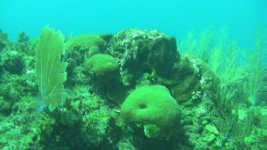
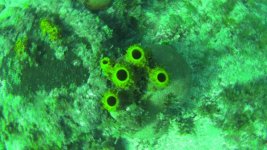
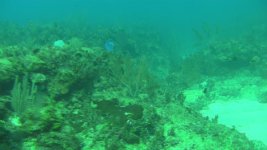
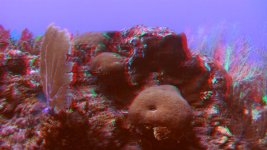
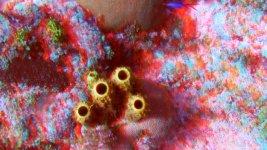
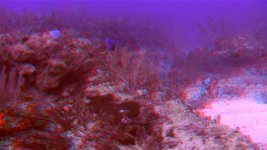
Some before and after frames below, with the ungraded files in deep, blown out green and the graded anaglyphic counterparts. My overall impressions are that although 3D is indeed complex and requires careful attention to many details, it is quite possible to produce very acceptable results with just some common sense and fairly common tools. As many of us suspected, the underwater realm does actually suit 3D quite well on the positive side, while adding very minor cons to the equation that can be easily dealt with. Enjoy!
I wanted to share some samples and findings from some recent underwater 3D work I've done. I will share a couple of videos with you as well as some frame grabs and expose some findings, but first, some technical details. Images posted were captured with an AVCHD housing made by Mike Hastings from Aquavideo which houses two small Canon HF-S10 cameras, posted with Cineform 3D and color graded on Color Finesse. Color Finesse is one of the hidden treasures of color grading, and ships with After Effects or on its own, and boasts true 32 bits processing throughout. Cineform 3D is probably the best 3D desktop application right now, for both Mac and PC, with the added benefit that you can work on files from SD to RED 4K, all at 10 to 12 bits. The Aquavideo housing is coming out of prototype phase, or so Mike's been telling me for a while now
, so several key elements will be improved towards making it a professional tool. At the time both these videos were shot, the front port was a full 1 inch thick acrylic plate, which adds diffraction and maginification errors, where the final plate will be less than 1/2 inch thick. Lastly, both videos are shown in Anaglyphic stereo (and must be watched with red/blue glasses), the worst and oldest stereo format, and one that results in ghosting, artifacts and limited color range, so this is as bad as 3D will ever look. Also, please keep in mind that both these videos were shot in the spur of the moment, and that both operators are capable of much steadier, smoother results First, there is an H.264 file called "Sharks" here: www.IdeasinBlue.com/testprojects/sharks.mp4 which was shot by Mike Hastings and posted by me. Interestingly, it was Mike's first test with his new housing, and my first 3D job with Cineform, I used this promo to cut my teeth with it so to speak. Now, I had limited time to play with this promo so I decided to give myself just a few hours to work on it, sort of a rushed job, to ascertain whether 3D was as technically complex as most people claim or if the casual operator has a chance at producing something half decent with limited time and resources. So I endeavored to not obsess on making it look its best, just good enough. Also, one of the cameras was slightly out of focus, while the other one had a smudge on the lens, so sharpening had to be used to bring the images into usable range. Color correction was difficult since the water was somewhat murky and everytime I upped levels, the floating particulate matter would tend to destroy the stereo effect. Likewise, the whole promo was done at a fixed convergence and interocular distance, which was far from ideal when shooting such fast moving objects that constantly change depth within the frame. As you can see, "Sharks" actually looks quite good, so from there on, I dove into more complex jobs with far bigger requirements.
But since I had to wait for the chance to shoot in nice, clear waters with better cameras (I was having a custom housing made for a pair of EX-1's) I decide to put the format through another torture test in the interim. So I took the Aquavideo housing on a trip to Jamaica and took it down on a reef that is notorious for its murky waters and uneven illumination. The result is here: www.IdeasinBlue.com/testprojects/jamaica.mp4 On "Jamaica" I pushed things several steps further with the intention of really making it impossible to get any decent 3D out of this footage. Things that I did: white balance was set to fluorescent giving images a deep green tone. Exposure was set at one stop over so highlights would be clipped. I operated the housing freediving (no tanks) with very little weight on me, so I was quite buoyant and unable to fight the strong undertow and I was swaying left and right, back and forth all the time, altering depth in the frame constantly. I made fast pans and tilts, and then made the transitions during editing right at those moments, looking for abrupt cuts and dissolves, not smooth ones. I had to push the images very, very hard in color correction to not only save them but to give the right tone and ideal saturation. My goal was really not to be able to bring these images into stereo compliance, but as you can see, they are not bad at all once again. With such encouraging results from such poor source material, I then spent the last 2 weeks shooting gorgeous stereo with the EX-1's, but unfortunately, I can't post any of that footage since it is the property of a customer. Suffice it to say that the EX-1 stuff looks utterly amazing, so am now very much looking forward to shooting RED, or better yet, Scarlett or Epic with their improved form factor underwater in 3D.
Some before and after frames below, with the ungraded files in deep, blown out green and the graded anaglyphic counterparts. My overall impressions are that although 3D is indeed complex and requires careful attention to many details, it is quite possible to produce very acceptable results with just some common sense and fairly common tools. As many of us suspected, the underwater realm does actually suit 3D quite well on the positive side, while adding very minor cons to the equation that can be easily dealt with. Enjoy!